Last updated: July 14, 2026
Before you implement the workflow below, complete a baseline assessment across four dimensions. These dimensions shape your integration complexity, staffing needs, and the workflow changes that will deliver the highest return.
Reducing non-actionable alerts starts at the device level before any software platform becomes involved. Programming adjustments at implant and at scheduled follow-up visits can meaningfully reduce false-positive transmission volume.
For atrial fibrillation burden alerts, a burden-led approach that uses cumulative burden over a 30-, 60-, or 90-day window rather than single-episode duration provides a more defensible and operationally useful triage category. The British Heart Rhythm Society recommends disabling AT/AF episode and burden alerts entirely for patients already on anticoagulation, while keeping High Ventricular Rate threshold alerts active for rate control management.
For NSVT and ventricular oversensing, pause events showed a 46.8% false-positive rate driven by R-wave undersensing. Sensitivity adjustments at programming can address this problem. Applying a “Rule of 3” approach, which requires three or more qualifying episodes before an alert fires, reduces single-event noise without masking true clinical events.
A common pitfall is leaving nominal OEM settings unchanged across all patients. Nominal settings and home monitoring alerts differ by manufacturer and are not standardized. Centers need to review and individualize thresholds at each follow-up visit. However, programming optimization alone cannot solve the operational challenge of managing alerts across multiple manufacturer portals.
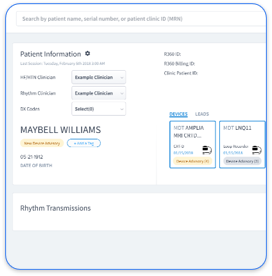
Multi-OEM practices gain real efficiency only when they work from a unified data layer. Rhythm360 ingests transmissions from Medtronic, Boston Scientific, Abbott, Biotronik, and other manufacturers into a single, normalized dashboard, so staff no longer log into separate portals.
Data normalization uses a mix of API connections, HL7 feeds, XML parsing, and computer vision-based OCR for unstructured PDF reports. A redundant data feed architecture acts as a fail-safe when an OEM server experiences downtime and maintains greater than 99.9% data transmissibility. This reliability matters clinically because a missed transmission from a technical failure carries the same patient risk as a missed alert.
Consolidation reduces portal chaos, and AI triage then tackles alert fatigue. Rhythm360’s AI triage layer automatically closes routine, non-actionable transmissions and surfaces only clinically relevant events for human review.
The scale of this problem is significant. A multicenter study analyzing 25,826 alerts from 1,140 patients across four ILR vendors found that positive predictive values for atrial tachycardia and AF alerts varied widely by manufacturer. A substantial share of alerts across all manufacturers did not represent true clinical events. Andrew Beaser, MD, at University of Chicago Medicine stated, “Decision support, including AI-assisted decision support, will become increasingly important as data volumes grow.”
AI triage in Rhythm360 aims to maintain high sensitivity for true events while cutting the number of transmissions that need manual review. Real-world AI implementations in CIED monitoring show meaningful reductions in forwarded transmission volume. A JACC: Advances study of 690,673 CIED transmissions from 74,217 devices at 78 U.S. clinics found that AI reduced the share of transmissions forwarded for review from 38.5% to 22.8%, while maintaining 99.1% sensitivity for clinically relevant events.
Schedule a demo to see Rhythm360’s AI triage layer applied to your alert volume.
AI triage identifies which alerts need human review, and a tiered escalation protocol defines response speed and ownership. Rhythm360 supports a structured three-tier response framework.
Practices without in-house 24/7 coverage can use Rhythm360’s optional oversight by certified cardiac technicians (CCTs) supervised by physicians. This service keeps Tier 2 and Tier 3 events under continuous triage. Andrew Beaser, MD, at University of Chicago Medicine noted, “We are able to address these issues earlier; rather than waiting for a 3-month visit, we can call patients in for evaluation.”
A frequent escalation mistake is applying the same urgency threshold to all alert types. Research on clinical alert systems has shown that clinicians cannot meaningfully attend to high volumes of significant alerts per day without degradation in response quality. Selective, tiered escalation therefore functions as a clinical safety requirement, not just an efficiency preference.
Manual documentation of remote monitoring encounters drives major revenue leakage in device clinics. When a clinician reviews a transmission but the encounter is not documented in the EHR with the correct CPT code, the billable event disappears.
Rhythm360’s bi-directional EHR integration automates this process. When a transmission is reviewed and closed, whether by AI for routine events or by a clinician for flagged events, the platform generates compliant documentation and maps the encounter to the appropriate CPT code. These codes include 93298 for remote interrogation of implantable cardiovascular monitors and 99454 for remote physiological monitoring device supply and daily recordings. This integration is available for Epic, Cerner, Athenahealth, eClinicalWorks, Greenway Health, and other systems via HL7.
Practices using this workflow have achieved up to a 300% improvement in revenue capture. Integrated EHR-billing systems can reduce the service-to-submission lag in typical workflows, which improves cash flow and reduces claim denial exposure.
Limiting critical alert review to a specific workstation creates coverage gaps, especially on evenings and weekends when Tier 2 and Tier 3 events still occur. Rhythm360’s HIPAA-compliant mobile application allows clinicians to review transmissions, sign reports, and coordinate care from any location.
Mobile access is particularly valuable for Tier 2 escalations. A clinician who receives a weekend notification of new-onset AF above the programmed burden threshold can review the electrogram, confirm the finding, and start anticoagulation protocols before the next business day. That workflow directly reduces stroke risk for patients who would otherwise wait for a scheduled visit.
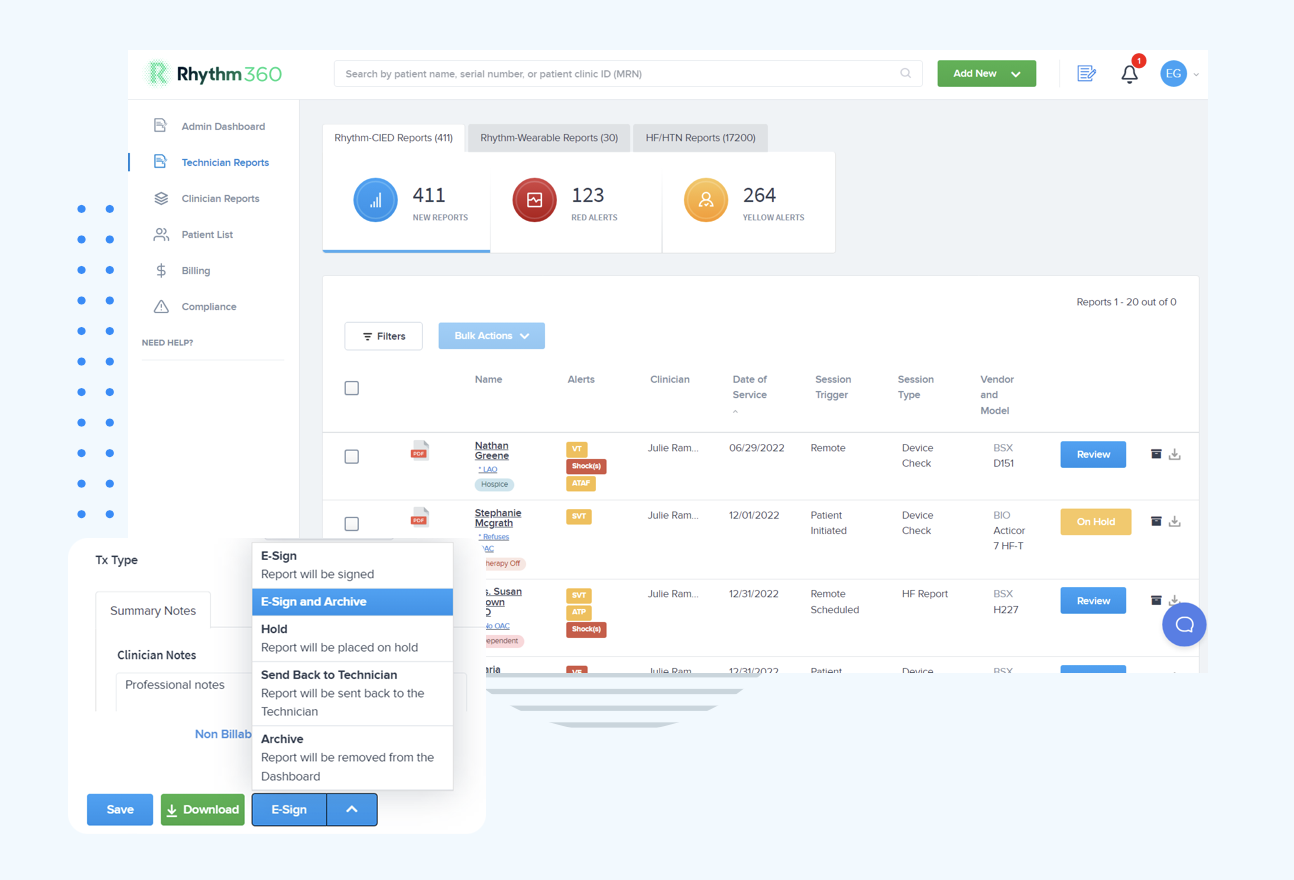
Workflow improvement requires continuous measurement. Rhythm360’s administrative dashboard gives real-time visibility into the metrics that matter most for device clinic performance.
Tracking these metrics over time supports continuous refinement of AI triage thresholds, escalation protocols, and device programming parameters. This feedback loop compounds efficiency gains.
After you implement the 7-step workflow, evaluate outcomes against four primary benchmarks at 30, 60, and 90 days.
Schedule a demo to review how Rhythm360’s dashboard tracks these metrics for your practice.
The 7-step workflow applies across practice sizes, but each setting emphasizes different steps.
Solo EP practices and small cardiology groups usually manage lower absolute transmission volumes with fewer staff to absorb manual review. For these practices, the highest-value steps are Step 3 (AI triage) and Step 5 (automated CPT capture). These steps reduce per-staff workload and recover revenue without new headcount. The optional 24/7 CCT oversight in Step 4 is especially relevant for solo practitioners who cannot maintain personal on-call coverage every night.
Large health systems and academic medical centers face the inverse challenge. They manage high absolute volume with more staff and greater complexity in escalation routing and EHR integration across departments. The high-volume experience at University of Chicago Medicine shows that high dismissal rates in CIED monitoring are structural features of safety-first remote monitoring, not signs of system failure. That framing helps large programs justify AI triage to clinical leadership. For health systems that also manage Heart Failure and Hypertension RPM populations, Rhythm360’s integrated HF/HTN service line allows the same workflow infrastructure to extend across chronic disease management without a separate platform.
After the initial 90-day validation period, you can pursue two optimization tracks.
First, refine AI triage thresholds based on the false-positive and false-negative data collected in Step 7. As the system learns clinic-specific alert patterns, triage accuracy improves and fewer non-actionable alerts reach human review while sensitivity for true events remains high. Artificial intelligence-based approaches to electrogram classification have demonstrated high accuracy in distinguishing AF from other atrial tachyarrhythmias and artifact, supporting faster adjudication at scale.
Second, practices that have stabilized their CIED monitoring workflow can expand into adjacent RPM service lines. Rhythm360’s HF/HTN module supports remote physiological monitoring for heart failure and hypertension patients on the same platform infrastructure. This expansion adds new recurring revenue streams through CPT codes including 99453, 99454, and 99457 without a separate vendor relationship or staff training program.
Implementation timelines vary by practice size, EHR system, and the number of OEM device types in the patient population. For most practices, the full onboarding process, including EHR integration setup, staff training, and data migration, takes between a few days and a few weeks. Solo EP practices and smaller cardiology groups with a single EHR system usually complete onboarding faster than large health systems with complex IT environments. RhythmScience’s implementation team manages the integration process to limit disruption to existing clinical workflows during the transition period.
Rhythm360 supports bi-directional integration with Epic, Cerner, Athenahealth, eClinicalWorks, and Greenway Health, as well as other EHR systems via HL7 messaging standards. Bi-directional integration means that patient demographic and scheduling data flows from the EHR into Rhythm360, while completed transmission reports and billing documentation flow back into the EHR automatically. This setup removes manual data re-entry and ensures that billable encounters, including CPT codes such as 93298, 93299, and 99454, are captured and documented without extra staff action after the clinical review is complete.
AI triage reduces the number of transmissions that require human review, so existing staff can manage a larger patient population without proportional headcount increases. The workflow does not eliminate clinical roles. Instead, it shifts staff time away from low-value manual sorting of non-actionable alerts toward higher-value work such as reviewing flagged events, coordinating patient care, and managing escalations. For practices facing staff burnout from alert fatigue, this reallocation of effort also supports retention. Practices using Rhythm360’s optional 24/7 CCT oversight layer can extend coverage without hiring additional in-house staff for overnight and weekend shifts.
Rhythm360 is a HIPAA-compliant platform designed for handling protected health information in a clinical remote monitoring context. Data ingested from OEM portals, patient devices, and EHR systems is processed and stored in line with HIPAA Security Rule requirements, including encryption in transit and at rest, access controls, and full audit trail documentation for all clinical actions taken within the platform. The mobile application used for on-call clinician review is also HIPAA-compliant. All patient communications facilitated through the platform’s integrated messaging framework are logged with a complete audit trail within the patient record, which supports documentation requirements for both clinical and billing compliance.
The manual review burden in cardiac device clinics reflects a workflow architecture problem rather than a pure staffing shortage. Fragmented OEM portals, unfiltered alert streams, disconnected EHR documentation, and the absence of tiered escalation protocols combine to create a system where clinicians spend most of their monitoring time on transmissions that require no action, while critical events compete for attention in the same undifferentiated queue.
The 7-step Rhythm360 workflow addresses each layer of this problem. It tunes device programming to reduce false positives at the source, consolidates transmissions into a single vendor-neutral dashboard with greater than 99.9% data reliability, applies AI triage to filter non-actionable alerts, and implements tiered escalation with optional 24/7 CCT oversight. It also automates EHR documentation and CPT capture, enables mobile review for on-call clinicians, and tracks performance metrics in real time. Practices that use this workflow have achieved up to an 80% reduction in critical alert response times and up to a 300% improvement in revenue capture.