

Last updated: July 13, 2026
Schedule a demo to see how Rhythm360 operationalizes all ten practices in a single platform.
The 2023 HRS/EHRA/APHRS/LAHRS consensus, last revised in August 2024, confirms that remote monitoring improves morbidity and mortality. It also provides evidence-based guidance across enrollment, alert management, staffing, patient education, and communication of results. The three most operationally significant directives are enrollment within two weeks of implant, individualized alert programming calibrated to patient risk, and structured triage with defined escalation criteria.
The 2026 evidence base strengthens these directives with quantified alert-burden data. A 2026 multicenter study of 1,140 patients across four ILR vendors documented a median of five alerts per patient. The findings show that alert volume varies substantially across OEMs, so a single triage standard applied across all devices is not sufficient without platform-level normalization.
Multi-OEM practices face a structural data problem because each manufacturer operates a proprietary portal with its own data schema, alert taxonomy, and export format. Rhythm360 addresses this by ingesting API feeds, HL7 messages, XML files, and unstructured PDFs through computer vision and AI-powered normalization. The platform then produces a single, standardized patient record regardless of device brand.
The platform’s redundant data feed architecture acts as a fail-safe when an OEM server is unavailable, which supports a very high transmissibility rate. University of Chicago Medicine processed more than 73,000 reports annually through Rhythm360 in 2025, averaging more than 18,000 reports per quarter, a volume that is operationally unmanageable across fragmented OEM portals. Once data sits in a single platform, the next challenge becomes prioritizing which alerts require immediate attention.
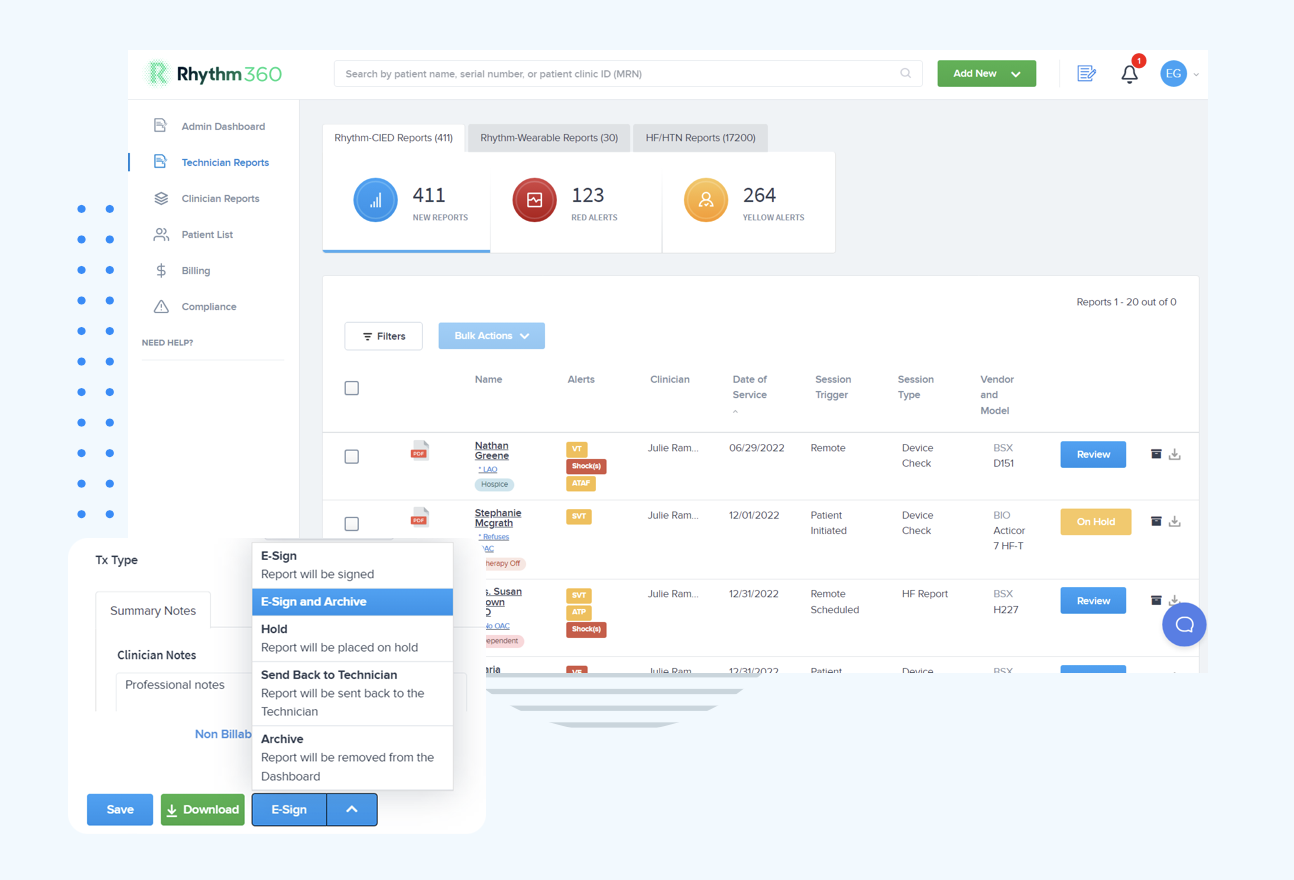
| Capability | Rhythm360 |
|---|---|
| OEM coverage | Medtronic, Boston Scientific, Abbott, Biotronik, and others |
| Data ingestion formats | API, HL7, XML, PDF (computer vision/OCR) |
| Transmissibility rate | Greater than 99.9% via redundant data feeds and AI extrapolation |
| EHR integration | Bi-directional with Epic, Cerner, Athenahealth, eClinicalWorks, Greenway Health, and others |
| AI alert triage | Automated prioritization with optional 24/7 CCT oversight |
| CPT documentation | Automated capture for 93298, 93299, 99454, and related codes |
| Patient communication | Twilio-powered messaging with full audit trail |
A color-coded triage framework separates transmissions into three response tiers so staff can focus on the right alerts at the right time. The thresholds below represent common starting points, and each clinic should calibrate them to its patient population and physician preferences.
Red — Respond within one hour:
Yellow — Respond within 24–72 hours:
Green — Routine review at next scheduled interval:
Alert fatigue is the primary operational risk in any triage system. A cross-manufacturer analysis of 2,659 rhythm episodes found that 32.9% were non-actionable and 30.6% were indeterminate even in AI-equipped devices, which shows that manufacturer algorithms alone do not remove review burden. Rhythm360’s AI triage layer applies a standardized, guideline-aligned adjudication framework across all OEM feeds and filters noise before it reaches the clinician queue.
Enrollment within two weeks of implant is the consensus standard, and a structured checklist prevents the connectivity gaps that generate missed transmissions and incomplete billing records.
Pre-discharge (Day 0–1):
Post-discharge (Days 2–14):
Ongoing connectivity verification:
The 2023 HRS consensus recommends a staffing ratio of 3 FTEs per 1,000 remotely monitored patients. Many clinics struggle to maintain that ratio. An international survey of device clinic staff found that a substantial proportion rated their staffing as somewhat or very insufficient, with the most burdensome tasks identified as managing disconnected patients, initial transmission review, and patient phone calls, all of which can be automated.
Rhythm360 automates data ingestion, report generation, connectivity alerts, and billing documentation so staff can shift time from data retrieval to clinical decision-making. At University of Chicago Medicine, staffing had been “always an issue,” with technician turnover and weekend coverage gaps creating persistent operational risk before implementing a centralized, service-supported monitoring model. Optional 24/7 oversight by Rhythm360’s certified cardiac technicians (CCTs) extends clinic capacity without adding headcount.
Transmission adherence drives every downstream outcome, including clinical safety, operational stability, and financial performance. Patients who do not transmit cannot be monitored, billed, or protected. Effective education programs address three variables: comprehension, motivation, and friction.
Comprehension means the patient understands what to do and when to do it. Motivation means the patient sees why regular transmissions matter for their health. Friction refers to how easy it is to comply with the plan. Automated messaging reduces friction by removing the need for patients to remember transmission schedules on their own.
Rhythm360’s integrated Twilio communication framework delivers automated reminders when transmissions are missed, logs all patient contacts with a full audit trail, and supports multilingual messaging to serve diverse patient populations. Every automated outreach attempt is documented within the patient record, which eliminates redundant staff calls and creates a defensible compliance record. UCM clinicians noted the ability to call patients in for evaluation earlier rather than waiting for a three-month visit, a direct result of reliable transmission data enabling proactive outreach.
Schedule a demo to see Rhythm360’s patient communication workflows in action.
Structured remote CIED monitoring generates billable events under CPT 93298 (remote interrogation, pacemaker), 93299 (remote interrogation, ICD/CRT), and 99454 (remote physiological monitoring device supply and daily recording). Consistent capture of these codes requires transmission completeness, timely physician review, and compliant documentation, all supported by workflow automation.
Rhythm360 automates CPT code identification at the point of transmission review and generates audit-ready documentation for each billable encounter. Practices using the platform have achieved up to 300% improvement in revenue generation through stronger code capture, improved staff efficiency, and the addition of RPM service lines for heart failure and hypertension. UCM reported improved billing and accountability for patients after integrating Rhythm360. Critical response times for actionable alerts have been reduced by up to 80%, and the platform maintains near-perfect data capture through redundant feeds and AI-powered extrapolation.
Missed transmissions and alert overload are the two most common failure modes in remote CIED programs, and both respond well to structured workflows and platform-level automation.
Missed transmissions usually result from communicator disconnection, patient non-adherence, or OEM server outages. Rhythm360’s redundant data feed architecture maintains transmission continuity when OEM infrastructure is unavailable, and AI-powered extrapolation fills data gaps to preserve the clinical record. Automated patient outreach via Twilio initiates contact within a defined window after any missed scheduled transmission.
Alert fatigue occurs when high volumes of non-actionable notifications desensitize clinical staff to genuine events. A large proportion of clinical alarms across monitoring environments are false or non-actionable, which establishes the scale of the problem. At UCM, the high dismissal rates mentioned earlier are recognized as a structural feature of safety-first monitoring rather than a system failure, but managing that volume requires AI-assisted triage instead of manual review. Andrew Beaser, MD, at UCM noted that “decision support, including AI-assisted decision support, will become increasingly important as data volumes grow.”
The 2023 HRS/EHRA/APHRS/LAHRS consensus recommends a baseline ratio of 3 FTEs per 1,000 remotely monitored patients. In practice, that ratio assumes a reasonably automated workflow. Programs that still rely on manual data retrieval across multiple OEM portals, manual report generation, and manual billing documentation typically require more staff to achieve the same throughput. Automation of routine tasks such as data ingestion, connectivity alerts, report generation, and CPT documentation makes the 3:1,000 ratio operationally achievable. Clinics with optional CCT oversight through a platform like Rhythm360 can extend effective capacity further without adding internal headcount.
Alert fatigue reduction requires action at three levels simultaneously. First, individualize alert thresholds by device type and patient risk profile rather than accepting OEM defaults, using guideline-based reprogramming that, as noted earlier, can reduce non-actionable alerts by 74%. Second, implement a structured Red/Yellow/Green triage SOP so that every alert has a defined response time and escalation path, which prevents low-priority notifications from competing with urgent events for clinician attention. Third, apply an AI-powered triage layer that filters non-actionable transmissions before they reach the review queue. Rhythm360 combines all three approaches through individualized threshold management, structured triage workflows, and AI-driven alert prioritization across all OEM data feeds.
The primary CPT codes for remote CIED monitoring are 93298 (remote interrogation of a pacemaker system), 93299 (remote interrogation of an ICD or CRT system), and 99454 (remote physiological monitoring device supply and daily recording or programmed alert transmission). Each code has specific documentation requirements tied to transmission completeness, physician review, and time intervals. Practices most often miss billable events because of incomplete transmission records, delayed physician sign-off, or manual billing workflows that fail to flag eligible encounters. Rhythm360 automates CPT code identification at the point of transmission review and generates compliant documentation for each encounter, which reduces the gap between clinical activity and captured revenue.
AI triage in remote CIED monitoring functions as a pre-filter rather than a replacement for clinical decision-making. It applies standardized, guideline-aligned criteria to incoming transmissions to separate clearly non-actionable events from those requiring human review. This approach reduces the volume of alerts that reach the clinician queue without suppressing clinically significant findings. The clinician retains full authority over every escalated alert. Rhythm360’s AI layer maintains the high transmissibility rate described earlier and reduces critical alert response times by up to 80%, so the events most likely to require intervention reach the right clinician faster, not fewer events overall. Optional 24/7 oversight by certified cardiac technicians adds a human layer of clinical judgment for programs that require it.
Implementation timelines vary by practice size, EHR system, and the number of OEM data feeds being integrated. Rhythm360’s onboarding process, including EHR integration with systems such as Epic, Cerner, Athenahealth, and eClinicalWorks, typically takes from a few days to a few weeks. The platform’s SaaS-based pricing model scales with clinic size and usage, so practices do not pay for capacity they do not yet need during the ramp-up period. The most important early milestone is confirming that all active OEM data feeds are ingesting correctly into the unified dashboard, because staff can then begin consolidating their daily workflow into a single interface.
Fragmented OEM portals, manual triage, and disconnected billing workflows create patient safety risks and revenue liabilities. The 2023 HRS consensus provides the framework, and the 2026 evidence base quantifies the cost of not following it. A unified, AI-powered, vendor-neutral platform provides the infrastructure that makes this framework executable at scale.
Rhythm360 aggregates data from all major device manufacturers into a single dashboard, applies AI-powered triage to reduce alert burden, automates CPT documentation to capture compliant revenue, and maintains near-perfect data capture through redundant feeds and AI extrapolation. As demonstrated throughout this article, the platform delivers measurable improvements in both clinical response speed and revenue capture.
Schedule a demo to see how Rhythm360 can standardize, scale, and strengthen your remote CIED monitoring program.





