Last updated: July 14, 2026
Enrollment failure is the first and most costly revenue leak. Patient identification should use EHR-based population queries, including diagnosis codes, readmission history, and device implant records, to prioritize the highest-risk patients who generate the strongest clinical and financial return. For CIED populations, that means querying for pacemaker, ICD, CRT, and implantable loop recorder implants and confirming each patient has an active monitoring-capable device.
Enrollment touchpoints include inpatient discharge and scheduled office visits. A systematic enrollment workflow covers seven steps: identifying eligible patients, verifying insurance, obtaining consent, creating a care plan, provisioning devices, beginning monitoring and time tracking, and billing at month-end after confirming thresholds. Skipping or abbreviating any step creates downstream denial risk.
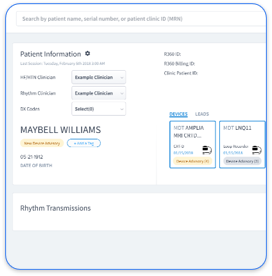
Rhythm360 automates patient identification by querying connected EHR systems, including Epic, Cerner, and Athenahealth, for implant records and flagging patients not yet enrolled in remote monitoring. The platform's onboarding checklist guides staff through each enrollment step and timestamps every action for audit readiness.
Many preventable denials start at front-end patient access and registration. Eligibility verification is the highest-leverage pre-service activity in the RCM workflow. Verify active coverage, confirm that remote cardiac monitoring is a covered benefit, and identify any prior authorization requirements before the first transmission is reviewed.
Consent documentation must satisfy CMS audit standards. Patient consent for remote monitoring must document explanation of data monitoring, transmission methods, cost-sharing obligations including the 20% Medicare coinsurance, and the patient's right to discontinue services. Missing or undated consent is a standalone audit finding that can invalidate an entire billing period.
Rhythm360 stores signed consent forms within the patient record alongside the enrollment date, insurance verification results, and any prior authorization approvals. This creates a single audit-ready file accessible to billing staff without manual retrieval.
Once patients are enrolled, the platform must reliably receive transmissions from every device manufacturer in the practice's population. A practice implanting devices from multiple OEMs faces a structural problem: each manufacturer runs a separate, non-interoperable portal. A transmission that never reaches the reviewer is a billable event lost for good. CIED remote monitoring transmissions billed via CPT 93296-93298 that are received but not billed within the required 90-day cycle result in permanent revenue loss.
Data reliability is not uniform across OEM portals. Server outages, connectivity gaps, and PDF-formatted reports that resist automated parsing all create transmission blind spots. Rhythm360 ingests data via API, HL7, XML, and PDF parsing through computer vision and AI-powered extrapolation, reaching greater than 99.9% transmissibility through redundant data feeds that serve as a fail-safe when an OEM server goes down.
The University of Chicago Medicine reviewed more than 73,000 reports annually through Rhythm360 in calendar year 2025, averaging more than 18,000 reports per quarter. That volume is operationally unsustainable without automated aggregation, and it sets up the next challenge: capturing charges the moment those reports come in.
Charge capture must happen at the moment a transmission is reviewed and documented, not days later during manual billing reconciliation. Delayed or missed charge capture drives the majority of remote monitoring revenue leakage. Missed remote monitoring billing is one of the largest preventable revenue leaks in electrophysiology practice.
The table below shows the core CIED remote monitoring CPT codes and their monitoring windows. The 30-day codes (93297, 93298) carry the highest leakage risk because their shorter windows leave less room for delayed charge capture before the cycle closes.
| CPT Code | Device Type | Monitoring Window | Approximate Medicare Rate | Rhythm360 Charge Capture Support |
|---|---|---|---|---|
| 93294 | Pacemaker (remote) | Up to 90 days | $29 national average, non-facility (2026 rate) | Automated 90-day calendar tracking; flags billing eligibility at day 90 |
| 93295 | ICD (remote) | Up to 90 days | $37 national average, non-facility (2026 CMS Physician Fee Schedule) | Automated 90-day calendar tracking; flags billing eligibility at day 90 |
| 93297 | Implantable cardiovascular monitor / loop recorder | Up to 30 days | Set by local Medicare Administrative Contractor | 30-day cycle tracking; auto-generates billing prompt on day 31 |
| 93298 | Subcutaneous cardiac rhythm monitor | Up to 30 days; billed on day 31 | Set by local Medicare Administrative Contractor | Supports -26 and -TC modifier split billing; auto-prompts on day 31 |
| 99454 | RPM device supply (CIEDs and FDA-cleared devices) | 16+ days per 30-day period | ~$52/month | Tracks daily transmission counts; flags patients approaching 16-day threshold |
Effective January 2026, the AMA CPT Editorial Panel approved CPT 99445 as a companion supply code for patients who transmit 2-15 days of data in a month. This creates new billable revenue for patients who previously fell below the 99454 threshold. Rhythm360's charge capture logic flags 99445 eligibility automatically.
Schedule a demo to see how Rhythm360 automates CPT code capture at the point of transmission.
Alert triage and clinical documentation are inseparable from billing compliance. Every reviewed transmission must produce a physician-signed interpretation recording the device type, transmission date, summary of interrogated data, and any clinical action taken. These are the exact elements CMS LCD policies require for remote cardiac monitoring claims.
Rhythm360's AI-powered alert triage system filters non-actionable transmissions and surfaces clinically significant events, such as new-onset AFib, ventricular tachycardia, lead malfunction, and ERI/RRT indicators, for immediate review. The practical impact is measurable. When a Saturday-morning AFib alert gets flagged and triaged within hours rather than discovered at Monday's manual portal review, the patient can be on anticoagulants by Saturday afternoon. Rhythm360 cuts critical alert response times by up to 80%. A UCM physician confirmed after implementation, "We have improved billing and accountability for our patients after the integration."
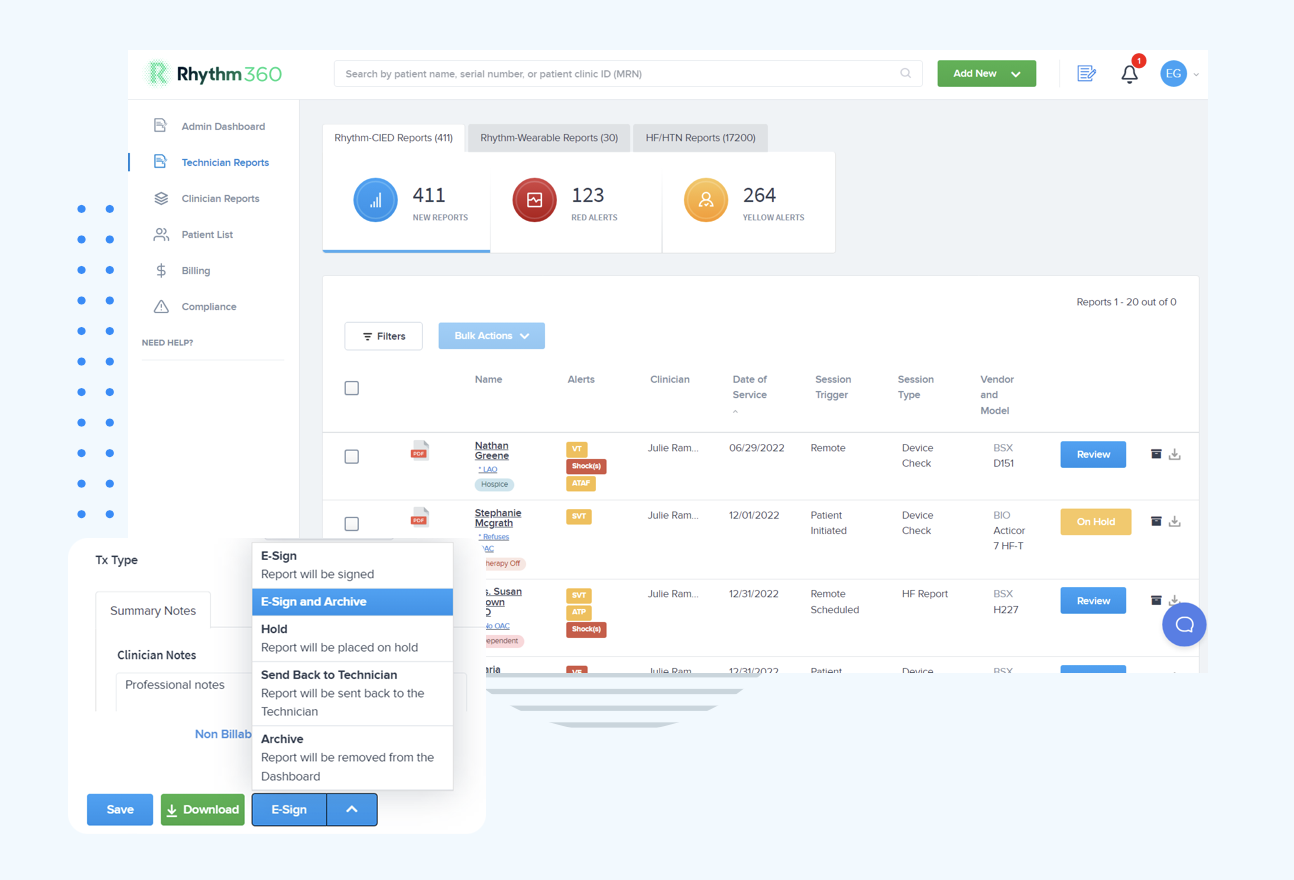
Rhythm360 auto-generates near-real-time reports for both routine checks and urgent alerts, with optional 24/7/365 oversight by certified cardiac technicians supervised by physicians. Every report is timestamped, linked to the originating transmission, and stored in the patient record for audit retrieval.
Pre-bill scrubbing using EP-specific NCCI edits and modifier validation typically reduces denial rates on initial submission to under 5% within 90 days for EP practices. Pre-submission scrubbing catches errors before they reach the payer, preserving cash flow and avoiding the administrative cost of appeals.
The table below shows the four denial reasons that account for most CIED remote monitoring rejections. Duplicate billing and device-code mismatches are the most preventable, since both trace back to gaps that automated tracking closes.
| Denial Reason | CARC Code | Root Cause | Rhythm360 Prevention Action |
|---|---|---|---|
| Duplicate claim | CO-18 | Billing 93294/93295/93297/93298 more than once inside the applicable look-back window | Per-patient calendar lock prevents submission before the 90-day or 30-day window closes |
| Wrong device code | CO-N822 | Device-type mismatch, such as billing 93297 for a pacemaker | Device registry cross-references implant records to validate CPT-to-device alignment before submission |
| Medical necessity | CO-50 | Missing ICD-10 specificity or absent physician interpretation | Documentation templates prompt for ICD-10 codes and require physician signature before charge release |
| Missing prior authorization | CO-197 | Authorization not obtained or expired before service date | Authorization tracking module flags expiring approvals and blocks charge submission without valid auth on file |
Successful appeals for device monitoring denials require the device interrogation transmission report showing monitoring start and end dates, a physician-signed interpretation, and confirmation that the device type matches the billed CPT code. Rhythm360 stores all three elements in a linked, retrievable format at the time of transmission review, which eliminates the retroactive document chase that delays appeals.
Clean claim submission requires that every charge leaving the practice carries the correct CPT code, modifier, ICD-10 code, place of service, and rendering provider NPI. A first-pass clean claim rate of 95% or better is the benchmark that separates thriving cardiology practices from those facing constant revenue leakage. For remote monitoring, that means confirming professional component claims carry modifier -26 when the technical component is billed separately, and that the billing date aligns with the close of the monitoring window.
Payment posting should occur within 24-48 hours of remittance receipt and must capture contractual adjustments, patient responsibility, and payer-specific reduction codes, because this speed and accuracy directly determine whether AR reporting can be trusted. When posting is delayed or incomplete, denial identification and follow-up prioritization become unreliable. Practices should reconcile posted payments against expected reimbursement by CPT code and payer to surface systematic underpayments before they age into write-offs.
Back-end AR follow-up in cardiology should prioritize high-dollar claims using a three-touch rule for claims in the 90-day-plus bucket before write-off consideration, with weekly escalation of unresolved claims. That AR discipline only works if reconciliation surfaces the right gaps in the first place, which is the next step.
Daily reconciliation between the device monitoring platform and the billing system is the step most practices skip, and the one most responsible for revenue leakage. Most practices billing RPM only capture the device supply code and leave 30-40% of billable RPM revenue unbilled each month by failing to document and bill management time codes. Eliminating that same manual comparison gap is what lets reconciliation confirm every reviewed transmission produced a charge, every charge matched a compliant documentation record, and every patient who crossed a billing threshold had a claim submitted.
Practices that automate this reconciliation, replacing manual comparison of OEM portal logs against billing system charge entries, have achieved revenue increases of up to 300% by capturing previously missed billable events and adding RPM service lines for heart failure and hypertension management.
Rhythm360's administrative dashboard provides a real-time view of transmission status, documentation completion, and charge capture by patient and device type. Billing staff can identify any patient whose transmission was received but whose charge has not been released, without logging into a separate OEM portal or running a manual audit.
Schedule a demo to see Rhythm360's reconciliation dashboard in action.
Reconciliation surfaces the gaps; AR follow-up closes them. The 48-Hour Rule works well for cardiology practices: touch and start resolution on every new denial within 48 hours of receipt to keep the revenue cycle moving and avoid missed appeal deadlines. For remote monitoring denials, the appeal package must be assembled quickly. Transmission reports, physician interpretations, and device records are time-sensitive and become harder to retrieve as the monitoring period recedes.
| Denial Category | Frequency Driver | Rhythm360 Fix Action |
|---|---|---|
| CO-18 duplicate (93294/93295/93297/93298) | Billing inside the 90-day or 30-day look-back window | Per-patient billing calendar with hard lock; appeal package auto-populates monitoring start/end dates |
| CO-50 medical necessity | Missing physician-signed interpretation or ICD-10 mismatch | Linked physician signature log and ICD-10 validation included in every appeal export |
| CO-N822 wrong device code | Device-type mismatch between implant record and billed CPT | Device registry correction workflow; corrected claim generated with updated CPT and supporting implant documentation |
Denial pattern analysis, categorizing denials by payer, provider, and reason code, targets training and workflow changes on the top three to five denial reasons. Rhythm360's reporting layer surfaces denial trends by CPT code and payer, letting billing directors identify systemic issues instead of treating each denial as an isolated event. Those same trends feed directly into the KPI framework practices need to track long-term.
Clinics should track monthly metrics including patient enrollment rate, data transmission compliance, alert response time, 30-day readmission rate, and monthly revenue per enrolled patient. For CIED-specific RCM, add first-pass clean claim rate by CPT code, denial rate by payer, days in AR by service line, and the percentage of enrolled patients with at least one billable transmission per monitoring window.
Top-quartile MGMA practices maintain denial rates below 4%, the same performance tier Step 6's pre-submission scrubbing targets. Reaching it requires continuous measurement and iterative workflow improvement, not a one-time fix. Practices that review KPIs monthly and tie denial trends back to specific documentation or coding behaviors close the loop between clinical workflow and financial performance.
Rhythm360's mobile-enabled charge capture and reporting tools let clinicians and billing staff review KPIs, approve charges, and sign reports from any device. This removes the workstation dependency that delays end-of-month reconciliation and KPI review. The platform's dashboard surfaces enrollment rate, transmission compliance, and revenue capture metrics in a single view, updated in real time as transmissions are processed.
Enrollment failures most commonly result from four gaps: incomplete identification of eligible patients in the EHR, missing or undated consent documentation, failure to verify insurance coverage and prior authorization before the first transmission, and the absence of a structured onboarding checklist that assigns accountability for each step. Practices relying on manual processes across fragmented OEM portals often lack a centralized view of which patients are enrolled, pending, or never contacted. An automated workflow that queries the EHR for implant records, flags unenrolled patients, and tracks consent status in one dashboard is the most reliable way to prevent enrollment failure from becoming a recurring revenue leak.
For most CIED codes, including 93294 and 93295 for pacemakers and ICDs, the global code covers both technical data collection and professional interpretation when performed by the same entity. When a separate facility or monitoring service performs the technical work and the physician provides only the interpretation, bill the professional component with modifier -26 and the technical component with modifier -TC. For implantable loop recorders billed under CPT 93298, bill the professional interpretation with modifier -26 once per 30-day period on day 31, alongside the appropriate remote monitoring technical code. A physician can only bill both components when a qualified employee or certified monitoring service performs the technical remote monitoring under the practice's supervision, not when a device manufacturer representative does the work. Confirm split-billing rules with your local Medicare Administrative Contractor, since technical component coding for some ILR codes has changed in recent years.
The most actionable KPIs fall into three categories. Front-end metrics include patient enrollment rate as a percentage of the eligible device population, insurance verification completion rate before first transmission, and prior authorization approval rate. Mid-cycle metrics include charge capture rate (the percentage of reviewed transmissions that produced a released charge), transmission compliance rate for RPM codes requiring 16-day data thresholds, and documentation completion rate. Back-end metrics include first-pass clean claim rate by CPT code, denial rate by payer and reason code, days in AR by service line, and monthly revenue per enrolled patient. Practices that track all three categories monthly can pinpoint whether revenue gaps originate in enrollment, documentation, coding, or payer behavior, and target corrective action precisely instead of broadly.
Each of the 10 steps in this workflow can be implemented incrementally. Individual tactics, such as tightening consent documentation, adding pre-submission scrubbing, or enforcing the 48-hour denial rule, produce measurable improvements on their own. The practices with the most durable results connect every step into one automated loop. Enrollment triggers insurance verification. Transmission receipt triggers charge capture. Charge release triggers scrubbing. Denial receipt triggers a timed follow-up workflow, all without manual handoffs between disconnected systems.
Rhythm360 supports that closed loop. By aggregating device data from all OEMs into one vendor-neutral platform, automating CPT code capture and documentation, and surfacing denial trends and KPIs in a real-time dashboard, Rhythm360 helps cardiology and EP practices recover revenue that fragmented workflows leave behind, without adding staff or administrative complexity.
Schedule a demo and see how Rhythm360 can strengthen your practice's revenue cycle.