Last updated: August 24, 2026
Four core metrics drive RCM ROI for cardiology: denial rate, days in A/R, net collection rate, and remote-monitoring charge capture. The table below contrasts average cardiology performance against best-in-class figures drawn from 2026 industry data. Best-in-class represents the top 10th percentile of practices. The gaps in these four metrics represent the primary levers for ROI improvement, and closing even half of each gap can create six-figure annual impact for a mid-size practice.
| KPI | 2026 Average | 2026 Best-in-Class |
|---|---|---|
| Denial Rate | 11% | 4% |
| Days in A/R | 35 days | under 24 days in A/R |
| Net Collection Rate | 87% | 96% |
| Remote-Monitoring Charge Capture | ~70% of eligible charges | high 90s with automated CPT documentation |
Remote-monitoring charge capture in particular remains the least mature of these levers for most cardiology groups. The next section explains where that revenue leakage occurs and how to close the gap.
Remote monitoring now ranks among the fastest-growing revenue lines in cardiology, yet it remains consistently underbilled. For a cardiac monitoring program, the gap between CMS-allowed billing time and actual monitoring time for CIED remote monitoring (90-day cycles) and RPM (monthly cycles) can represent significant uncollected revenue on patients the practice already serves.
Most practices capture only about 70% of eligible remote-monitoring charges, which means nearly one-third of billable events go undocumented. Three specific leakage patterns drive that 30% revenue loss:
Rhythm360 addresses each pattern directly. The platform ingests CIED transmissions from all major OEMs, including Medtronic, Boston Scientific, Abbott, and Biotronik, into a single dashboard. It automatically flags billable events against CPT cycle windows and generates compliant documentation before deadlines expire. University of Chicago Medicine, after implementing Rhythm360, reviewed more than 73,000 reports annually, averaging more than 18,000 per quarter, and reported improved billing and accountability for patients after integration.
Days in A/R functions as the single most capital-intensive metric for a cardiology practice. At 32 days average, a $10M practice carries roughly $877,000 in receivables outstanding at any given time. That capital remains locked until claims pay. Closing half that gap, moving from 32 to 16 days, releases approximately $438,000 in working capital and accelerates cash flow on a permanent basis.
When you combine A/R improvement with denial reduction and remote-monitoring capture, the total revenue impact becomes substantial. The table below breaks down the annual financial impact of moving from average to best-in-class performance across all three levers for a $10M cardiology practice.
| Revenue Lever | Calculation Basis | Estimated Annual Impact |
|---|---|---|
| Denial Rate Reduction (average to best-in-class) | approx 8 pp reduction × $40k–$80k per point for mid-size cardiology practice | +$300,000–$600,000 |
| A/R Days Improvement (32 → 16 days) | standard A/R days formula applied to $10M annual charges | approximately +$438,000 cash-flow release |
| Remote-Monitoring Charge Capture | based on per-patient RPM revenue for large monitoring program | +$200,000+ |
Combined annual revenue impact: $950,000+ for a $10M cardiology practice moving from average to best-in-class performance. RCM improvements at a comparable 6-physician cardiology practice reached maturity in several months, consistent with a 90-day payback timeline. RPA and AI automation solutions deployed in 6 to 8 weeks enable most organizations to reach full break-even within 3 to 6 months.
Bundling errors create a quiet but consistent source of revenue loss across cardiology subspecialties. The revenue at stake from cardiology billing errors can reach significant levels per cardiologist each year, depending on case mix and current error rates. Common patterns include:
The labor cost of managing these errors compounds the revenue loss. When a bundling error triggers a denial, the practice absorbs two costs: lost revenue from the denied claim and staff time required to appeal or rework it. Approximately 65% of denied claims across U.S. healthcare are never appealed or reworked, which creates direct write-off revenue loss. The cost to rework one denied claim averages $25–$35 in staff time according to cardiology denial management sources. That rework burden grows when staff must manage multiple OEM portals manually, logging into separate systems for Medtronic, Boston Scientific, Abbott, and Biotronik. Those hours of non-billable administrative time displace coding review and appeal work.
Those ROI figures from earlier sections assume clean claims. In practice, bundling errors and coding mistakes reduce the revenue base before it ever reaches the collection cycle. Rhythm360 eliminates the multi-portal burden by consolidating all device data into a single dashboard with automated documentation, which frees clinical staff to focus on charge capture accuracy rather than data retrieval.
Cardiology practices can use this checklist to baseline current revenue cycle performance against 2026 standards and identify quick wins.
Rhythm360 by RhythmScience is a vendor-neutral, HIPAA-compliant platform that unifies data from all major OEMs into a single source of truth. The platform uses AI-powered ingestion across APIs, HL7, XML, and PDF parsing via computer vision to normalize disparate data streams with greater than 99.9% transmissibility.
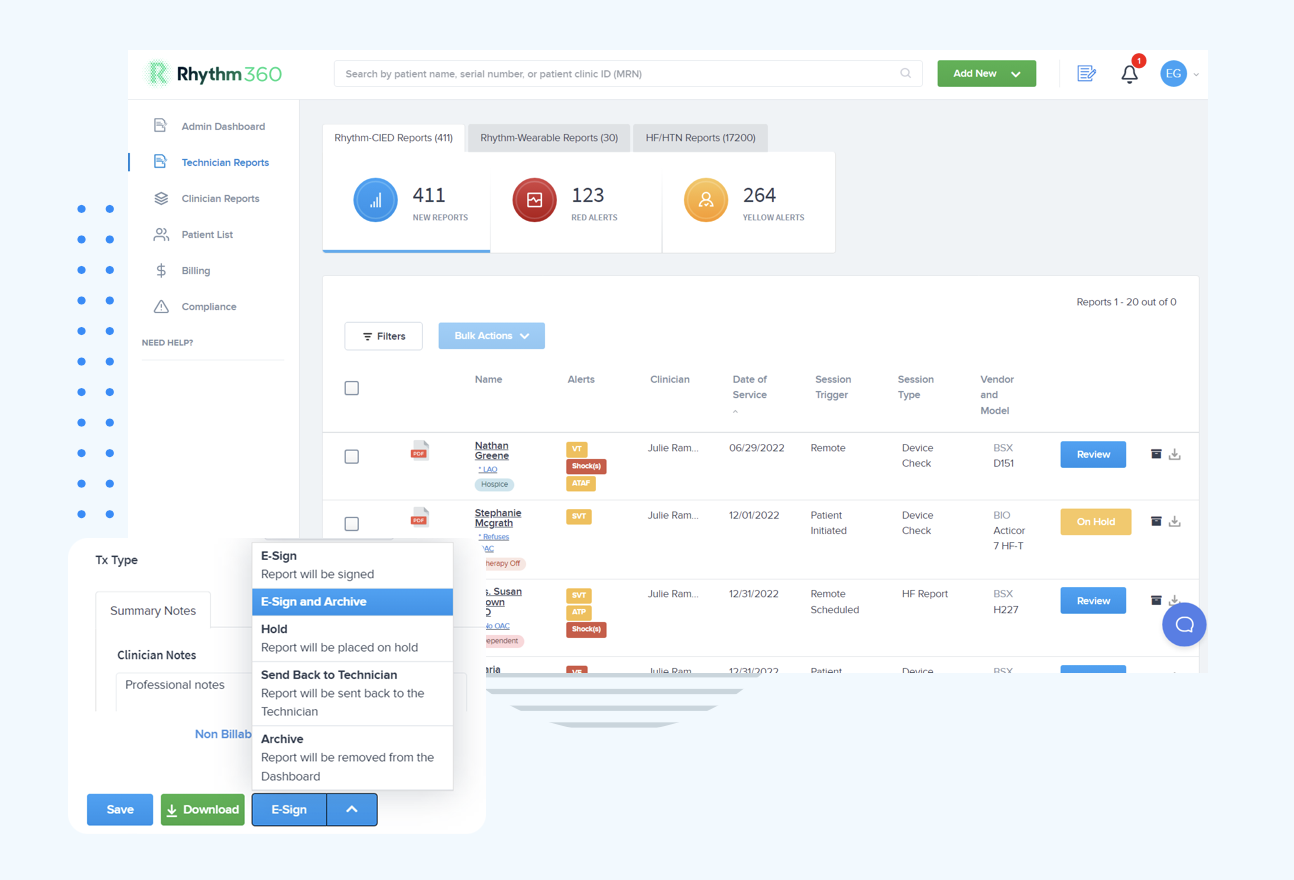
On the billing side, Rhythm360 automates CPT code capture and documentation for CIED remote monitoring and RPM service lines, including codes 93298, 93299, 99454, 99457, and the 2026 CMS Final Rule’s updated supply codes. The system flags billable events against cycle windows before they expire. Practices implementing Rhythm360 have documented up to a 300% increase in revenue generation through improved CPT code capture and staff efficiency, along with an 80% reduction in response times for critical patient alerts.
The University of Chicago Medicine results described earlier, with 73,000+ reports annually and improved billing, show what automated documentation and unified data ingestion enable at high volume. Clinicians can address clinical issues earlier rather than waiting for scheduled visits, while maintaining stable dismissal rates and centralized triage.
Rhythm360’s SaaS pricing scales with clinic size and platform usage. Implementation, including EHR integration with Epic, Cerner, Athenahealth, eClinicalWorks, and others, typically completes in days to a few weeks rather than months.
A $10M cardiology practice operating at 2026 average benchmarks leaves substantial revenue on the table through denial write-offs, slow collections, and uncaptured remote-monitoring charges. Moving to best-in-class performance across denial rate, days in A/R, and CIED or RPM charge capture is achievable within a 90-day implementation window, and the financial case is straightforward to model.
Rhythm360 provides the unified data infrastructure, automated CPT documentation, and AI-powered alert triage that keep those improvements sustainable instead of dependent on manual effort or staff heroics.
Get your 90-day ROI forecast and implementation roadmap.
The 2026 industry average denial rate for cardiology practices is approximately 11%, while best-in-class practices in the top 10th percentile achieve under 5%. Practices that implement cardiology-specialized coding review, automated prior authorization, and real-time eligibility verification consistently outperform the average. A denial rate below 5% is a realistic target for practices with structured denial prevention processes in place. Automated CPT documentation for remote monitoring codes, which rank among the most commonly missed billable events, offers one of the highest-impact interventions for reducing denial volume.
Remote monitoring revenue leakage in cardiology typically occurs through three mechanisms. First, CIED transmissions are reviewed and clinical decisions are made, but billing documentation is not completed before the 90-day cycle window closes, so the billable event expires. Second, monthly RPM management time is documented in clinical notes but never tallied against the 20-minute billing threshold required for codes like 99457, so the time goes unbilled. Third, updated billing logic for newer CMS-recognized codes, including those introduced or revised in the 2026 CMS Final Rule, is not implemented, which leaves supply and management codes uncaptured. For a large monitoring program, these gaps can represent substantial annual uncollected revenue from patients the practice already actively monitors.
The highest-risk codes for bundling errors and denials in cardiology include transthoracic echocardiography (93306), cardiovascular stress testing (93015), myocardial perfusion imaging (78452), coronary angiography (93454), and routine ECG (93000). Stress echocardiography (93351) is frequently billed alongside complete TTE (93306) in error, since 93351 already includes the complete echo. Diagnostic catheterization (93458) billed separately from same-session PCI (92928) requires modifier -59 or XE and specific operative documentation to avoid denial under NCCI edits. ICD implantation (33249) faces medical necessity denials when documentation lacks required ejection fraction thresholds or arrhythmia history. Holter interpretation (93227) and radiopharmaceutical supply codes for nuclear stress testing are frequently omitted entirely, leaving $30–$400 per study uncollected depending on the code.
Most cardiology practices see measurable improvements within 90 days of implementing structured RCM workflows. Operational improvements such as cleaner claims and faster submission typically appear within the first 30 to 60 days. KPI improvements in collection rate, days in A/R, and denial rate generally materialize within 60 to 90 days. For practices deploying AI-powered automation, particularly for prior authorization, charge capture, and denial prediction, break-even on the investment typically occurs within 3 to 6 months. A comparable 6-physician cardiology practice that implemented automated prior authorization and cardiology-specialized coding reached full maturity in a matter of months, with denial write-offs reduced from $340,000 to $52,000 annually.
Rhythm360 is a vendor-neutral, HIPAA-compliant platform that consolidates data from all major cardiac device manufacturers, including Medtronic, Boston Scientific, Abbott, Biotronik, and others, into a single dashboard. This approach removes the need for staff to log into multiple non-interoperable OEM portals. Its AI-powered data ingestion achieves greater than 99.9% transmissibility through redundant data feeds, computer vision, and AI-powered extrapolation across APIs, HL7, XML, and unstructured PDFs. On the billing side, the platform automates CPT code capture and documentation for CIED and RPM service lines, flagging billable events against cycle windows before they expire. Practices using Rhythm360 have documented up to a 300% increase in revenue generation through improved CPT capture and an 80% reduction in critical alert response times. Implementation, including EHR integration, typically completes in days to a few weeks.