RPM Patient Consent Requirements for CPT 99454 Billing
Last updated: July 14, 2026
Key Takeaways
CPT 99454 delivers approximately $52.11 per patient per 30-day period when consent is documented before the first billable service.
Six specific consent elements must be captured and stored in the medical record before device supply and billing begin.
CPT 99454 requires 16 or more automated transmission days within each 30-day period. Claims below this threshold must use CPT 99445 instead.
Commercial payers impose additional diagnosis and documentation rules that differ from Medicare, requiring pre-enrollment verification.
Rhythm360 automates consent capture, transmission tracking, and audit-ready documentation to protect your cardiology practice's CPT 99454 revenue. Talk to our team to see how.
What CPT 99454 Covers and Why Consent Comes First
CPT 99454 covers device supply and automated data transmission for remote physiologic monitoring when a patient transmits readings on 16 or more days within a 30-day billing period. Six consent elements must be documented in the medical record before the first claim goes out. The table below lays out exactly what each element requires, so your team can check its own consent process against the standard before billing begins.
Required Consent Element
Acceptable Form
Documentation Standard
Retention / Refresh
Agreement to participate in RPM
Verbal or written
Date, staff name, summary of disclosures in chart
Annual or upon program change
Explanation of what RPM involves
Verbal or written
Description of data collected and transmission method
Annual or upon program change
Cost-sharing disclosure (Part B coinsurance, typically 20%)
Verbal or written
Explicit acknowledgment in chart note or signed form
Annual or upon program change
Single-provider billing acknowledgment
Verbal or written
Statement that only one practitioner bills RPM per calendar month
Annual or upon program change
Patient measurement cadence responsibilities
Verbal or written
Documented explanation of expected transmission frequency
Annual or upon program change
Right to discontinue at any time
Verbal or written
Explicit opt-out language in chart note or signed form
Written consent with a patient signature provides substantially stronger audit protection than verbal consent, since a signed form leaves no ambiguity about what the patient agreed to. If a practice relies on verbal consent instead, the chart note has to compensate. It must include the date, the staff member's identity, and a summary of every disclosure made. Until that documentation exists, any RPM claims submitted stay exposed to retroactive compliance risk.
The following verbatim language may be adapted for EHR consent templates:
"I agree to participate in remote patient monitoring services provided by [Practice Name]. I understand that physiologic data from my device will be collected and transmitted automatically to my care team. I have been informed that Medicare Part B cost-sharing (typically 20% coinsurance) may apply, that only one provider may bill for these services per calendar month, that I am responsible for using the device as instructed, and that I may discontinue participation at any time without affecting my other care. Consent obtained by: [Staff Name]. Date: [MM/DD/YYYY]."
The examples below show how the same 16-day threshold applies differently across common cardiology monitoring scenarios, determining whether a claim qualifies for CPT 99454 or falls back to CPT 99445.
Submit CPT 99454 if transmission days total 16 or more. Submit CPT 99445 for 2 to 15 days. Bill no device supply code for fewer than 2 days.
Retain the daily transmission log as part of the claim support file.
Why 99445 and 99454 Can't Be Billed Together
Because each 30-day period produces a single day count, the code selection is mutually exclusive. CPT 99445 and CPT 99454 cannot both be billed in the same month for the same patient. The practice must pick the single code matching the patient's actual transmission count for that period.
CPT 99445: covers 2 to 15 days of transmitted data in a 30-day period, at a national average non-facility rate of $47.43.
CPT 99454: covers 16 to 30 days of transmitted data, reimbursed at the $52.11 rate noted earlier.
Fewer than 2 days: no device supply code is billable.
The same exclusivity rule applies to management codes. CPT 99470 (first 10 to 19 minutes of treatment management) and CPT 99457 (first 20 minutes) cannot be billed together in the same month. Practices must select one management code per patient per calendar month based on total documented clinical staff time.
Medicare fee-for-service sets the baseline consent and documentation framework. Commercial payers add rules on top of it that directly affect CPT 99454 billing eligibility.
Notable 2026 commercial-payer positions:
UnitedHealthcare commercial, individual exchange, and Medicare Advantage policies effective January 1, 2026, limit RPM coverage including CPT 99454 to heart failure or hypertensive disorders of pregnancy only. Other indications such as hypertension, diabetes, or COPD count as not medically necessary.
Aetna commercial policy covers RPM for heart failure, hypertension, and diabetes under CPB 1093.
Cigna commercial policy sets specific medical necessity criteria for RPM.
Anthem commercial policy requires devices capable of transmitting clinical data.
Checklist for verifying payer-specific CPT 99454 requirements before enrollment:
Confirm the payer's current medical policy number and effective date for RPM coverage.
Verify which diagnoses qualify for CPT 99454 reimbursement under that payer's policy.
Determine whether the payer has adopted the 2026 tiered structure (99445/99454) or still requires the legacy 16-day minimum exclusively.
Check whether prior authorization is required and how often it must be renewed.
Confirm whether the payer requires written consent specifically, or accepts verbal consent documented per Medicare standards.
Flag any patients whose RPM indication falls outside the payer's covered diagnoses before device supply and billing begin.
These payer-specific gaps are also among the first things auditors check, which is why a complete audit-ready file matters just as much as upfront verification.
Building an Audit-Ready CPT 99454 Claim File
An audit-ready CPT 99454 claim file must contain the following elements, retrievable on demand:
Patient consent documentation: date obtained, staff member who obtained it, form of consent, and summary of all six required disclosures. Written consent with a patient signature provides the strongest audit protection.
Physician order: signed by an eligible provider with an established patient relationship, specifying the qualifying chronic condition and monitoring type, commonly renewed annually.
Device assignment record: device type, model, FDA clearance reference, and date supplied to patient.
Daily transmission log: date, reading type, and data receipt for each qualifying day, with confirmation that 16 or more days transmitted, tied to ICD-10 diagnosis codes for the qualifying condition.
Clinical time documentation: time-stamped notes supporting management code billing (CPT 99457/99458 or 99470) with evidence of at least one real-time interactive communication per month.
Submitted claim with supporting diagnosis codes: billing provider NPI, date the 16-day threshold was met, and payer-specific eligibility verification record.
Internal compliance audits for RPM programs should run at least quarterly, reviewing a random 10 to 20% sample of active RPM patients and checking consent documentation, physician order validity, device provisioning, transmission compliance, and time documentation quality.
The most common CPT 99454 audit triggers are billing below the 16-day threshold, expired physician orders, missing consent documentation, and insufficient time log detail for CPT 99457/99458.
Closing the Documentation Gaps with Rhythm360
These audit triggers mostly trace back to manual, fragmented documentation workflows. That is the gap Rhythm360 was built to close for cardiology practices managing CIEDs and chronic conditions including heart failure and hypertension.
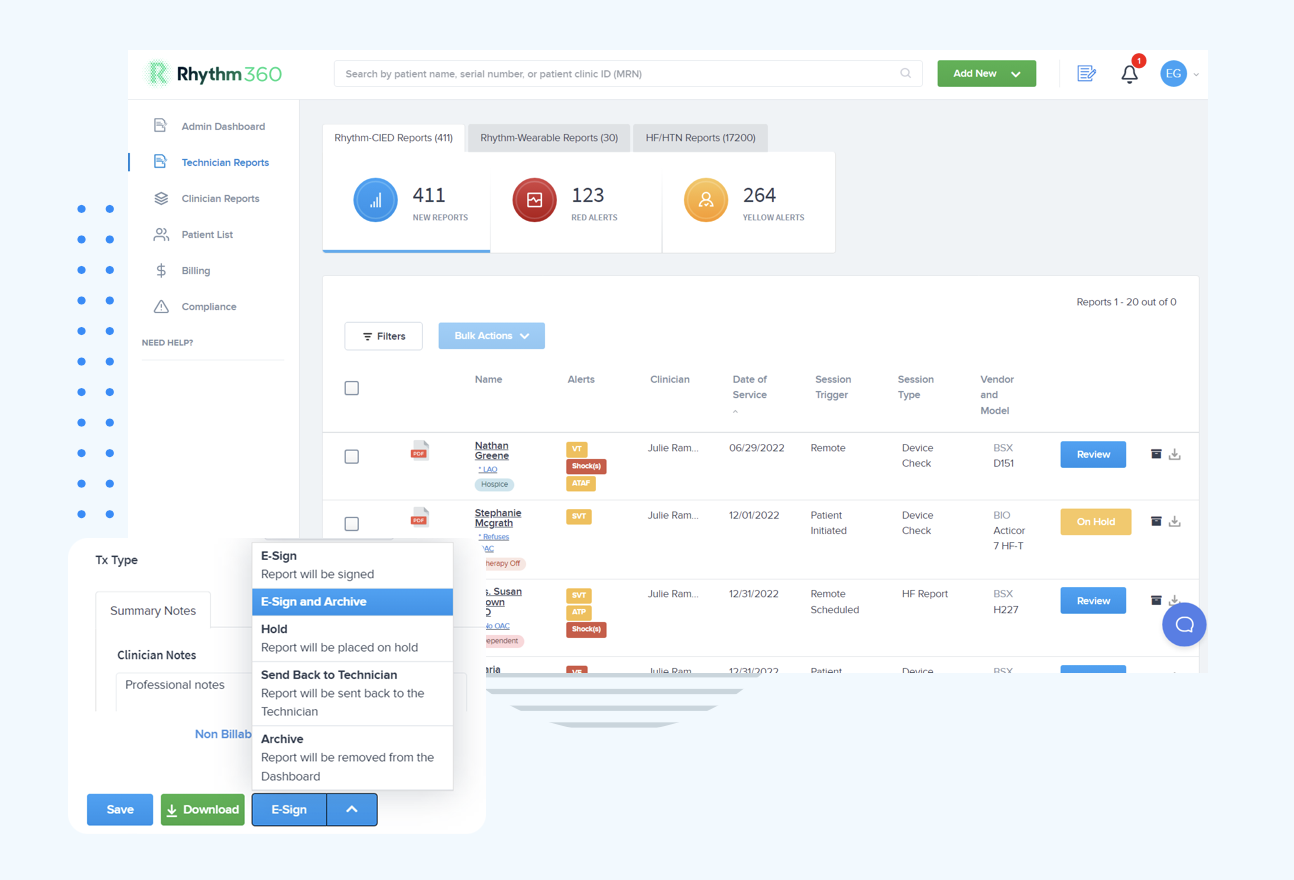
Rhythm360 consolidates data from all major device manufacturers, including Medtronic, Boston Scientific, Abbott, and Biotronik, into a single dashboard. Practices no longer need to log into separate OEM portals to retrieve transmission records. Automated CPT code capture tracks device-day counts in real time, flags patients approaching or falling short of the 16-day threshold, and generates billing-ready documentation without manual transcription.
Rhythm360
Key capabilities relevant to CPT 99454 compliance include:
Timestamped consent capture built into the enrollment workflow, stored in a retrievable format for audit response.
Daily transmission logs that automatically aggregate readings across multiple devices per patient and map to ICD-10 diagnosis codes.
Bi-directional EHR integration with Epic, Cerner, Athenahealth, eClinicalWorks, and others, so RPM data posts directly into the patient record instead of sitting only in a separate vendor system.
A real-time administrative dashboard showing consent status, transmission day counts, and billable activity, so practices can catch and fix compliance gaps before claim submission.
Over 99.9% data transmissibility through redundant data feeds, AI-powered data normalization, and computer vision, cutting the risk of missed transmission days from OEM server issues.
Practices using Rhythm360 have achieved up to a 300% increase in revenue generation through better CPT code capture and an 80% reduction in response times for critical patient alerts.
To see how Rhythm360 supports compliant CPT 99454 billing and RPM patient consent requirements for your cardiology practice, schedule a demo.
Frequently Asked Questions
When must consent be obtained and refreshed for CPT 99454 billing?
Consent must be obtained and documented in the medical record before RPM services begin, specifically before device supply and before the first billing cycle. As noted earlier, billing before consent is documented creates retroactive exposure across an entire enrollment episode, a risk that becomes especially relevant when consent lapses go unnoticed. Consent must be refreshed at least annually or whenever the RPM program changes significantly, such as when a new device type is added or the monitored condition changes. Flagging patients with missing or expired consent before claims generate is a core part of a compliant RPM billing workflow.
Who may obtain and document consent for RPM services?
CMS does not restrict consent collection to physicians. Clinical staff, including registered nurses, medical assistants, and device technicians, may obtain and document RPM consent under general supervision of the billing provider. That provider must be a physician, nurse practitioner, physician assistant, or clinical nurse specialist with an established relationship with the patient. Only one practitioner may bill RPM services, including CPT 99454, for a given patient in any 30-day period. When staff use verbal consent, the chart note must identify who obtained it, the date, and a summary of the disclosures made.
How does Rhythm360 support audit defense for CPT 99454 claims?
Rhythm360 addresses the three most common audit triggers: missing consent documentation, transmission counts below the 16-day threshold, and thin billing support records. The platform captures and timestamps consent at enrollment, stores it for immediate retrieval, and integrates that record directly into the patient's EHR. Daily transmission logs generate automatically, aggregating readings across all supplied devices and flagging any patient at risk of falling short before the billing period closes. When a payer requests documentation, Rhythm360's audit-ready file structure provides consent records, physician orders, device assignment records, transmission logs, and clinical time documentation in one retrievable location, cutting the administrative burden of audit response.
What happens if consent is documented after the first transmission?
Documenting consent after the first transmission creates retroactive compliance exposure. Every CPT 99454 claim submitted before consent was formally recorded is vulnerable to denial or recoupment on audit. CMS requires consent at the time RPM services are furnished, which in practice means before device supply and before the first billable period begins. Practices that find a retroactive consent gap should document consent immediately, note the date obtained, and consult their compliance team on whether prior claims need correction. Building consent capture into the device enrollment workflow, rather than treating it as a separate step, is the most reliable way to prevent this exposure.
Protecting 99454 Revenue Starts with the Consent Workflow
CPT 99454 billing compliance in 2026 depends on a documented chain of evidence that starts with patient consent and ends with a verified 16-day transmission log. The six required consent elements must be captured before device supply, stored in a retrievable format, refreshed annually, and checked against payer-specific requirements that vary across Medicare fee-for-service, Medicare Advantage, and commercial plans. The 2026 introduction of CPT 99445 for 2 to 15 transmission days creates a tiered structure that removes the prior all-or-nothing gap, but it also adds a mutual exclusivity rule that demands accurate day-count tracking before any device supply code goes out.
For cardiology practices managing CIEDs and chronic cardiac conditions across multiple OEM platforms, manual consent and documentation workflows create the exact audit vulnerabilities payers look for. Rhythm360 automates consent capture, transmission tracking, and billing documentation in a single vendor-neutral dashboard, protecting RPM patient consent requirements for CPT 99454 billing while reducing the administrative burden on clinical and billing staff.