

Last updated: July 14, 2026
Contact Rhythm360 to schedule a demo and see how the platform can transform your practice.
The remote cardiac monitoring market is growing quickly, and practices that don't adapt will fall behind. The global remote cardiac monitoring market is projected to reach approximately USD 21.79 billion by 2034 at a CAGR of 14.0%. Other analyses project similarly strong growth. Demand for continuous, home-based cardiac monitoring is accelerating no matter which forecast you trust.
This growth extends beyond implantable device monitoring. Remote monitoring for chronic heart failure management is expected to expand rapidly to support preventive care and reduce admissions. Practices running separate workflows for CIED monitoring and heart failure RPM face compounding administrative burden as both programs scale. EHR and cloud-analytics integration is central to this market's expansion, and the software and services segment is growing fastest as health systems outsource more monitoring tasks.
Legacy on-premise systems and single-OEM portals weren't built for this environment. The market is moving toward unified, cloud-based platforms that support both CIED and chronic disease programs under one workflow.
Reaching greater than 99.9% data transmissibility takes an ingestion architecture that doesn't rely on a single data pathway. Rhythm360 normalizes data from all major CIED manufacturers, including Medtronic, Boston Scientific, Abbott, and Biotronik, using four parallel ingestion methods.
The platform ingests structured data through direct APIs and HL7 v2 and FHIR R4 messaging standards, the clinical messaging backbone for hospital orders and results. XML feeds add a secondary structured pathway. For OEM reports delivered as unstructured PDFs, a common format on legacy manufacturer portals, Rhythm360 applies computer vision to extract and map data fields automatically.
A redundant data feed system acts as a fail-safe when an OEM server goes down. AI-powered extrapolation fills gaps in transmission records, so a manufacturer outage doesn't create a blind spot in a patient's monitoring history. HL7 FHIR R4, normative since 2019, is the federally mandated standard for integrating remote monitoring data into EHRs like Epic through RESTful APIs, and Rhythm360's architecture follows this standard for downstream EHR delivery.
The result is a single, continuously updated patient record clinicians can trust for decision-making, regardless of which manufacturer's device is implanted. That same architecture is what makes the five scalability capabilities below possible.
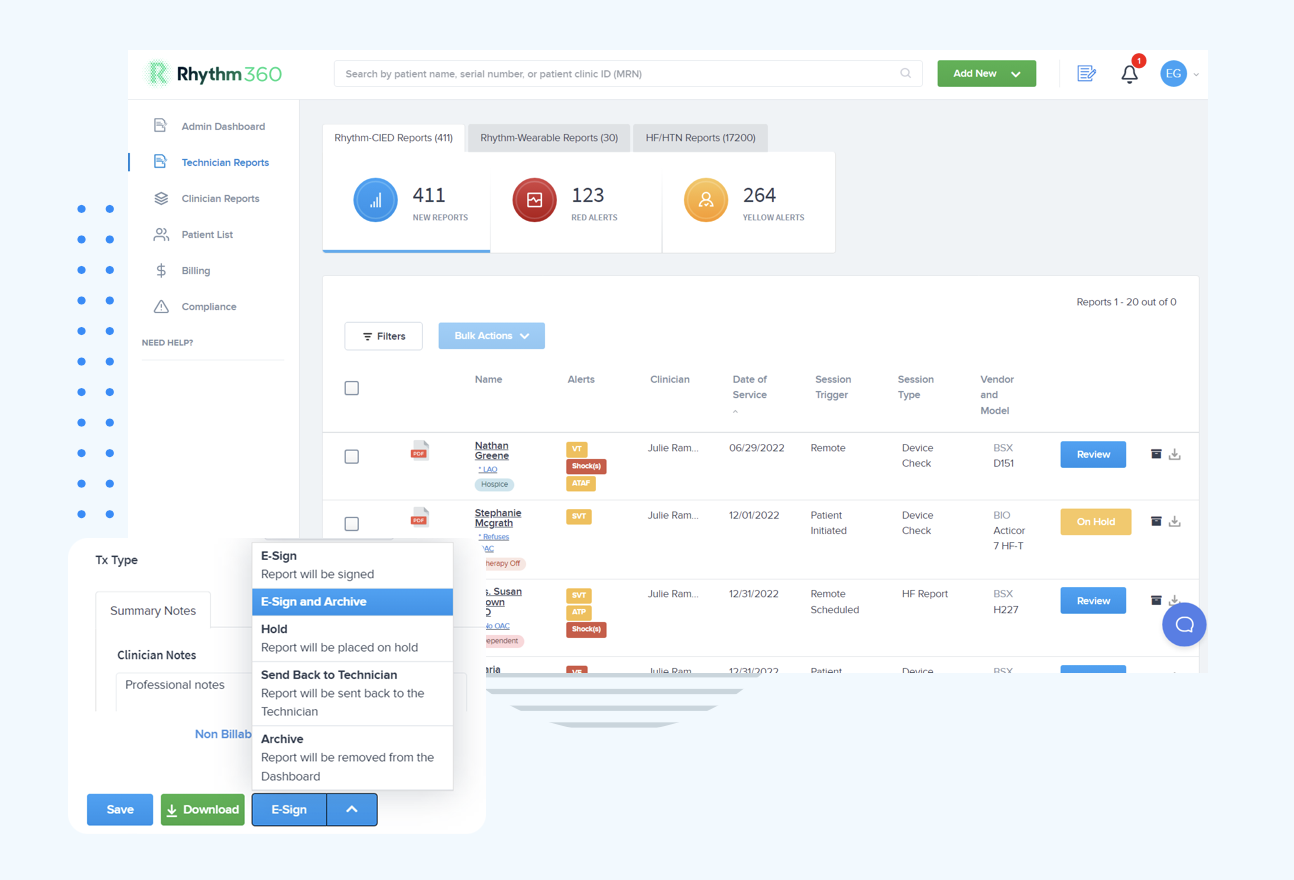
These capabilities determine whether a remote cardiac monitoring platform grows with a practice or creates new bottlenecks.
Remote pacemaker monitoring starts when the implanted device transmits data wirelessly, usually through a bedside communicator or cellular connection, to the manufacturer's server. In a fragmented workflow, a technician then logs into that manufacturer's portal to retrieve the report.
In the Rhythm360 workflow, that transmission is ingested automatically through the platform's API or HL7 connection, normalized into a standard format, and delivered to the clinician's unified dashboard. The AI triage layer evaluates the transmission for clinically significant findings, such as ventricular tachycardia, new-onset atrial fibrillation, lead impedance changes, or battery depletion near end of life, and assigns a priority level. Routine transmissions get archived. Urgent findings trigger an immediate alert through the mobile app or dashboard.
The clinician reviews the flagged transmission, documents the response, and the platform generates the corresponding CPT billing record automatically. The entire path, from transmission to documented review, happens in one platform without manual entry or portal switching.
University of Chicago Medicine implemented Rhythm360 and enabled clinicians to review more transmissions daily and catch more abnormalities, according to Andrew Beaser, MD, Associate Professor of Medicine at UCM. UCM reviewed more than 73,000 reports in 2025, a volume that shows the platform holds up in a high-acuity academic setting.
Accurate CPT documentation is the foundation of remote monitoring revenue, and getting it wrong is the fastest way to lose money on a program that's otherwise working well. Practices running both CIED and chronic disease RPM programs need to track two separate code sets.
For CIED monitoring, the primary codes are:
For heart failure and hypertension RPM programs, the 2026 code set includes:
Rhythm360 tracks monitoring periods, classifies transmissions by device type and manufacturer, and generates billing-ready documentation automatically. As UCM put it after implementation: "We have improved billing and accountability for our patients after the integration."
Alert volume is a structural problem in remote cardiac monitoring, not just a nuisance. A cross-manufacturer analysis of 2,659 rhythm episodes from 1,710 patients found AI-equipped ICMs had 32.9% non-actionable episodes, compared to 45.4% in devices without proprietary AI, a 12.5 percentage point reduction. False positives for events like pauses remain a challenge even with device-level AI, which is why platform-level triage matters.
Rhythm360's AI triage operates at the platform level, evaluating normalized data from all manufacturers against clinical significance thresholds before routing alerts. An optional 24/7/365 oversight layer, staffed by IBHRE-certified cardiac technicians supervised by physicians, adds human review for complex cases. Combined, these layers produce the 80% reduction in critical-alert response times mentioned earlier, shifting practices from reactive to proactive patient management.
As UCM described it: "We are able to address these issues earlier; rather than waiting for a 3-month visit, we can call patients in for evaluation." Earlier intervention compounds in value over time through fewer hospitalizations, avoided adverse events, and captured follow-up billing. That same alerting layer feeds directly into documentation, which is where EHR integration comes in.
Bi-directional EHR integration turns remote monitoring data into documented clinical encounters and billable events. Without it, clinicians manually transcribe device findings into the EHR, a process that introduces errors, delays billing, and creates compliance risk.
Rhythm360 supports bi-directional integration with Epic, Cerner, Athenahealth, eClinicalWorks, Greenway Health, and other systems through HL7 FHIR R4 RESTful APIs and SMART on FHIR authorization, which let third-party apps authenticate against Epic and request specific patient data. The 21st Century Cures Act requires certified EHR vendors, including Epic, to expose FHIR R4 APIs, making this a regulatory baseline rather than a differentiator.
In practice, patient demographics, device assignments, and scheduling data flow from Epic into Rhythm360, while completed reports, clinical notes, and billing documentation flow back automatically. Onboarding, including EHR setup, typically takes days to weeks, not months.
Heart failure remote monitoring brings physiologic data streams, including daily weights, blood pressure, and fluid status indicators, that run on different transmission schedules and billing rules than CIED data. Managing these programs separately from CIED monitoring creates the same fragmentation a unified platform is meant to fix.
Rhythm360 offers distinct but integrated service lines for Rhythm-CIED and HF/HTN remote monitoring. The HF line supports patient onboarding, automated device supply tracking for CPT 99454 and 99445, and treatment management documentation for CPT 99457 and 99470. Daily weight and vital sign monitoring identifies fluid overload days before it becomes a hospitalization, and structured HF RPM programs help reduce admissions.
The CardioMEMS pulmonary artery pressure monitor, which provides direct hemodynamic data for advanced heart failure management, is also supported. Practices can manage their highest-acuity HF patients alongside their CIED population in one workspace.
The table below maps each of the five scalability requirements covered above to how Rhythm360 delivers it and the measurable outcomes practices have reported.
| Capability | Rhythm360 Delivery | Result |
|---|---|---|
| Vendor-neutral CIED data ingestion | API, HL7, XML, and computer-vision PDF parsing across all major OEMs | Single dashboard replaces multiple OEM portal logins |
| Data transmissibility | Greater than 99.9%, achieved via redundant feeds and AI extrapolation | No critical data gaps from OEM outages |
| AI-powered alert triage with optional CCT oversight | Platform-level AI plus optional 24/7/365 IBHRE-certified review | Up to 80% reduction in critical-alert response times |
| Bi-directional EHR integration | HL7 FHIR R4 and SMART on FHIR with major EHRs; setup in days to weeks | Automated report delivery; no manual transcription |
| Automated CPT documentation | Tracks periods and generates billing-ready records for 93294 to 93298, 99453 to 99458, 99445, 99470 | Up to 300% increase in captured CPT revenue |
| Integrated HF/HTN RPM service line | Turnkey onboarding and treatment management documentation | New recurring revenue; one platform for both programs |
| HIPAA-compliant mobile app | Secure iOS/Android access from any location | Continuity of care for on-call coverage |
| SaaS pricing | Scales with clinic size; no rigid per-seat contracts | Accessible for solo practices and large health systems |
Before evaluating a new platform, walk through these readiness steps in order. Each one builds on the last, so completing them together gives you a clear picture of where you stand before vendor conversations start.
At 7:14 a.m. on a Saturday, Rhythm360's AI triage flags a transmission from a 68-year-old patient with a dual-chamber ICD. The transmission shows new-onset atrial fibrillation with rapid ventricular response and a CHA₂DS₂-VASc score indicating high stroke risk. The on-call electrophysiologist gets a prioritized push notification on the mobile app.
The EP opens the app, reviews the arrhythmia log, device parameters, and medication history pulled from the Epic integration, then calls the patient directly. By 9:30 a.m., the patient has a same-day urgent care appointment, anticoagulation has started, and the encounter is documented in both Rhythm360 and the EHR.
The platform logs the call through the integrated Twilio framework, timestamps the response, and generates the CPT billing record automatically. Without a mobile-enabled, AI-triaged platform, this transmission would have waited until Monday, a 48-hour window with the patient's stroke risk unaddressed.
This scenario shows the core value of a scalable monitoring platform: the right alert reaches the right clinician at the right time, with documentation that supports both clinical and billing outcomes.
A vendor-neutral platform ingests and normalizes data from all major CIED manufacturers without requiring the practice to use each manufacturer's proprietary portal. It maintains direct connections to OEM servers through APIs, HL7 feeds, and XML, and processes unstructured PDF reports through computer vision when structured feeds aren't available. The result is one patient record reflecting all implanted devices, with no manual entry required. Rhythm360 achieves this through redundant data feed architecture and AI-powered normalization, delivering greater than 99.9% transmissibility.
Manual CPT documentation is error-prone and time-consuming. Practices must track monitoring period dates, confirm transmission day thresholds for codes like 99454 and 99445, document staff time for 99457 and 99458, and build compliant records for each event. Done manually, periods get undercounted and thresholds get missed. Rhythm360 automates the entire process: monitoring periods log automatically, transmission counts update in real time, and billing records generate at the close of each period, reinforcing the revenue gains discussed earlier in this guide.
Rhythm360 supports bi-directional integration with Epic, Cerner, Athenahealth, eClinicalWorks, Greenway Health, and other systems through HL7 FHIR R4 and SMART on FHIR. Onboarding typically takes a few days to a few weeks, depending on IT environment complexity and administrator availability, far shorter than legacy implementations that often require months. Once live, completed reports, notes, and billing documentation flow directly into the EHR without manual transcription.
Yes. Rhythm360 offers distinct but integrated service lines for CIED monitoring and HF/HTN remote monitoring, both running on the same dashboard. The HF/HTN line includes onboarding support, device supply tracking for CPT 99454 and 99445, treatment management documentation for CPT 99457 and 99470, and support for CardioMEMS. Practices can launch a new HF RPM line with minimal overhead and start generating recurring revenue from an existing patient population.
Rhythm360 is HIPAA-compliant and operates under a Business Associate Agreement with all client practices. Data in transit uses TLS 1.2 or higher encryption, and data at rest uses AES-256, consistent with proposed 2026 HIPAA Security Rule updates. Role-based access controls ensure each user sees only relevant patient data. All communications, including calls logged through Twilio, get tracked with a full audit trail. The mobile app maintains the same security standards as the desktop platform, with OAuth 2.0 authentication and enterprise-grade session controls.
A scalable remote cardiac monitoring program needs five things: vendor neutrality, greater than 99.9% data transmissibility, AI-driven alert triage, bi-directional EHR integration, and automated CPT documentation. Each addresses a specific failure mode in fragmented workflows, from administrative overload to lost billing revenue.
Rhythm360 meets all five requirements in a single cloud-based platform. UCM's experience, detailed throughout this guide, shows what that looks like at scale: tens of thousands of reports processed annually, earlier clinical interventions, and stronger billing outcomes. Practices of all sizes have seen similar gains in alert response time and CPT revenue capture.
The remote cardiac monitoring market keeps growing, and fragmented workflows will become harder to sustain. Practices that unify their platform now will be positioned to absorb volume growth, add HF and HTN RPM service lines, and keep clinical staff by removing the administrative burden that drives burnout.
Schedule a demo to walk through the Rhythm360 platform with a RhythmScience specialist and see how it fits your practice's device population, EHR environment, and revenue goals.





