

Cardiology practices that work with devices from Medtronic, Boston Scientific, Abbott, Biotronik, and other manufacturers often manage separate portals for each vendor. Clinical and administrative teams spend significant time logging in, reconciling data, and tracking alerts across multiple systems.
This fragmentation increases the risk of missed or delayed responses to events such as new-onset atrial fibrillation, ventricular tachycardia, or device malfunctions. Manual processes also contribute to alert fatigue, incomplete documentation, and denied claims linked to missed CPT billing opportunities.
Staff burnout grows when specialists must track population health metrics, device compliance, and billing activity without a unified dashboard. These pressures make it difficult to scale remote monitoring while maintaining quality of care.
Practices that want to support long-term growth benefit from a shift to scalable heart rhythm monitoring software that consolidates data sources, automates routine tasks, and highlights clinically important alerts.
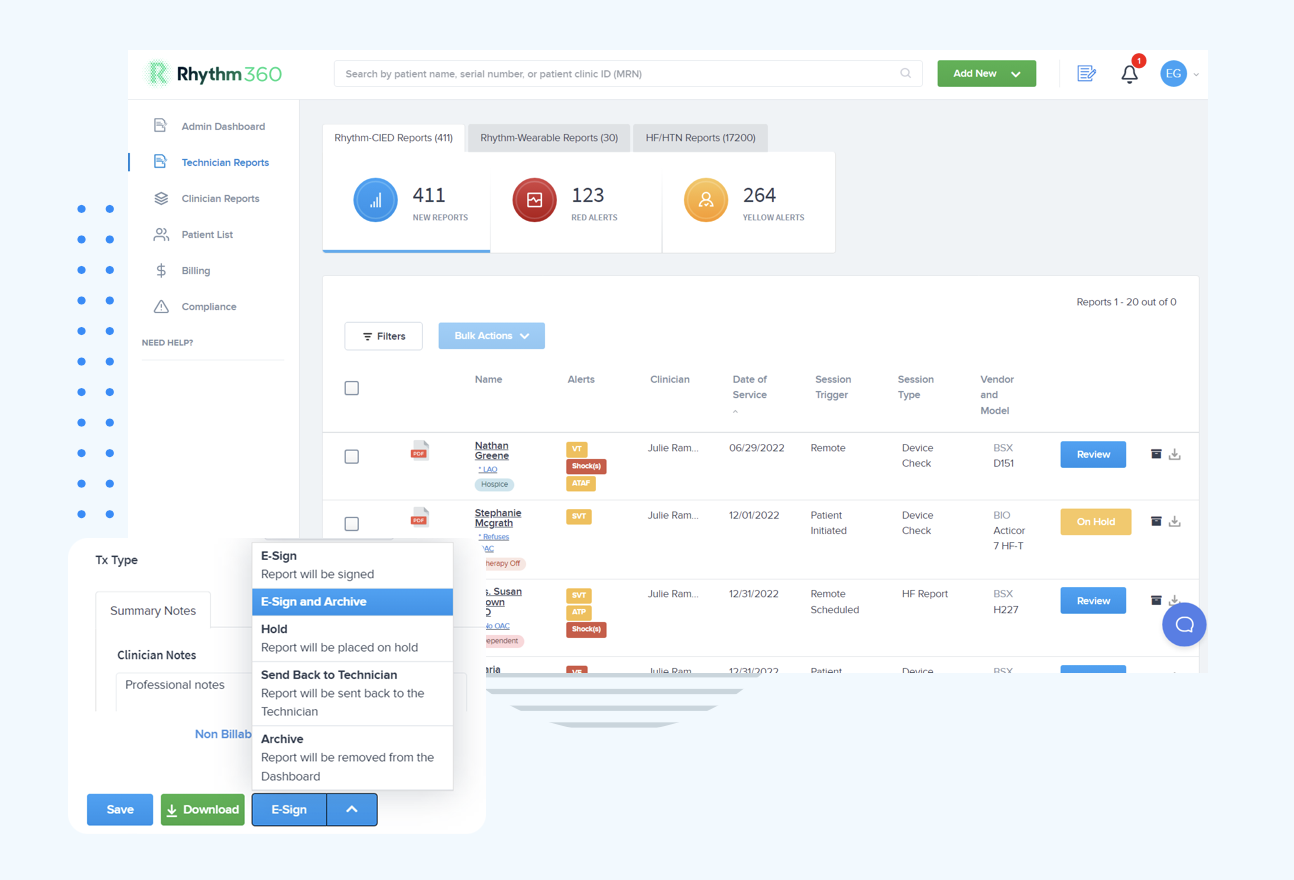
Rhythm360 functions as a vendor-neutral, HIPAA-compliant platform that aggregates all implantable and wearable cardiac device data into a single dashboard. This cloud-based system connects with major manufacturers while supporting secure workflows and consistent clinical processes.
Comprehensive cardiology coverage: Rhythm360 captures and standardizes data from pacemakers, ICDs, implantable loop recorders, CRT and CCM devices, and sensors such as CardioMEMS pulmonary artery monitors. Device technicians view consolidated reports for each patient instead of moving between multiple portals.
Multi-modality chronic disease management: The platform supports remote physiological monitoring for heart failure and hypertension, with automated billing for CPT codes such as 99453, 99454, and 99457. Practices can add new RPM services without building complex infrastructure.
High data reliability: Integrations use APIs, HL7, XML, and computer vision for PDF parsing to support greater than 99.9% data transmissibility. Redundant data feeds help maintain availability when OEM servers experience downtime.
Intelligent alerting and reporting: Real-time reporting supports routine checks and urgent events, with optional 24/7 oversight by certified cardiac technicians supervised by physicians. AI-based triage prioritizes important alerts and can reduce response times for critical events by as much as 80%.
Integrated communication: Built-in Twilio-based messaging records automated and manual outreach within the patient record, which supports coordinated care and follow-up tracking.
Teams that want to see how this works in practice can schedule a demo of Rhythm360.
Cardiology leaders can start by cataloging all OEM portals, manual data entry steps, and reporting workflows. This audit should capture staff time spent on logging into different systems, resolving data discrepancies, and re-entering information into the EHR.
Tracking issues such as missed alerts, slow response times, and incomplete CPT documentation establishes a baseline. This baseline makes it easier to quantify improvements after adopting unified software.
A vendor-neutral platform such as Rhythm360 brings data from all supported manufacturers into one environment. Features such as AI-based data validation, standardized reporting, and EHR integration help reduce manual work and improve data quality.
Rhythm360 can ingest data through multiple channels and formats, which allows practices to maintain a single source of truth instead of juggling separate portals and one-off integrations.
Bi-directional integration with EHR systems such as Epic, Cerner, Athenahealth, eClinicalWorks, and Greenway Health through HL7 supports consistent documentation and streamlined workflows. AI triage filters non-actionable alerts and highlights clinically significant changes so clinicians can focus on high-priority events.
Practices that apply structured automation often report faster responses to urgent events. This focus on comprehensive features and compliance is a core selection factor for leading EHR platforms.
Remote monitoring programs perform best when billing is standardized. Software that supports automated capture and documentation of CPT codes such as 93298, 93299, 99454, 99453, and 99457, helps reduce missed revenue and billing errors.
Rhythm360 tracks billable events and generates auditable documentation, which can help practices recover previously unbilled revenue and materially improve margins on monitoring services.
Platforms used for heart rhythm monitoring should include role-based access controls, audit logs, encryption, and secure messaging to support HIPAA compliance. Effective telehealth programs rely on structured safeguards for remote care. Leading HIPAA compliance tools highlight centralized document management and strict permissions as core features.
Feature | Rhythm360 | Legacy OEM Portals | Manual Methods |
Data Aggregation | Single, vendor-neutral platform | Separate portals by manufacturer | Disconnected systems |
Workflow Efficiency | Automated reporting and AI triage | Manual data review | High administrative workload |
Critical Alert Response | Faster response with prioritized alerts | Delayed by alert volume | Higher risk of overlooked events |
CPT Code Management | Automated capture with audit trail | Manual tracking | Frequent missed revenue |
Bi-directional EHR integration with Rhythm360 allows orders, reports, and billing data to flow into existing clinical systems. Data accuracy and integration quality remain central criteria when organizations choose EHR software, and the same standards support successful remote monitoring.
Clinicians can use Rhythm360's secure mobile access to review alerts, reports, and patient summaries when away from the clinic. This capability supports on-call coverage, more flexible staffing, and faster follow-up on urgent notifications.
Many practices start with CIED monitoring, then extend to heart failure and hypertension RPM. Remote patient monitoring software continues to play an important role in modern care delivery, and Rhythm360 can support these broader service lines.
Teams that want to explore a structured roadmap for expansion can schedule a demo and review options with the RhythmScience team.
Rhythm360 uses APIs, HL7, XML, and computer vision for PDF parsing to ingest and normalize data from major CIED manufacturers such as Medtronic, Boston Scientific, Abbott, and Biotronik. This approach builds a vendor-neutral record for each patient and reduces the need to access individual OEM portals. Redundant data feeds help maintain connectivity and support more than 99.9% data transmissibility.
HIPAA-compliant platforms such as Rhythm360 use technical and administrative safeguards that include secure user authentication, encryption, audit logging, and controlled access to protected health information. Secure messaging and communication within the system help maintain data integrity and reduce reliance on unsecured channels.
Rhythm360 tracks time-based and event-based activity to support documentation for CPT codes such as 93298, 93299, 99453, 99454, and 99457. Automated logs and reports create an audit trail that helps reduce missed billable events and supports cleaner claims, which can increase net revenue from monitoring services.
The Rhythm360 platform applies rules and AI-driven logic to categorize alerts by clinical relevance. Non-actionable or low-priority notifications are filtered or grouped, while significant arrhythmias, device issues, and important status changes are highlighted. This process supports faster responses to critical events and reduces the volume of unnecessary alerts presented to clinicians.
Effective monitoring platforms typically integrate with major EHRs such as Epic, Cerner, Athenahealth, eClinicalWorks, and Greenway Health through HL7 or similar standards. Integrations with device manufacturers, secure messaging tools, and billing systems allow automated data normalization, real-time synchronization, and structured CPT documentation to support both clinical and financial goals.
Cardiology practices that replace fragmented OEM portals and manual workflows with unified software gain clearer visibility into their device population, more consistent clinical processes, and better support for compliance.
A scalable heart rhythm monitoring program built on a platform such as Rhythm360 can help practices improve patient outcomes, streamline staff workloads, and strengthen revenue capture. This approach supports a shift toward more proactive and organized cardiovascular care.
Organizations that want to evaluate this model can schedule a demo of Rhythm360 and discuss how unified monitoring software may fit their specific operational and clinical needs.





