Last updated: July 14, 2026
Remote physiologic monitoring (RPM) for heart failure uses FDA-cleared devices, including connected weight scales, blood pressure cuffs, and pulse oximeters, to transmit daily biometric data to a clinical team. The 30- to 90-day post-discharge window is the highest-risk readmission period. Active RPM during that window directly addresses the CMS Hospital Readmissions Reduction Program penalties that cardiology practices face.
Core prerequisites include an established cardiology or heart failure patient panel, EHR access with HL7 or API capability, and familiarity with CPT codes 99453, 99454, 99457, and 99458. Practices managing patients with cardiac implantable electronic devices (CIEDs) from multiple manufacturers such as Medtronic, Boston Scientific, Abbott, and Biotronik face an additional layer because each OEM operates a separate, non-interoperable portal. Rhythm360 ingests data from all major CIED manufacturers plus CardioMEMS via API, HL7, XML, and computer vision, consolidating every data stream into one dashboard. The following 10-step playbook turns these capabilities into a practical 90-day launch plan for your team.
Define Patient Selection Criteria. Start with French national eligibility criteria: chronic HF with at least one hospitalization in the prior year, or NYHA class II or higher plus BNP >100 pg/mL or NT-proBNP >1,000 pg/mL. The Trento cohort analysis identified ischemic heart disease, age 75 or older, atrial fibrillation, and severe CKD as independent predictors of adverse outcomes. These patients face the highest risk of readmission and mortality, so prioritizing them for enrollment maximizes clinical impact and the chance of capturing billable interventions. Pro Tip: Build a simple EHR query using ICD-10 codes I50.x plus recent hospitalization flags to generate your initial candidate list.
Assemble Your Care Team. Every RPM program relies on four core roles: supervising physician, clinical monitor (RN preferred for high-acuity HF panels), enrollment coordinator, and billing specialist. For a 25-patient pilot, existing staff can usually absorb these duties. At 50 or more patients, a dedicated clinical monitor becomes necessary, and revenue of about $8,000 per month from 50 patients typically covers that salary. Pro Tip: Favor RNs over MAs for heart failure panels because they can exercise independent clinical judgment on escalated alerts.
Select and Procure Devices. A standard HF RPM kit includes a connected weight scale for daily use, a blood pressure cuff for twice-daily readings, and a pulse oximeter for daily or symptom-triggered checks. All devices must be FDA-cleared and capable of automatic digital upload. CMS pays the same rate regardless of device type, so base selection on patient digital literacy and connectivity reliability. Pro Tip: Negotiate a loaner or lease model with device vendors to limit upfront capital during the pilot.
Choose a Vendor-Neutral Platform. Each new OEM input requires its own login and workflow, which fragments cardiovascular service lines. Rhythm360 removes this friction by ingesting data from all major device manufacturers and CardioMEMS into a single dashboard, with AI-powered alert triage that filters non-actionable noise and surfaces clinically significant events. The platform reaches more than 99.9 % data transmissibility through redundant feeds, computer vision OCR, and AI-powered gap extrapolation. Pro Tip: Ask any platform vendor to demonstrate live multi-OEM data ingestion, not just slides, before you sign.
Integrate with Your EHR. Successful remote monitoring depends on EHR integration, including discrete fields so device data appears in the clinical workflow like laboratory results. Rhythm360 offers bi-directional integration with Epic, Cerner, Athenahealth, eClinicalWorks, Greenway Health, and others via HL7. Onboarding, including integration setup, usually takes from a few days to a few weeks. Pro Tip: Map your EHR’s existing HF flowsheet fields to RPM data elements before go-live to avoid duplicate documentation.
Configure Clinical Thresholds. Set individualized alert thresholds based on each patient’s baseline, using the Clinical Thresholds section below as your starting point. Next-generation systems compare parameters against patient-specific ranges, automatically logging normal values and escalating only true abnormalities. Pro Tip: Create a standing diuretic adjustment order set tied to the weight-gain alert so nurses can act without waiting for a physician callback on every event.
Establish Escalation Pathways. A viable remote monitoring program defines actionable events, escalation pathways with time targets and clear ownership, documentation standards, and a feedback loop. Assign explicit ownership for each alert tier: MA for green, RN for yellow or orange, and physician or NP for red. Document every action in the patient record with a timestamp so the team can audit outcomes later. Pro Tip: Run a tabletop simulation of a critical alert scenario, such as new-onset AFib on a Saturday, before go-live to expose gaps in after-hours coverage.
Configure CPT Billing Documentation. Rhythm360 automates CPT code capture and generates structured documentation for 99453, 99454, 99457, and 99458. The platform tracks the 16-day reading threshold per patient per 30-day period and flags accounts at risk of falling below the billing floor before the month closes. As the University of Chicago Medicine reported after implementing Rhythm360, “We have improved billing and accountability for our patients after the integration.” Pro Tip: Ask a billing specialist to audit the first three months of claims against the platform’s compliance tracker so you can correct documentation gaps early.
Onboard and Educate Patients. The 2026 HFSA/AAHFN scientific statement highlights suboptimal patient engagement and digital literacy disparities as major implementation challenges. Provide device setup in-office at the first visit, give a written daily measurement schedule, and confirm that the patient can transmit data before discharge. Rhythm360’s integrated Twilio-powered messaging framework automates reminders and logs all patient communications with a full audit trail. Pro Tip: Identify a caregiver or family member as a proxy reporter for frail or older patients who may struggle with daily device use.
Run a 25-Patient Pilot, Then Scale. Launch with 25 patients over 30 days and track alert response time, 16-day compliance rate, CPT capture rate, and 30-day readmission rate. Use these metrics to fine-tune staffing ratios and threshold sensitivity before you expand. University of Chicago Medicine scaled to over 73,000 reports annually through Rhythm360, averaging more than 18,000 reports per quarter, which illustrates what a mature program can achieve. Pro Tip: Set a 90 % 16-day compliance rate as your pilot success threshold before approving full-panel expansion.
Rapid weight gain is the earliest detectable sign of fluid retention in HF patients, with a gain of 2 or more pounds in 24 hours or 5 or more pounds in a week often preceding acute decompensation by 3–5 days. The following color-coded framework provides a starting configuration, and you can individualize it based on each patient’s baseline.
| Alert Level | Trigger | Required Action | Time Target |
|---|---|---|---|
| 🟢 Green | Weight within ±2 lbs of baseline for 7 days | Routine documentation, continue current regimen | Next scheduled review |
| 🟡 Yellow | Weight gain >2 lbs/24h | Nurse callback, assess diet, meds, congestion, consider diuretic adjustment | Within 4 hours |
| 🟠 Orange | Weight gain >5 lbs/7 days | Same-day telehealth, evaluate decompensation, order BNP/NT-proBNP if indicated | Same day |
| 🔴 Red — BP | SBP >180 / DBP >120 | Immediate nurse contact, assess end-organ damage, refer to ER if symptomatic | Immediate |
| 🔴 Red — SpO2 | SpO2 <90 % | Immediate nurse contact, refer to ER if sustained or with dyspnea at rest | Immediate |
| 🔴 Red — HR | HR >120 bpm (new onset) | Nurse callback, evaluate AFib or infection, order ECG | Within 4 hours |
The recommended nurse-to-patient ratio for high-acuity HF RPM is 1 RN per 100–125 patients. With AI-powered alert triage, a care manager can manage larger panels at lower per-patient costs. Without AI triage, HF RPM programs reach staffing ratios of 1:100 patients with PPPM staffing costs above $90. These staffing investments are sustainable because the 2026 Medicare reimbursement structure creates predictable revenue for compliant programs.
The 2026 Medicare Physician Fee Schedule introduced structural changes to RPM billing. CMS expanded coverage to include a new low-volume pathway for patients transmitting 2–15 days of data per month, alongside the existing 16-day standard pathway. Heart failure qualifies as a single chronic condition eligible for RPM under 2026 CMS rules.
| CPT Code | Service Description | 2026 Medicare Avg. Rate | Key Requirement |
|---|---|---|---|
| 99453 | Initial device setup and patient education (one-time) | ~$19 | Device used at least 16 days in first 30-day period |
| 99454 | Device supply and data transmission, 16–30 days/month | $48 | At least 16 separate days of auto-uploaded data |
| 99445 | Device supply and data transmission, 2–15 days/month (new 2026) | ~$47 | 2–15 separate days of auto-uploaded data |
| 99457 | Treatment management, first 20 min/month | $51.77 | At least one synchronous two-way patient interaction |
| 99458 | Treatment management, each additional 20 min (add-on) | ~$38–$42/unit | Billed in addition to 99457, up to 2 units |
| 99470 | Brief treatment management, 10–19 min/month (new 2026) | ~$26 | At least one synchronous interaction, no add-on codes |
A single Medicare patient fully enrolled in RPM can generate about $150–$200 or more per month, with Month 1 totals reaching about $202 including 99453. High-acuity HF patients often justify two units of 99458 because they require more than 40 minutes of monthly clinical staff time. Rhythm360’s real-time compliance tracking, described in Step 8, generates structured reports that support clean claim submission and directly reduce the revenue leakage that manual workflows create.
CMS also expanded RPM billing eligibility in 2026 to include federally qualified health centers and rural health clinics, which broadens the addressable patient population for heart failure programs.
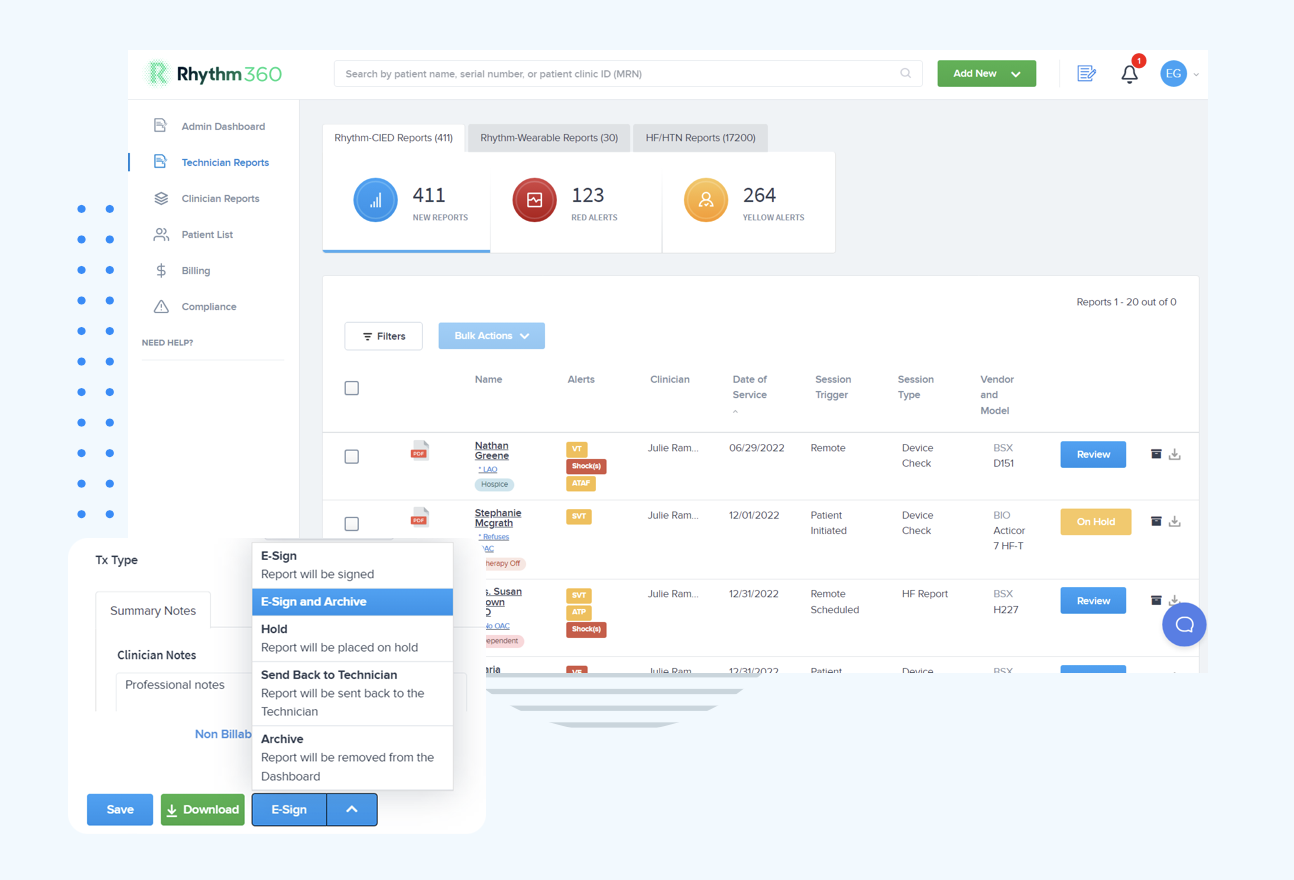
Rhythm360 is a HIPAA-compliant, cloud-based platform built for the operational complexity of multi-OEM cardiac monitoring and chronic disease RPM. The following table summarizes its core capabilities for a heart failure program.
| Capability | How It Works | Clinical/Operational Outcome |
|---|---|---|
| Multi-OEM Data Ingestion | API, HL7, XML, and computer vision OCR ingest data from Medtronic, Boston Scientific, Abbott, Biotronik, CardioMEMS, and others into one dashboard | Removes multiple OEM portal logins and creates a single source of truth for the entire device population |
| AI Alert Triage | AI filters non-actionable transmissions and surfaces clinically significant events with priority ranking | Up to 80 % reduction in critical alert response times and less alert fatigue for clinical staff |
| 16-Reading Compliance Tracking | Real-time per-patient reading counter with proactive flags when accounts risk falling below the billing threshold before month-end | Prevents missed CPT 99454 billing and supports up to 300 % revenue improvement through complete CPT capture |
| Mobile Sign-Off | HIPAA-compliant mobile app lets clinicians review transmissions, sign reports, and coordinate care from any location | Removes workstation dependency and enables weekend and after-hours critical event response |
As Andrew Beaser, MD, Associate Professor of Medicine at University of Chicago Medicine, explained after implementing Rhythm360, “That was a big piece for us, to have an integrated review of data from trained personnel.” UCM’s implementation enabled clinicians to review more transmissions daily and identify more abnormalities, achieving the scale described earlier.
A structured 25-patient pilot over 30–60 days establishes your operational baseline before full-panel expansion. The following metrics define pilot success.
Use pilot data to calibrate the nurse-to-patient ratio before scaling. If alert volume overwhelms the RN at 25 patients, adjust threshold sensitivity or add staff before you expand to 100 or more patients.
Practices that implement Rhythm360 have reported an 80 % reduction in response times for critical patient alerts and up to a 300 % increase in revenue through more complete CPT capture, better staff efficiency, and the addition of HF and HTN RPM service lines. These outcomes align with published evidence: the TIM-HF2 trial showed a 30 % reduction in all-cause mortality (HR 0.70) and fewer days lost due to unplanned cardiovascular hospital admissions or death (HR 0.80) with remote monitoring, and a Trento cohort analysis found reduced cardiovascular hospitalization rates with remote monitoring versus standard in-office monitoring.
At 90 days post-launch, a mature program should show measurable improvement across three domains.
Rhythm360’s implementation process, including EHR integration setup, usually takes from a few days to a few weeks, depending on the EHR environment and the number of OEM data feeds. The platform supports Epic, Cerner, Athenahealth, eClinicalWorks, Greenway Health, and others via HL7. A 25-patient pilot can typically begin transmitting data within the first two weeks of onboarding.
Rhythm360 is a fully HIPAA-compliant, cloud-based platform. All patient data is encrypted in transit and at rest. The platform maintains a complete audit trail for every patient communication, alert action, and report sign-off, which supports clinical accountability and CMS documentation requirements. The integrated Twilio-powered messaging framework logs all patient interactions, including phone call records, within the patient record.
For a 25-patient pilot, existing staff can usually absorb RPM duties, with a clinical monitor spending 30–60 minutes per day on dashboard review and patient outreach. At 50 or more patients, a dedicated RN clinical monitor is recommended. At scale, a single RN can manage 100–125 high-acuity HF patients, which reflects the ratio detailed in the clinical thresholds section above. Rhythm360’s AI alert triage reduces the volume of non-actionable notifications that reach clinical staff, which lowers the per-patient time burden and lets one monitor manage a larger panel without sacrificing response quality.
Rhythm360 ingests data from all major CIED manufacturers, including Medtronic, Boston Scientific, Abbott, and Biotronik, plus CardioMEMS pulmonary artery monitors, using a combination of direct API connections, HL7 feeds, XML parsing, and computer vision OCR for PDF-based reports. The platform normalizes all data into a single schema and applies redundant data feeds as a fail-safe when an OEM server is unavailable. This architecture reaches more than 99.9 % data transmissibility so critical events are not missed because of a failure in any single manufacturer’s data pipeline.
A standard heart failure RPM program bills under CPT 99453 for one-time device setup, 99454 or 99445 for monthly device supply based on reading volume, 99457 for the first 20 minutes of treatment management, and 99458 for additional 20-minute increments. The 2026 Medicare rules introduced CPT 99445 for patients transmitting 2–15 days of data and CPT 99470 for 10–19 minutes of management time, which expands billing eligibility for lower-adherence patients. Rhythm360 tracks the reading count per patient in real time, alerts staff when an account risks missing the billing threshold before month-end, and generates structured documentation that supports clean claim submission for each applicable code.
The 10-step playbook above gives you a complete operational path from patient selection through phased rollout. The 2026 Medicare reimbursement structure, the published evidence on readmission reduction, and the availability of a vendor-neutral platform that removes multi-OEM fragmentation create the strongest environment yet for launching a reimbursable remote heart failure monitoring program.
Fragmented OEM portals, manual CPT documentation, and alert fatigue are operational problems with a documented solution. Rhythm360 consolidates every data stream, automates compliance tracking, and delivers the mobile-first workflow that clinical teams need to act on critical alerts wherever they are and whenever those alerts occur.
Launch your remote heart-failure monitoring program this quarter and schedule your implementation consultation now.