Last updated: July 13, 2026
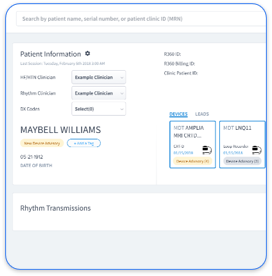
A vendor-neutral aggregation layer ingests transmissions from every major OEM, including Medtronic, Boston Scientific, Abbott, Biotronik, and others, into a single normalized dataset. Clinicians work from one unified dashboard instead of toggling between separate portals, which removes redundant logins and reduces transcription errors from manual data movement.
The operational impact is significant. University of Chicago Medicine reviewed more than 73,000 CIED reports annually through a unified platform in calendar year 2025, averaging more than 18,000 reports per quarter. This volume demonstrates that centralized aggregation scales in high-volume environments without degrading review quality.
Implementation checklist:
Rhythm360 aggregates data from all major OEM portals into a single source of truth, achieving greater than 99.9% transmissibility through redundant data feeds, computer vision, and AI-powered normalization.
Open standards prevent future lock-in and support seamless data exchange across systems. HL7 International announced the launch of the Caliper FHIR Accelerator on March 5, 2026, and the accelerator became fully operational on January 1, 2026 after 2025 formation phases. Caliper addresses real-time medical device data interoperability and explicitly aligns HL7 FHIR with IEEE 11073 device communication standards and IHE integration profiles. The IHE Implantable Device Cardiac Observations (IDCO) profile, IHE PCD-05 / DEV-05, remains the designated standard for transferring interrogated implantable cardiac device data to information management systems. The HL7 FHIR Point-of-Care Device Implementation Guide (PoCD IG) version 1.0.0 STU1, generated July 1, 2026, extends this framework with deep device metadata using IEEE 11073 nomenclature.
Clinics that adopt FHIR R5 and IHE IDCO-aligned platforms today position themselves ahead of the 2027 patient-access mandate and avoid costly rework as standards mature. HL7 Europe published version 2.0.0 of its Base and Core FHIR Implementation Guides on April 28, 2026, incorporating new profiles and terminology updates to support European Health Data Space interoperability requirements, which signals global convergence on these standards.
Implementation checklist:
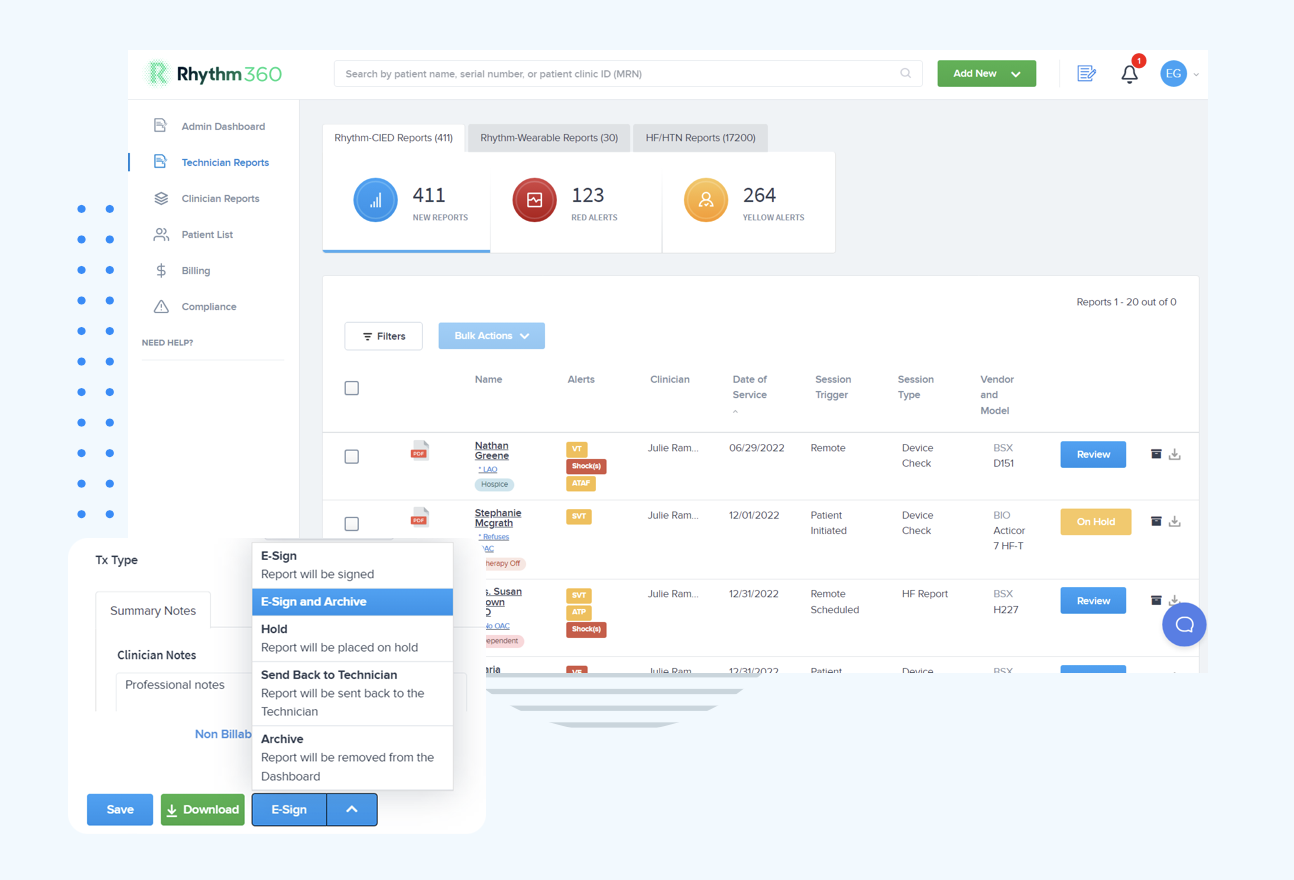
Rhythm360 ingests data via API, HL7, XML, and PDF parsing, providing a standards-aligned foundation that accommodates both current HL7 v2 workflows and emerging FHIR R5 surfaces. Once device data flows into a unified platform through standards-based interoperability, the next challenge is managing the volume of alerts that this data generates.
Alert fatigue creates a direct patient-safety risk. When every transmission generates an undifferentiated notification, clinically significant events such as new-onset atrial fibrillation, ventricular tachycardia, or lead malfunction compete with noise. AI-powered triage filters non-actionable transmissions and surfaces prioritized alerts, which compresses the time between event detection and clinical response.
Andrew Beaser, MD, Associate Professor of Medicine at University of Chicago Medicine, noted, “Decision support, including AI-assisted decision support, will become increasingly important as data volumes grow.” His institution’s implementation enabled clinicians to identify more abnormalities and act earlier. He added, “We are able to address these issues earlier; rather than waiting for a 3-month visit, we can call patients in for evaluation.”
Implementation checklist:
Rhythm360’s AI-powered alert triage reduces critical alert response times by up to 80%, with optional 24/7/365 oversight by certified cardiac technicians (CCTs) supervised by physicians.
Schedule a demo to see Rhythm360’s AI triage in action.
Revenue leakage in CIED remote monitoring programs is structural, not incidental. The root cause is timing, because CIED transmissions received but not billed within the 90-day cycle slip through the revenue cycle entirely. This timing problem becomes worse in manual workflows, where cardiology RPM programs consistently underbill CPT 99457 and 99458 because staff lack real-time visibility into billing cycle status. Automated workflows close this visibility gap and improve capture rates for these codes.
Under the 2026 CMS Final Rule, RPM now includes a new device supply code, 99445, for 2–15 days of data transmission. Automated CPT documentation closes this gap by pairing each transmission event with its billing cycle in real time. Gaurav A. Upadhyay, MD, at University of Chicago Medicine, observed, “We have improved billing and accountability for our patients after the integration.”
Implementation checklist:
Rhythm360’s automated CPT code capture and documentation helps practices recover previously lost revenue, with profitability improvements reaching 300% in practices that previously underbilled remote monitoring codes.
Device data that does not flow into the EHR creates a parallel record that clinicians cannot trust or use efficiently. Bi-directional integration writes normalized CIED observations directly to the patient chart and pulls relevant clinical context back into the monitoring platform. This approach eliminates manual transcription and supports coordinated care decisions.
Major US EHR vendors support HL7 v2 messaging, and FHIR R4 APIs are available for certified systems. A production bi-directional integration that combines HL7 v2 and FHIR R4 typically takes 8–16 weeks when scoped to standardized resources.
Implementation checklist:
Rhythm360 offers deep, bi-directional integrations with Epic, Cerner, Athenahealth, eClinicalWorks, Greenway Health, and others via HL7, with onboarding typically completed in days to weeks.
OEM server outages and inconsistent transmission formats create routine operational hazards. A single-path ingestion architecture fails silently and leaves clinicians unaware that data is missing. Redundant data feeds combined with computer-vision OCR for unstructured PDF reports create a fail-safe that maintains data completeness regardless of upstream disruptions.
This architecture matters most for high-acuity patients where a missed transmission could delay detection of a critical arrhythmia or device malfunction. For cardiology practices with significant device populations, the gap between CMS-allowed billing hours and actual monitoring time represents hundreds of thousands of dollars in annual uncollected revenue due to fragmented data and operational leaks in CIED remote monitoring. Transmission gaps directly compound that leakage by making it impossible to document the monitoring activity required for CPT code capture.
Implementation checklist:
The architecture described above delivers the greater than 99.9% transmissibility mentioned in Solution 1, ensuring no transmission is silently lost even during OEM server outages.
Schedule a demo to review Rhythm360’s data reliability architecture.
Reliable data transmission only creates value when clinicians can act on it immediately, regardless of location or time of day. Critical events do not observe business hours. Clinicians tethered to a workstation cannot review a Saturday-morning arrhythmia alert, sign a report, or initiate an anticoagulation protocol until Monday, which introduces real clinical risk. A HIPAA-compliant mobile application extends the monitoring workflow to wherever the on-call clinician is located.
Mobile access also supports the team-based approach to remote monitoring endorsed by the 2023 HRS/EHRA/APHRS/LAHRS Expert Consensus Statement on Practical Management of the Remote Device Clinic, which recommends including both clinical and nonclinical personnel in all remote monitoring tasks. A mobile-enabled platform allows NPs, PAs, and CCTs to triage and escalate from any location, which distributes the on-call burden across the team.
Implementation checklist:
Rhythm360’s secure, HIPAA-compliant mobile application allows clinicians to review transmissions, sign reports, and coordinate care from their smartphones, which supports continuity of care around the clock.
Disconnected patient outreach, with phone calls logged in one system, automated reminders in another, and no unified audit trail, creates redundant work and compliance gaps. An integrated communication hub ties automated messaging, manual outreach, and call logging to the patient record, which gives the care team a complete picture of every interaction.
This approach is particularly relevant for heart failure and hypertension RPM programs where device connectivity issues, such as a disconnected scale or a missed weight reading, require timely patient follow-up. A documented communication trail also supports CPT billing compliance by demonstrating the required clinical touchpoints for codes such as 99457 and 99458.
Implementation checklist:
Rhythm360 facilitates automated and manual patient messaging via an integrated Twilio framework, with all communications, including phone call logs, tracked with a full audit trail within the patient record.
The eight solutions above provide the technical infrastructure to break data silos, but technology alone does not eliminate silos. A governance model defines who owns each workflow, who is accountable for outcomes, and what service levels are required. A lightweight RACI-style accountability structure is recommended to clarify institutional and vendor responsibilities for unified cardiac device data workflows, covering clinical safety oversight, data and AI oversight, IT and security oversight, and vendor liabilities.
The following RACI framework applies to a unified CIED monitoring program and separates daily execution from strategic accountability:
Implementation artifacts for governance of AI-enabled cardiovascular devices include a governance workbook aligned with predefined change planning, a monitoring dashboard linking KPIs to escalation actions, a transparency document for auditability, and a site acceptance testing protocol. SLAs should define maximum alert response times, minimum transmissibility thresholds, and billing cycle completion deadlines, with automated dashboard alerts when any threshold is breached.
The four phases below reflect realistic timelines for a cardiology practice deploying vendor-neutral CIED aggregation with bi-directional EHR integration. Real-world FHIR integrations support the feasibility of a 90-day end-to-end deployment for practices with defined workflows.
Vendor-neutral aggregation means a platform ingests and normalizes data from all major cardiac device manufacturers, including Medtronic, Boston Scientific, Abbott, Biotronik, and others, without requiring the clinic to use a single OEM’s proprietary portal or software. In practice, a device technician logs into one dashboard to see the complete transmission history for every patient, regardless of which company manufactured their pacemaker, ICD, or loop recorder. The platform handles the translation between proprietary OEM data formats using APIs, HL7 messaging, XML parsing, and computer-vision OCR for PDF reports. This process produces a standardized dataset that feeds into the EHR and billing systems. The clinical benefit is a single source of truth, and the operational benefit is the removal of redundant logins, manual transcription, and the data gaps that occur when one OEM portal is unavailable.
FHIR R5 and the IHE Implantable Device Cardiac Observations (IDCO) profile, formally IHE PCD-05 / DEV-05, define how interrogated cardiac device data is structured, transmitted, and consumed by information management systems including EHRs. In 2026, the HL7 Caliper FHIR Accelerator became fully operational and is actively developing standardized FHIR profiles for real-time implantable device data, aligning FHIR with IEEE 11073 device communication standards. The HL7 FHIR Point-of-Care Device Implementation Guide (PoCD IG) version 1.0.0 STU1, published July 9, 2026, extends IDCO functionality with deep device metadata. For clinics, adopting a platform that supports these standards means device data can flow into any certified EHR without custom point-to-point interfaces. This capability reduces integration costs and future-proofs the technology investment ahead of the 2027 ONC patient-access deadline.
Remote CIED monitoring is billed primarily through CPT codes 93296 for remote interrogation of a pacemaker system, 93297 for a single or dual chamber device, 93298 for an implantable cardioverter-defibrillator, and 93299 for an implantable loop recorder. RPM programs for heart failure and hypertension patients use codes 99453, 99454, 99457, and 99458, with the 2026 CMS Final Rule adding a new device supply code, 99445, for 2–15 days of data transmission. Manual workflows consistently underbill. Code 99457 is captured on only 60–70% of eligible patient-months and 99458 on 25–35% in manual programs. Automated documentation platforms push 99457 capture above 90% and routinely capture a second unit of 99458 for complex patients by pairing each transmission event with its 90-day billing cycle in real time and generating compliant documentation at the point of review. The revenue impact of closing this gap in a 500-patient program is substantial, with incremental captured revenue in the range of $300,000 to $500,000 annually from automation of the full CPT code set.
Implementation timelines depend on the number of OEM data feeds, the complexity of EHR integration, and the practice’s existing workflow documentation. For a cardiology practice connecting to the four major OEM portals and integrating with a single EHR via HL7 and FHIR, a 90-day timeline is achievable when the platform vendor has pre-built connectors and a structured onboarding process. The critical path typically involves the EHR integration. A bidirectional production integration that combines HL7 v2 and FHIR R4 takes 8–16 weeks when scoped to standardized resources. Rhythm360’s onboarding process, including EHR integration setup, typically takes from a few days to a few weeks for practices with standard configurations, because pre-built OEM connectors and existing EHR interface templates remove the custom development work that extends timelines in greenfield implementations.
Sustaining a unified remote monitoring program requires four defined roles. Device technicians and clinical staff are responsible for daily alert review, transmission documentation, and patient follow-up. The EP Lab Director or Director of Cardiology Services is accountable for clinical safety outcomes, SLA performance, and escalation decisions. IT security and the platform vendor are consulted for cybersecurity reviews, software update validation, and data integrity audits. Practice administrators and billing staff are informed when software updates, SLA breaches, or billing anomalies occur. The 2023 HRS/EHRA/APHRS/LAHRS Expert Consensus Statement on Practical Management of the Remote Device Clinic reinforces this team-based approach and emphasizes adequate dedicated staffing, defined workflows, and structured communication of transmission results as prerequisites for a sustainable remote device clinic. Quarterly governance reviews against defined SLAs, including transmissibility rates, alert response times, and CPT capture rates, keep the program accountable and identify optimization opportunities before they become operational problems.
Fragmented OEM portals, disconnected workflows, and absent EHR integration are solvable problems with measurable solutions. The eight solutions detailed above, anchored in vendor-neutral aggregation, 2026 interoperability standards, AI-powered triage, automated billing documentation, and a structured governance model, give cardiology practices and EP clinics a concrete path to an 80% reduction in critical alert response times and up to 300% improvement in revenue capture. University of Chicago Medicine’s high-volume experience cited in Solution 1 demonstrates that these outcomes are achievable at scale. Other platforms in this space exist. Rhythm360 by RhythmScience delivers this capability as a vendor-neutral, HIPAA-compliant, AI-powered platform with bi-directional EHR integration and a 90-day implementation path.