Heart failure RPM supports 2026 Medicare reimbursements of $52.11 monthly for CPT 99454 (16+ days of data), $51.77 for CPT 99457 (20 minutes of management), and $21.71 for CPT 99453 setup.
Core HF devices include weight scales for fluid retention, blood pressure cuffs, and pulse oximeters, with automated data transmission required for billing compliance.
Use a 6-step workflow: verify eligibility and consent, set up devices, bill 99453, collect 16 days of data for 99454, document time for 99457/99458, and maintain audit-ready records.
Prevent denials by meeting the 16-day transmission threshold, avoiding manual entry, aligning ICD-10 codes (I50.xx), and tracking time for management codes.
Partner with Rhythm360 for AI-driven automation, EHR integration, and more than 99.9% data reliability that protects HF RPM revenue.
Specific CPT codes and reimbursement rates drive the financial performance of a heart failure RPM program. Medicare's 2026 Physician Fee Schedule lists national average reimbursement amounts for each component of heart failure remote monitoring.
The table below shows how all four billable codes work together across a typical month and how they combine into a complete billing cycle that can generate more than $125 per patient when fully documented.
CPT Code | Description | Heart Failure Requirements | 2026 Reimbursement |
|---|---|---|---|
99453 | Device setup and patient education | HF device onboarding, consent | $21.71 (once per 30 days) |
99454 | Device supply with data transmission | 16+ days of weight/BP data for fluid monitoring | $52.11 (monthly) |
99457 | First 20 minutes of treatment management | Interactive HF review and adjustments | $51.77 (monthly) |
99458 | An additional 20 minutes of management | Extended HF consultation time | $41.42 (add-on) |
Heart failure patients qualify for RPM when they have a chronic HF diagnosis and use FDA-cleared devices such as weight scales for fluid retention and pulse oximeters for oxygen saturation.
The 2026 CMS updates expanded eligibility to patients with a single chronic condition, which makes heart failure an ideal focus for RPM programs. With the codes and eligibility rules defined, the next priority is building a repeatable workflow that captures every billable activity.
Start by confirming that the patient has a documented heart failure diagnosis using appropriate ICD-10 codes from the I50.xx series. Accurate pairing of CPT and ICD-10 codes prevents denials for lack of medical necessity. Capture written patient consent for RPM, and clearly explain device use, data transmission expectations, and how monitoring supports their HF care plan.
Eligibility Checklist:
Documented heart failure diagnosis (I50.xx)
Signed patient consent form
Verification that HF is a chronic condition
Confirmation that the patient can use monitoring devices
Use FDA-cleared devices that directly support heart failure management. Weight scales for fluid retention and pulse oximeters for oxygen saturation play central roles for HF patients. Configure each device so that readings flow automatically into your monitoring platform, which prevents billing issues tied to manual data entry.
Device Setup Workflow:
Weight scale for daily fluid retention monitoring
Blood pressure cuff for cardiovascular status
Pulse oximeter for oxygen saturation tracking
Automatic transmission of readings into the RPM platform
See how Rhythm360 automates device integration to connect major manufacturers, normalize data with AI, and remove manual entry from your HF RPM workflow.
CPT 99453 covers one-time setup of the RPM device, patient education, and onboarding, with a 2026 Medicare reimbursement in the $19 to $21 range. Bill this code once per device per 30-day period after you complete education and confirm that data flows correctly. Keep clear notes that show when the setup occurred and what training the patient received.
99453 Billing Requirements:
Document completion of device setup
Record the patient education session
Verify device connectivity and successful data transmission
Avoid billing on the same day as an E/M visit
CPT 99454 drives recurring HF RPM revenue and requires patients to transmit data on at least 16 days within a 30-day period. For heart failure, this usually means daily weight readings to detect fluid shifts and regular blood pressure measurements to track cardiovascular stability.
Data Collection Requirements:
Minimum 16 days of automatically transmitted data in each 30-day cycle
Daily weight measurements for fluid monitoring
Regular blood pressure and heart rate readings
Oxygen saturation levels when clinically indicated
CPT 99457 covers the first 20 minutes of clinical staff time reviewing RPM data and providing interactive communication. For HF patients, this work includes reviewing weight trends, adjusting diuretics or other medications, and reinforcing education on symptom and fluid management.
Time Documentation Template:
A typical 20-minute billing cycle follows a predictable pattern. Begin with 8 to 10 minutes reviewing transmitted data to identify trends in weight, blood pressure, and symptoms.
Next, spend 10 to 12 minutes in direct communication by phone or video to discuss findings and address concerns. Use 5 to 8 minutes to adjust the care plan based on the data review and patient conversation. Finish with 3 to 5 minutes documenting all activities in the EHR so that your records remain audit-ready.
Medicare requires five core data elements for RPM claim approval: CPT codes, ICD-10 diagnosis codes, date of service, place of service, and provider NPI. Build a documentation process that captures these fields for every claim and links them to detailed encounter notes, time logs, and device data.
CMS Compliance Checklist:
Accurate alignment of CPT and ICD-10 codes
Documented patient consent and device setup
Verification that data transmission meets the required threshold
Time tracking for all management services
Complete audit trail stored in a HIPAA-compliant system
Small documentation gaps can create significant denial risk in heart failure RPM programs. Missing the 16-day transmission threshold or failing to document key elements often triggers Recovery Audit Contractor reviews. Manual patient entry also breaks compliance rules, so automated device transmission becomes a nonnegotiable requirement.
Top Denial Triggers:
Insufficient data transmission days that fall short of the 16-day threshold for CPT 99454
Missing or incomplete documentation of patient consent
Billing both CPT 99445 and 99454 in the same 30-day period
Manual patient data entry instead of automated device transmission
Weak or incomplete time documentation for management codes
Rhythm360's AI-powered platform tracks data transmission thresholds, time logs, and documentation in real time, which reduces these denial risks through automation and continuous compliance monitoring.
Rhythm360 delivers a vendor-neutral cardiovascular platform that supports HF and hypertension RPM with more than 99.9% data reliability through AI-based normalization and redundant data feeds.
The system supports turnkey HF RPM service lines, captures CPT codes such as 99453, 99454, and 99457 automatically, and connects with Epic, Cerner, Athenahealth, eClinicalWorks, Greenway Health, and other EHRs through bi-directional integrations that streamline billing.
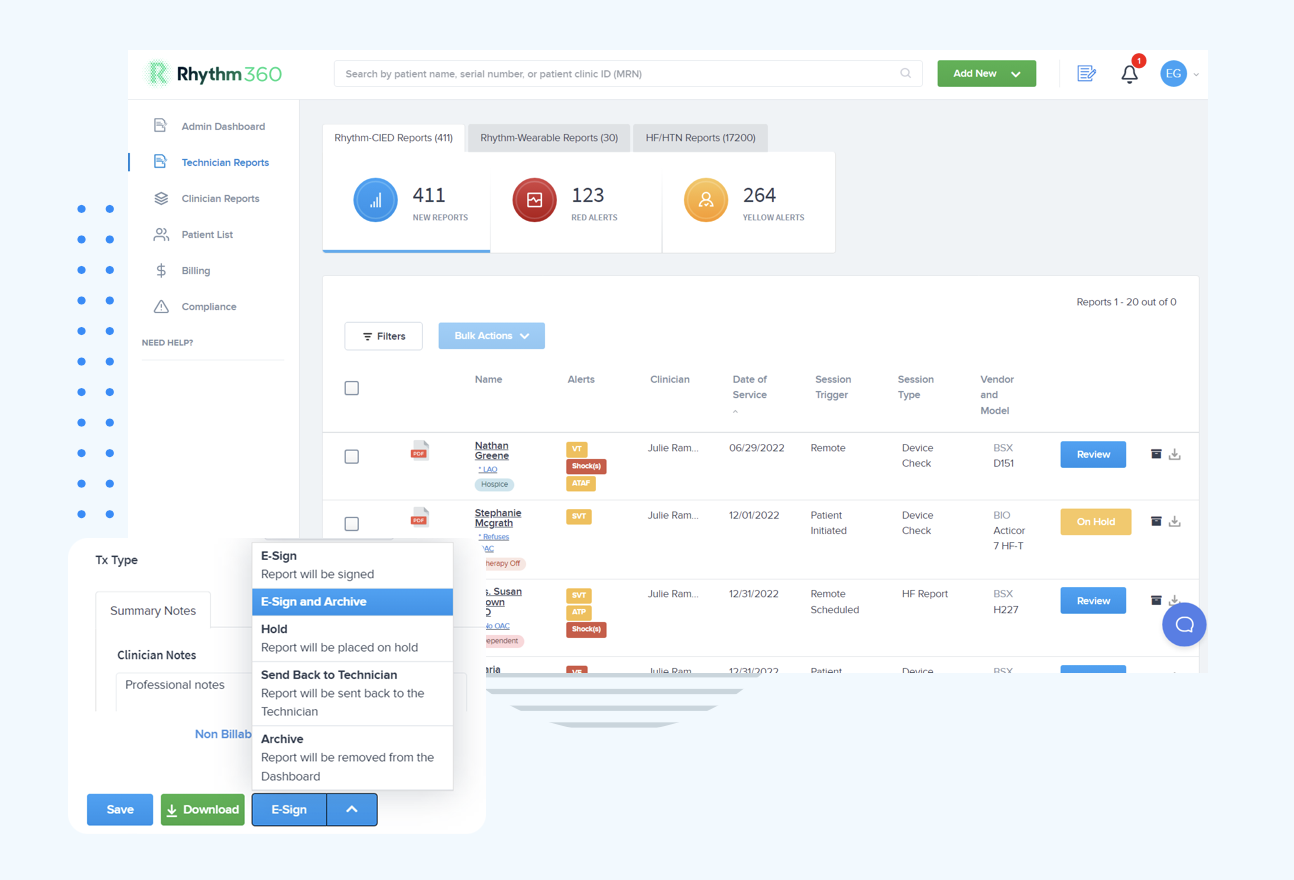
Cardiology practices using Rhythm360 report 80% faster alert response times and revenue growth up to 300% through automated CPT capture and audit-ready documentation.
Discover how our heart failure RPM platform works in practice and see how it can increase revenue while supporting proactive HF monitoring and better outcomes.
Heart failure RPM CPT codes include 99453 for device setup and patient education, 99454 for monthly device supply and data transmission, 99457 for the first 20 minutes of treatment management, and 99458 for each additional 20-minute increment. These codes support monitoring of weight, blood pressure, and oxygen saturation in heart failure patients so that clinicians can detect fluid retention and cardiovascular changes earlier.
CPT 99457 requires at least 20 minutes of cumulative clinical staff time per calendar month, including interactive communication with the patient or caregiver.
For heart failure patients, this work includes reviewing transmitted weight and vital sign data, discussing symptom changes, adjusting medications based on trends, and providing education on fluid and sodium management. Document each activity and interaction with time stamps so that the total clearly reaches or exceeds 20 minutes.
CPT 99454 covers the supply of remote monitoring devices and the collection of physiologic data for 16 to 30 days within a 30-day period. For heart failure patients, this usually includes daily weight measurements to monitor fluid retention, blood pressure readings to track cardiovascular status, and other relevant physiologic parameters. The device must transmit data automatically, since manual patient entry does not qualify for billing.
The 2026 Medicare national average reimbursement for CPT 99453 is approximately $21.71. This code covers the initial setup of RPM devices, patient education on proper device usage, and onboarding to the monitoring program. It can be billed once per device per 30-day period and cannot be billed on the same day as an evaluation and management visit.
CPT 99458 is an add-on code for each additional 20-minute block of RPM treatment management services beyond the initial 20 minutes covered by 99457.
It carries a 2026 Medicare reimbursement of about $41.42 and can be billed for up to two units per calendar month, which supports a maximum of 60 total minutes. This code becomes especially valuable for complex heart failure patients who need frequent medication adjustments and closer monitoring.
Heart failure RPM billing creates meaningful revenue opportunities for cardiology practices that follow clear workflows and strong documentation standards. By using this 6-step blueprint and platforms such as Rhythm360, practices can capture revenue that previously went unbilled while delivering continuous monitoring and better HF care.
Schedule your demo today to start billing heart failure RPM with confidence and compliance.