Last updated: July 13, 2026
The 24- to 48-hour Holter monitor rarely captures infrequent arrhythmias because the recording window is too short. Extended-wear patch monitors and remote cardiac monitoring devices now handle most patients with infrequent or paroxysmal arrhythmias.
The diagnostic yield improvement is substantial. In a study of 146 patients monitored simultaneously with a 24-hour Holter and a 14-day patch, the patch detected more arrhythmias than the Holter. Some events appeared only on the longer-duration device. Analysis of 26,751 first-time patch users confirmed that 29.9% of first arrhythmia detections occurred after the initial 48 hours, the point at which traditional Holter monitoring ends. In a registry of 122,815 patients, seven days of monitoring identified 92.9% of potentially high-risk arrhythmias.
Practices that rely only on short-duration Holter monitoring miss a large share of clinically significant events. Rhythm360 ingests data from all major extended-wear and implantable device manufacturers, including Medtronic, Boston Scientific, Abbott, and Biotronik, into one dashboard. Staff can shift from Holter to multi-modality monitoring without multiplying portal logins.
The extended-wear patches that have replaced many Holters sit inside a broader remote arrhythmia monitoring ecosystem. Modern monitoring spans three primary modalities, and each one generates its own data stream:
Each CIED manufacturer uses proprietary nomenclature, technical standards, and communication protocols. This fragmentation makes unified data access difficult without a vendor-neutral intermediary.
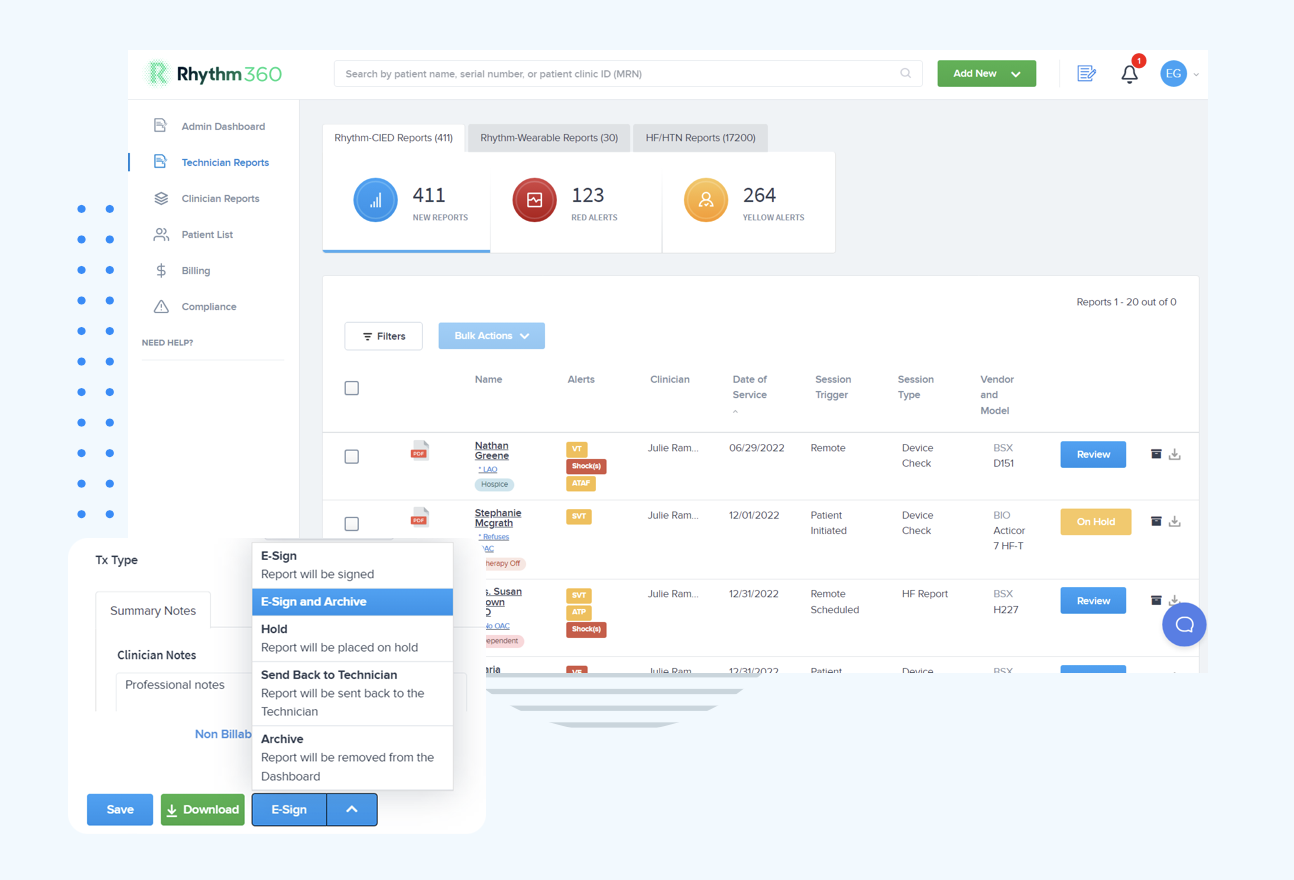
Consider a Saturday-morning scenario. A patient’s CIED transmits a new-onset atrial fibrillation alert at 7:00 a.m. In a fragmented workflow, the on-call clinician must identify the correct OEM portal, log in with separate credentials, and manually interpret the transmission before acting. With Rhythm360, the alert appears in a single prioritized queue with full context. Practices using this consolidated workflow have reduced critical-alert response times by up to 80%. By Saturday afternoon, the patient can already be on anticoagulants or have their device reprogrammed, which may prevent a stroke.
In the University of Chicago Medicine (UCM) implementation of Rhythm360, pre-implementation workflows were described by Andrew Beaser, MD, Associate Professor of Medicine at UCM, as “a major challenge and incredibly difficult.” After implementation, UCM clinicians reviewed more transmissions daily and identified more abnormalities at scale, processing more than 73,000 reports annually.
Alert fatigue grows when high transmission volumes combine with a large share of non-actionable notifications. The rapid increase in CIED patients has created an exponential quantity of data that must be sorted, interpreted, acted upon, and stored. Legacy systems rarely filter this data intelligently.
Rhythm360 uses AI-powered alert triage to filter non-actionable transmissions and surface only clinically significant events. The platform’s redundant data feed architecture, computer vision OCR, and AI-powered extrapolation achieve >99.9% data transmissibility. OEM server outages or connectivity failures rarely create data gaps, so clinicians base decisions on complete information.
Andrew Beaser, MD, at UCM noted, “Decision support, including AI-assisted decision support, will become increasingly important as data volumes grow.” Real-world implementations of AI in arrhythmia triage show 20–30% faster emergency intervention times in acute cardiovascular settings. Rhythm360’s documented 80% reduction in critical-alert response times aligns with this trend.
For on-call clinicians, Rhythm360’s HIPAA-compliant mobile application removes the need to sit at a workstation. Clinicians can review transmissions, sign reports, and coordinate care from a smartphone. This capability directly addresses the staffing challenge described by Gaurav A. Upadhyay, MD, FACC, FHRS, Director of the Pacing & Defibrillation Device Clinic at UCM: “Staffing was always an issue for our center, because our device clinic — like many other medical centers — had struggled with technician turnover and timely weekend coverage.”
Report generation speed directly affects billing capture. Manual cardiology RPM workflows can lose roughly 30% of revenue to administrative overhead. The financial impact is clear. Practices performing remote monitoring without systematic CPT capture for codes 99453, 99457, and 99458 often miss $100,000 to $200,000 in annual revenue.
Rhythm360 automates report generation in near-real-time and syncs documentation bi-directionally with EHR systems such as Epic, Cerner, Athenahealth, eClinicalWorks, and Greenway Health via HL7. CPT codes, including the 93279–93298 series for implantable devices and the 99453–99458 series for RPM, are tracked automatically against their billing windows and documentation requirements.
Closing these gaps has a material revenue impact. For example, improving CPT 99457 capture rates on a cardiology RPM panel can add substantial additional claims and revenue annually. When practices combine this improvement with the January 1, 2026 CPT 93296 RVU increase, and track the 90-day billing window automatically, the cumulative effect becomes significant. Practices implementing Rhythm360 have achieved up to 300% revenue recovery by improving CPT capture, increasing staff efficiency, and adding new RPM service lines. As Gaurav A. Upadhyay, MD, at UCM confirmed, “We have improved billing and accountability for our patients after the integration.”
Schedule a demo to quantify the revenue gap in your current workflow.
| Capability | How It Works | Key Metric | Clinical/Admin Benefit |
|---|---|---|---|
| Vendor-Neutral Data Ingestion | API, HL7, XML, and PDF parsing via computer vision ingest all OEM data streams into one dashboard | UCM processes tens of thousands of reports annually | Removes redundant OEM portal logins and creates a single source of truth for all device data |
| AI-Powered Alert Triage | Redundant data feeds, computer vision, and AI extrapolation filter non-actionable alerts and prioritize critical events | Near-complete data transmissibility and documented 80% faster response to critical alerts | Reduces alert fatigue and prevents missed transmissions during OEM server outages |
| HIPAA-Compliant Mobile Access | Secure mobile app supports transmission review, report signing, and care coordination from any device | 24/7/365 access with an optional CCT oversight layer | Enables weekend and on-call coverage without requiring staff to remain on-site |
| Automated CPT Capture & EHR Sync | Bi-directional HL7 integration with Epic, Cerner, Athenahealth, and others, plus automated tracking of 93279–93298 and 99453–99458 billing windows | Up to $200,000 annual revenue recovery on formalized RPM billing and up to 300% profitability increase | Closes CPT documentation gaps and removes manual transcription and missed billing windows |
EHR integration and full platform onboarding usually complete in a few days to a few weeks, depending on system complexity and panel size. Rhythm360’s SaaS-based pricing scales with clinic size and platform usage and avoids the high upfront costs of on-premise legacy systems.
Revenue recovery at that scale comes from closing several billing gaps at once. Most practices lose revenue through missed CPT codes caused by incomplete documentation, billing windows that expire before transmissions are logged, and RPM service lines that never launch. Rhythm360 automates CPT tracking for both implantable device codes and RPM physiological monitoring codes and flags approaching billing deadlines. It also generates compliant documentation automatically. When a practice adds new RPM service lines for heart failure and hypertension patients and recovers previously missed CIED billing, the cumulative revenue impact can reach 300% compared with a fragmented, manual baseline. The platform does not manage revenue cycles directly. It improves the accuracy and completeness of billing documentation so practices and billing teams can capture what payers already owe.
High-volume CIED clinics can receive thousands of transmissions per month, and most are routine or non-actionable. Without intelligent filtering, staff spend significant time reviewing low-priority alerts, which increases burnout and raises the risk of missing critical events. Rhythm360’s AI triage layer analyzes incoming transmissions, classifies clinical urgency, and presents a prioritized worklist instead of an undifferentiated queue. The result is an 80% reduction in response time for critical alerts because the most urgent events appear at the top of the list. UCM processed more than 73,000 reports annually through Rhythm360 with stable dismissal rates, which shows that the triage logic scales as patient panels grow.
Yes. Rhythm360 is vendor-neutral by design and ingests data from Medtronic, Boston Scientific, Abbott, Biotronik, and other manufacturers through direct APIs, HL7 feeds, XML data, and PDF parsing via computer vision. The platform normalizes data across proprietary manufacturer formats into a single standardized view. This approach directly addresses the interoperability problem described in the HRS White Paper on CIED data, which notes that proprietary nomenclature and communication protocols make unified access difficult without a dedicated intermediary layer.
Full onboarding, including EHR integration, typically takes a few days to a few weeks. Rhythm360 supports bi-directional integration with Epic, Cerner, Athenahealth, eClinicalWorks, Greenway Health, and additional systems via HL7. The implementation process minimizes disruption to existing clinical workflows, and the SaaS pricing model removes large upfront infrastructure costs. Practices can also launch new RPM service lines for heart failure and hypertension patients during onboarding, which creates new recurring revenue streams from day one.
Fragmented OEM portals, manual CPT documentation, and undifferentiated alert queues reflect workflow design problems, not unavoidable realities of a busy cardiology practice. Rhythm360 consolidates all CIED and RPM data into one vendor-neutral, AI-powered platform, delivering an 80% reduction in critical-alert response times, >99.9% data transmissibility, and up to 300% revenue recovery through automated CPT capture. The experience at UCM, with tens of thousands of reports processed annually, shows that these gains can scale to large programs while improving both clinical outcomes and billing accountability.
For clinic administrators and directors of cardiology services replacing fragmented multi-OEM workflows, the operational and financial case for Rhythm360 is quantified and repeatable.
Schedule a demo to see Rhythm360 in your practice environment.