

Last updated: July 14, 2026
Cardiology practices ready to eliminate fragmented workflows should contact Rhythm360 to schedule a demo and see the platform in action.
Cardiology practices that implant devices from more than one manufacturer, such as Medtronic, Boston Scientific, Abbott, and Biotronik, must log into separate, non-interoperable portals to retrieve patient data. This fragmentation creates data silos. It also increases the risk of missed transmissions. Staff lose hours that could go toward billable clinical work.
Rhythm360 aggregates data from all major OEM portals into a single vendor-neutral dashboard. The platform achieves greater than 99.9% transmissibility through redundant data feeds, computer vision OCR for unstructured PDFs, and AI-powered extrapolation that fills gaps when an OEM server goes down. The result is one real-time view of the entire device population, with no redundant logins or manual data transcription.
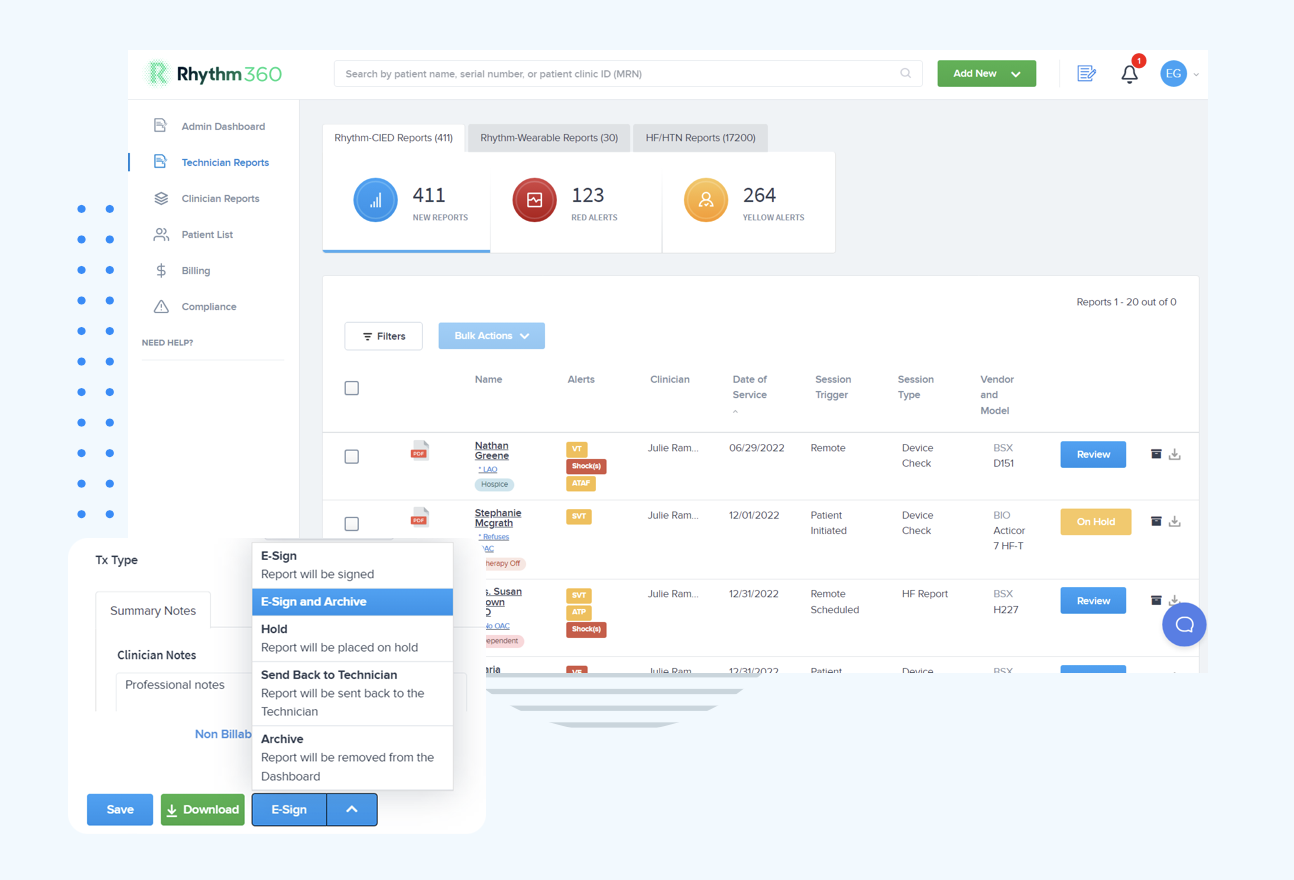
The University of Chicago Medicine (UCM) implemented Rhythm360 to overhaul cardiovascular remote monitoring across its CIED and heart failure populations. UCM now manages over 73,000 reports annually with stable dismissal rates, showing that centralized, vendor-neutral data aggregation scales in high-volume environments.
CIED remote monitoring is billed via CPT codes 93279 to 93299, with 90-day transmission cycles requiring documented evidence of transmission receipt and clinical review. Transmissions received but not billed within the 90-day cycle are lost permanently, and cardiac rehab, CCM, and RPM are the revenue streams most cardiology practices underclaim.
Rhythm360 closes that gap in three connected steps. First, the platform auto-generates compliant reports for routine checks and urgent alerts in near-real time. Second, it attaches time-stamped logs that satisfy audit requirements for codes including 93298 and 99457, capturing staff identity, activity performed, and patient response, the exact standard CMS requires for 99457 and 99458 claims. Third, automated pre-bill scrubbing flags missing modifiers, place-of-service mismatches, and incomplete time logs before submission, cutting into the 15 to 20% telehealth claim denial rates caused by improper coding.
UCM described the result this way: "We have improved billing and accountability for our patients after the integration."
The Medicare Physician Fee Schedule 2026 Final Rule, effective January 1, 2026, introduced two new RPM codes and updated place-of-service and modifier requirements for telehealth E/M services. The Consolidated Appropriations Act, 2026 extended Medicare telehealth flexibilities through December 31, 2027, including the patient's home as an eligible originating site and removal of geographic restrictions.
| CPT Code | Service Description | 2026 Modifier / POS Requirement | Approx. 2026 Medicare Rate |
|---|---|---|---|
| 99202-99205 | New patient office/outpatient E/M (telehealth-eligible) | Modifier -95 (A/V) or -93 (audio-only); POS 02 or POS 10 | Varies by level |
| 99211-99215 | Established patient office/outpatient E/M (telehealth-eligible) | Modifier -95 (A/V) or -93 (audio-only); POS 02 or POS 10 | Varies by level; POS 10 pays non-facility rate (10-25% higher than POS 02) |
| 99453 | RPM device setup and patient education (once per device type per year) | No telehealth modifier required; RPM is a care-management service | ~$22 |
| 99445 (new 2026) | RPM device supply and data transmission, 2-15 days in a 30-day period | Bill either 99445 or 99454 per period, not both | ~$47 |
| 99454 | RPM device supply and data transmission, 16-30 days in a 30-day period | Bill either 99445 or 99454 per period, not both | ~$47 |
| 99457 | RPM treatment management, first 20+ minutes per calendar month | Requires at least one documented interactive communication per month | ~$52 |
| 99458 | RPM treatment management, each additional 20-minute increment | Add-on to 99457; separate time-log entries required | ~$41 |
| 99470 (new 2026) | RPM treatment management, first 10-19 minutes per calendar month | Mutually exclusive with 99457 in the same billing period | ~$26 |
| 93279-93299 | CIED remote monitoring (pacemakers, ICDs, ILRs, CRT devices), 90-day cycles | Requires documented transmission receipt and clinical review within 90-day cycle | Varies by device type and interrogation complexity |
Among these codes, one of the most frequent questions concerns established-patient visits. CPT 99214 is a standard established-patient office/outpatient E/M code, fully eligible for Medicare telehealth billing in cardiology. Medicare requires providers to bill 99202-99215 with POS 02 or POS 10 and the appropriate modifier rather than a separate telehealth-specific code series.
The correct modifier depends on visit modality:
Place-of-service selection directly affects reimbursement. POS 10 pays non-facility rate (10-25% higher than POS 02). Incorrect POS selection is a top cause of telehealth underpayment. Rhythm360's automated documentation workflow captures visit modality at the point of care and maps the correct POS and modifier to each claim before submission.
Billing accuracy solves one problem. Clinician burnout from alert overload is another. High-volume, non-actionable notifications are a primary driver of burnout in cardiology device monitoring. Bureaucratic and administrative work, including excessive EHR screen time, is a key factor behind healthcare professional burnout, and manual alert review adds to that load.
Rhythm360's AI-powered triage engine filters non-actionable transmissions and surfaces clinically significant events, such as new-onset atrial fibrillation, ventricular tachycardia, lead malfunction, and ERI/RRT indicators, in priority order. This cuts critical alert response times by up to 80%. Earlier intervention also affects CPT capture directly. UCM reported being "able to address these issues earlier; rather than waiting for a 3-month visit, we can call patients in for evaluation", generating billable encounters that would otherwise be missed.
Optional 24/7/365 oversight by certified cardiac technicians, supervised by physicians, is available for practices that need around-the-clock coverage. A critical arrhythmia flagged on a Saturday morning gets a clinical response the same day.
Rhythm360 integrates bi-directionally with Epic, Cerner, Athenahealth, eClinicalWorks, Greenway Health, and other EHR systems via HL7, API, and XML. Time logs, communication records, and device data flow directly into the patient chart, satisfying the CMS requirement that RPM platforms enforce EHR integration so documentation flows directly into the patient record to prevent claim denials.
Onboarding, including EHR integration setup, typically takes a few days to a few weeks, not months. The secure, HIPAA-compliant Rhythm360 mobile application lets clinicians review transmissions, sign reports, and coordinate care from any location, removing the need to stay tethered to a specific workstation while on-call.
The table below summarizes how Rhythm360 replaces four of the most error-prone manual workflows with automated, audit-ready processes.
| Workflow Step | Without Rhythm360 | With Rhythm360 | Outcome |
|---|---|---|---|
| Multi-OEM Data Ingestion | Manual logins to separate Medtronic, Boston Scientific, Abbott, and Biotronik portals | Automated ingestion via API, HL7, XML, and computer vision OCR into one dashboard; >99.9% transmissibility | Eliminates portal fatigue; no missed transmissions from OEM server outages |
| Report Generation | Manual transcription and report assembly; hours of staff time per patient | Near-real-time automated report generation with time-stamped audit logs for every transmission | Staff hours redirected to clinical tasks; audit-ready documentation at all times |
| CPT Documentation (93298, 99457, 99445, 99454) | Manual tracking of transmission day counts, management minutes, and modifier selection; high denial risk | Automated CPT capture with pre-bill scrubbing for POS, modifier, and threshold compliance | Significant revenue recovery; reduced claim denial rates |
| EHR Sync | Manual data entry or one-directional exports; documentation gaps cause denials | Bi-directional Epic/Cerner/Athenahealth integration; time logs and device data auto-populate patient charts | Eliminates duplicate entry; satisfies CMS documentation requirements for RPM codes |
Schedule a demo to see how Rhythm360 automates every step of this workflow for your practice.
Cardiology practices can bill a range of CPT codes depending on the service type:
Only one device supply code (99445 or 99454) and one first-increment management code (99470 or 99457) may be billed per patient per 30-day period.
Rhythm360 automatically tracks daily data transmission counts per patient, distinguishing between the 2-15 day window required for 99445 and the 16-30 day window required for 99454. The platform enforces mutual exclusivity between these codes so both are never submitted for the same patient in the same billing period.
For management codes, Rhythm360 logs every minute of clinical staff time with timestamps, staff identity, activity descriptions, and confirmation of at least one interactive communication per calendar month, the documentation standard CMS requires for 99457, 99458, and 99470. Pre-bill scrubbing flags any claim where thresholds are unmet or documentation is incomplete before submission.
Rhythm360's implementation process, including bi-directional EHR integration with Epic, Cerner, Athenahealth, eClinicalWorks, and other systems, typically takes a few days to a few weeks. The platform uses a SaaS-based pricing model that scales with clinic size and usage, so there are no large upfront infrastructure costs. RhythmScience provides guided onboarding support to configure OEM data feeds, alert thresholds, and CPT documentation workflows before go-live.
As noted earlier, practices using Rhythm360 have achieved up to 300% more revenue through optimized CPT code capture, improved staff efficiency, and new RPM service lines for heart failure and hypertension management. The platform targets the most common sources of CIED billing leakage: transmissions that expire within the 90-day billing cycle without documentation, RPM data that falls below threshold due to lack of automated tracking, and management time that gets logged but never converted to a claim because it doesn't reach the billing threshold.
The new 2026 codes 99445 and 99470 also let practices bill for shorter monitoring periods and lower-intensity interactions that previously went uncompensated. Rhythm360 automates eligibility tracking for both codes.
Fragmented OEM portals, manual billing workarounds, and missed CPT thresholds are workflow problems with a defined solution, not inevitable features of cardiology practice management. Rhythm360 consolidates multi-OEM CIED and RPM data into a single vendor-neutral platform, automates compliant documentation for 2026 Medicare telehealth and RPM CPT codes, integrates bi-directionally with major EHR systems, and delivers the AI-powered alert triage described in Section 5. Practices that have implemented Rhythm360 have recovered the revenue gains detailed above and eliminated the administrative overload that drives device technician burnout.
The 2026 CPT landscape, with new codes 99445 and 99470, updated POS and modifier requirements, and stricter documentation standards, makes automated, audit-ready billing infrastructure more important than ever for cardiology practices managing large CIED and RPM populations.





