Last updated: July 14, 2026
The EHR itself is rarely the bottleneck in cardiology workflows. The real gap is the absence of a purpose-built layer connecting device data to the EHR in both directions. Remote cardiac monitoring platforms create system fragmentation because each third-party device vendor requires its own separate login and workflow. Clinicians end up managing multiple disconnected portals no matter which EHR the practice uses.
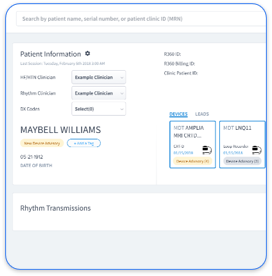
Rhythm360 offers deep, bidirectional integrations with Epic, Cerner, Athenahealth, eClinicalWorks, Greenway Health, and others via HL7. Instead of batch-syncing cached snapshots, modern API-driven EHR integration using FHIR requests current patient context the moment a report opens. This surfaces up-to-date medications, diagnoses, and recent hospitalizations. Rhythm360's vendor-neutral ingestion layer normalizes data from Medtronic, Boston Scientific, Abbott, Biotronik, and others via API, HL7, XML, and PDF parsing through computer vision. The EHR of record receives one reconciled data stream instead of siloed OEM exports.
At the University of Chicago Medicine (UCM), implementing Rhythm360 enabled clinicians to review more transmissions daily and identify more abnormalities. Gaurav A. Upadhyay, MD, noted: "We have improved billing and accountability for our patients after the integration."
See how bidirectional EHR integration works in your environment. Schedule a Rhythm360 walkthrough.
The 2026 Medicare Physician Fee Schedule Final Rule added two new RPM CPT codes and finalized national average non-facility outpatient payment rates. The finalized 2026 national average non-facility outpatient payments are:
Practices also bill cardiac-specific codes for CIED remote monitoring. Standard RPM billing using 99454 plus 99457 generates approximately $104 per patient per month, while full billing with extended management can reach approximately $245 per month. The new lower-threshold codes 99445 and 99470 add roughly $78 per month for lower-engagement patients who previously generated no billable activity at all.
Medicare's rules also shape who can deliver these services and where. Medicare treats RPM as a care-management service rather than telehealth, so it is not subject to geographic or originating-site restrictions. The Consolidated Appropriations Act, 2026 extended telehealth flexibilities through December 31, 2027. CMS 2026 guidance also permits RPM treatment management services to be performed by auxiliary staff under general supervision, removing the requirement for the supervising physician to be physically present.
Capturing this revenue depends on tracking every billable event correctly. Rhythm360's automated CPT code capture and documentation tracks billable events across 93298, 93299, 99453, 99454, 99445, 99457, 99458, and 99470, so no qualifying transmission goes unbilled.
Capturing this revenue is only half the picture. The other half is whether RPM programs pay for themselves once staffing and service costs are factored in. Studies comparing remote monitoring to standard in-office care for CIED patients show reductions in cardiovascular hospitalizations and net savings for payers and hospitals after offsetting service fees and staffing costs.
Practices implementing Rhythm360 have reported a 300% increase in revenue generation through optimized CPT code capture, improved staff efficiency, and new RPM service lines for heart failure and hypertension management. Disconnected cardiology systems can produce a claim submission lag of three to seven days, which has a real impact on monthly cash flow for practices of every size.
The most consistently cited disadvantage of remote patient monitoring is alert fatigue. Across studied hospital settings, 80–99% of clinical alarms are false or clinically insignificant, with critical-care monitoring reaching up to 90% false positives. Device clinics process large volumes of transmissions each year, and many generate alerts with no clinical relevance.
This volume of noise wears down clinical vigilance. Alarm burden produces a measurable reduction in staff vigilance, with the most dangerous outcome being conditioned inattention, where clinicians assume alarms are unlikely to be life-threatening after repeated non-actionable events. This conditioned inattention has real consequences. The US FDA's MAUDE database recorded 566 reports of alarm-related patient deaths between January 2005 and June 2010, which shows that filtering non-actionable alerts is a patient-safety issue, not just an efficiency one.
Multi-portal login compounds the problem. When staff must access separate Medtronic, Boston Scientific, Abbott, and Biotronik portals to triage one patient population, cognitive load multiplies and critical events are more likely to be delayed or missed.
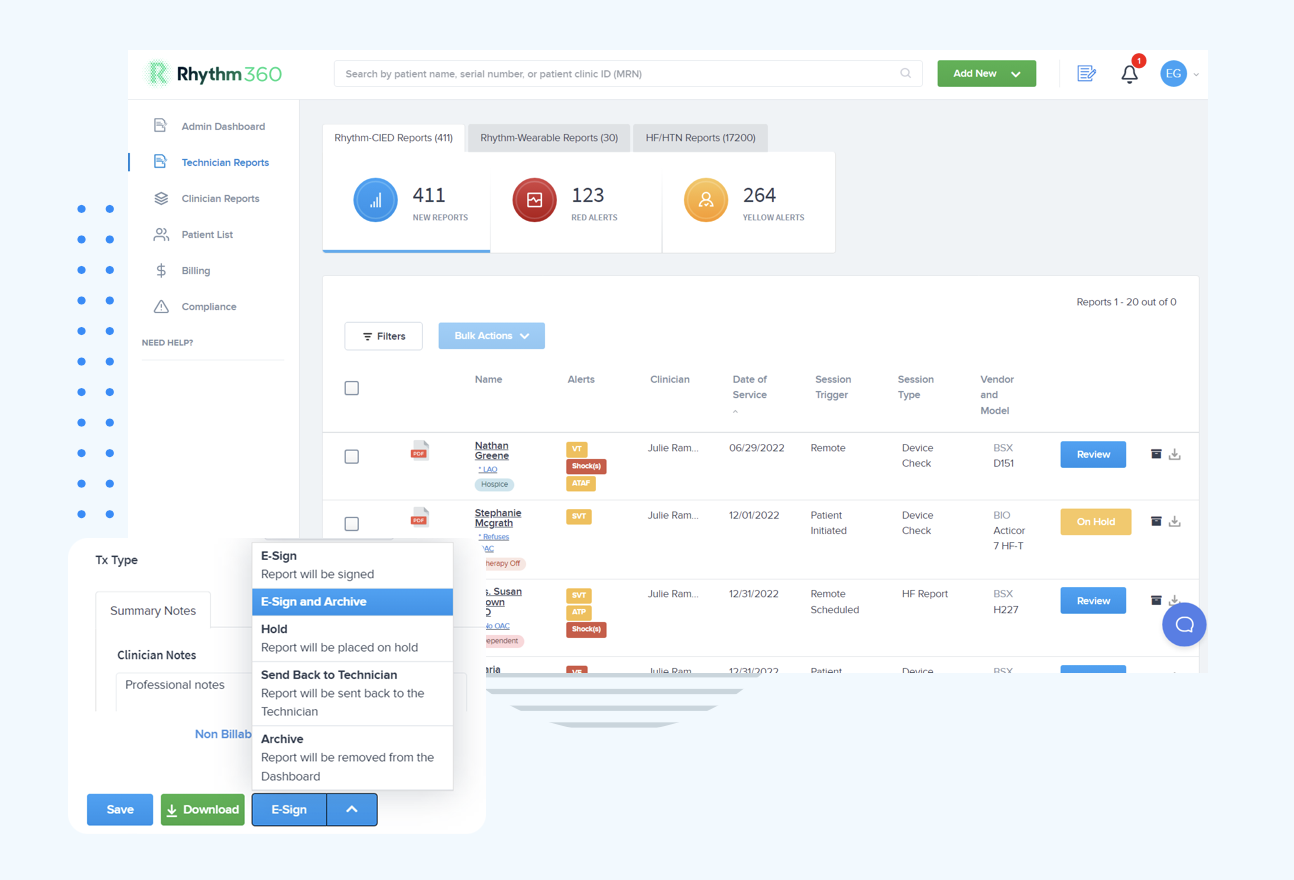
Rhythm360 addresses this through AI-powered alert triage that filters non-actionable noise and prioritizes clinically significant events, reducing critical response times by up to 80% while maintaining greater than 99.9% data reliability (see Section 6 for platform architecture details). All device data from all OEMs flows into a single dashboard, eliminating redundant logins. An optional 24/7/365 oversight layer staffed by certified cardiac technicians (CCTs) provides an additional triage tier for high-volume practices.
Andrew Beaser, MD, Associate Professor of Medicine at UCM, observed: "Decision support, including AI-assisted decision support, will become increasingly important as data volumes grow."
Cardiology practices vary in device population size, staffing models, and EHR infrastructure, but Rhythm360's core architecture stays the same across all of them. The platform adjusts configuration, onboarding speed, and oversight level to match practice size rather than gating features behind pricing tiers. The table below shows how each profile maps to that configuration.
| Practice Type | Core Challenge | Key Requirement | Rhythm360 Fit |
|---|---|---|---|
| Solo Practitioner / Small EP Clinic | High overhead and low margins from manual billing and data re-entry | Automated CPT capture, minimal IT overhead, fast onboarding | SaaS pricing scales with clinic size; onboarding in days to weeks; automated billing documentation for 99453, 99454, 99445, 99457, 99458, 93298, 93299 |
| Mid-Size EP Clinic | Multiple OEM portals requiring separate logins and fragmented workflows | Vendor-neutral data ingestion, bidirectional EHR integration, AI alert triage | Single dashboard consolidating all OEM data; bidirectional Epic/Cerner/Athenahealth integration; AI triage reducing alert fatigue by up to 80% |
| Large Integrated Health System | Managing 73,000+ reports annually with stable dismissal rates across multiple service lines | Scalable infrastructure, redundant data feeds, CCT oversight, multi-service-line support | Redundant data feeds ensuring >99.9% transmissibility; optional 24/7/365 CCT oversight; integrated CIED and HF/HTN service lines in one platform |
Talk to Rhythm360 about which configuration fits your practice size and staffing model.
Rhythm360's architecture is built to close the technical and clinical gaps that fragmented systems leave open. Core platform capabilities include:
UCM reviewed more than 73,000 reports annually through Rhythm360 in calendar year 2025, averaging more than 18,000 reports per quarter. Andrew Beaser, MD, noted: "We are able to address these issues earlier; rather than waiting for a 3-month visit, we can call patients in for evaluation."
Practice administrators commonly raise three concerns before implementing new monitoring software: disruption to clinical workflows, EHR integration complexity, and staff retraining time. Staff resistance to new workflows slows RPM-EHR integration adoption, but targeted training that demonstrates reduced manual entry and improved patient outcomes increases acceptance. Integrations that interrupt clinical workflows or add provider burden face resistance from clinicians regardless of technical success.
Rhythm360's implementation process is designed to minimize disruption. Onboarding typically runs from a few days to a few weeks, depending on EHR environment and practice size. The five steps are:
The Consolidated Appropriations Act, 2026 extended major Medicare telehealth flexibilities through December 31, 2027, including the patient's home as an originating site and removal of geographic restrictions. CMS also expanded RPM eligibility in 2026 to patients with a single chronic condition and introduced two new CPT codes, 99445 and 99470, that lower data transmission and management time thresholds. These changes reflect a sustained CMS policy direction toward reimbursing continuous remote monitoring rather than episodic in-office care.
Individual OEM portals transmit data only from their own devices and are subject to server outages that can create gaps in monitoring coverage. Rhythm360 solves both problems with a redundant data feed system that acts as a fail-safe when an OEM server is unavailable, plus AI-powered data normalization that ingests API, HL7, XML, and unstructured PDF data using computer vision to fill gaps and cross-reference data fidelity. This architecture achieves greater than 99.9% transmissibility across mixed device fleets, a level individual OEM portals cannot match for practices managing multiple device manufacturers.
Rhythm360 tracks billable events and generates compliant documentation for the full set of remote cardiac monitoring and RPM CPT codes. This includes 93298 and 93299 for CIED remote monitoring, and 99453, 99454, 99445, 99457, 99458, and 99470 for remote physiological monitoring. The platform's administrative dashboard shows captured and potential revenue in real time, letting billing teams recover missed charges without manual chart review.
Fragmented OEM portals, manual billing workflows, and disconnected EHR environments are not inevitable features of cardiology practice. They are solvable problems. A unified, vendor-neutral platform that consolidates CIED and chronic-condition monitoring, automates CPT documentation, and integrates bidirectionally with the practice's EHR removes the alert fatigue, revenue leakage, and staff burnout that fragmented systems create. The 2026 Medicare Physician Fee Schedule expanded the billable patient population and added new codes that reward practices with the infrastructure to capture them. Rhythm360 delivers that infrastructure at every practice size, from solo EP clinics to large integrated health systems managing tens of thousands of annual reports.
Request a Rhythm360 demo and see the platform run against your own patient data.