Last updated: July 13, 2026
Four capabilities separate purpose-built heart failure remote monitoring platforms from legacy or single-OEM tools.
Together, these four capabilities form the technical foundation of a production-grade monitoring program. Rhythm360 delivers all four within a single HIPAA-compliant, cloud-based platform that serves practices from solo electrophysiologists to large integrated health systems.
The 2026 environment for heart failure remote monitoring reflects four converging forces: a growing CIED implant population, rising expectations for EHR interoperability, tighter CMS billing requirements, and a strong clinical evidence base supporting remote monitoring at scale.
Recent meta-analyses of randomized trials show that remote monitoring can reduce heart failure hospitalizations and all-cause mortality. Separately, CardioMEMS pulmonary artery pressure monitoring reduced heart failure hospitalizations by approximately 44% relative to usual care.
On the technology side, cardiovascular leaders at a 2026 Becker’s Healthcare webinar highlighted infrastructure, governance, protocols, and a shift from episodic monitoring to longitudinal value as priorities for the next five years. Several platforms now compete in this space. Care teams and administrators should evaluate how completely each option covers the full cycle of consolidation, triage, and billing automation.
A production-grade heart failure remote monitoring workflow moves through four stages: data ingestion, alert triage, clinical reporting, and billing documentation.
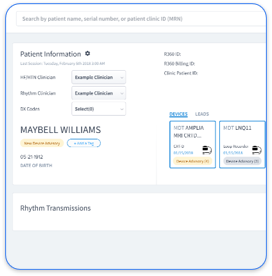
Data ingestion forms the base of the workflow. Rhythm360 ingests data via APIs, HL7, XML, and unstructured PDFs using computer vision (OCR) and AI-powered extrapolation. A redundant data feed system acts as a fail-safe when an OEM server is unavailable and maintains the >99.9% transmissibility rate described earlier across the patient population. When remote monitoring data sits in disconnected manufacturer portals or as PDFs and free text, extracting clinically useful information becomes slower, harder, and more resource-intensive as volumes grow. Rhythm360’s multi-format ingestion architecture directly addresses this constraint.
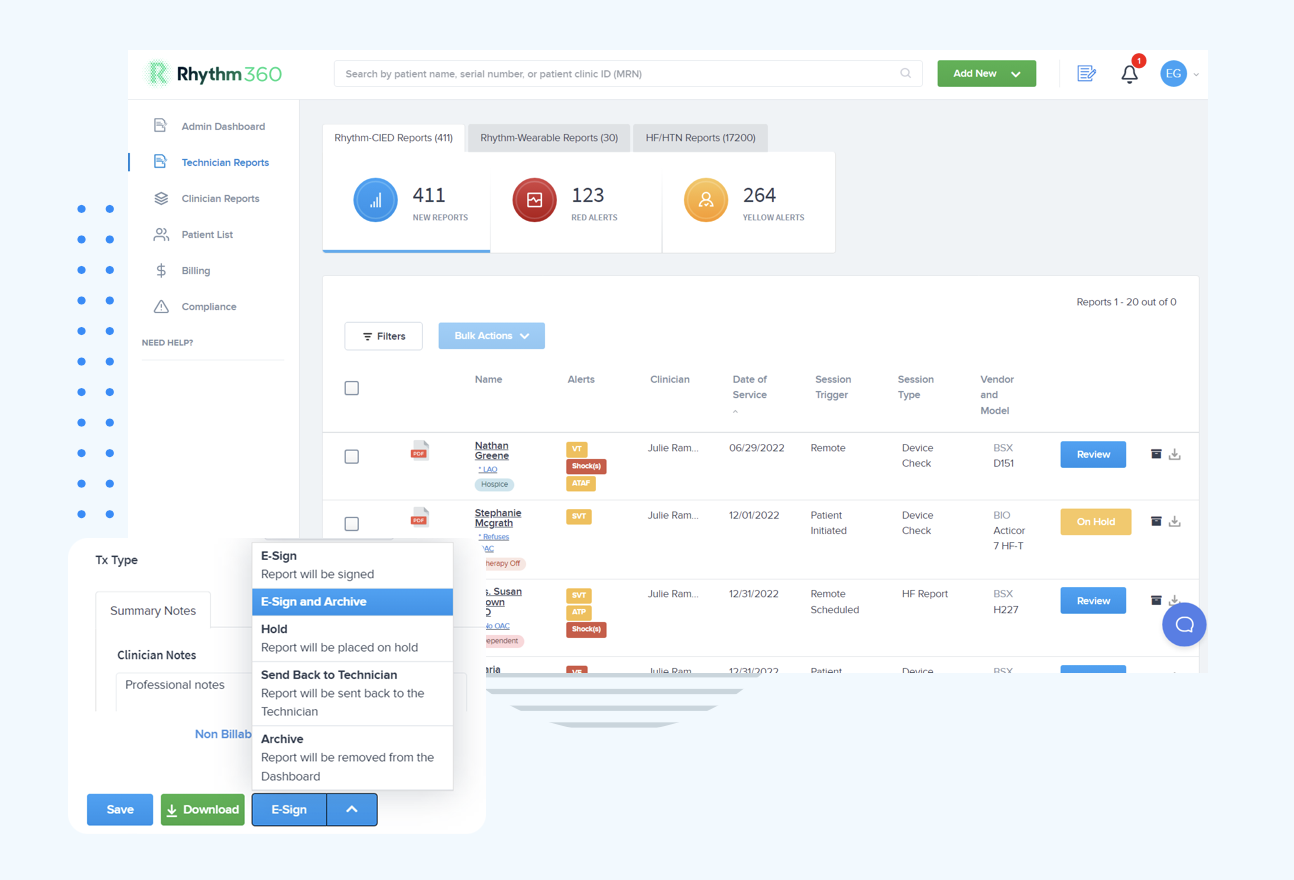
Alert triage uses AI to filter non-actionable transmissions and prioritize events such as new-onset atrial fibrillation, ventricular tachycardia, lead malfunction, and significant weight gain in heart failure patients. Practices managing high-acuity populations still need rapid human judgment on filtered alerts, so optional 24/7/365 oversight by certified cardiac technicians (CCTs) supervised by physicians adds a human review layer for these programs.
After alerts are triaged and reviewed, reporting is generated in near-real time. Bidirectional EHR integration ensures findings populate discrete clinical fields instead of requiring manual entry. Cardiovascular service line leaders identify building discrete fields in Epic for heart failure metrics so device data lands in clinical workflows like lab results as the path forward for remote monitoring.
Billing documentation runs in the background throughout the workflow. The platform tracks transmission days, management minutes, and required interpretation notes against applicable CPT code thresholds in real time.
Practices evaluating heart failure remote monitoring platforms face three strategic trade-offs that shape long-term outcomes.
Centralization vs. distributed monitoring. Centralizing CIED and heart failure monitoring into a single platform reduces per-transmission labor costs and creates a consistent alert response protocol. The trade-off involves upfront workflow redesign and clear ownership of triage responsibilities. Successful RPM programs route the right data to the right person at the right time, with dashboards that surface actionable data, thresholds that reduce noise, assigned triage responsibilities, and defined escalation protocols.
Staffing models. Structural gaps in remote patient monitoring disproportionately affect smaller practices that lack capacity to dedicate nursing staff or build separate care teams. Rhythm360’s optional CCT oversight layer allows practices without dedicated device technicians to maintain clinical coverage without adding headcount.
Integration complexity. Many SaaS RPM platforms provide only outbound FHIR R4 exports. True bidirectional EHR integration, where care plans, medication changes, and discharge summaries inform monitoring logic in real time, requires deeper architectural access than many vendors expose. Rhythm360’s bidirectional integrations with Epic, Cerner, Athenahealth, eClinicalWorks, and Greenway Health meet this standard.
Implementation success depends on four readiness factors assessed before go-live.
Common pitfalls include unclear alert ownership, which leaves events acknowledged by no one, and poor alert threshold design, which recreates alert fatigue. Weak billing documentation practices can also carry over from manual to automated workflows. A dashboard generating 20 alerts per clinician per day where 18 are not actionable will be ignored within two weeks, so AI-powered triage configuration becomes a critical implementation step rather than an afterthought.
A structured measurement framework across four domains helps practices quantify the return on their platform investment.
| Capability | How It Works | Quantified Outcome | Supporting Evidence |
|---|---|---|---|
| Vendor-neutral data consolidation | Ingests API, HL7, XML, and PDF data from all major OEMs using computer vision and AI normalization. Redundant feeds maintain continuity when OEM servers are unavailable. | >99.9% transmissibility across the monitored patient population | University of Chicago Medicine reviewed more than 73,000 reports annually through Rhythm360, averaging more than 18,000 reports per quarter |
| AI-powered alert triage | Filters non-actionable transmissions, prioritizes ventricular arrhythmias, lead malfunctions, AFib onset, and HF decompensation signals, and offers an optional 24/7 CCT oversight layer. | Up to 80% reduction in critical alert response times | RhythmScience client outcomes; UCM clinicians reported the ability to address issues earlier rather than waiting for 3-month visits |
| Bidirectional EHR integration | Connects to Epic, Cerner, Athenahealth, eClinicalWorks, Greenway Health, and others via HL7. Data flows in both directions so device findings populate clinical workflows without manual entry. | Elimination of redundant manual transcription and implementation in days to weeks | UCM noted improved billing and accountability for patients after integration |
| Automated CPT billing documentation | Tracks transmission days, management minutes, and interpretation notes against 93294–93298, 99453, 99454, 99445, 99457, 99458, and 99470 thresholds in real time and generates audit-ready documentation. | Up to 300% revenue increase, as noted in the key takeaways | RhythmScience client outcomes; automated tracking of rolling transmission windows prevents denials by flagging shortfalls on day 21 and prompting patient outreach |
Private groups of 5–20 physicians. These practices need a platform that removes OEM portal fragmentation, automates billing documentation without a dedicated RCM team, and scales without relying on a single “super-user.” Rhythm360 fits these needs. Its SaaS pricing scales with practice size, onboarding completes in days to weeks, and the administrative dashboard provides a real-time view of compliance, alerts, and billable activity without additional headcount. The structural gaps noted earlier, where smaller practices lack dedicated monitoring staff, make Rhythm360’s optional CCT oversight especially valuable.
EP-heavy clinics. Electrophysiology-intensive practices managing high volumes of ICD, CRT, and implantable loop recorder patients require near-real-time alert triage, reliable transmissibility across all device families, and CPT documentation that captures the full 93294–93298 code set. Rhythm360’s AI triage engine and the transmissibility rate validated at the scale of the University of Chicago Medicine’s 73,000+ annual reports make it a strong option for EP-heavy environments. UCM’s implementation enabled clinicians to review more transmissions daily and identify more abnormalities.
Advanced heart failure programs. Programs managing CardioMEMS, wearable sensors, and multi-condition chronic disease populations alongside CIEDs need a platform that combines physiological monitoring data with device data in a single workspace. Rhythm360’s integrated HF and HTN RPM service line, covering CPT codes 99453, 99454, 99445, 99457, 99458, and 99470, provides this unified workspace alongside CIED monitoring and supports both the clinical and billing complexity of advanced heart failure programs.
Schedule a demo tailored to your practice type and patient volume.
The most consistently documented disadvantage of remote patient monitoring is alert fatigue. When platforms apply population-level alert thresholds instead of per-patient clinical logic, non-actionable notifications overwhelm clinical staff. Research shows that most clinical alarms are false or clinically insignificant, and clinicians who receive dozens of low-value alerts per shift begin to ignore notifications, including rare true critical events.
Integration complexity creates a second disadvantage. Practices that adopt platforms without true bidirectional EHR connectivity find that clinicians must manually transfer readings and care notes between systems, which reduces adoption and recreates data fragmentation. Rhythm360 addresses both disadvantages through AI-powered alert triage that filters non-actionable transmissions before they reach clinical staff and through bidirectional EHR integrations that remove manual data transfer.
Several developments define the 2026 heart failure landscape. Recent meta-analyses of randomized trials show that remote monitoring can reduce heart failure hospitalizations and all-cause mortality, which supports broad remote monitoring adoption at the population level. On the technology side, deep learning models using consumer wearable data now detect clinically meaningful declines in functional capacity a median of seven days before unplanned healthcare utilization events.
CMS introduced two new CPT codes, 99445 and 99470, that expand reimbursement eligibility to patients transmitting data for as few as two days per month and to shorter care management interactions. These changes remove the all-or-nothing billing cliff that previously excluded patients with variable adherence. Bidirectional EHR integration and AI-powered alert filtering have shifted from differentiators to baseline expectations among cardiovascular service line leaders evaluating remote monitoring infrastructure.
Five features carry the most weight in a 2026 evaluation. First, vendor neutrality ensures that a platform ingests data from every OEM a practice uses, not just a preferred manufacturer’s devices. Second, reliable transmissibility prevents data gaps caused by OEM server outages or PDF-only transmission formats, which otherwise translate to missed clinical events and unbillable periods. Redundant data feeds and AI-powered normalization address this risk.
Third, AI-powered alert triage with per-patient threshold calibration avoids the population-level thresholds that create alert fatigue. Fourth, true bidirectional EHR integration prevents outbound-only exports from forcing manual reconciliation and eroding clinical adoption. Fifth, automated CPT documentation with real-time tracking of transmission days and management minutes supports audit readiness. Given the OIG’s active audit focus on 99454 and 99457 documentation, practices need a system that flags compliance shortfalls before claims go out.
Heart failure remote monitoring billing in 2026 draws from two code sets, depending on the monitoring modality. For CIED-based monitoring, the primary codes are 93294 for physician interpretation of pacemakers, 93295 for physician interpretation of ICD and CRT-D devices, 93296 for the technical component billed with 93294 or 93295, and 93297 for implantable loop recorder transmissions. Each code requires a minimum 30-day monitoring period per calendar year before billing, except 93297. The 93296 technical component RVU increased approximately 60% on January 1, 2026, which improves the economics of CIED monitoring programs that track the 90-day billing window automatically.
For physiological remote monitoring of heart failure patients using connected weight scales, blood pressure monitors, and similar devices, the 2026 code set includes 99453 for one-time setup and patient education, 99454 for device supply with 16 or more days of data in a 30-day period at approximately $47 reimbursement, and 99445 for device supply with 2–15 days at approximately $47 reimbursement. Code 99457 covers the first 20 minutes of care management per month, requires at least one synchronous patient interaction, and reimburses approximately $52. Code 99458 covers each additional 20 minutes as an add-on to 99457 at approximately $41, and 99470 covers the first 10 minutes of care management at approximately $26.
Practices must bill either 99445 or 99454 in a given month, never both, and either 99470 or 99457 for the first management block. Automated tracking of transmission days and management minutes remains essential for audit readiness given the OIG’s active review of Medicare Part B RPM billing.
The evaluation framework for heart failure remote monitoring in 2026 remains clear. Vendor neutrality, AI-powered alert triage, and automated CPT billing documentation function as core operational requirements. These capabilities determine whether a monitoring program improves patient outcomes, supports clinical staff, and captures the revenue it generates.
Fragmented OEM portals and manual workflows create alert fatigue, missed critical events, and billing leakage that compound over time. University of Chicago Medicine’s implementation of Rhythm360 shows what a unified, vendor-neutral platform can achieve at scale: more than 73,000 reports reviewed annually, earlier clinical interventions, and improved billing accountability. For private groups, EP-heavy clinics, and advanced heart failure programs, Rhythm360 delivers the consolidation, triage intelligence, and billing automation that 2026 practice economics require.