Last updated: July 13, 2026
Fragmented multi-portal workflows slow teams down and increase clinical risk. The Heart Rhythm Society's white paper on CIED data interoperability confirms that each manufacturer has developed proprietary nomenclature, technical standards, and communication protocols to describe similar, if not identical, device features and functionalities. These differences create persistent interoperability barriers for clinicians. The same white paper also notes that the growing number of CIED patients generates an exponential volume of data that must be sorted, interpreted, acted on, and stored, which manual, multi-portal workflows cannot sustain.
In a fragmented workflow, a device technician starts the morning by logging into the Medtronic CareLink portal, then Boston Scientific's Latitude, then Abbott's Merlin.net, and then Biotronik's Home Monitoring portal. Each system surfaces data in a different format. Alerts from one portal have no visibility in another. Reconciling a single patient's status across vendors can consume 20–30 minutes of staff time. Billing documentation must be assembled manually from multiple sources, and transmission periods are tracked in spreadsheets or not tracked at all.
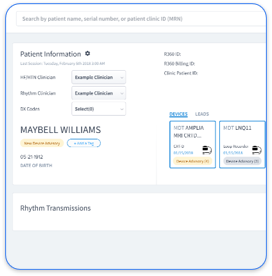
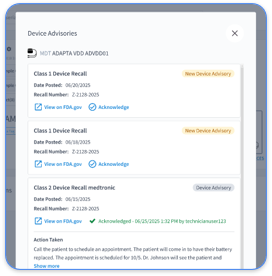
In the Rhythm360 workflow, a single login surfaces every patient across every device manufacturer. Alerts are AI-triaged and prioritized by clinical urgency. Billing documentation is generated automatically. The technician's morning begins with a prioritized worklist, not a series of browser tabs.
Andrew Beaser, MD, Associate Professor of Medicine at the University of Chicago Medicine (UCM), described pre-implementation workflows as “a major challenge and incredibly difficult.” Gaurav A. Upadhyay, MD, FACC, FHRS, Professor of Medicine and Director of the Pacing & Defibrillation Device Clinic at UCM, added: “Staffing was always an issue for our center, because our device clinic, like many other medical centers, had struggled with technician turnover and timely weekend coverage.”
Given these operational challenges, practices evaluating solutions to portal fatigue should focus on capabilities that directly address fragmentation, staffing burden, and revenue leakage. When evaluating a multi-vendor cardiac device management platform, cardiology administrators and electrophysiologists should assess the following capabilities:
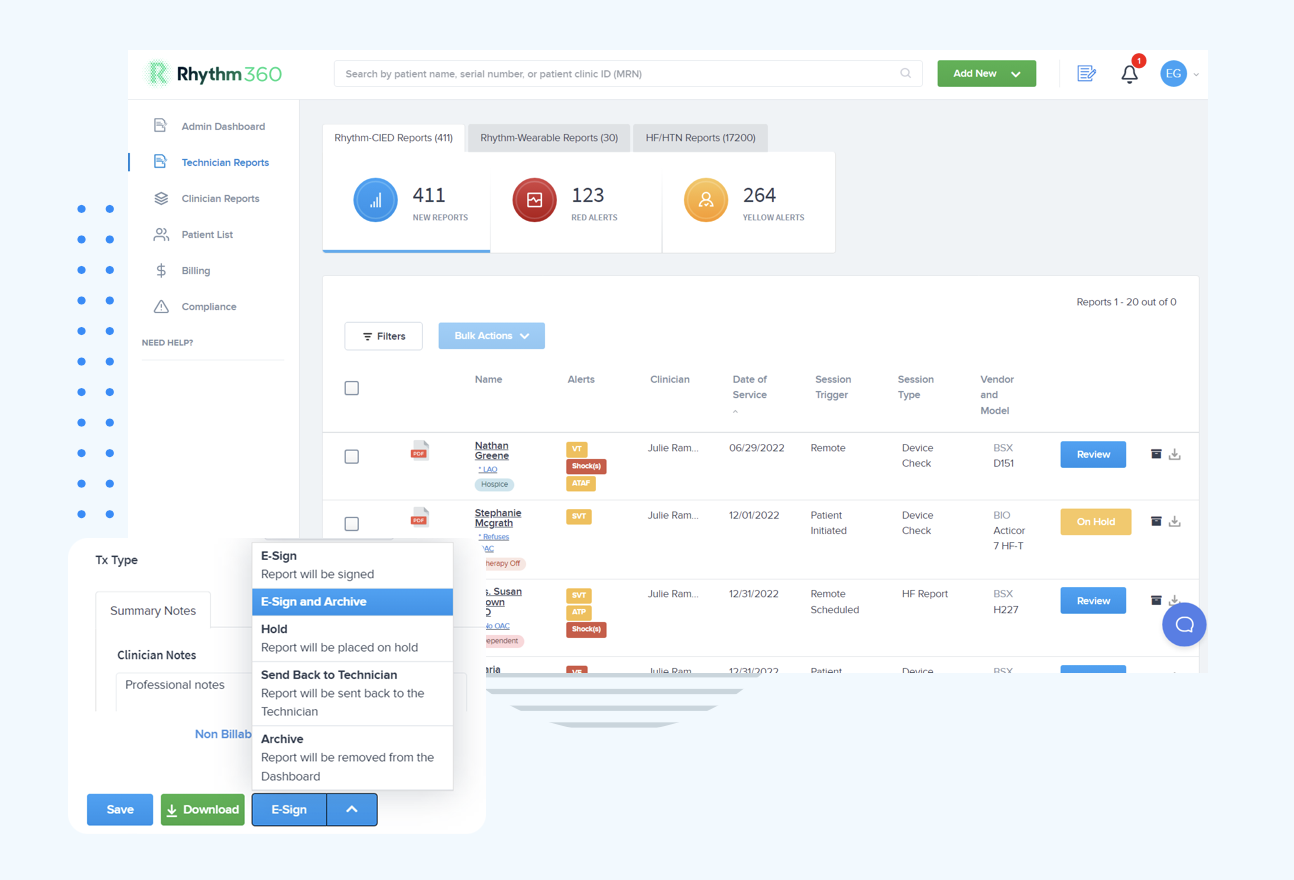
Rhythm360 presents clinicians and administrators with a single, structured workspace organized around four core views: patient list, compliance metrics, prioritized alerts, and revenue tracking. The table below outlines the Rhythm360 workflow from data ingestion to billing documentation.
| Step | Rhythm360 Action | Output | Time Frame |
|---|---|---|---|
| 1. Data Ingestion | Redundant feeds via API, HL7, XML, and computer vision PDF parsing ingest data from all OEM portals automatically | Normalized, unified patient record across all device manufacturers | Near real-time |
| 2. AI Alert Triage | AI engine classifies transmissions by clinical urgency, filters non-actionable alerts, and surfaces critical events (AFib, VT, lead malfunction) at the top of the worklist | Prioritized alert queue with clinically actionable notifications | Near real-time |
| 3. Clinical Review & Response | Clinician reviews prioritized alert, accesses full device history, and coordinates care via integrated communication hub or mobile app | Documented clinical action; UCM clinicians reported addressing issues earlier rather than waiting for 3-month visits | Same day for critical alerts, up to 80% faster than fragmented workflows |
| 4. Automated CPT Documentation | Platform auto-generates billing-ready documentation for applicable CPT codes (93294, 93295, 93296, 93297, 93298, 99454, 99457, 99458) and pushes records to the EHR via bi-directional integration | Compliant, audit-ready billing documentation; automated workflows push CPT 99457 capture above 90% of eligible patient-months | Automated at point of transmission review |
Reliable clinical decisions require complete and timely data. Rhythm360 achieves greater than 99.9% transmissibility through a multi-layered ingestion architecture. The platform connects to OEM data sources via device-native APIs, HL7 feeds, and XML streams. For data delivered in unstructured PDF format, a common output from legacy OEM portals, Rhythm360 applies computer vision and optical character recognition to extract and normalize clinical data.
A redundant data feed system acts as a fail-safe when an OEM server experiences downtime. AI-powered gap-filling algorithms identify missing transmission windows and flag connectivity issues before they become clinical blind spots. The result is a data layer that addresses the core interoperability challenge identified by HRS: the inability of standalone products to reliably unlock data from proprietary formats across vendors.
As Andrew Beaser, MD, at UCM observed: “Decision support, including AI-assisted decision support, will become increasingly important as data volumes grow.”
Rhythm360 delivers the measurable improvements outlined above across both clinical and financial dimensions, primarily through optimized CPT code capture and the addition of RPM service lines for heart failure and hypertension management. These improvements show up in both daily workflows and quarterly financial reports.
The University of Chicago Medicine case provides the most detailed public benchmark available. UCM reviewed more than 73,000 reports annually through Rhythm360 in calendar year 2025, averaging more than 18,000 reports per quarter, a volume that would be operationally impossible to sustain across fragmented OEM portals with manual workflows.
Gaurav A. Upadhyay, MD, at UCM stated: “We have improved billing and accountability for our patients after the integration.” On the clinical side, Andrew Beaser, MD, explained: “We are able to address these issues earlier; rather than waiting for a 3-month visit, we can call patients in for evaluation.”
The financial case is equally concrete. A cardiology practice managing 200 CIED patients can capture $80,000–$120,000 in annual recurring revenue from properly billed remote monitoring under CPT 93294, 93295, and 93298. Beyond these baseline CIED codes, automated billing workflows unlock additional revenue streams by improving capture of RPM codes such as 99457, 99458, and 99454, which manual processes often miss. The cumulative effect of automating both CIED and RPM billing windows can substantially increase total revenue for CIED monitoring programs.
Rhythm360's onboarding process minimizes disruption while moving clinics to value quickly. EHR integration, including bi-directional connections to Epic, Cerner, Athenahealth, eClinicalWorks, and Greenway Health, is completed in a few days to a few weeks depending on the complexity of the existing IT environment. Staff training runs in parallel, and the platform's SaaS architecture removes the infrastructure provisioning delays associated with on-premise systems.
This implementation timeline contrasts sharply with the months-long deployment cycles common in enterprise health IT. Practices can begin reviewing unified transmissions and generating automated CPT documentation within weeks of signing, not quarters.
Rhythm360 meets the security and compliance requirements of cardiology practices operating under HIPAA. The platform's compliance posture includes the following controls:
Rhythm360 scales across the full spectrum of cardiology practice sizes and device volumes. Solo electrophysiologists and small group practices benefit from the elimination of manual portal management and the immediate revenue capture improvements from automated CPT documentation. Mid-size EP clinics that manage hundreds of CIED patients gain the most from AI-driven alert triage and bi-directional EHR integration, which reduce staff hours and remove the dependency on a single “super-user.” Large integrated health systems, such as UCM, which operates at the scale described earlier, rely on Rhythm360's scalable data infrastructure and optional 24/7/365 oversight by certified cardiac technicians (CCTs) supervised by physicians.
Other platforms in the cardiac device management space address portions of the remote monitoring workflow. The key evaluation task for any practice is to confirm whether a given solution delivers vendor-neutral data ingestion, AI-powered triage, bi-directional EHR integration, automated CPT documentation, and mobile access within a single, unified environment.
Schedule a demo to see how Rhythm360 maps to your clinic's device volume and workflow requirements.
Rhythm360 ingests data from all major CIED manufacturers, including Medtronic, Boston Scientific, Abbott, and Biotronik, using a combination of device-native APIs, HL7 feeds, XML streams, and computer vision-based PDF parsing. Each data source is normalized into a canonical patient record within the platform. A redundant feed architecture ensures that if one OEM's server experiences downtime, data continuity is maintained. AI-powered gap-filling algorithms identify missing transmission windows and flag connectivity issues proactively. The result is a single, unified patient view with greater than 99.9% transmissibility, regardless of which manufacturer implanted the device.
Rhythm360 supports automated documentation and billing capture for the full range of cardiac remote monitoring CPT codes. For implantable pacemakers and ICDs, the platform tracks 90-day monitoring periods and generates documentation for CPT 93294 (pacemaker remote interrogation), 93295 (ICD remote interrogation), and 93296 (technical component for remote monitoring infrastructure). For implantable loop recorders, the platform supports CPT 93297 and 93298, including the updated 2026 Medicare minimum monitoring period for shorter windows. For remote physiological monitoring programs covering heart failure and hypertension patients, Rhythm360 automates documentation for CPT 99454, 99457, and 99458, tracking the 16-day transmission threshold and 20-minute time requirements that are the primary focus of current OIG audit activity. The platform also supports the newer short-period RPM codes 99445 and 99470 for patients who do not meet traditional monthly thresholds.
Most practices begin seeing measurable improvements in alert response times within the first weeks of going live on Rhythm360. The AI-powered triage engine immediately starts filtering non-actionable transmissions and surfacing clinically significant events, such as new-onset AFib, ventricular tachycardia, lead malfunction, and ERI/RRT indicators. The 80% reduction in critical alert response times reflects the combined effect of eliminating manual portal navigation, automating transmission review queues, and enabling mobile access so clinicians can act on critical alerts outside of office hours. Practices with optional 24/7/365 CCT oversight see the fastest response time improvements, particularly for weekend and after-hours events.
Rhythm360 offers bi-directional integration with Epic, Cerner, Athenahealth, eClinicalWorks, Greenway Health, and other EHR systems via HL7. Bi-directional in this context means data flows in both directions. Device transmission data and clinical documentation push from Rhythm360 into the EHR, while patient demographic and scheduling data pull from the EHR into Rhythm360. This approach eliminates manual data transcription, reduces the risk of documentation errors, and keeps the EHR aligned with the most current device status and clinical actions. Integration setup is completed as part of the standard onboarding process, typically within a few days to a few weeks depending on the EHR environment's configuration requirements.
Fragmented OEM portals are a structural source of clinical risk and financial loss, not a minor inconvenience. The administrative burden of managing separate Medtronic, Boston Scientific, Abbott, and Biotronik portals consumes staff hours that should be directed at patient care. Manual alert triage creates conditions for missed critical events. Incomplete CPT documentation leaves substantial recurring revenue uncaptured, with a correctly documented CIED and RPM workflow generating more than $3,000 per complex patient per year when all applicable codes are tracked automatically.
Rhythm360 resolves each of these problems within a single, vendor-neutral, AI-powered platform. The University of Chicago Medicine's experience, delivering earlier clinical interventions and improved billing accountability at the volume benchmarks established earlier, demonstrates what a unified dashboard for managing multi-vendor cardiac devices delivers at scale. Gaurav A. Upadhyay, MD, at UCM summarized the integrated value: “That was a big piece for us, to have an integrated review of data from trained personnel.”
Cardiology practices and EP clinics that want to move from portal fatigue to a single source of truth can adopt Rhythm360 on a timeline measured in days to weeks. Clinical and financial impact begins as soon as unified transmissions and automated billing workflows go live.
Schedule a demo and see Rhythm360's unified dashboard in action.