Last updated: July 14, 2026
Legacy CIED database systems were built as storage repositories, not real-time monitoring hubs. They can't ingest multi-vendor data streams, apply AI triage logic, or generate compliant billing documentation on their own. That gap is why cloud-based, vendor-neutral platforms have taken over in 2026.
Several platforms now compete in this space. For practice administrators, the real question isn't which platform exists. It's which one can prove its architecture and outcomes at scale.
University of Chicago Medicine (UCM) reviewed more than 73,000 reports annually through Rhythm360 in 2025, averaging over 18,000 reports per quarter. That volume shows the scale a unified platform needs to handle in a high-acuity academic setting. Andrew Beaser, MD, Associate Professor of Medicine at UCM, described pre-implementation workflows as "a major challenge and incredibly difficult."
Platforms also need to bridge two data standards. HL7 v2.x still carries about 95% of U.S. hospital interface traffic, so any platform must support it to move data reliably today. At the same time, FHIR handles modern cloud and mobile use cases that HL7 v2.x wasn't built for. A platform that only supports one standard creates integration gaps that delay EHR data flow and complicate compliance records.
Rhythm360 pulls data from Medtronic, Boston Scientific, Abbott, Biotronik, and other OEMs through APIs, HL7 feeds, XML parsing, and computer vision-assisted PDF extraction. A proprietary engine normalizes everything before it reaches the clinical dashboard.
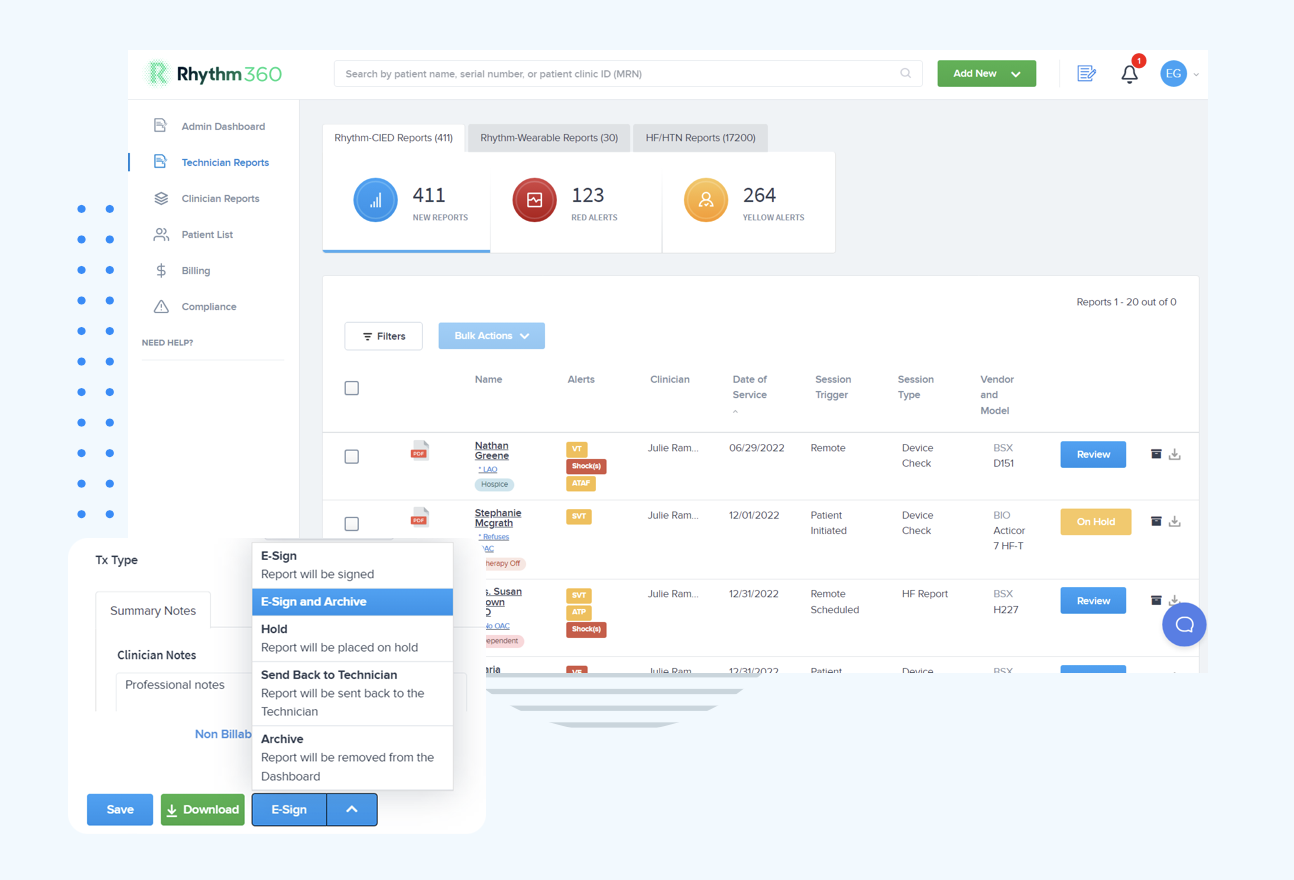
For device technicians and clinic administrators, this means no more redundant portal logins. One dashboard shows transmission history, device diagnostics, alert status, and billing eligibility without staff reconciling data across disconnected systems. Gaurav A. Upadhyay, MD, FACC, FHRS, Director of the Pacing & Defibrillation Device Clinic at UCM, said: "That was a big piece for us, to have an integrated review of data from trained personnel."
The administrative view also tracks patient compliance rates, pending transmissions, open alerts by severity, and captured versus potential CPT revenue in one place.
Alert fatigue creates real patient safety risk in multi-vendor CIED monitoring. When staff face high volumes of non-actionable notifications from multiple OEM portals, clinically significant events like new-onset atrial fibrillation, ventricular tachycardia, lead malfunction, or early replacement indicators can get delayed or missed.
Rhythm360's AI triage engine filters out non-actionable transmissions and surfaces prioritized events in near real time. Redundant data feeds and AI-powered gap extrapolation keep transmissibility above 99.9%, so a failed OEM server connection never creates a blind spot in patient monitoring. The result: an 80% reduction in critical response times for practices using the platform.
Andrew Beaser, MD, at UCM, explained: "We are able to address these issues earlier; rather than waiting for a 3-month visit, we can call patients in for evaluation." This matches independent research: in a study of an AI-enabled virtual heart failure care program, most red alerts were reviewed quickly, with many resolved at first triage by LVNs and RNs without cardiologist involvement.
Beaser added that AI-assisted decision support will matter more as data volumes grow.
Bi-directional EHR integration links a unified platform to the broader clinical record. Without it, device data stays siloed, forcing manual transcription that introduces errors and eats staff time.
Rhythm360 connects bi-directionally with Epic, Cerner, Athenahealth, eClinicalWorks, Greenway Health, and other systems via HL7. Device transmissions and reports push into the EHR, while patient demographic and scheduling data pull back into Rhythm360. This kills duplicate data entry and keeps the clinical record current at all times.
Custom HL7 suites typically take 6 to 18 months, with bidirectional multi-EHR costs starting at $150K and ranging up to $1.2M. Rhythm360's pre-built integration layer compresses that to days or weeks, depending on the EHR environment and practice scope.
A HIPAA-compliant mobile app extends this access beyond the clinic. Electrophysiologists and nurse practitioners can review transmissions, sign reports, and coordinate care from anywhere, a critical capability for weekend and on-call coverage. That same real-time visibility is what makes accurate billing possible. Without it, revenue leakage becomes both predictable and pervasive.
Medicare RPM payments hit $311 million in 2022, up twentyfold from $15 million in 2019. Many RPM recipients received fewer than all three required billing components, which is why OIG has increased scrutiny of whether services were furnished as intended.
Rhythm360 automates documentation for CPT codes 93298, 93299, and 99454, among others, by capturing transmission timestamps, clinician review records, and patient interaction logs in an auditable format. Gaurav A. Upadhyay, MD, at UCM, said: "We have improved billing and accountability for our patients after the integration." Practices using Rhythm360 have seen revenue capture increase by up to 300% through optimized CPT billing and new RPM service lines for heart failure and hypertension management.
Understanding where your data goes helps practice administrators evaluate security and reliability claims. Rhythm360's architecture moves data through four layers before it reaches the clinical user.
In the first layer, OEM sources like Medtronic, Boston Scientific, Abbott, and Biotronik transmit data via manufacturer APIs, HL7 feeds, and XML files. Unstructured PDF reports run through a computer vision engine that extracts structured data using optical character recognition.
In the second layer, a normalization engine maps everything to a common schema, resolving manufacturer-specific terms, unit differences, and timestamp formats. If an OEM server goes down, redundant feeds and AI extrapolation keep data continuous and flag the issue for staff.
In the third layer, normalized data populates the clinical dashboard. AI triage logic scores alert severity, generates reports for clinician review, and checks billing eligibility against CPT code requirements in real time.
In the fourth layer, bi-directional HL7 integration pushes finalized reports and documentation into the EHR while pulling updated patient data back into Rhythm360. All data in transit and at rest is encrypted and stored in compliance with HIPAA residency requirements.
The table below summarizes how these capabilities translate into timelines, pricing, and measurable outcomes.
| Capability | Onboarding Timeline | Pricing Model | Quantified Outcome |
|---|---|---|---|
| Vendor-neutral CIED and RPM data consolidation (Medtronic, Boston Scientific, Abbott, Biotronik, and others) via API, HL7, XML, and computer vision PDF parsing | Days to a few weeks, including EHR integration setup | SaaS-based, scaled by clinic size and platform usage | 73,000+ reports processed annually at UCM in 2025 (cited above) |
| AI-powered alert triage with greater than 99.9% transmissibility via redundant data feeds and AI extrapolation | Configured at go-live; no additional implementation phase required | Included in base platform subscription | 80% reduction in critical alert response times |
| Bi-directional EHR integration with Epic, Cerner, Athenahealth, eClinicalWorks, Greenway Health, and others via HL7 | Days to a few weeks depending on EHR environment | Included; no separate integration fee disclosed | Versus 6 to 18 months and up to $1.2M for custom builds (cited above) |
| Automated CPT code documentation for 93298, 93299, 99454, and related codes with full audit trail | Active from day one of go-live | Included in base platform subscription | Up to 300% increase in revenue capture (cited above) |
This checklist covers the standard implementation sequence for Rhythm360 across solo practices, EP clinics, and integrated health systems.
Rhythm360 is HIPAA-compliant by design. All electronic protected health information is encrypted in transit and at rest, and the platform logs a full audit trail of every data access event, report action, and patient communication, a requirement for both HIPAA compliance and CPT billing defensibility.
Healthcare SaaS companies handling patient data must comply with HIPAA, SOC 2, and NIST CSF 2.0 simultaneously under 2026 guidance. HIPAA penalties alone range from $141 to $2.1 million per violation category per year. Rhythm360's compliance architecture covers access management, encryption, incident response, and risk assessment. Because these control categories overlap 40 to 60% across HIPAA, SOC 2, and NIST CSF 2.0, a well-designed control set satisfies multiple frameworks at once, cutting down on redundant compliance work for practices.
The platform's Twilio-powered communication hub logs all patient messaging and call records within the patient record, creating a documented contact history that supports both clinical continuity and compliance audits. Data stays within U.S. boundaries, consistent with HIPAA requirements.
The revenue case rests on three levers: capturing billable events that go undocumented, meeting documentation thresholds for complex CPT codes, and adding new RPM service lines without adding proportional staff overhead.
CPT 93298 covers analysis of implantable cardioverter-defibrillator data with a physician report. CPT 93299 covers remote monitoring of implantable cardiovascular physiologic monitor systems. CPT 99454 covers device supply and daily recording or programmed alert transmission for RPM. As noted earlier, missing the 90-day billing cycle or documentation thresholds on these codes can cost practices hundreds of thousands of dollars annually.
Rhythm360 closes these gaps by capturing transmission timestamps, clinician review records, and patient interaction logs in real time, turning previously lost billable events into documented, defensible claims.
Implementation ranges from a few days to a few weeks, depending on EHR complexity and the number of OEM data feeds connected. Onboarding includes EHR configuration, OEM feed activation, alert customization, and staff training. Practices with a single EHR and defined OEM connections typically reach go-live within days. Multi-site health systems with more complex requirements fall toward the longer end. Rhythm360's implementation team manages the technical work, minimizing disruption to clinical operations.
Rhythm360 maintains greater than 99.9% transmissibility through redundant data feeds. If a manufacturer's server goes down, AI-powered extrapolation fills data gaps and flags the issue for staff review, so patient monitoring continues without interruption. The system ingests data through multiple pathways, so no single point of failure creates a blind spot. This matters most during weekend and overnight periods, when manual portal checks aren't practical.
Yes. A secure, HIPAA-compliant mobile app provides full platform access from any smartphone or tablet. Clinicians can review transmissions, sign reports, respond to prioritized alerts, and coordinate care from anywhere. When the AI triage engine flags a high-severity arrhythmia on a weekend, the responsible clinician gets a prioritized notification and can act immediately, whether that means anticoagulation, device reprogramming, or a patient recall. The mobile app keeps the same audit trail as the desktop platform.
Rhythm360 automates documentation for CIED codes 93298 and 93299, RPM codes including 99454, and treatment management codes 99457 and 99458, among others. The platform captures transmission timestamps, clinician review records, patient interaction logs, and device diagnostic summaries, then organizes them into an auditable package. Billing staff review completed documentation before claim submission, with the audit trail ready for payer review or OIG inquiry. The platform also flags patients approaching a billable threshold or transmission cycles at risk of expiring without a completed claim.
Rhythm360 serves the full range, from solo practitioners to large integrated health systems managing thousands of patients. SaaS-based pricing scales with clinic size and usage, so smaller practices aren't paying for enterprise features they don't need. Vendor-neutral data consolidation, AI alert triage, EHR integration, and automated billing documentation are available at every practice size. Smaller practices without dedicated device technicians can add Rhythm360's optional 24/7/365 certified cardiac technician oversight instead of hiring more staff.
The costs of managing multi-vendor CIED and RPM data through fragmented OEM portals are measurable and avoidable. Staff hours lost to redundant logins, alerts delayed by manual triage, and CPT revenue lost to incomplete documentation all drain practice resources. A unified platform addresses each of these directly.
Rhythm360 consolidates manufacturer data into one normalized dashboard, applies AI triage to surface significant events faster, integrates bi-directionally with major EHR systems, and automates the documentation needed to capture remote-monitoring revenue. It's HIPAA-compliant, deploys in days to weeks, and scales from solo practices to integrated health systems.
UCM's experience with Rhythm360, reflected in the report volume cited earlier, demonstrates earlier clinical interventions and improved billing accountability, outcomes that translate directly to patient safety and practice financial health.
Schedule a demo and see how Rhythm360 captures the revenue your practice has already earned.