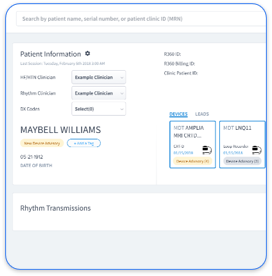
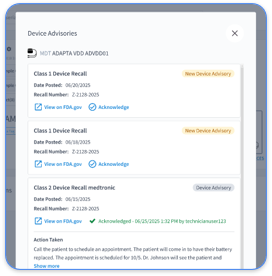
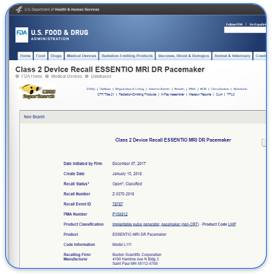
Last updated: August 24, 2026
The first step is building a structured inventory of every active CIED patient. For each patient, the record should capture the device manufacturer, device type (pacemaker, ICD, CRT, ILR, CCM), programmed transmission frequency, and the OEM portal credentials currently used to retrieve that patient's data.
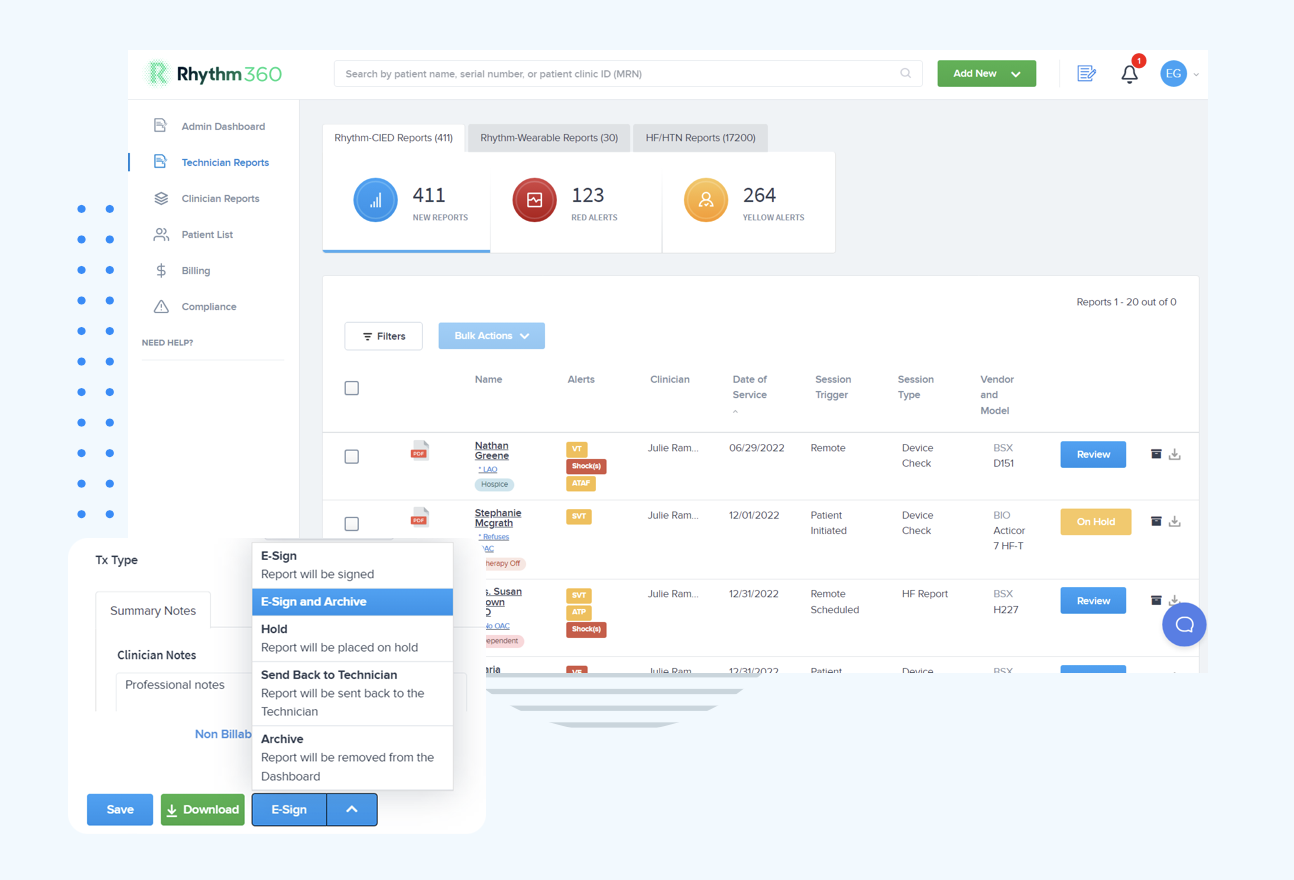
This mapping exercise surfaces the full scope of the fragmentation problem. It reveals how many portals staff must log into daily, which highlights the administrative burden driving inefficiency. It identifies patients with devices from multiple manufacturers, who face the highest risk of missed transmissions when data lives in separate silos. It also exposes where transmission gaps already exist, which gives you a baseline for measuring improvement after consolidation.
Pro Tip: Rhythm360 supports bulk inventory import, so practices can upload existing device lists directly into the platform instead of re-entering records manually. This single step removes the most time-consuming part of onboarding.
Step 2: Connect Every OEM with Vendor-Neutral Ingestion
Once the device inventory is mapped, the platform must pull data from every OEM source without requiring staff to log into individual portals. A production-grade ingestion layer uses multiple complementary methods at the same time.
The HL7 CardX CIED Implementation Guide defines the Implantable Device Cardiac Observation (IDCO) FHIR profile, which organizes a device transmission as a FHIR Bundle containing patient context, a DiagnosticReport for the interrogation event, and structured Observation resources using IEEE 11073-10103 terminology. This standard allows discrete findings such as measurements, programmed settings, episode summaries, therapy details, and notifications to flow into downstream workflows including inbox review, longitudinal trending, and EHR incorporation across manufacturer platforms.
For sources that do not yet expose FHIR endpoints, a complete ingestion architecture also includes direct API pulls, HL7 v2 messaging, XML feeds, and computer-vision OCR for parsing unstructured PDF reports. A redundant-feed fail-safe keeps data flowing even when an OEM server experiences downtime.
Pro Tip: Rhythm360's ingestion architecture combines API, HL7, XML, and AI-powered computer vision OCR to reach greater than 99.9% transmissibility. Redundant data feeds act as an automatic fail-safe if any single OEM source becomes temporarily unavailable.
Step 3: Use AI Triage to Control Alert Volume
Once all manufacturer data flows into a single platform, the next challenge is managing the volume of incoming transmissions. A technician managing remotely monitored CIED patients manually spends time daily on portal review, alert logging, and documentation across vendor systems. Automation shifts that work to exception review for flagged critical and urgent alerts. The mechanism behind that reduction is structured alert triage.
An AI triage layer evaluates every incoming transmission against configurable clinical rules, suppresses non-actionable notifications, and surfaces only events that require a clinical response. The table below shows common alert types and the recommended action pathway.
Alert Type Clinical Significance Recommended Action Target Response Window New-onset atrial fibrillation High Immediate clinician notification, evaluate anticoagulation Same day Ventricular tachycardia / VF episode Critical Urgent clinician review, consider device reprogramming or hospitalization Within hours Lead impedance out of range Moderate–High Schedule in-clinic evaluation, assess for lead fracture or dislodgement Within 24–48 hours ERI / RRT battery status Moderate Schedule elective generator replacement Within scheduled visit cycle Routine scheduled transmission, no findings Low Auto-dismiss after review, document for CPT compliance Standard queue Pro Tip: Rhythm360's AI triage engine filters non-actionable noise and prioritizes clinically significant events, delivering the response-time improvement mentioned earlier. Optional 24/7/365 oversight by certified cardiac technicians (CCTs) supervised by physicians adds a human review layer for the highest-acuity events.
Step 4: Push Structured CIED Data Directly into the EHR
Consolidating CIED data into a single platform delivers limited value if that data remains siloed outside the EHR. Bi-directional integration pushes discrete structured data and signed reports directly into the patient record and pulls demographic and scheduling context back into the monitoring platform.
Integration targets include Epic, Cerner, Athenahealth, eClinicalWorks, Greenway Health, and other systems via HL7. On the inbound side, the EHR provides patient identity data that supports accurate transmission matching. On the outbound side, completed device reports populate the chart automatically, which removes manual transcription and the transcription errors that come with it.
Pro Tip: Rhythm360's bi-directional EHR integrations are configured during onboarding, which typically takes from a few days to a few weeks. Once live, signed reports flow directly into the EHR without staff intervention.
Step 5: Give Each Role One Unified Clinical Queue
After ingestion and EHR integration are live, the daily clinical experience shifts from navigating four or more OEM portals to working a single prioritized queue. Role-based views present each user, such as EP physician, NP, RN, or device technician, with the subset of tasks and alerts relevant to their scope. This approach reduces cognitive load and the risk of items being overlooked.
A secure mobile application extends that same queue to clinicians who are on-call or away from the office. Clinicians can review transmissions, sign reports, and coordinate care from a smartphone without compromising HIPAA compliance.
Pro Tip: Rhythm360's HIPAA-compliant mobile app gives clinicians full access to the clinical queue from any location. A critical arrhythmia flagged on a Saturday morning can be reviewed and acted on within hours, before the next scheduled office visit.
Step 6: Automate CPT Documentation and Audit-Ready Logs
In manual remote cardiac monitoring workflows, a portion of billable events for CPT codes such as 93296 go unbilled because of missed 90-day periods or absent physician interpretation notes. Automation closes this gap and generates additional annual revenue for a CIED program.
An automated documentation layer captures every billable event at the moment it occurs, attaches the appropriate CPT code, and generates the physician interpretation note required for claim submission. Audit logs record every action with a timestamp and user identifier, which supports payer audits and compliance reviews.
Pro Tip: Rhythm360 automatically captures billable events and generates CPT-compliant documentation for codes 93294–93299 and 99453–99457. University of Chicago Medicine reported improved billing and accountability for patients after integrating Rhythm360.
The table below illustrates the metrics a practice can track once automated documentation is live.
Metric Pre-Automation Baseline Post-Automation Target Source Billable events captured (%) 75–85% 95–100% Automation gap analysis Daily portal review time (150-patient panel) 2–3 hours 30–45 minutes Automation time metrics Critical-alert response time reduction Baseline Up to 80% faster Rhythm360 platform outcomes Annual reports processed (high-volume center) Varies 73,000+ (UCM, 2025) UCM white paper Key Selection Criteria Checklist for CIED Platforms
Any platform evaluated for CIED workflow consolidation should meet the following technical and operational requirements before deployment.
- Vendor-neutral ingestion: The platform must ingest data from all major OEM sources, including Medtronic, Boston Scientific, Abbott, Biotronik, and others, without requiring separate staff logins for each portal.
- Multi-format data normalization: Support for API, HL7/FHIR, XML, and PDF parsing via computer vision OCR is required to handle the full range of manufacturer data formats, including IDCO FHIR profiles for structured device observations.
- Redundant feed architecture: A fail-safe mechanism must maintain data flow when any single OEM server is unavailable, with a goal of greater than 99.9% transmissibility.
- AI-powered alert triage: The system must filter non-actionable transmissions and surface clinically significant events in a prioritized queue, with configurable rules by alert type and severity.
- Bi-directional EHR integration: The platform must push discrete data and signed reports into the EHR and pull patient identity data back, supporting Epic, Cerner, Athenahealth, and other major systems.
- Automated CPT documentation: Billable events for codes 93294–93299 and 99453–99457 must be captured automatically with audit-ready logs, which removes the manual documentation gap that causes revenue leakage.
Schedule a demo to see how Rhythm360 meets every criterion on this checklist.
Frequently Asked Questions
How IHE IDCO HL7 FHIR CIED Integration Works in a Clinic
The Integrating the Healthcare Enterprise (IHE) Implantable Device Cardiac Observation (IDCO) profile defines a standardized structure for representing the clinical content of a CIED interrogation, including measurements, programmed settings, episode summaries, therapy details, and notifications, as computable data. The current HL7 FHIR implementation of IDCO translates that content into FHIR Bundles and Observation resources that can be exchanged, queried, and reused across manufacturer platforms, middleware layers, and EHR systems. For a cardiology clinic, a platform supporting IDCO FHIR can receive structured device data from any compliant OEM source and route it directly into clinical workflows and the patient record without manual transcription. Rhythm360's ingestion architecture is built to handle FHIR alongside HL7 v2, XML, and PDF formats, which covers the full range of manufacturer data delivery methods in use today.
How a Unified CIED Platform Reduces Alert Fatigue
Alert fatigue in CIED monitoring arises when clinical staff receive a high volume of notifications, most of which are routine or non-actionable, mixed with the small subset that require an urgent response. When staff cannot reliably distinguish critical alerts from noise, response times slow and events get missed. A unified platform addresses this by applying AI-powered triage rules that evaluate every incoming transmission against configurable clinical criteria. Non-actionable transmissions are filtered or auto-dismissed after documentation, while high-acuity events such as new-onset atrial fibrillation, ventricular tachycardia, lead malfunction, and ERI status are surfaced immediately in a prioritized queue. Rhythm360's triage engine delivers the faster response times described above and shifts EP teams from reactive manual review to proactive, exception-based management.
Typical Timeline for Implementing a Vendor-Neutral CIED Platform
Implementation timelines vary by practice size, the number of EHR integrations required, and the complexity of the existing device population. For most cardiology practices, Rhythm360's onboarding process, including EHR integration setup, device inventory import, and staff training, takes from a few days to a few weeks. The platform is cloud-based, which removes the hardware installation and IT infrastructure requirements associated with legacy on-premise systems. Practices managing high patient volumes, such as University of Chicago Medicine, which processed more than 73,000 reports annually through Rhythm360 in 2025, show that the platform scales without requiring proportional increases in staffing or infrastructure.
CPT Codes Affected by CIED Remote Monitoring Automation
Remote monitoring of CIEDs generates billable events under CPT codes 93294 through 93299, which cover remote interrogation and monitoring of pacemakers, ICDs, and CRT devices at defined intervals. Practices that also manage chronic conditions such as heart failure and hypertension through remote physiological monitoring bill under codes 99453, 99454, and 99457. In manual workflows, 15–25% of billable events go uncaptured because of missed monitoring periods or absent physician interpretation documentation. Automated platforms capture each billable event at the point of occurrence, attach the appropriate CPT code, and generate the required documentation, which closes the billing gap and improves revenue outcomes. Rhythm360 automates this process across the full CIED and RPM CPT code set.
Managing CIED Monitoring Alongside Heart Failure and Hypertension RPM
Rhythm360 can manage CIED monitoring and remote physiological monitoring for heart failure and hypertension on a single platform. The system ingests data from implantable cardiac devices alongside readings from RPM sensors and presents clinicians with a unified workspace that covers rhythm disorders, volume status, and blood pressure management in one dashboard. This approach removes the need for separate systems for different condition types and allows practices to launch new RPM service lines for heart failure and hypertension patients without adding separate administrative infrastructure.
Practices Using Rhythm360 Gain Faster Response and Higher Revenue
University of Chicago Medicine processed more than 73,000 CIED reports annually through Rhythm360 in calendar year 2025, averaging more than 18,000 reports per quarter, with clinicians reviewing more transmissions daily and identifying more abnormalities than under the prior fragmented workflow. As Andrew Beaser, MD, Associate Professor of Medicine at UCM, noted: "We are able to address these issues earlier; rather than waiting for a 3-month visit, we can call patients in for evaluation." UCM also reported improved billing and accountability following the integration.
Automation enables a cardiology device clinic to manage 300+ remotely monitored CIED patients with the same staffing levels by removing manual triage burden across multiple OEM portals. For practices currently losing 15–25% of billable remote monitoring events to documentation gaps, the revenue recovery from a fully automated workflow is substantial.
Rhythm360 is a vendor-neutral, HIPAA-compliant platform that consolidates every CIED transmission into one automated clinical workflow, covering ingestion, triage, EHR integration, and CPT-compliant documentation, with an implementation timeline measured in weeks, not months. Other platforms in the CIED monitoring space, including Murj, Implicity, Rhythm Management Group, and Octagos, also exist. Rhythm360 is built to deliver the complete workflow in a single, integrated system.
Schedule a demo to see how Rhythm360 unifies your CIED data into one automated workflow.
Read Next