Last updated: July 14, 2026
The table below breaks the cardiology revenue cycle into ten stages. Each row shows the manual pain point, the automation fix, and the measurable 2026 benefit. This roadmap sets up the six steps detailed later in the article, which group these stages into the practical actions Rhythm360 takes on your behalf.
| Stage | Manual Pain Point | Automation Opportunity | 2026 Benefit |
|---|---|---|---|
| 1. Eligibility Verification | Coverage lapses missed between scheduling and service | Real-time API-driven eligibility checks at scheduling and pre-service | Real-time eligibility checks cut eligibility denials by 67% for one major health system |
| 2. Prior Authorization | Manual fax/phone workflows averaging 40-100 minutes per request | AI-driven documentation assembly and electronic PA submission | Significant reduction in auth-related denials |
| 3. Device & RPM Charge Capture | Missed transmissions across fragmented OEM portals | Vendor-neutral ingestion with redundant data feeds and AI extrapolation | Greater than 99.9% transmissibility and substantial revenue recovery |
| 4. Coding & Documentation | Generalist coders missing complex CIED and RPM CPT codes | Bi-directional EHR integration with automated documentation and AI code suggestion | High first-pass clean claim rate |
| 5. Claim Submission | Manual claim creation with 1-5% charge leakage | Automated claim generation with pre-submission ML risk scoring | Reduction in coding-related denials |
| 6. Denial Management | 42-day average denial resolution; $89 cost per denial | Predictive denial flagging, automated work-queue routing, AI-drafted appeals | Reduced denial resolution time and lower cost per denial |
| 7. Patient Billing | Surprise balances, low point-of-service collections | Automated pre-service estimates, digital statements, and payment reminders | Improved patient collections at point of service |
| 8. Reporting & Analytics | No unified view of billable events, compliance gaps, or payer trends | Real-time administrative dashboard tracking CPT compliance and revenue KPIs | Proactive identification of revenue leakage before month-end close |
| 9. Compliance Audit | Manual audit trails; risk of documentation gaps under payer scrutiny | Automated audit logs, override records, and CCT-supervised report sign-off | Auditable documentation for every billable transmission event |
| 10. Continuous Improvement | Static workflows that lag payer policy changes | ML models that update denial risk scoring as payer patterns shift | Sustained benchmark performance: denial rate under 5%, AR under 30 days |
CIED and RPM billing runs on a dense set of CPT codes. A single documentation gap can void an entire claim. The table below shows the primary codes, their documentation requirements, and the automation Rhythm360 applies to each.
| CPT Code | Service Description | Common Manual Failure | Rhythm360 Automation |
|---|---|---|---|
| 93298 | Remote monitoring, ICD/CRT-D, physician review and report | Missing physician attestation or incomplete transmission log | Automated report generation with bi-directional EHR push for physician sign-off |
| 93299 | Remote monitoring, pacemaker/CRT-P, physician review and report | Transmission not linked to billable review event | AI-matched transmission-to-billing event with audit trail |
| 99453 | RPM setup and patient education, first 30 days | Setup not documented as a discrete billable encounter | Automated onboarding checklist with timestamped documentation |
| 99454 | RPM device supply and daily recording, 30-day period | Compliance threshold (16+ days) not tracked or documented | Automated compliance tracking with alerts when threshold is at risk |
| 99457 / 99458 | RPM treatment management, 20+ and additional 20 minutes | Time not captured or attributed to the correct provider | Automated time logging with provider attribution for billing |
Rhythm360's bi-directional EHR integration supports Epic, Cerner, Athenahealth, eClinicalWorks, and others through HL7. Every transmission event generates a documentation record that maps directly to the applicable CPT code. Best-in-class cardiology practices target a 95%+ clean claim rate, a benchmark Rhythm360 is built to support. The University of Chicago Medicine processed more than 73,000 reports in 2025, averaging over 18,000 per quarter, after implementing the platform.
Missing or expired prior authorization and insufficient documentation drive most cardiology denials. Initial medical-necessity denial rates on CCTA, stress echo, nuclear stress, and elective PCI claims run 12-18% across commercial plans in 2026.
Rhythm360 verifies eligibility in real time at scheduling and runs API-driven prior authorization workflows that assemble clinical documentation before service delivery. This catches authorization requirements early, before a claim ever reaches the payer. As shown in the roadmap above, real-time eligibility checks can cut eligibility denials by roughly two-thirds, largely by catching coverage changes between initial verification and service delivery.
The CMS Interoperability and Prior Authorization Final Rule (CMS-0057-F) requires payers to send prior authorization decisions within 72 hours for expedited requests and seven calendar days for standard requests, with FHIR-based PA APIs mandated by January 1, 2027. Practices that adopt API-ready platforms now avoid a scramble later. Waiting until the deadline means retrofitting workflows under time pressure instead of testing them on your own schedule.
A cardiology practice implanting devices from more than one manufacturer runs into an immediate problem. Each OEM operates a separate, non-interoperable portal. Staff must log into multiple systems to retrieve transmission data, reconcile discrepancies, and document billable events by hand. The result is missed charges, delayed billing, and technician burnout.
Rhythm360 ingests data from Medtronic, Boston Scientific, Abbott, Biotronik, and other manufacturers through APIs, HL7, XML, and PDF parsing via computer vision. A redundant data feed architecture acts as a fail-safe when an OEM server goes down, keeping transmissibility above 99.9%. Every qualifying transmission, whether from a pacemaker, ICD, implantable loop recorder, CRT device, or CardioMEMS pulmonary artery monitor, gets captured, normalized, and linked to its billable event.
For RPM programs, providers can generate $100-$150 in monthly reimbursement per patient through CPT codes 99453, 99454, 99457, and 99458. A 100-patient panel yields $10,000-$15,000 in monthly revenue.
In 2025, healthcare providers faced initial claim denial rates averaging 10.6%, with many organizations seeing higher volumes that tie up millions of dollars in unresolved claims. These losses stem largely from preventable errors caught too late. Organizations that deploy AI-powered denial management before submission see lower initial denial rates than those relying on manual review alone.
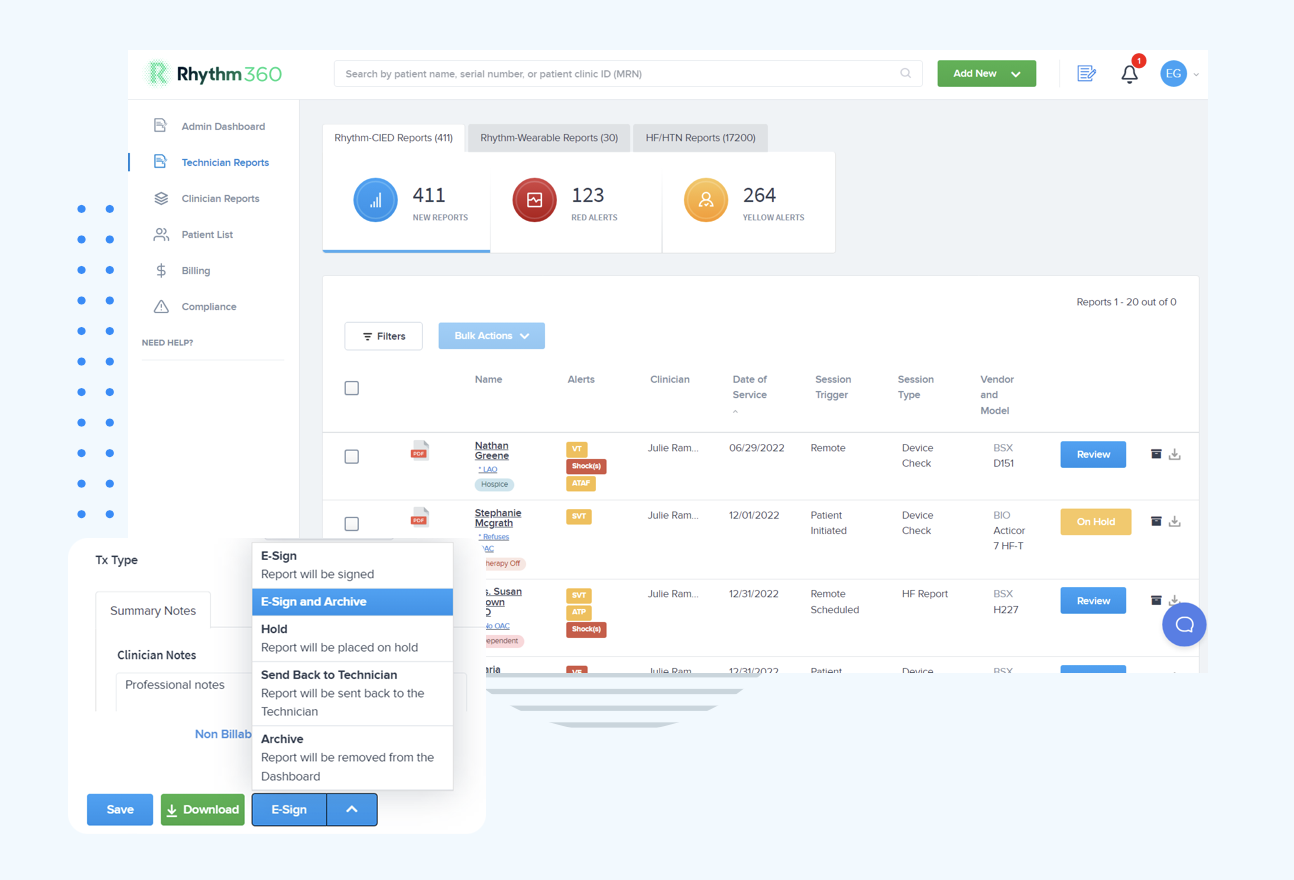
Rhythm360's pre-submission ML review scores each claim for denial risk before it leaves the practice. Claims flagged above a risk threshold get routed to a human reviewer, a certified cardiac technician (CCT) or billing specialist, for correction before submission. This hybrid model prevents denials instead of reacting to them after the fact.
The result is faster denial resolution, better appeal success rates, and lower cost per denial. This shift from reactive denial management to proactive revenue integrity also frees RCM staff to focus on strategic work instead of repetitive rework.
Cardiology practices improve patient collections in high-deductible environments by offering pre-service estimates, digital payment options, payment plans, and automated follow-up reminders. The No Surprises Act adds a compliance layer, requiring clear cost estimates before service delivery.
Rhythm360 supports this through an integrated communication hub built on a Twilio framework. It automates patient messaging, logs every communication with a full audit trail, and lets medical assistants review prior outreach before making personal calls. Automated billing reminders cut the manual follow-up burden on staff while improving collection rates at the point of service.
Full automation does not fit every cardiology billing scenario. Complex prior authorization cases, multi-payer coordination, and claims with ambiguous documentation still need human judgment. Building on the patient billing improvements in Step 5, Rhythm360 applies the same balance of automation and oversight to clinical and billing decisions across the platform. Predictive AI flags risk before denials occur, generative AI speeds up outputs like appeal drafts, and human oversight handles complex clinical, contractual, and strategic calls.
Rhythm360 sets clear handoff points between automated workflows and human review:
Device clinics have long struggled with technician turnover and weekend coverage gaps that create monitoring blind spots. Rhythm360's optional 24/7/365 oversight by certified cardiac technicians, supervised by physicians, closes that gap without adding to your headcount.
Rhythm360's implementation process, including EHR integration, typically takes from a few days to a few weeks depending on the complexity of the practice's existing systems. Support for Epic, Cerner, Athenahealth, eClinicalWorks, Greenway Health, and others through HL7 streamlines technical onboarding compared to building custom connections from scratch.
Rhythm360 uses a SaaS-based pricing model that scales with clinic size and platform usage. This avoids the high upfront setup fees common with legacy on-premise systems and lets practices align their investment with the actual volume of patients and devices they manage. Pricing details come up directly during the demo.
Rhythm360 is a HIPAA-compliant, cloud-based platform. All patient data, including device transmissions, clinical communications, and billing documentation, is stored and transmitted according to HIPAA requirements. The platform keeps a full audit trail for every automated action, communication log, and report sign-off, supporting internal compliance reviews and external payer audits. A secure mobile application lets clinicians access patient data remotely without compromising security.
Yes. Rhythm360 offers bi-directional EHR integration with major platforms including Epic, Cerner, Athenahealth, eClinicalWorks, and Greenway Health, using HL7 standards. Data flows both from the EHR into Rhythm360 and back from Rhythm360 into the EHR. This eliminates redundant manual data entry and keeps billing documentation, clinical reports, and alert records synchronized across systems.
Rhythm360 is vendor-neutral and supports all major cardiac implantable electronic device manufacturers, including Medtronic, Boston Scientific, Abbott, and Biotronik. The platform ingests data through APIs, HL7, XML, and PDF parsing via computer vision, backed by a redundant data feed architecture that keeps transmissibility above 99.9% even during OEM server downtime. Staff never need to log into multiple separate portals to retrieve patient data.
The six pillars outlined above, AI-driven charge capture, automated eligibility and prior authorization, vendor-neutral device data ingestion, predictive denial management, patient billing automation, and hybrid human-AI oversight, form a repeatable 2026 roadmap. Practices that follow it close the gap between average and best-in-class revenue performance.
Manual workflows cost practices thousands in missed CIED and RPM charges every month. Rhythm360 consolidates the full billing documentation workflow into one auditable platform, from the moment a device transmits data to the moment a clean claim gets submitted, while keeping the human oversight complex cardiology billing requires. Practices implementing Rhythm360 have achieved the revenue gains and response-time improvements noted throughout this roadmap.
Schedule a demo and start closing your revenue gaps today.