Last updated: July 14, 2026
Device clinics process thousands of transmissions annually, and a substantial share of those alerts turn out to be clinically non-relevant. That noise problem gets worse as device populations grow, since each clinic ends up managing more patients per staff member. Staff must log into separate OEM portals for Medtronic, Boston Scientific, Abbott, Biotronik, and others, then reconcile conflicting data by hand. The risk is missing the one transmission that actually matters.
Marcus Pritchett, Cardiac Device Specialist at the Kansas City Heart Rhythm Institute, frames the core issue this way: "Having alert systems clear urgent versus non-urgent is the timeline difference." That timeline gap, between a critical event and clinical action, is exactly what a unified interface is built to close. It's why a purpose-built platform has become the central infrastructure investment for cardiology clinics in 2026.
The workflow below shows how a single alert moves from queue to signed EHR report in four clicks, collapsing what used to require multiple portal logins into one continuous action.
| Click | Action | Platform Element |
|---|---|---|
| 1 | Open prioritized alert from sortable alert list | Color-coded alert queue (Red / Orange / Yellow) |
| 2 | Review AI-contextualized patient workspace | Left / Center / Right panel layout with device data, history, and EHR context |
| 3 | Select clinical action or escalation pathway | One-click documentation template pre-populated from transmission data |
| 4 | Sign and push report to EHR; trigger billing capture | Bi-directional EHR integration with automated CPT code tagging |
The filter table below shows the specific dimensions staff can combine to isolate the alerts that matter most, instead of scrolling through an undifferentiated queue.
| Filter Dimension | Options |
|---|---|
| Severity | Red (critical), Orange (urgent), Yellow (routine) |
| Device Manufacturer | Medtronic, Boston Scientific, Abbott, Biotronik, others |
| Alert Type | Arrhythmia, lead integrity, battery status, therapy delivered, connectivity |
| Transmission Date | Ascending / Descending |
| Clinician Assignment | Assigned / Unassigned / My Queue |
| Billing Status | Billable / Pending / Completed |
Rhythm360 pulls data from all major device manufacturers through direct APIs, HL7 feeds, XML parsing, and AI-assisted computer vision applied to unstructured PDFs. Every transmission gets normalized into a single schema and shown on one dashboard, regardless of OEM origin. A device technician managing a mixed Medtronic and Abbott population no longer toggles between portals. Every patient record sits in the same interface.
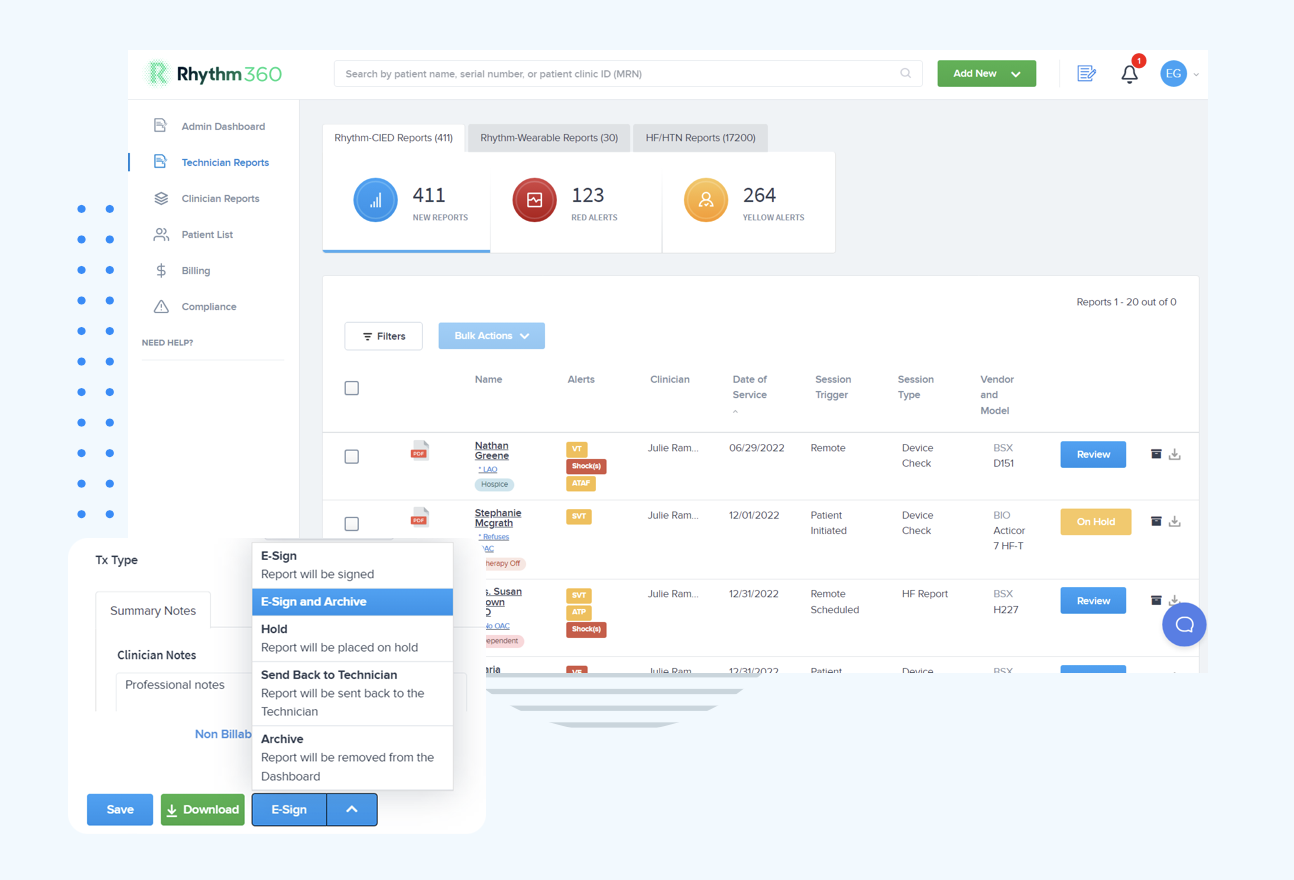
This consolidation saves measurable time. Clinics moving from multiple proprietary vendor portals to one unified system have cut workflow time per patient significantly. For a clinic handling thousands of annual transmissions, that adds up to real reclaimed staff hours, hours that can go back into direct patient care.
Rhythm360 also runs a redundant data feed system that kicks in when an OEM server goes down, which helps the platform maintain a transmissibility rate above 99.9%. That reliability matters for what comes next: triage only works if the data feeding it is complete.
Once alerts land in the unified dashboard, Rhythm360 applies a three-tier traffic-light system to every incoming transmission:
AI prioritization checks each transmission against the patient's historical baseline, device type, and programmed thresholds before assigning a tier. This kind of AI-driven triage reduces alert fatigue while keeping data reliability high.
The 2026 Frontiers in Digital Health guidelines for AI-enabled cardiovascular monitoring specify that escalation pathways must be predefined and proportionate, with rapid review timelines for safety-critical signals. The Rhythm360 triage architecture is designed to meet that standard.
Staff can filter the full transmission queue by severity tier, OEM, alert type, transmission date, clinician assignment, and billing status at the same time. Filters apply in real time without page reloads, which speeds up queue management during high-volume periods.
Duplicate suppression logic identifies when multiple transmissions from the same device within a set window represent one underlying clinical event. Instead of generating separate alert entries for each transmission, the platform consolidates them into a single record with a transmission count indicator. This directly addresses the non-relevant alert problem: nearly 60% of raw transmissions are classified as clinically non-relevant, so suppression logic is a structural requirement, not an optional feature.
2026 expert guidance recommends that AI cardiovascular monitoring programs track alert rates and downstream workload with predefined bounds on positive and negative predictive value to manage triage capacity. Rhythm360 surfaces PPV/NPV-relevant metrics in the administrative dashboard so clinics can monitor their own triage performance over time.
Once a filtered queue narrows to a specific alert, selecting it opens a three-panel patient workspace:
The workspace is fully accessible through Rhythm360's HIPAA-compliant mobile app. Andrew Beaser, MD, Associate Professor of Medicine at the University of Chicago Medicine, described the practical effect: "I am more likely to sign off on these while in meetings because I can easily access them on my phone." Mobile escalation means a Red-tier alert that surfaces on a Saturday morning can lead to a same-day clinical intervention, without the clinician needing to be at a workstation.
Rhythm360 maintains bi-directional integrations with Epic, Cerner, Athenahealth, eClinicalWorks, Greenway Health, and other systems through HL7. When a clinician finishes a transmission review, one click pushes a pre-populated clinical note to the patient's EHR record. The note includes device data, the AI-generated summary, the clinician's attestation, and the relevant CPT codes, including 93298, 93299, and 99454, flagged for billing.
Gaurav A. Upadhyay, MD, at the University of Chicago Medicine, confirmed the downstream financial effect: "We have improved billing and accountability for our patients after the integration."
That improvement shows up directly in the numbers. One clinic cut billing time by 50% and supported a 67% jump in patient volume without adding staff, and Rhythm360 clients overall have reported revenue gains of up to 300% through more consistent CPT code capture and fewer claim rejections. Together, these figures point to the same underlying shift: automated documentation removes the manual bottleneck that used to cap both volume and revenue.
See Rhythm360's automated billing workflow firsthand, request a walkthrough for your clinic.
Rhythm360 is a cloud-based, HIPAA-compliant platform built specifically for the operational realities of cardiology clinics managing mixed-OEM device populations. Its core capabilities include:
The University of Chicago Medicine processed more than 73,000 reports annually through Rhythm360 in 2025, averaging more than 18,000 reports per quarter, with clinicians reviewing more transmissions daily and catching more abnormalities than before implementation. As Dr. Beaser noted, "Decision support, including AI-assisted decision support, will become increasingly important as data volumes grow."
Implementation timelines range from a few days to a few weeks, depending on clinic size, the number of OEM data feeds being connected, and EHR integration complexity. Onboarding includes EHR setup, staff training, and configuration of alert thresholds and triage rules specific to the clinic's protocols. Rhythm360 is cloud-based, so there's no on-premise hardware installation, which cuts deployment friction compared to legacy systems.
Yes. Rhythm360 includes a HIPAA-compliant mobile app that provides full access to the alert queue, patient workspace, transmission reports, and documentation tools. Clinicians can review transmissions, sign reports, escalate critical alerts, and coordinate care directly from a smartphone. This matters most for on-call coverage, where a Red-tier alert, such as a ventricular arrhythmia or lead fracture, can be reviewed and acted on without a clinic workstation.
Rhythm360 automates CPT code identification and documentation for remote monitoring services, including codes 93298, 93299, and 99454. When a clinician signs a completed transmission review, the platform pushes a pre-populated clinical note to the EHR with billing codes already tagged. This reduces manual billing entry and minimizes claim rejections tied to incomplete documentation. As noted earlier, Rhythm360 clients have reported revenue gains of up to 300%, driven largely by more consistent CPT code capture. Rhythm360 supports the billing documentation process; the clinic's own billing and revenue cycle operations stay under the clinic's management.
Rhythm360 tackles alert fatigue two ways. First, its AI triage engine checks every incoming transmission against the patient's historical device data, programmed thresholds, and clinical baseline before assigning a severity tier. Transmissions that don't meet the threshold for clinical action get classified as Yellow or suppressed as duplicates, keeping the active queue focused on events that need a response. Second, the platform's redundant data feed architecture and transmissibility rate above 99.9% make sure suppressing non-relevant alerts doesn't cost data completeness. Clinically significant events, including new-onset atrial fibrillation, ventricular tachycardia, and device malfunctions, get reliably surfaced and escalated through the color-coded triage system and mobile push notifications.
Rhythm360 is built specifically for multi-OEM environments. The platform ingests data from all major cardiac device manufacturers, including Medtronic, Boston Scientific, Abbott, and Biotronik, through direct APIs, HL7 feeds, XML parsing, and AI-assisted computer vision applied to unstructured PDF reports. All data gets normalized into a single schema and shown on one unified dashboard, so staff don't need separate logins and workflows for each manufacturer's portal. This vendor-neutral design is a foundational principle of Rhythm360, not an add-on feature.
The operational and clinical case for a unified CIED alert management interface is well established in 2026. Fragmented OEM portals, non-relevant alert volumes approaching 60% of all transmissions, and manual billing workflows drain staff capacity, patient safety margins, and clinic revenue. The full architecture, a multi-OEM dashboard, color-coded triage, filterable alert lists with duplicate suppression, a three-panel patient workspace, mobile escalation, and one-click EHR documentation, isn't a future roadmap item. Rhythm360 delivers it today, with deployment measured in days to weeks and a track record that includes one of the highest-volume academic cardiology programs in the country.