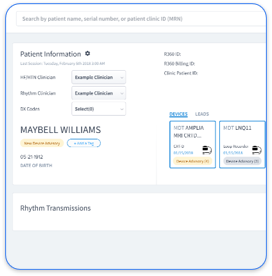
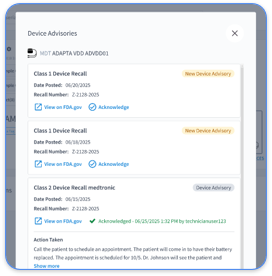
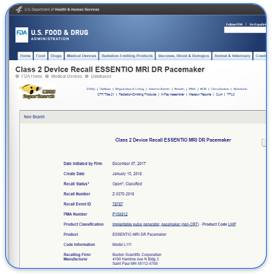
Last updated: July 14, 2026
Contact Rhythm360 to see how these features apply to your practice.
Clinical staff adopt a platform only when it saves them time. A genuinely user-friendly EP workflow automation platform puts all device data in one role-appropriate dashboard. It skips redundant logins and works mobile-first, so clinicians are not tied to a workstation.
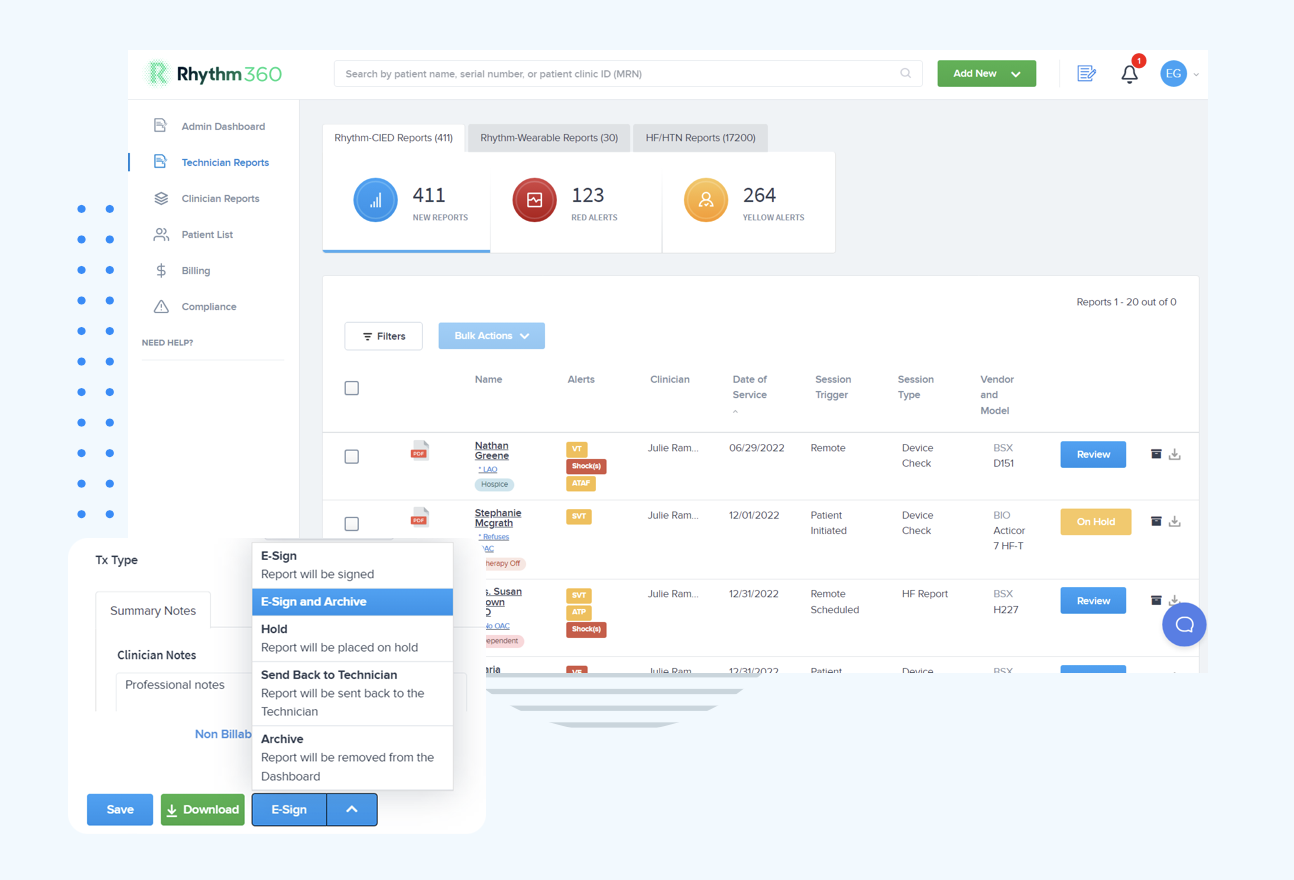
Rhythm360 consolidates every CIED and remote physiological monitoring (RPM) transmission into one dashboard. Device technicians, nurses, and electrophysiologists each see a view built for their role. This cuts cognitive load and time spent switching between systems. UCM's implementation of Rhythm360 let clinicians review more transmissions daily while improving how quickly they identified actionable findings.
A platform that connects to only one or two OEMs forces clinics to run parallel workflows. True vendor neutrality means seamless ingestion from every major manufacturer, including Medtronic, Boston Scientific, Abbott, and Biotronik, through API, HL7, XML, and computer vision-powered PDF parsing.
Rhythm360 achieves greater than 99.9% data transmissibility by layering redundant data feeds with AI-powered gap-filling. If an OEM server goes offline, the platform's fail-safe architecture keeps capturing and normalizing data. This reliability matters because a missed transmission can mean a missed arrhythmia.
Other platforms in the EP automation space exist, and their OEM coverage varies widely. Before committing to any vendor, confirm the specific connections and data formats it supports.
Device clinics process thousands of transmissions annually, and many alerts carry no clinical relevance. Without intelligent filtering, staff spend most of their time dismissing noise instead of acting on genuine events.
Rhythm360's AI-powered alert triage filters non-actionable transmissions and surfaces clinically significant events, such as new-onset atrial fibrillation, ventricular tachycardia, lead malfunction, and ERI/RRT indicators, in near real time. The result is an 80% reduction in critical-alert response times. Andrew Beaser, MD, noted that AI-assisted decision support will become increasingly important as data volumes grow. Rhythm360 also offers optional 24/7/365 oversight by certified cardiac technicians supervised by physicians for practices that want an added clinical safety layer.
See Rhythm360's AI triage filter real transmission data. Request a walkthrough.
Remote monitoring reimbursement depends on precise, time-stamped documentation. Billing CPT codes 93294 through 93298 requires patient demographics, device type and manufacturer, monitoring period dates, and a clinician interpretation note covering device function, programmed parameters, and actionable findings. Documenting these elements manually across thousands of annual transmissions leads to errors and revenue leakage.
Rhythm360 automates CPT-code capture for CIED remote monitoring codes (93294 through 93299) and RPM codes (99453, 99454, 99457, 99458). The billing automation aligns with Medicare requirements, supporting reimbursement for shorter monitoring windows such as post-ablation or AF burden assessment. Practices using Rhythm360 have seen billing improvements contributing to up to a 300% increase in revenue. Gaurav A. Upadhyay, MD, FACC, FHRS, Director of the Pacing & Defibrillation Device Clinic at UCM, said the integration improved billing and accountability for patients.
On-call electrophysiologists and NPs cannot always sit at a desktop when a critical alert fires on a Saturday morning. A HIPAA-compliant mobile app that supports full transmission review and report sign-off is essential for any EP workflow platform evaluated in 2026.
Rhythm360's mobile app provides secure, anywhere access to patient transmissions, alert queues, and report sign-off. Andrew Beaser, MD, said he is more likely to sign off on reports during meetings because he can access them easily on his phone. This mobility compresses response times and enables same-day interventions, like anticoagulation initiation or device reprogramming, that prevent strokes and hospitalizations.
Faster mobile sign-off also sets up the next question clinics ask: how quickly can a platform like this actually get running?
Rhythm360's onboarding, including EHR integration, typically takes a few days to a few weeks depending on practice size and existing infrastructure. A phased approach limits disruption by running the new platform alongside existing processes before full cutover.
A representative implementation sequence looks like this:
Healthcare automation implementations for initial workflows such as eligibility checks typically finish in 2 to 4 weeks, which is why Rhythm360's phased approach prioritizes stability before scale.
Before finalizing a vendor shortlist, EP clinic administrators should get clear answers to these questions:
The answers to these questions look different depending on practice size, which shapes how each clinic should scope its rollout.
Rhythm360's SaaS-based pricing scales with clinic size and platform usage, so the right implementation scope shifts depending on how big the practice is.
Solo and small EP practices (1 to 3 providers): The top priority is eliminating manual OEM portal logins and automating CPT documentation. A focused deployment covering vendor-neutral ingestion and billing automation delivers fast ROI with minimal IT overhead. Implementation for solo and small practices typically runs 2 to 8 weeks.
Mid-size EP groups (4 to 15 providers): These practices benefit most from AI triage, mobile access, and EHR integration, which ease the load on a small team managing a growing device population. Some mid-size clinics now manage device populations in the thousands, a volume manual workflows cannot sustain without added staff.
Large EP programs and integrated health systems: High-volume environments need scalable infrastructure and strong reporting. UCM's enterprise-scale report volume, noted earlier, demonstrates the platform's capacity at scale. Gaurav A. Upadhyay, MD, FACC, FHRS, said staffing had always been a challenge, since the device clinic struggled with technician turnover and timely weekend coverage like many other medical centers. Rhythm360's centralized platform reduces dependence on any single super-user and supports continuity across shifts and sites.
Talk to Rhythm360 about the right rollout scope for your practice size.
The table below breaks down how each Rhythm360 capability maps to the outcomes clinic administrators care about most during evaluation. Use it to see which features drive the response-time and revenue gains covered earlier.
| Evaluation Criterion | Rhythm360 Capability |
|---|---|
| Vendor-neutral OEM ingestion | Medtronic, Boston Scientific, Abbott, Biotronik, and others via API, HL7, XML, and computer vision; greater than 99.9% transmissibility with redundant fail-safe feeds |
| AI-powered alert triage | Filters non-actionable transmissions; surfaces critical events in near real time; optional 24/7/365 CCT oversight |
| EHR integration | Bidirectional integration with Epic, Cerner, Athenahealth, eClinicalWorks, Greenway Health, and HL7-compatible systems |
| HIPAA-compliant mobile app | Full transmission review, alert management, and report sign-off from any device; supports on-call workflows |
| CPT code automation | Automated documentation for 93294 through 93299, 99453, 99454, 99457, and 99458; aligned with 2026 Medicare requirements |
| Implementation speed | Phased onboarding from a few days to a few weeks; EHR integration included; parallel validation before full cutover |
The response-time and revenue gains noted earlier come from combining reliable data ingestion, intelligent triage, and automated billing documentation in one platform. No single feature produces those results alone.
How long does it take to implement Rhythm360 in an EP clinic?
Onboarding follows the phased timeline outlined in Section 6: workflow discovery, platform build, parallel validation, then full cutover, typically completing within a few days to a few weeks depending on practice size and EHR complexity.
Is Rhythm360 HIPAA-compliant, and how is patient data secured?
Rhythm360 is a fully HIPAA-compliant, cloud-based platform. Patient data is encrypted in transit and at rest, and all access is role-based and auditable. The platform keeps a complete audit trail of every transmission review, report sign-off, and patient communication, including phone call logs through the integrated Twilio framework. The mobile app carries the same HIPAA-compliant protections.
How is Rhythm360 priced, and does it scale for smaller practices?
Rhythm360 uses SaaS-based pricing that scales with clinic size and platform usage. Solo practitioners and small EP groups avoid enterprise-tier flat fees, and larger programs avoid per-seat structures that penalize growth. Pricing reflects the value delivered at each stage, from a single-provider clinic automating CPT documentation for the first time to a large health system managing tens of thousands of annual transmissions.
Which CPT codes does Rhythm360 automate, and how does it handle 2026 Medicare changes?
Rhythm360 automates documentation for CIED remote monitoring codes 93294 through 93299 and RPM codes 99453, 99454, 99457, and 99458. The platform reflects 2026 Medicare updates, including the reduced minimum monitoring period for CPT 93298, which supports reimbursement for shorter windows like post-ablation assessments. Required documentation, including demographics, device details, monitoring dates, and interpretation notes, generates automatically with a full audit trail.
Can Rhythm360 support both CIED monitoring and chronic disease management like heart failure and hypertension?
Yes. Rhythm360 offers Rhythm-CIED for implantable device monitoring alongside a separate service line for heart failure and hypertension remote monitoring. Both run on the same platform, giving practices one workspace for rhythm disorders and chronic cardiometabolic conditions. The HF/HTN line includes patient onboarding checklists and automated billing support for relevant RPM codes.
Fragmented OEM portals, alert fatigue, and CPT documentation gaps are not inevitable parts of running an EP clinic. They are symptoms of operating without a unified, vendor-neutral workflow automation platform. The nine features in this guide give administrators a clear framework for evaluating EP platforms in 2026: usability, vendor-neutral integration, AI triage, billing automation, mobile access, implementation speed, a structured evaluation checklist, practice-size fit, and quantified ROI.
Rhythm360 delivers on every criterion. From UCM's enterprise-scale report volume mentioned earlier to the response-time and revenue gains covered in Sections 3 and 4, the outcomes are documented and reproducible across practice sizes and clinical environments.
Book time with Rhythm360's team to map these results onto your clinic's workflow.