

Last updated: August 24, 2026
Cardiology practices managing 500 or more CIED patients in 2026 face a structural problem: device data lives in separate, non-interoperable OEM portals, and the administrative cost of reconciling those silos now exceeds what most staffing models can absorb. The consequences are measurable, including missed critical alerts, incomplete CPT capture, and clinician burnout from alert fatigue.
Vendor-neutral workflow automation addresses this challenge by consolidating Medtronic, Boston Scientific, Abbott, and Biotronik data into a single AI-powered dashboard. Practices that have made this transition report an 80% reduction in critical response times and revenue increases of up to 300% through more complete billing documentation. This guide walks decision-makers through the strategic, technical, and operational steps required to evaluate and implement a unified platform in 2026.
The remote cardiac monitoring market has reached an inflection point. A substantial number of remote-monitoring-capable implanted devices remain inactive, which reflects the friction of multi-portal workflows rather than a lack of clinical intent.
Growing volume compounds the problem. High volumes of transmissions from device patients can overwhelm staff who work across disconnected portals without a unified triage layer.
The regulatory environment raises the stakes. The HTI-1 Final Rule updates certification criteria for EHRs to include the USCDI v3 data set, and platforms that cannot meet this standard create compliance exposure for the practices that rely on them.
These regulatory requirements directly shape the build-versus-buy decision for CIED data consolidation. Building a proprietary integration layer for multi-OEM CIED data is technically feasible but economically prohibitive for most practices. Bidirectional HL7 or FHIR integration with a single EHR involves significant costs and implementation time, and practices managing multiple EHR environments face additional expenses for multi-resource FHIR integration, certification, and licensing.
Buying a purpose-built vendor-neutral platform removes those per-integration costs and shortens timelines. For example, Rhythm360 onboarding, including EHR integration, typically completes in a few days to a few weeks, which accelerates time to value. That ROI is straightforward: practices recover previously uncaptured CPT revenue while also reducing the staff hours required to generate compliant documentation.
Alert fatigue in CIED monitoring stems from both volume and signal quality. Certain device types, such as loop recorders, generate a disproportionate number of alerts, which makes undifferentiated notification delivery clinically unsustainable.
AI-powered triage addresses this problem by filtering non-actionable transmissions before they reach the clinical queue. A 2026 study reported 98.3% sensitivity for clinically meaningful arrhythmias while filtering 61.6% of non-actionable false alerts in AI-equipped devices. Rhythm360 applies this principle at the platform level, using AI alert triage to surface only clinically significant events and deliver the response-time improvements described earlier.
The University of Chicago Medicine’s experience with Rhythm360 shows the clinical impact at scale. UCM managed over 73,000 reports annually through Rhythm360 in calendar year 2025 with stable dismissal rates, which demonstrates that AI-assisted triage scales without degrading signal quality. As Andrew Beaser, MD, Associate Professor of Medicine at UCM, noted, “Decision support, including AI-assisted decision support, will become increasingly important as data volumes grow.”
A successful EHR integration for consolidated CIED data starts with clear architectural decisions before configuration begins. The following checklist reflects current 2026 best practices.
Rhythm360 supports Epic, Cerner, Athenahealth, eClinicalWorks, Greenway Health, and other systems via HL7, with bi-directional integration that feeds device observations directly into care team worklists, which removes the PDF-attachment workflows that create documentation gaps.
Revenue leakage in CIED programs usually stems from documentation gaps rather than coding errors. Practices understand which CPT codes apply, yet they lack the automated infrastructure that produces compliant documentation at the required volume and frequency.
Key billing considerations for 2026 include:
Rhythm360 automates the documentation required to support each billable event and generates audit-ready records that align with CPT requirements. The University of Chicago Medicine reported directly, “We have improved billing and accountability for our patients after the integration.” Practices that implement Rhythm360 have achieved revenue increases of up to 300% through more complete CPT capture and improved staff efficiency.
Rhythm360 by RhythmScience is a cloud-based, HIPAA-compliant platform that consolidates CIED and remote physiological monitoring data from Medtronic, Boston Scientific, Abbott, Biotronik, and other manufacturers into a single AI-powered dashboard. Data ingestion uses API, HL7, XML, and computer-vision OCR to normalize disparate data streams, and a redundant feed architecture maintains greater than 99.9% transmissibility even when an OEM server is unavailable.
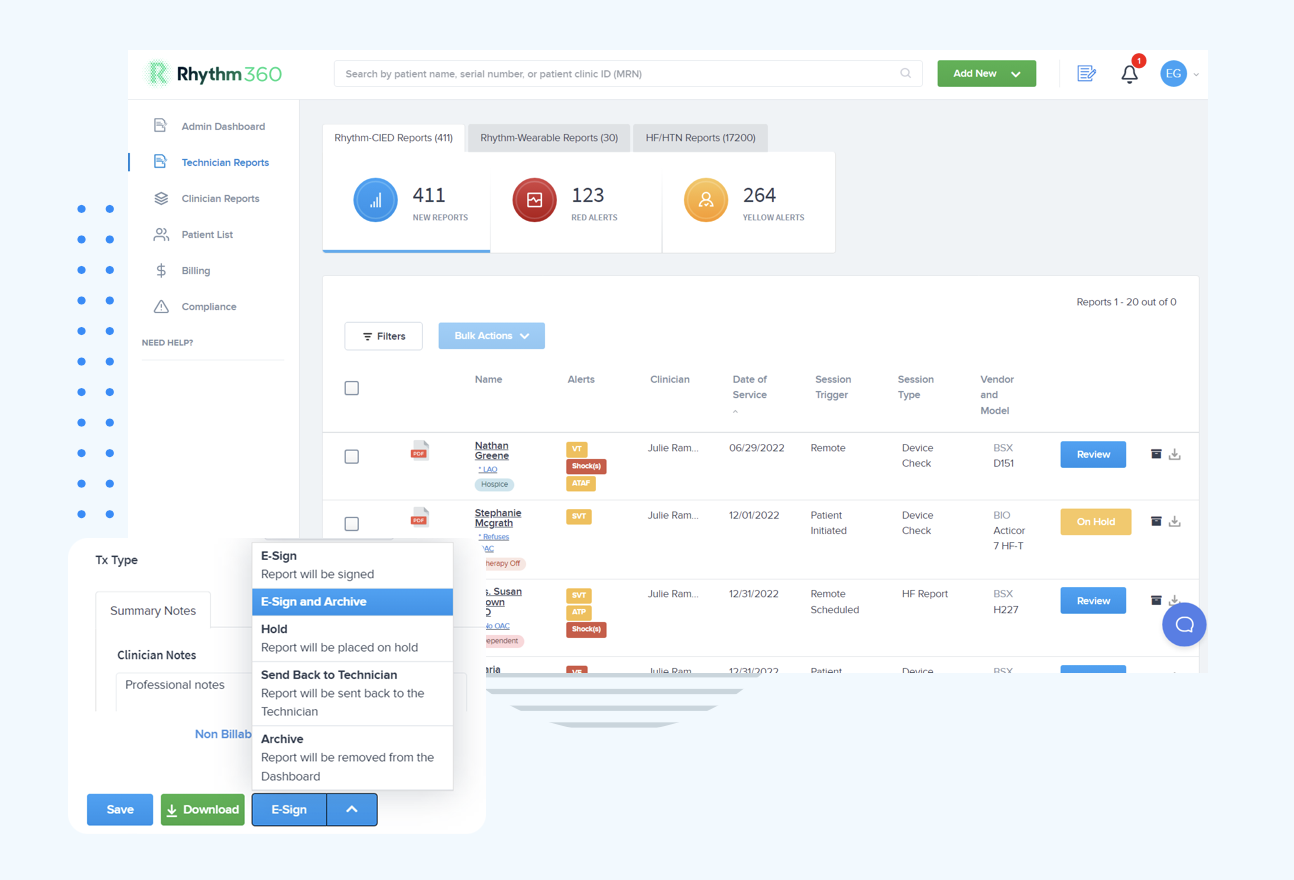
The platform’s AI alert triage filters non-actionable transmissions and prioritizes clinically significant events, achieving the critical response-time reductions that distinguish vendor-neutral automation from manual multi-portal workflows. Automated reporting and bi-directional EHR integration remove manual transcription. An optional 24/7/365 oversight layer staffed by certified cardiac technicians (CCTs) supervised by physicians provides continuous coverage, and a HIPAA-compliant mobile application allows clinicians to review transmissions, sign reports, and coordinate care from any location.
Rhythm360 also supports distinct but integrated service lines for Rhythm-CIED (implantable devices) and HF or HTN remote physiological monitoring. This structure gives teams a centralized workspace for rhythm disorders, heart failure, and hypertension management under a single SaaS-based pricing model that scales with clinic size.
Other vendor-neutral platforms operate in this space, and the evaluation criteria in this guide help decision-makers assess any option against their operational requirements. Schedule a demo to see Rhythm360’s unified dashboard and AI triage capabilities in a live environment configured for your patient volume.
A mid-size EP clinic managing 750 CIED patients provides a representative baseline. At 7.7 transmissions per patient annually, the practice processes approximately 5,775 transmissions per year, and if 40% carry alert classifications, that equals roughly 2,310 alert-level events that require triage and documentation.
Without automation, each transmission requires manual portal login, data retrieval, documentation, and billing preparation. At a conservative estimate of 20 minutes per transmission, staff spend approximately 1,925 hours annually on transmission processing alone, before they even address billing reconciliation or escalation workflows.
Rhythm360’s automated ingestion and documentation layer eliminates the majority of that manual time, which directly enables the revenue gains practices report. Those implementing the platform have seen up to 300% revenue increases, driven by three compounding factors that automation makes operationally feasible: capturing previously missed billable events that manual workflows could not track at scale, reducing claim rejections through consistently compliant documentation, and freeing staff capacity to add RPM service lines for HF or HTN patients that generate new recurring revenue under CPT codes 99453, 99454, and 99457.
Payback on healthcare workflow automation investments can arrive within the first year when teams set measurable baselines before deployment and track specific metrics such as cycle-time reduction. Rhythm360’s implementation timeline of days to weeks shortens the time-to-value window compared with custom-built integrations.
A vendor-neutral platform ingests and normalizes data from all major CIED manufacturers, including Medtronic, Boston Scientific, Abbott, Biotronik, and others, without requiring staff to log into each OEM’s proprietary portal separately. In 2026, this approach matters because most cardiology practices implant devices from multiple manufacturers, and the administrative burden of managing non-interoperable portals has become a primary driver of staff burnout, missed alerts, and revenue leakage. A vendor-neutral platform creates a single source of truth for the entire device population, regardless of manufacturer mix.
AI alert triage applies machine learning models to incoming transmissions to distinguish clinically significant events, such as new-onset atrial fibrillation, ventricular tachycardia, or device malfunction, from non-actionable noise. The system filters transmissions that do not meet clinical thresholds before they reach the care team’s queue, so clinicians see prioritized, actionable alerts instead of an undifferentiated volume of notifications. Rhythm360 maintains greater than 99.9% transmissibility through redundant data feeds and AI-powered extrapolation, which ensures that filtering non-actionable alerts does not create gaps in clinically meaningful data, and the optional 24/7/365 CCT oversight layer adds a human review tier for critical events, particularly during nights and weekends.
The primary CPT codes for remote CIED monitoring are 93298 for subcutaneous cardiac rhythm monitor remote services, 93299 for implantable cardiovascular physiologic monitor remote services, and 99454 for remote physiological monitoring device supply with daily recording or programmed alert transmission. Each code has specific documentation requirements tied to device type, monitoring period, and the nature of the clinical review performed. Manual documentation workflows create gaps when staff manage high transmission volumes across multiple portals, and Rhythm360 automates the generation of audit-ready documentation aligned to each code’s requirements, which reduces claim rejections and captures billable events that would otherwise go undocumented. Practices should confirm code compatibility with their billing team, because certain codes have restrictions on concurrent reporting.
Rhythm360’s implementation timeline usually ranges from a few days to a few weeks, depending on the complexity of the practice’s EHR environment and the number of OEM data feeds that need consolidation. The onboarding process includes EHR integration setup, OEM portal connection, staff training, and configuration of alert escalation protocols. RhythmScience’s pre-built integrations with Epic, Cerner, Athenahealth, eClinicalWorks, Greenway Health, and other systems via HL7 remove the custom development work that often extends timelines in independently managed integration projects, and practices benefit when they document baseline metrics such as transmission review rates, response times, and CPT capture rates before go-live to enable measurable ROI tracking within the first 90 days.
Rhythm360 serves the full range of cardiology providers, from solo practitioners to large integrated health systems. The platform’s SaaS-based pricing scales with clinic size and platform usage, which keeps it accessible to smaller practices without enterprise-level overhead. For solo practitioners and small clinics, the primary value comes from removing the multi-portal administrative burden and automating CPT documentation, while for large health systems the value grows with population management capabilities, multi-site workflow coordination, and the ability to process very high annual report volumes with stable, AI-assisted triage. UCM’s experience demonstrates the platform’s capacity at the high end of the volume spectrum.
The operational and financial case for vendor-neutral workflow automation in cardiac device management now rests on real-world evidence rather than theory. Practices that continue to manage fragmented OEM portals in 2026 absorb measurable costs in staff hours, missed alerts, and uncaptured revenue, and those costs compound as patient populations grow and device mix diversifies.
Rhythm360 consolidates that complexity into a single AI-powered platform with bi-directional EHR integration, automated CPT documentation, and the clinical oversight infrastructure required to cut critical response times and increase revenue capture by as much as 300%. UCM’s real-world results confirm that the platform scales to the demands of high-volume environments without sacrificing signal quality or clinical accountability.
The seven-step readiness assessment in this guide gives practices a structured starting point. The next step is a live demonstration configured to your patient volume and EHR environment.
Schedule a demo and see how Rhythm360 performs against your current workflow with your device mix, your EHR, and your patient population as the baseline.





