The following table shows which clinicians can bill CPT 99454 on their own and what level of supervision applies to each role.
Provider Type | Eligible to Bill 99454? | Supervision Required | Notes |
MDs/DOs | Yes | None | Independent billing authority |
Nurse Practitioners | Yes | None (as QHP) | Must be within scope of practice |
Physician Assistants | Yes | General supervision | State regulations may vary |
Clinical Nurse Specialists | Yes | None (as QHP) | Must be within scope of practice |
Qualified healthcare professionals form the core group allowed to bill CPT code 99454 on their own. This group includes physicians, nurse practitioners, physician assistants, and clinical nurse specialists who meet state licensing rules. In many cardiology practices, an electrophysiologist provides general supervision for device technicians and medical assistants who handle setup and data collection under incident-to billing.
General supervision means the supervising physician stays immediately available by telephone or other telecommunication device. This level of oversight fits cardiology workflows that use CIED-integrated RPM, where electrophysiologists or cardiologists supervise technicians who manage pacemaker and ICD monitoring along with physiologic parameter tracking. The supervising provider reviews and interprets the collected data and then bills for the service.
CPT code 99454 covers the monthly supply of a remote physiologic monitoring device and its initial setup for patients who need ongoing vital sign tracking. The code applies to device provision, patient education, and technical support for equipment that sends data electronically to the care team.
Cardiology practices often use 99454 for heart failure patients who rely on connected weight scales, blood pressure cuffs, and pulse oximeters that integrate with existing CIED systems. Patients with pacemakers or ICDs who also live with heart failure or hypertension gain value from combined rhythm monitoring and physiologic parameter tracking. The device must send data automatically rather than depend on manual patient entry.
The code also covers patient training on device use, troubleshooting support, and ongoing technical assistance during the monitoring period. Many cardiology groups align 99454 billing with established CIED monitoring programs so they can deliver coordinated remote care for patients with complex cardiovascular disease.
Once practices understand what the code includes, they can plan billing frequency and panel size with more confidence.
CPT code 99454 can be billed once per calendar month per patient when the minimum data collection threshold discussed later is met. The billing cycle resets each month, so practices can bill up to 12 times per year for a single qualifying patient. Data collection must occur on at least 16 separate days within the billing month.
Practices cannot bill 99454 more than once in the same month for the same patient, even when they supply multiple devices or replace equipment. This monthly limit supports appropriate use and prevents duplicate billing for overlapping services. Documentation should clearly show that the 16-day minimum data transmission requirement was met for every billed month.
To bill CPT 99454 correctly, your team must meet several specific conditions that auditors can verify in your records.
Requirement | Description | Documentation Needed |
Patient Consent | Written agreement for RPM services | Signed consent form |
16-Day Minimum | Data collection ≥16 days per month | Transmission logs |
Physiologic Data | Weight, BP, heart rate, oxygen saturation | Electronic data records |
Electronic Transmission | Automatic data upload to provider | Device connectivity reports |
The 99454 code requires electronic transmission of physiologic data instead of patient self-reporting or manual entry. Typical parameters include weight for heart failure management, blood pressure for hypertension, heart rate trends, and oxygen saturation. The monitoring device sends this information automatically into the provider’s system.
Patient consent documentation should clearly describe the RPM service scope, data collection methods, and billing expectations. The consent process explains how the device works, what data the practice collects, and how clinicians respond to abnormal readings. Strong consent records protect the practice during audits and help patients understand the service.
Incident-to billing lets non-physician staff such as medical assistants and device technicians perform 99454-related tasks under physician supervision. The supervising physician remains immediately available and has already established the patient’s treatment plan. In cardiology, technicians often manage RPM setup while cardiologists focus on oversight and data interpretation.
Common denial reasons for incident-to 99454 billing include weak supervision documentation, use of unqualified staff, and limited evidence of physician involvement in treatment planning. The supervising clinician reviews transmitted data and makes clinical decisions based on the results. Documentation should clearly show the physician’s role in service delivery and patient management.
Successful incident-to billing depends on staff training, clear supervision protocols, and detailed records of physician oversight. Written policies should define roles and responsibilities for RPM services and align with both incident-to rules and state scope of practice standards.
The 2026 Medicare Physician Fee Schedule keeps RPM reimbursement stable while raising expectations for audit-ready documentation of 99454 claims. March 2026 updates call for more detail on device performance, patient adherence, and clinical decisions based on transmitted data.
New expectations include quarterly device calibration records, stronger patient education documentation, and tighter integration with electronic health records. Practices must show clear clinical protocols for responding to abnormal readings and track patient outcomes tied to RPM interventions. These changes support appropriate use and reinforce quality of care.
Reimbursement for 99454 averages $64 to $68 per month, depending on geography and payer mix. Commercial plans often pay more than Medicare, which increases the value of RPM for practices with diverse patient panels. Reliable monthly billing can meaningfully increase revenue when compliance remains strong.
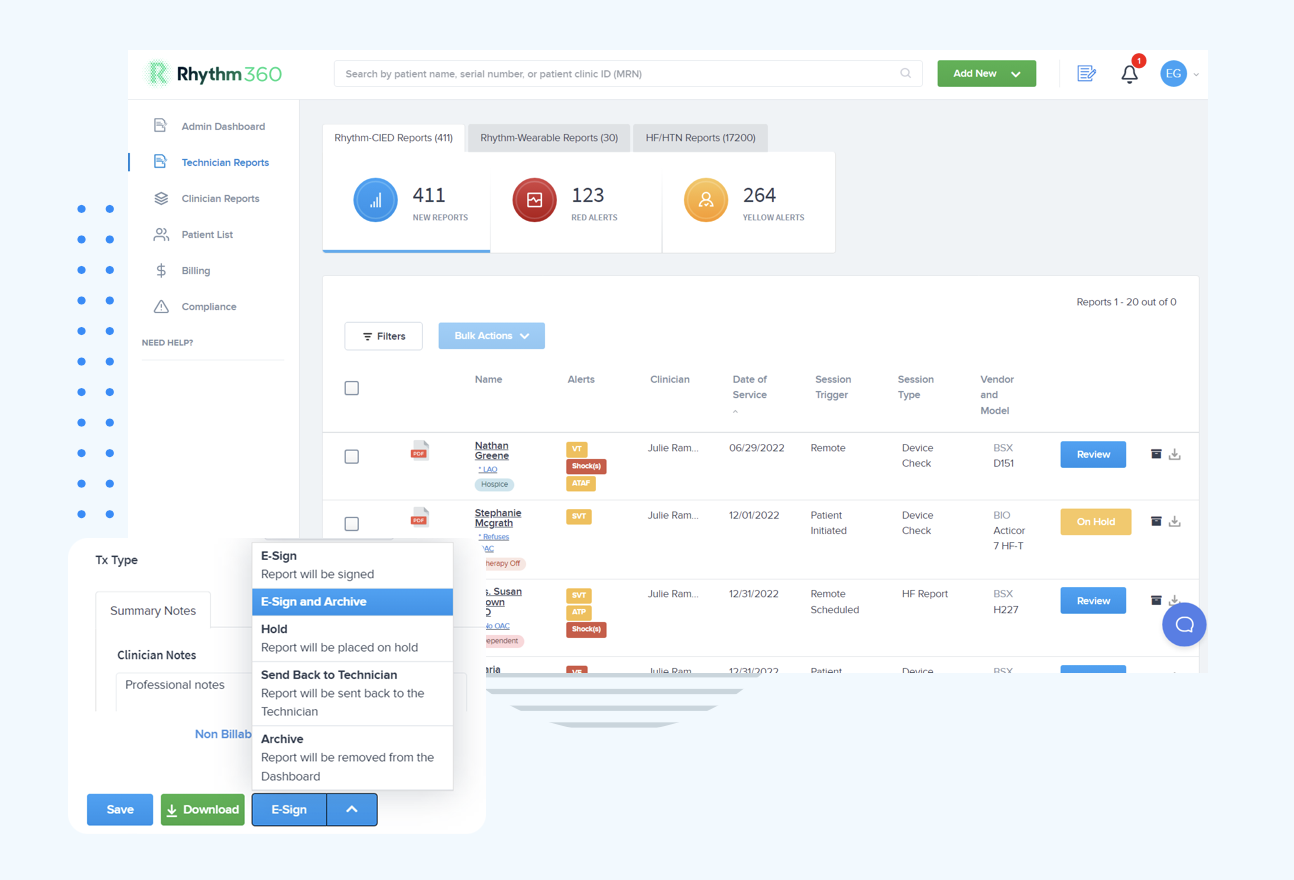
Rhythm360 automates 99454 compliance by pulling data from major device manufacturers such as Medtronic, Abbott, Boston Scientific, and Biotronik. The platform tracks the 16-day threshold, builds compliant documentation, and connects with Epic, Cerner, and other EHR systems. AI-driven dashboards give teams real-time visibility into billable activity and compliance status.
The vendor-neutral platform removes manual data entry and reduces billing errors by capturing physiologic data directly from connected devices. Practices using Rhythm360 report the kind of revenue growth highlighted earlier, along with 80% faster response times to critical alerts. The system supports audit-ready documentation and smoother workflows for technicians and billing teams.
A mid-sized cardiology group recovered $150,000 in missed 99454 revenue within six months of adopting Rhythm360. The platform surfaced patients who met billing criteria but were overlooked because of fragmented systems and manual tracking. See how Rhythm360 can improve your RPM billing and close similar revenue gaps.
Frequent 99454 billing problems include weak supervision records, billing without meeting the 16-day threshold, and missing patient consent. Practices also struggle to prove general supervision when they rely on incident-to billing for technician work. Manual tracking systems often fail to catch gaps in data collection that later trigger denials.
Rhythm360 reduces these risks through automated compliance checks and complete audit trails. The platform tracks supervision needs, monitors data collection patterns, and alerts staff to issues before claim submission. Integrated documentation helps teams meet all RPM requirements while easing the workload on clinicians.
Yes. Nurse practitioners can bill CPT 99454 independently as qualified healthcare professionals. They must follow state scope of practice rules and maintain active licensing. They do not need physician supervision for 99454, but they must personally review and interpret the transmitted physiologic data before billing.
CPT 99453 covers initial setup and patient education for remote physiologic monitoring and is billed once per episode of care. CPT 99454 covers monthly device supply and ongoing technical support and is billed monthly when the minimum data collection requirement is met. Most comprehensive RPM programs use both codes together.
Yes. CPT 99454 can be billed for CIED patients who also need physiologic monitoring for conditions such as heart failure or hypertension. The code applies to additional devices beyond the implanted cardiac device, including connected weight scales and blood pressure cuffs that send data electronically to the care team.
CPT 99454 can be billed up to 12 times per year per patient, once per calendar month when all requirements are met. Each billed month must include at least 16 days of data collection within that specific month. No separate annual cap applies beyond the monthly limit.
Qualified healthcare professionals such as physicians, nurse practitioners, physician assistants, and clinical nurse specialists can supervise incident-to 99454 services. The supervising provider stays immediately available and reviews transmitted data to guide clinical decisions. General supervision usually meets requirements for RPM tasks performed by support staff.
Clear knowledge of CPT 99454 rules helps cardiology practices capture RPM revenue while supporting better outcomes. When teams understand qualified provider roles, supervision expectations, and documentation standards, they can bill confidently and withstand audits. Take the next step toward maximizing your RPM revenue with Rhythm360 and support your staff with automated compliance and streamlined workflows.