

Last updated: July 14, 2026
These four levers work together in sequence. Each one covered below builds on the last, starting with the data itself.
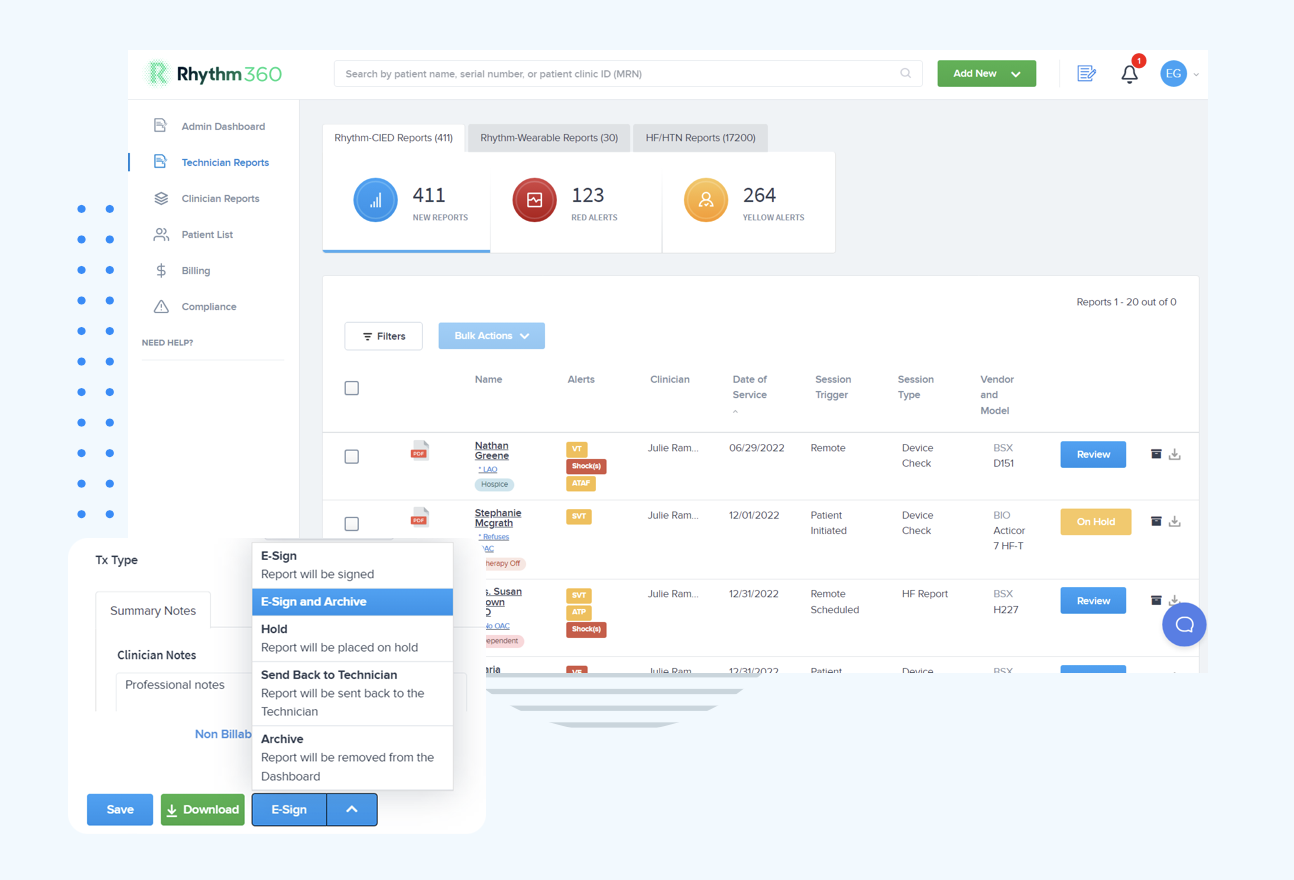
The first lever is vendor-neutral data consolidation. Without it, every later automation step gets undermined by fragmented inputs.
Rhythm360 pulls data from all major CIED manufacturers, including Medtronic, Boston Scientific, Abbott, and Biotronik, through APIs, HL7 feeds, XML parsing, and computer vision-based PDF extraction. A redundant data feed architecture acts as a fail-safe when an OEM server goes down. All incoming data gets normalized into a single, unified dashboard.
The workflow sequence for Step 1 looks like this:
University of Chicago Medicine (UCM) uses Rhythm360 to manage its cardiovascular remote monitoring reports, a volume that would be operationally impossible to manage across disconnected OEM portals.
Pro tip: Audit each OEM connection for transmission gaps before go-live. Rhythm360's connectivity diagnostics flag missing feeds automatically, preventing blind spots from day one.
Success criteria: Critical alerts acknowledged in under 15 minutes from transmission receipt.
Consolidation alone doesn't solve alert fatigue. A unified feed of unfiltered alerts from thousands of devices still overwhelms clinical staff. The second lever is AI-powered alert triage that separates actionable signals from noise before a human sees them.
Rhythm360's AI triage engine applies configurable clinical rules to every incoming transmission. It prioritizes events such as ventricular tachycardia (VT), new-onset atrial fibrillation (AFib), lead malfunction, and elective replacement indicators (ERI/RRT). Routine transmissions get automatically categorized and queued for batch review, while high-priority events surface immediately.
The workflow sequence for Step 2 looks like this:
The clinical and operational impact of AI triage is well-documented. Research published in JACC: Advances shows AI triage tools can reduce the volume of transmissions forwarded for clinician review while maintaining high sensitivity for clinically relevant events. Separately, research on autonomous AI triage agents shows potential to outperform clinician performance in leave-one-out analyses.
Pro tip: Review triage rule performance monthly. If the critical alert queue grows faster than staff can clear it, recalibrate thresholds to reduce false-positive escalations without sacrificing sensitivity.
Success criteria: Fewer than 25% of total transmissions escalated for immediate clinician review, with zero missed VT or device malfunction events.
AI triage identifies the critical event. Automated escalation ensures the right clinician receives it within seconds, not hours. The third lever is tiered routing with mobile push notifications and retry logic.
Rhythm360 routes escalated alerts through configurable pathways based on alert severity, time of day, and clinician availability. The secure, HIPAA-compliant mobile app delivers push notifications to on-call physicians, NPs, or CCTs regardless of location. If an alert goes unacknowledged within a defined window, the system automatically escalates to the next contact in the routing chain.
The workflow sequence for Step 3 looks like this:
UCM's implementation of Rhythm360 helped clinicians identify more abnormalities and address issues earlier. As Dr. Beaser explained: "Rather than waiting for a 3-month visit, we can call patients in for evaluation." That shift from reactive to proactive management is the direct result of automated escalation reaching the right clinician at the right moment.
Rhythm360 also offers optional 24/7/365 oversight by certified cardiac technicians (CCTs) supervised by physicians. This adds a human layer for practices that need around-the-clock coverage without expanding in-house staffing.
Pro tip: Configure weekend and after-hours escalation pathways separately from weekday workflows. A Saturday morning VT alert requires a different routing chain than a Tuesday afternoon routine transmission.
Success criteria: 100% of critical alerts acknowledged by a qualified clinician within 15 minutes of transmission receipt, with full audit trail documentation.
The final lever closes the loop between the monitoring platform and the clinical record. Without bi-directional EHR synchronization, clinicians who respond to an alert must still manually transcribe findings into the EHR. That extra step costs time and introduces transcription errors that delay CPT documentation.
Rhythm360 supports bi-directional FHIR EHR synchronization with Epic, Cerner, Athenahealth, eClinicalWorks, Greenway Health, and others via HL7. Device data, alert details, clinical reports, and response documentation flow automatically into the patient's EHR record. At the same time, the platform pulls patient demographics, active diagnoses, and medication lists from the EHR to provide full clinical context at the point of alert review.
The workflow sequence for Step 4 looks like this:
Manual transcription is a well-documented source of error in EHR workflows. Eliminating it, as Rhythm360's FHIR sync does, directly reduces the risk of missed or delayed documentation tied to poorly configured EHR operations.
Pro tip: Validate FHIR mapping against your EHR's sandbox environment before go-live. Mismatched field mappings are the most common source of synchronization errors and can delay CPT documentation capture.
Success criteria: Zero manual transcription steps between Rhythm360 alert response and EHR documentation, with CPT-eligible events captured automatically within the same workflow session.
The four steps above each replace a specific manual bottleneck. The table below lines up the old process against the Rhythm360 process for each one, so you can see where the time and revenue gains actually come from.
| Process Step | Manual Workflow | Rhythm360 Automated Workflow | Outcome |
|---|---|---|---|
| Data retrieval from OEM portals | Staff log into multiple separate portals per patient; data reconciled manually | All OEM feeds consolidated into one dashboard via API, HL7, XML, and computer vision | Eliminates redundant logins; single source of truth for all device data |
| Alert triage and prioritization | Clinicians review all incoming transmissions without automated filtering; high false-positive burden | AI triage engine filters and prioritizes events automatically | Significant reduction in non-actionable alert volume; clinicians focus on high-priority events |
| Critical alert escalation | Manual phone calls or pages; no retry logic; response time dependent on staff availability | Automated tiered routing with mobile push notifications and configurable retry escalation; full timestamp audit trail; optional 24/7 CCT oversight | Faster response times, as detailed in Step 3 above |
| EHR documentation and billing capture | Manual transcription of device findings into EHR; CPT codes documented separately or missed | FHIR-native bi-directional EHR sync pushes structured reports automatically; CPT-eligible events captured within the alert response workflow | Stronger revenue capture, as detailed in Step 4 above |
These comparisons raise practical questions practices often ask before adopting the platform. The section below covers the ones that come up most.
Implementation timelines vary based on practice size, the number of OEM data feeds being connected, and the complexity of the EHR integration. For most practices, full onboarding, including OEM connectivity setup, EHR integration configuration, and staff training, wraps up within a few days to a few weeks. Rhythm360's implementation team manages the technical integration, which minimizes disruption to existing clinical workflows during the transition.
Yes. Rhythm360 includes a secure, HIPAA-compliant mobile app that lets electrophysiologists, cardiologists, NPs, PAs, and CCTs review device transmissions, acknowledge alerts, sign clinical reports, and coordinate care from their smartphones. The app supports one-tap acknowledgment for escalated critical alerts, so on-call clinicians can respond regardless of location, including evenings, weekends, and holidays.
Rhythm360 is a HIPAA-compliant, cloud-based platform built with data security as a foundational requirement. All patient data is encrypted in transit and at rest. The platform maintains a full audit trail of alert acknowledgments, escalation events, clinician actions, and patient communications, including phone call logs through its integrated Twilio framework. Access controls, role-based permissions, and secure authentication protect against unauthorized access. The FHIR EHR integration uses authenticated, standards-compliant data exchange protocols with Epic, Cerner, and other supported EHR systems.
Rhythm360 automates the capture of documentation required for remote monitoring CPT codes, including 93298, 93299, 99454, and related codes. When a clinician responds to an alert and completes the workflow within the platform, the relevant documentation generates and syncs to the EHR automatically. The administrative dashboard shows captured and potential billable events across the patient population in real time, helping practices recover revenue that would otherwise be lost to incomplete or delayed documentation. As noted earlier, this combination of optimized CPT capture and improved staff efficiency drives significant revenue gains for practices.
The four workflow automation levers, vendor-neutral data consolidation, AI-powered alert triage, automated escalation pathways, and FHIR-native EHR synchronization, address the root causes of slow cardiac alert response times. Each step builds on the previous one. Consolidated data enables accurate AI triage. AI triage enables meaningful escalation. Automated escalation paired with EHR sync eliminates the manual steps that delay both clinical response and billing capture.
These response time and revenue gains, outlined above, demonstrate that the improvements scale to high-volume environments. University of Chicago Medicine processed more than 73,000 reports annually through the platform in 2025, without sacrificing clinical accuracy.
For cardiology practices and EP clinics still managing fragmented OEM portals and manual triage workflows, the gap between current operations and what automation makes possible carries both clinical risk and financial cost. JACC editorial guidance published in 2026 recommends that practices define the alert-to-action pathway as the true clinical intervention. That pathway starts with the infrastructure to receive, triage, escalate, and document alerts without manual bottlenecks.
Ready to cut alert response times at your practice? Talk to the Rhythm360 team.





