

Last updated: July 14, 2026
Most RPM practices bill only the device supply code, 99454, and leave management revenue under 99457 and 99458 uncollected each month. Manual processes cannot sustain per-patient minute tracking across panels of 50 or more patients, which is where the money disappears. Four automation drivers close these gaps: automated CPT time tracking, bidirectional EHR integration, AI-powered alert triage, and pre-submission claims scrubbing. Each one targets a specific leak, and together they turn latent billing eligibility into captured revenue without adding staff. The steps below walk through how each driver works in practice, starting with the time-tracking problem that costs practices the most.
Action: Replace manual time logs with a platform-level, per-patient minute counter. It timestamps every qualifying activity, including data review, care plan adjustment, and live interactive communication, and blocks claim release until threshold conditions are met.
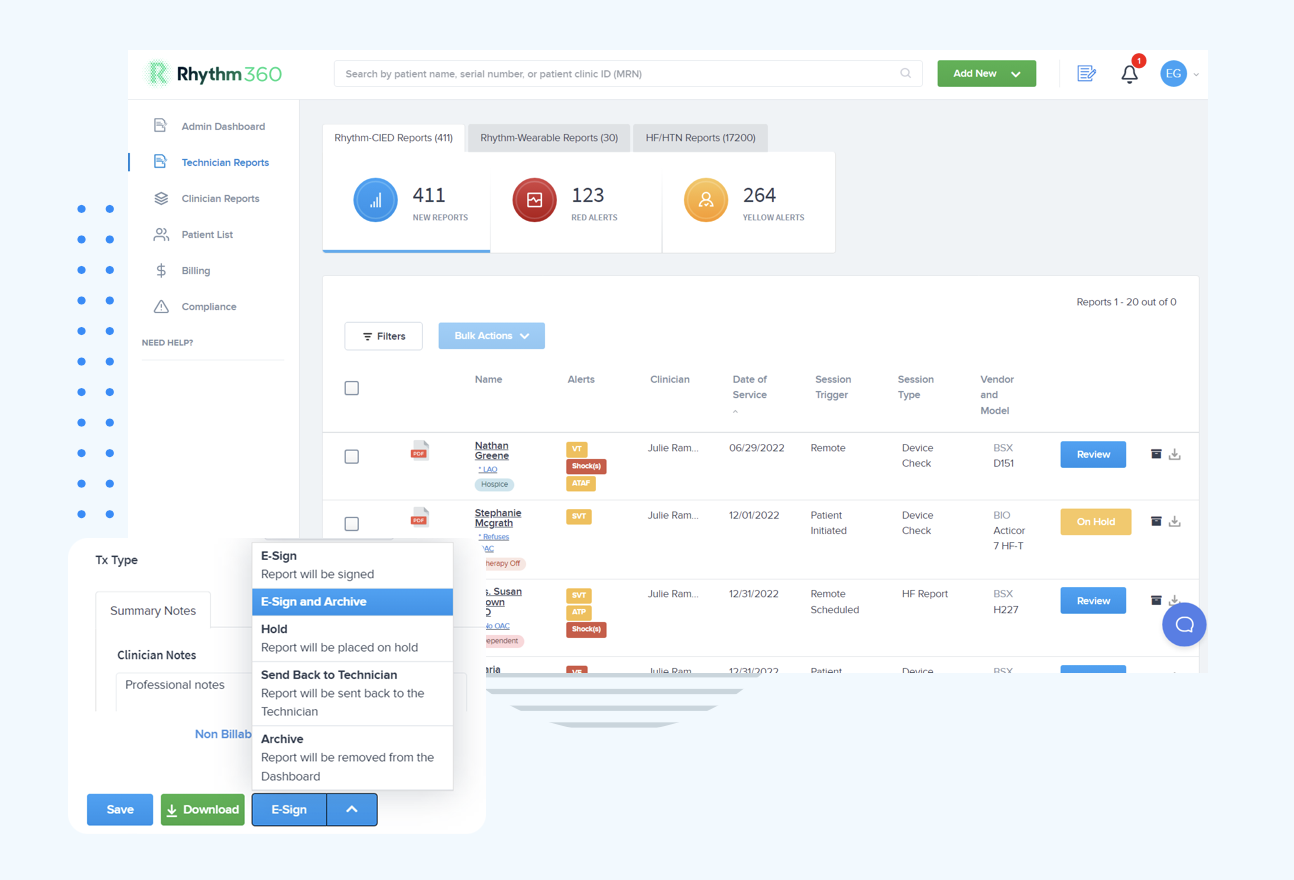
By normalizing real-time transmission feeds from Medtronic, Boston Scientific, Abbott, and Biotronik into a single dashboard, Rhythm360 makes it possible to track the 20-minute threshold required for CPT 99457 and the additional 20-minute increments billable under 99458. These are thresholds manual logs routinely miss. Automation improves RPM capture rates compared with manual processes, adding meaningful revenue for practices with large Medicare RPM panels.
Rhythm360's CPT dashboard displays each patient's accumulated qualifying minutes, transmission day count, and interactive communication status in one view. RPM billing requires proper documentation of time and clinical activities, and the platform enforces those requirements automatically.
Pro tip: A 4-provider internal medicine group saw 41% of 99454 claims denied because patients transmitted data on only 14 days instead of the required 16, due to a lack of automated transmission tracking. Rhythm360's redundant data feeds maintain greater than 99.9% transmissibility even during a single OEM portal outage, protecting both device supply and management code eligibility at once.
Action: Configure bidirectional HL7 integration between Rhythm360 and the practice EHR. Device data, time logs, and interactive communication records then flow automatically into the patient chart and billing module, with no manual transcription.
This connects to Epic, Cerner, Athenahealth, eClinicalWorks, Greenway Health, and others, covering CPT 99453 (setup and education), 99454 (device supply and transmission), and 99457 (treatment management time). A 6-provider internal medicine group reached 96.4% RPM first-pass claim acceptance after adding automated pre-bill scrubbing and EHR time-log templates, landing above the HFMA MAP Keys benchmark of 95%.
RPM management time under 99457 and 99458 must be tracked separately from CCM time to avoid duplicate-billing denials when both services are billed in the same month. Rhythm360's bidirectional sync enforces this separation at the data layer, so claim-ready documentation arrives in the billing queue already segmented by service type. University of Chicago Medicine reported improved billing and accountability after integrating a centralized workflow platform, a direct result of eliminating manual hand-offs between device portals and the EHR.
Action: Deploy AI-powered alert ranking that suppresses non-actionable transmissions, routes clinically significant events to eligible personnel, and timestamps every review as a qualifying billable activity.
Rhythm360's AI triage engine filters normalized alert feeds from all connected CIED and RPM devices, with optional 24/7 oversight from certified cardiac technicians. Clinician review time only counts toward the 99457 20-minute threshold when performed by eligible personnel with documented clinical substance, so filtering out noise directly protects billable minutes. Rhythm360 cuts critical alert response times by up to 80%. Separately, personalized baselines in RPM anomaly detection reduce false alerts by 60-80% compared with fixed thresholds, which frees clinical staff to spend billable time on events that actually move care plans forward.
Every ranked alert routes to an eligible clinician or CCT for active review before any billing timestamp gets generated, keeping each captured minute audit-defensible. As the same University of Chicago Medicine white paper noted, AI-assisted decision support becomes more important as data volumes grow, enabling earlier interventions instead of waiting for scheduled visits.
Pro tip: Across studied hospital settings, 80-99% of alarms are false or clinically insignificant. Non-actionable alerts consume billable clinical time without advancing care or generating a reimbursable event. AI triage is the main mechanism for converting alert volume into billable, clinically substantive review time.
Action: Run an automated pre-submission scrub on every RPM claim. It validates transmission day counts, reconciles time logs against CPT thresholds, confirms interactive communication documentation, and checks for bundling conflicts before the claim goes out.
Rhythm360's billing documentation module cross-references CMS 2026 PFS threshold rules and payer-specific edit libraries, covering all three codes required for a complete RPM claim: 99453, 99454, and 99457. Organizations using comprehensive claim scrubbing software typically see denial write-off reductions of 40% to 60% and clean claim rate improvements of 3 to 8 percentage points, matching the 95% HFMA benchmark noted earlier. Reworking a single denied Medicare Advantage claim costs an average of $47.77 in administrative effort. Catching the error at the scrubbing stage eliminates that cost entirely.
Three denial reasons account for most of what the scrub prevents:
Action: Use Rhythm360's redundant data ingestion infrastructure, combining API, HL7, XML, and computer vision-based PDF parsing, to expand the monitored panel across CIED, heart failure, and hypertension service lines without hiring proportionally more staff.
The same greater-than-99.9% transmissibility described in Step 1 makes this possible at scale, since redundant OEM feeds and AI-powered data extrapolation keep CPT codes 99453 through 99457 billable across all three service lines simultaneously. Practices using Rhythm360 have reported up to a 300% increase in revenue through better CPT code capture and new RPM service lines. This kind of scaling is only sustainable if the underlying infrastructure can handle volume: University of Chicago Medicine, cited earlier for its billing gains, also managed over 73,000 reports annually with stable dismissal rates using the same centralized approach, proof that automation supports high-volume monitoring without proportional staffing growth.
Measurable success criteria for this step include:
Curious how much revenue your practice is currently missing on 99457 and 99458? Talk to Rhythm360 about a claims capture audit tailored to your panel size.
The five steps above explain why each automation layer matters. Rolling them out in the right order matters just as much, so here is the sequence that gets a cardiology practice from zero to a fully automated RPM workflow.
The rollout plan above covers desktop-based review, but a growing share of clinician review now happens on mobile devices, and that time needs the same billing protection. Rhythm360's HIPAA-compliant mobile app lets electrophysiologists, cardiologists, NPs, and PAs review transmissions, sign reports, and coordinate care from anywhere. Every mobile review action generates the same timestamped, attributable documentation as a desktop session, so after-hours or on-call review time counts toward monthly 99457 thresholds without creating audit gaps.
The platform's Twilio communication framework logs every patient-facing message and call, including automated reminders for disconnected devices and manual care-coordination calls, with a full audit trail in the patient record. Asynchronous texting must be logged separately from billable RPM minutes under CPT 99457 to avoid inflating time logs with non-qualifying activity that triggers denials. Rhythm360's Twilio integration tags each communication as billable or non-billable at the point of logging, so the audit trail stays clean before the claim is ever assembled.
Workflow determines whether every billable clinical event, such as a device transmission review, a care plan update, or a live patient call, gets captured, documented, and submitted with the evidence needed for first-pass claim acceptance. CPT codes 99457 and 99458 require documented time thresholds, interactive communication logs, and clinical narrative summaries that manual workflows routinely fail to produce consistently. When workflow steps are automated and sequenced correctly, each patient encounter generates a complete, audit-ready record before submission. When they're not, practices face denial rates that can exceed 40% on individual code lines, rework costs averaging nearly $48 per denied Medicare Advantage claim, and revenue leakage that compounds month over month.
Workflow automation delivers measurable improvements across four areas. It eliminates the manual tracking failures that cause missed 99457 thresholds, since per-patient minute counters and threshold alerts tell staff in real time which patients need more monitoring time before the month closes. Bidirectional EHR integration removes manual transcription from the documentation chain, cutting the coding errors and data mismatches that generate denials. AI-powered alert triage converts high-volume, low-signal feeds into prioritized review queues, protecting billable time from non-actionable notifications. Pre-submission claims scrubbing catches missing time logs, mismatched transmission counts, and incomplete documentation before a claim reaches the payer. Together, these layers let cardiology practices add heart failure and hypertension service lines alongside CIED monitoring without hiring proportionally more staff.
CPT 99457 is affected the most because it requires at least 20 minutes of qualifying time plus one synchronous live interactive communication per calendar month, conditions manual workflows can't reliably enforce across panels of 50 or more patients. CPT 99454 comes second, since it requires 16 or more days of device data transmission per 30-day period, a threshold automated tracking monitors daily while manual tracking often catches failures only at month end. CPT 99453 (initial setup and education) benefits through standardized onboarding checklists and consent documentation that prevent eligibility denials before monitoring begins. The 2026 CMS Physician Fee Schedule also introduced CPT 99445 for 2-15 days of transmitted data, giving practices a billing pathway for shorter windows that previously went unpaid, one that only automated day-count tracking can reliably capture.
Vendor-neutral integration eliminates the data fragmentation behind most RPM billing failures in cardiology practices. When patients use devices from multiple manufacturers, such as Medtronic, Boston Scientific, Abbott, and Biotronik, staff must log into separate, non-interoperable portals to retrieve transmission data. Each login is a potential gap. A portal outage, a silently failed transmission, or unreconciled data between manufacturers can cost the practice device supply and management code eligibility for that patient that month. A vendor-neutral platform that normalizes data from all manufacturers into one source of truth, with redundant feeds keeping transmissibility above 99.9%, closes those gaps systematically. Transmission day counts, alert histories, and device status records stay current and available to the claims scrubbing engine before submission.
Manual RPM workflows leak revenue at every step: missed 99457 time thresholds, fragmented OEM portal data, non-actionable alerts eating billable time, and incomplete documentation reaching payers as denied claims. The automation steps outlined here, covering CPT time tracking, EHR integration, AI alert triage, claims scrubbing, and headcount-neutral scaling, address each leak with a specific, measurable fix. Practices that implement all of them consistently hit the clean claim and denial reduction benchmarks noted earlier, with revenue increases reaching 300% when new HF and HTN service lines join an existing CIED monitoring program.
Rhythm360 delivers all of these automation drivers in one vendor-neutral, HIPAA-compliant platform that integrates with every major EHR and every major device manufacturer, without requiring extra headcount or a long implementation timeline. Schedule a demo to see how Rhythm360 maps to your practice's current CPT code capture gaps and what your reimbursement recovery could look like in the first billing cycle.





