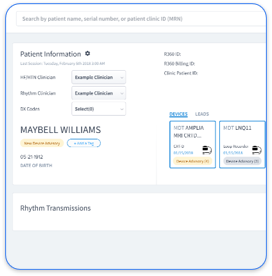
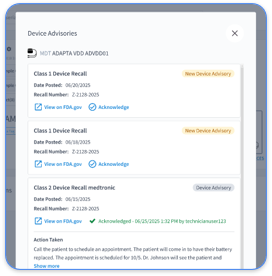
Rhythm360 is a cloud-based, HIPAA-compliant platform that achieves more than 99.9% data transmissibility through API, HL7, XML, and OCR-powered AI integration. The system unifies CIED data from Medtronic, Boston Scientific, Abbott, and Biotronik while connecting directly to Epic, Cerner, and other EHR systems. Rhythm360 delivers comprehensive vendor neutrality with deep cardiac specialization, unlike PaceMate or Implicity. The platform also includes Twilio-powered patient outreach and a secure mobile app for on-call access. In real-world use, a Saturday morning AFib alert in Rhythm360 can trigger same-day anticoagulation and help prevent a stroke that manual workflows might miss.

Schedule a demo of Rhythm360 for vendor-neutral relief: https://www.rhythm360.io/contact-us
First, connect all OEM data feeds directly to the Rhythm360 unified dashboard through secure API integrations. Next, allow AI algorithms to normalize different data formats automatically and remove the need for manual portal logins. Rhythm360’s redundant data feed system prevents outages when individual OEM servers fail and keeps monitoring continuous. This automation saves practices 6-8 hours every week that previously went to manual data retrieval across multiple vendor portals.
Start by configuring AI filters that remove non-actionable noise from routine device checks. Then prioritize clinically significant events such as AFib onset, ventricular arrhythmias, and device malfunctions. AI triage systems reduce alert response times by 80% and help prevent alert fatigue. Legacy systems often overwhelm clinicians with false positives. Rhythm360’s intelligent filtering mirrors the Cleveland Clinic’s real-time seizure detection protocols and accelerates critical interventions.
Begin by tracking billable events for CPT codes 93298, 93299, and 99454 automatically within each patient workflow. Then generate compliant documentation that meets CMS requirements without manual effort from staff. Automated RPM billing delivers 300% revenue increases with net margins of 40-60%. The 2026 CMS updates that introduce CPT 99445 and 99470 codes unlock additional reimbursement opportunities for shorter monitoring periods.
First, establish HL7 connections that enable automatic data flow between Rhythm360 and Epic, Cerner, or other EHR systems. Then remove manual transcription by synchronizing patient reports, alerts, and billing documentation in real time. This integration prevents data entry errors and saves clinical staff 2-3 hours each day that previously went to manual EHR updates.
Start by deploying Twilio-powered automated reminders for device transmissions and appointment scheduling. Then escalate to personal calls only when automated outreach does not succeed. Automated patient communication reduces manual follow-up calls by 50% while maintaining complete audit trails for compliance documentation.
Configure customizable dashboards that display patient compliance metrics, revenue tracking, and clinical outcomes. Then monitor population-level trends and build proactive intervention strategies instead of reacting to individual events. These dashboards help practice administrators spot revenue opportunities and clinical risks without creating manual reports.
Download the Rhythm360 HIPAA-compliant mobile application for secure remote access to patient data. Then review transmissions, sign reports, and coordinate care from any location. In one common scenario, weekend VT detection through the mobile platform enables immediate device reprogramming and prevents an emergency department visit.
Workflow automation reduces RPM administrative burden through seven core mechanisms:
AI-powered RPM systems reduce hospital readmissions by 25% through predictive accuracy and shift documentation from reactive to proactive. Virtual heart failure ward pilots using AI triage achieved 30% readmission reductions over 6 months while limiting unnecessary clinician alerts through green-light stable patient classifications.
AI algorithms automatically generate compliant documentation for CPT billing and turn time-intensive manual tasks into streamlined workflows. These workflows support clinical decision-making instead of adding administrative overhead.
AI-powered virtual care platforms achieve nurse-to-patient ratios exceeding 1:12 and allow practices to scale without hiring more staff. Multi-specialty ACOs that implement RPM automation achieve a 5x return on investment through lower acute care utilization and better patient outcomes. Net margins of 40-60% become achievable when automation removes manual workflow bottlenecks that previously forced additional staffing.
Workflow automation turns cardiac RPM from an administrative burden into a profitable growth engine. Practices can expect 80% faster alert responses, up to 300% revenue increases, and scalable operations without staff expansion. Advanced programs can launch integrated HF and HTN service lines using the same automation infrastructure. Next, complete Rhythm360 onboarding within days to weeks instead of months.
Schedule a demo of Rhythm360 for low-friction transformation: https://www.rhythm360.io/contact-us
RPM administrative burden includes the time-intensive manual tasks required for remote patient monitoring. These tasks include logging into multiple OEM portals, transcribing device data into EHRs, managing alert fatigue from non-actionable notifications, and generating compliant documentation for CPT billing. These workflows often consume 6-10 hours each day for cardiology practices that manage CIED patients across multiple device manufacturers.
Rhythm360 provides bi-directional integrations with Epic, Cerner, Athenahealth, eClinicalWorks, Greenway Health, and other major EHR systems. The integration synchronizes data automatically and removes manual transcription while keeping patient reports, alerts, and billing documentation up to date in real time. Onboarding, including integration setup, usually takes from a few days to a few weeks.
RPM automation delivers operational benefits within 30-60 days through reduced manual workflows and faster alert responses. Financial ROI becomes visible within 90-120 days as automated CPT billing captures revenue that teams previously missed. Practices often achieve a 5x return on investment within the first year through combined efficiency gains and stronger revenue capture.
Automation reduces alert fatigue through AI-powered triage systems that filter non-actionable notifications and highlight clinically significant events such as AFib onset, ventricular arrhythmias, and device malfunctions. This intelligent filtering cuts alert volume by 70-80% and ensures that critical events receive immediate attention. Clinicians avoid notification overload that can cause burnout and missed events.
Workflow automation supports dramatic scaling through nurse-to-patient ratios that exceed 1:12 compared with 1:4 ratios in manual workflows. Automated data ingestion, AI triage, and billing compliance remove bottlenecks that once required more staff as patient volumes grew. Practices can expand from 50 to more than 500 RPM patients while keeping the same core team by using a comprehensive automation platform.