Last updated: July 14, 2026
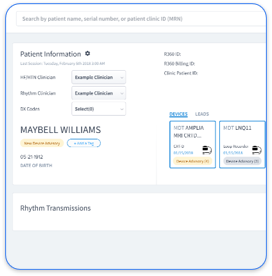
Enrollment is the first point where manual processes create delay and compliance risk. To eliminate these vulnerabilities at the source, Rhythm360 automates the complete onboarding checklist, including consent collection, device registration, and initial connectivity verification. No patient enters the monitoring program without a confirmed transmission pathway.
Pro Tip: Configure automated day-3 and day-7 connectivity checks after enrollment. If a device fails to transmit within the first week, the platform flags the patient for a technician callback before the 16-day window is at risk.
Troubleshooting Connectivity Gaps: When an OEM server becomes temporarily unavailable, Rhythm360’s redundant data feed system activates as a fail-safe. The computer-vision OCR layer parses any available PDF transmissions to keep data flowing. This architecture supports the platform’s greater than 99.9% transmissibility rate and keeps enrollment records complete during OEM outages.
As Gaurav A. Upadhyay, MD, FACC, FHRS, Director of the Pacing & Defibrillation Device Clinic at the University of Chicago Medicine, noted, “Staffing was always an issue for our center, because our device clinic — like many other medical centers — had struggled with technician turnover and timely weekend coverage.” Automated enrollment and connectivity verification reduce dependence on individual staff members to manually initiate and confirm patient onboarding.
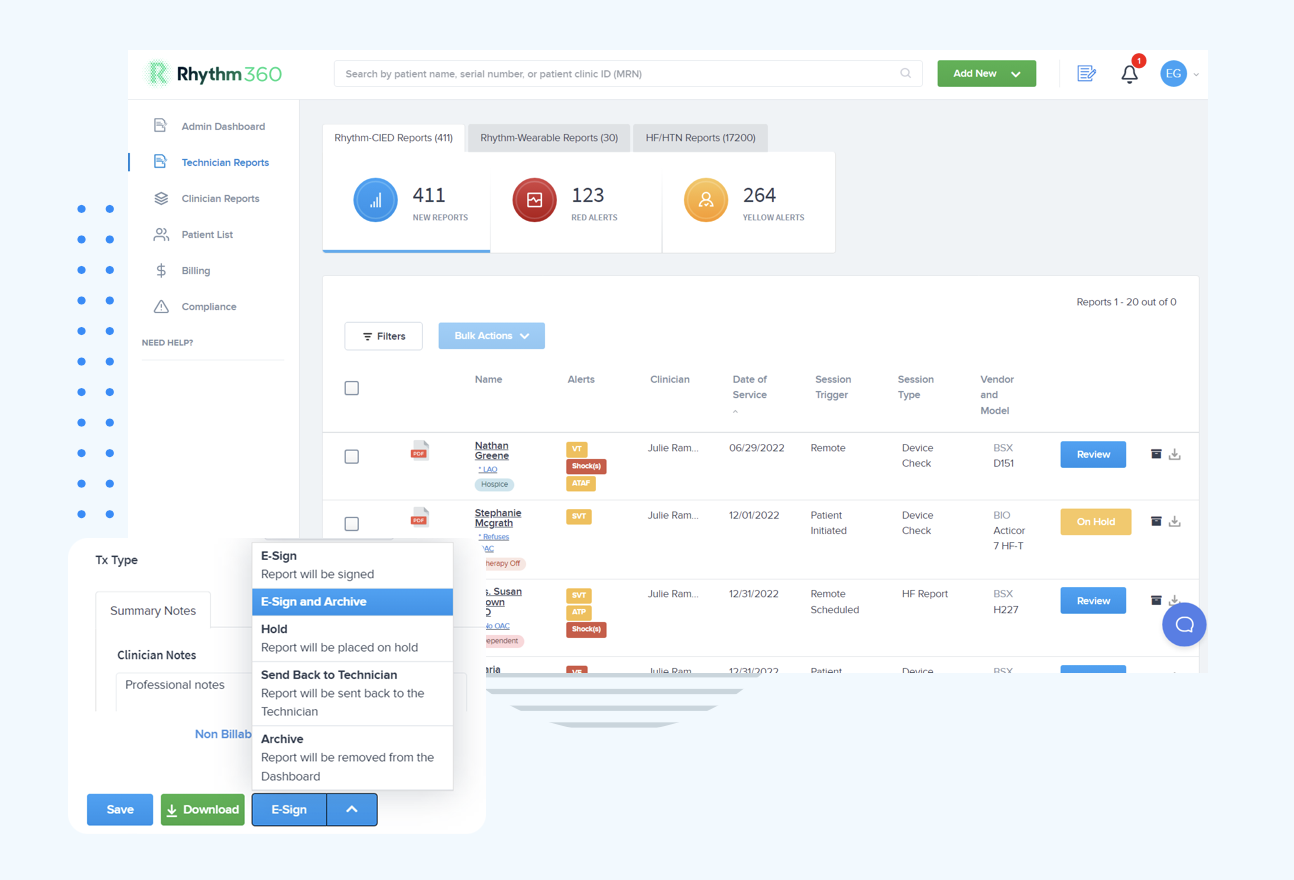
Cardiology practices that implant devices from more than one manufacturer immediately inherit a fragmented data environment. Rhythm360 ingests transmissions from Medtronic, Boston Scientific, Abbott, Biotronik, and other OEMs through API connections, HL7 feeds, XML parsing, and computer-vision PDF extraction. All data is normalized into a single triage queue and paired with the correct 90-day billing cycle for CIED interrogation codes such as 93296, 93297, and 93298.
This consolidation becomes critical at scale. UCM processed more than 73,000 reports annually through Rhythm360 in calendar year 2025, averaging more than 18,000 reports per quarter, a volume that is operationally unsustainable without a unified, vendor-neutral ingestion layer. As Dr. Upadhyay stated, “That was a big piece for us, to have an integrated review of data from trained personnel.”
Alert fatigue creates real clinical risk in CIED monitoring programs. Machine learning models trained on large arrhythmia datasets have shown higher specificity in separating clinically meaningful rhythm changes from artifact compared with conventional threshold-based alarm systems, cutting false-positive alarms while preserving sensitivity to true events. Rhythm360 applies this approach through a hybrid AI-human triage model. AI filters non-actionable transmissions and surfaces only high-priority events such as ventricular tachycardia, new-onset AFib, lead malfunction, and ERI/RRT alerts to certified cardiac technicians supervised by physicians.
In the LINK-HF2 trial of AI-enabled remote monitoring, 95% of AI-generated alerts were reviewed by clinicians within 24 hours, and 26.7% of reviewed alerts led to clinical action such as therapy adjustment. These results show that a well-calibrated AI triage layer increases the clinical yield of each human review instead of replacing it.
Pro Tip: Set AI triage thresholds at the device-type level, not only at the practice level. A pacemaker-dependent patient needs different alert sensitivity than a patient with an ILC for unexplained syncope. Rhythm360’s per-patient threshold configuration prevents over-alerting that drives technician burnout while maintaining safety for high-acuity device populations.
As Roshini Moodley Naidoo, MBA, MPH, MBChB, Professor of Practice at Arizona State University, outlined at the 10th Remote Patient Monitoring Summit, successful RPM programs rely on dashboards that surface actionable data, thresholds that reduce noise, defined triage responsibilities, and clear escalation protocols. Rhythm360’s architecture aligns directly with this model.
The 16-day transmission requirement for CPT 99454 remains the most common source of preventable claim denials in CIED and chronic cardiac RPM programs. Automation systems track the rolling 30-day window of transmissions. On day 21 of a window with only 12 transmissions logged, the system flags the patient and triggers an outreach task to verify device function and adherence, enforcing the 16-day transmission requirement for CPT 99454 upstream of claim submission.
Rhythm360 applies this upstream enforcement in real time. When the threshold is at risk, the platform sends an automated Twilio patient message and creates a staff task. These actions prevent denials before they occur instead of processing them weeks after month close. Upstream transmission enforcement helps recover lost 99454 revenue in cardiology RPM programs.
However, the billing landscape itself continues to evolve. Medicare’s 2026 RPM rules require practices to select either CPT 99445, which covers device supply for 2–15 days of data in a 30-day period, or CPT 99454, which covers device supply for 16–30 days of data in a 30-day period, but not both. In addition, the 16-day rule governs device supply codes 99453 and 99454 but does not apply to time-based RPM treatment management codes such as 99457, 99458, or the new 99470. Rhythm360’s billing engine enforces these distinctions automatically, stages claims with the correct code selection, and flags exceptions before submission.
Schedule a demo to see how Rhythm360 enforces 16-day tracking across your full patient panel.
Every interaction within Rhythm360, including transmission review, alert acknowledgment, patient communication, report signature, and billing action, is timestamped and stored in a complete, immutable audit trail. Automation produces an on-demand per-patient, per-month OIG audit packet that contains exact timestamped minutes logged, staff attribution, interactive communications, transmission counts, and source device events, replacing manual document-retrieval scrambles that expose documentation gaps.
The Rhythm360 HIPAA-compliant mobile application extends this audit capability beyond clinic walls. On-call clinicians can review transmissions, sign reports, and coordinate care from their smartphones, and every action is logged to the patient record. This coverage closes gaps that occur when a critical alert arrives on a weekend and the reviewing clinician is off-site. Andrew Beaser, MD, Associate Professor of Medicine at UCM, described this as enabling earlier intervention: “We are able to address these issues earlier; rather than waiting for a 3-month visit, we can call patients in for evaluation.”
The tables below compare the pre-implementation state using RhythmScience legacy manual processes with the post-implementation state using the Rhythm360 automated platform. They highlight operational and financial changes based on documented outcomes.
| Operational Metric | RhythmScience (Pre-Automation) | Rhythm360 (Post-Automation) |
|---|---|---|
| OEM portal logins per review session | Multiple separate logins (Medtronic, Abbott, Boston Scientific, Biotronik) | Single unified dashboard, all OEM data normalized automatically |
| Critical alert response time | Hours to days (manual triage, weekend coverage gaps) | Up to 80% reduction in critical alert response time |
| 16-day CPT 99454 compliance enforcement | Manual spreadsheet tracking, denials discovered after submission | Automated day-21 flag and patient outreach, denials prevented upstream |
| Weekend/on-call transmission review | Dependent on on-site staff availability, technician turnover and timely weekend coverage identified as persistent challenge | HIPAA-compliant mobile app enables remote review and report signing from any location |
| Financial Metric | RhythmScience (Pre-Automation) | Rhythm360 (Post-Automation) |
|---|---|---|
| CPT revenue capture rate | Manual processes, billing capture lower prior to automation | High capture rates on eligible CPT codes after adding automated time-tracking and audit trails |
| Revenue increase through optimized CPT capture | Baseline (pre-implementation) | Up to 300% increase in revenue generation through optimized CPT code capture and improved staff efficiency |
| Billing accountability | Fragmented documentation across OEM portals and manual logs | “We have improved billing and accountability for our patients after the integration” — Gaurav A. Upadhyay, MD, UCM |
Clear success criteria before and after automation help practices quantify ROI and uncover remaining improvement opportunities. The metrics below work together as a practical measurement framework.
Practices that stabilize their CIED monitoring workflow on Rhythm360 can expand into heart failure and hypertension remote physiological monitoring with minimal extra infrastructure. Rhythm360 offers distinct but integrated service lines for Rhythm-CIED and HF/HTN that share the same unified dashboard, audit logging, and billing automation layer.
Cardiology practices running automated multi-vendor RPM and CIED workflows can scale to 800-patient CCM/RPM programs while maintaining the same clinical staff headcount and achieving high capture rates on all codes in the stack. For HF programs specifically, next-generation remote monitoring replaces static thresholds and continuous surveillance with AI-driven trajectory analysis and intelligent alert triage that prioritizes events most likely to benefit from intervention. This model maps directly to Rhythm360’s hybrid AI-human triage architecture.
UnitedHealthcare delayed its planned January 2026 policy restricting RPM coverage to heart failure and hypertensive disorders of pregnancy, and the restriction will not take effect on that date. Payer-specific eligibility verification therefore remains an essential step when launching new service lines. Rhythm360’s billing engine incorporates payer rule logic and flags ineligible claims before submission.
Rhythm360 preserves clinical judgment while removing repetitive administrative work. The platform functions as a clinician-supervised decision-support system, not an autonomous system. The AI triage layer filters non-actionable transmissions and surfaces prioritized alerts, and every clinically significant event is reviewed and acted on by a qualified clinician or certified cardiac technician supervised by a physician. The optional 24/7/365 CCT oversight layer keeps human expertise in the loop for all high-acuity events. Automation handles data retrieval, normalization, threshold tracking, and documentation, which frees clinicians to focus on decisions that require their training.
Rhythm360 implementation, including EHR integration, typically takes from a few days to a few weeks, depending on practice size and the number of OEM portals in scope. The platform does not replace the existing EHR. It sits between the EHR, OEM portals, and practice management system, intercepts billable events, and normalizes data before pushing it bi-directionally into the EHR via HL7. Supported EHR systems include Epic, Cerner, Athenahealth, eClinicalWorks, Greenway Health, and others. Staff training is included in onboarding, and the centralized dashboard reduces the number of systems staff must navigate each day.
Rhythm360 is a HIPAA-compliant, cloud-based platform with full audit logging across every user action, patient communication, transmission review, and billing event. All communications handled through the integrated Twilio framework, including automated messages and manual call logs, are stored with timestamps in the patient record and create an OIG-ready audit trail without manual document assembly. The HIPAA-compliant mobile application uses secure authentication and encrypted data transmission so clinicians can review transmissions remotely without adding compliance risk. The platform’s redundant data feed architecture and computer-vision PDF parsing layer also protect data completeness, a common audit vulnerability in manual workflows, and maintain greater than 99.9% transmissibility.
Alert fatigue in CIED monitoring comes from large volumes of non-actionable transmissions reaching clinical staff without filtering. Rhythm360’s AI triage layer applies machine-learning-based classification to separate clinically significant events such as ventricular tachycardia, new-onset AFib, lead malfunction, ERI/RRT indicators, and significant weight gain in HF patients from routine or artifact-driven transmissions. Only high-priority events move to clinical staff through a defined, timed escalation protocol with bi-directional communication capability. Alert thresholds are configurable at the per-patient and per-device-type level, which prevents over-alerting that drives technician burnout while maintaining sensitivity for true critical events. The optional CCT oversight layer adds another human review checkpoint for any event where AI confidence falls below the defined threshold so safety is never traded for efficiency.
Manual multi-OEM workflows impose a compounding cost on cardiology practices through staff hours lost to redundant portal logins, revenue lost to missed CPT thresholds, and clinical risk from alert fatigue and delayed response times. Workflow automation with Rhythm360 addresses each of these failure points through a unified, vendor-neutral platform that consolidates data ingestion, automates the full RPM lifecycle from enrollment through billing documentation, and delivers measurable outcomes, including up to an 80% reduction in critical alert response times and up to a 300% increase in revenue through optimized CPT capture.
The 10-step workflow, real-world implementation data from the University of Chicago Medicine, and the before-and-after metrics in this guide give you a practical framework to evaluate where your current workflow loses time and revenue and what a fully automated alternative looks like in production.