Last updated: July 13, 2026
Device clinic workloads now scale directly with the growing number of implanted devices under management. Clinicians managing large CIED populations must aggregate data from multiple settings and multiple vendors because each manufacturer uses proprietary nomenclature, technical standards, and communication protocols. Traditional EHRs do not handle this volume or complexity well. Rapid growth in CIED patients has created an exponential rise in transmissions that staff must sort, interpret, act on, and store.
Alert fatigue magnifies this burden. In AI-equipped implantable cardiac monitors, 32.9% of rhythm episodes are non-actionable and 30.6% are indeterminate, totaling more than 63% of alerts that require no clinical intervention, according to a cross-manufacturer analysis presented at the 2026 EHRA Congress. In devices without proprietary AI algorithms, 45.4% of episodes are non-actionable. As Niraj Varma, MD, PhD, Professor of Medicine at the Cleveland Clinic, stated, “False-positive alerts remain one of the biggest operational challenges in remote cardiac monitoring. Every episode flagged by an implantable cardiac monitor must be reviewed by a clinician, yet even devices equipped with manufacturer AI algorithms still generate a substantial number of non-actionable alerts.”
Staffing instability often follows this constant pressure. Gaurav A. Upadhyay, MD, FACC, FHRS, Professor of Medicine and Director of the Pacing & Defibrillation Device Clinic at the University of Chicago Medicine, observed, “Staffing was always an issue for our center, because our device clinic — like many other medical centers — had struggled with technician turnover and timely weekend coverage.”
Revenue leakage creates a parallel financial problem. Manual workflows in cardiology RPM programs can miss billable CPT 99457 opportunities on a substantial share of eligible patient-months, while automated workflows can substantially improve capture rates. The OIG announced a formal audit of Medicare Part B RPM billing in December 2024, following $536 million in Medicare RPM payments in 2024. Accurate documentation now functions as a compliance requirement and a revenue driver.
Rhythm360 is a cloud-based, HIPAA-compliant platform that ingests and normalizes data from all major cardiac device manufacturers, including Medtronic, Boston Scientific, Abbott, and Biotronik, into a single unified workspace. The platform maintains greater than 99.9% data transmissibility through redundant data feeds, computer vision-based PDF parsing, and AI-powered extrapolation so a downed OEM server does not create a monitoring gap. Bi-directional integrations with Epic, Cerner, Athenahealth, eClinicalWorks, Greenway Health, and other EHR systems via HL7 remove manual transcription in both directions.
Rhythm360 addresses these operational challenges through integrated capabilities that work together:
See the unified Rhythm360 dashboard in a live demonstration.
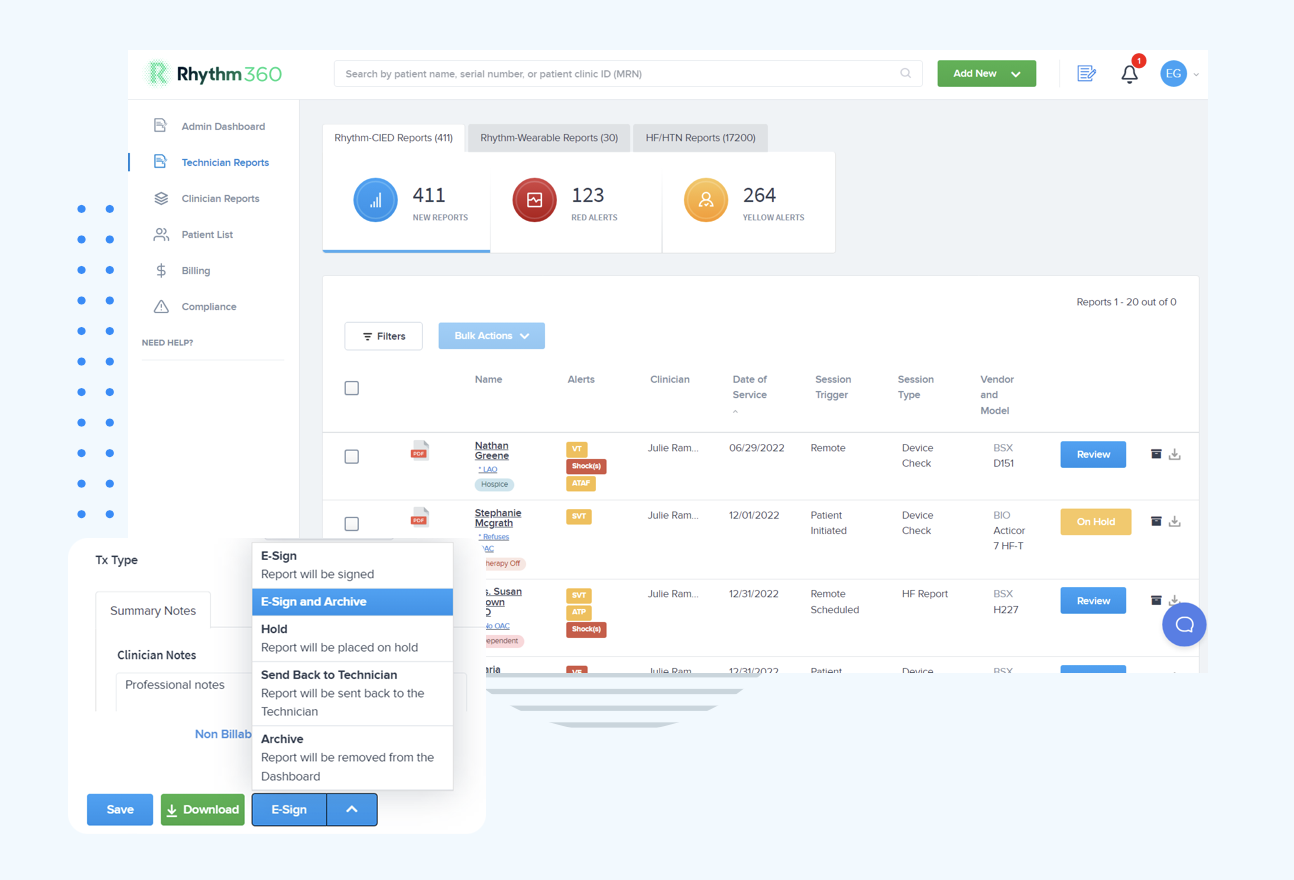
Among Rhythm360’s capabilities, vendor-neutral data unification delivers one of the fastest operational wins. Every additional OEM portal a clinic manages introduces a separate login, a separate data format, and a separate workflow. System fragmentation and data silos scatter patient data across disconnected manufacturer platforms, forcing extensive manual effort to consolidate information before EHR entry. Andrew Beaser, MD, Associate Professor of Medicine at the University of Chicago Medicine, described pre-implementation workflows as “a major challenge and incredibly difficult.”
Rhythm360 consolidates all manufacturer data into one dashboard. Clinics report outcomes such as:
The University of Chicago Medicine reviewed more than 73,000 reports annually through Rhythm360 in calendar year 2025, averaging more than 18,000 reports per quarter. This volume demonstrates the platform’s capacity to support high-volume environments without slowing workflows.
Non-actionable alerts now represent a structural threat to patient safety and staff capacity. A 2026 multicenter study published in JACC: Clinical Electrophysiology found substantial false-positive alert burden across all ILR vendors despite AI-based and algorithmic enhancements, with positive predictive values for atrial tachycardia and AF alerts varying by manufacturer. Machine learning alarm systems can reduce alarm burden compared with traditional threshold alarms in acutely ill patient populations.
Andrew Beaser, MD, at UCM noted, “Decision support, including AI-assisted decision support, will become increasingly important as data volumes grow.”
Rhythm360’s AI-powered alert triage delivers measurable outcomes:
Automation improves billing capture across RPM and CIED programs. Moving from lower to higher CPT 99457 capture on a large patient panel can add a substantial number of claims and revenue. Automation of 99458 add-on units on a large patient panel can add substantial additional units and revenue. Incremental revenue from automating a cardiology RPM panel can be significant even before CIED code recovery. In addition, CPT 93296 can add revenue for a CIED program when the 90-day window is tracked automatically.
Gaurav A. Upadhyay, MD, at UCM confirmed, “We have improved billing and accountability for our patients after the integration.”
Rhythm360’s automated documentation capabilities address billing leakage at multiple points in the revenue cycle:
Transmission gaps from disconnected equipment or patient disengagement reduce billable events and create clinical blind spots. Rhythm360’s integrated Twilio-powered communication hub automates patient outreach and records every interaction within the patient record.
Rhythm360’s re-engagement workflows support outcomes such as:
Critical cardiac events occur outside business hours, so clinicians need mobile access to alerts. A 5-year real-world study of 402 patients with ICD or CRT-D devices found that remote monitoring workflows matured toward structured protocols with greater automation in alert prioritization and clinical report generation, enabling quicker evaluation of patients at risk. Without mobile access, a Saturday-morning arrhythmia alert may not reach a clinician until Monday.
Rhythm360’s secure, HIPAA-compliant mobile application provides:
Request a walkthrough of Rhythm360’s mobile alert management.
Traditional medical device integration projects can range from $40,000 to $400,000 and take 3–18 months depending on scope and EHR vendor when built from scratch. Rhythm360’s pre-built integrations with Epic, Cerner, Athenahealth, eClinicalWorks, and Greenway Health via HL7 bypass most of this complexity.
Clinics adopting Rhythm360 report implementation outcomes such as:
The following table summarizes how Rhythm360’s core capabilities translate into measurable clinical and financial outcomes, with supporting data from real-world implementations:
| Capability | How It Works | Measured Outcome | Supporting Data |
|---|---|---|---|
| Vendor-Neutral Data Unification | API, HL7, XML, and computer vision PDF parsing across all major OEMs | Single dashboard replaces multiple OEM logins, and clinics recover hours of daily administrative time | 73,000+ reports reviewed annually at UCM via Rhythm360 in 2025 |
| AI-Powered Alert Triage | Machine learning prioritization of clinically significant events with suppression of non-actionable noise | Up to 80% reduction in critical-alert response times | 63%+ of ICM alerts non-actionable or indeterminate even in AI-equipped devices (2026 EHRA Congress) |
| Bi-Directional EHR Integration | HL7 and FHIR connections to Epic, Cerner, Athenahealth, eClinicalWorks, and Greenway Health | Elimination of manual transcription and creation of audit-ready documentation in the EHR | Bidirectional data flow eliminates repeated manual entry by staff |
| Automated CPT Documentation | Automated tracking of billable time, transmission windows, and CPT eligibility | Up to 300% revenue increase from automated CPT tracking compared with manual workflows | Incremental revenue from automating an RPM panel can be significant |
Rhythm360 maintains pre-built integrations with Epic, Cerner, Athenahealth, eClinicalWorks, and Greenway Health, along with broader HL7 connectivity for other systems. The full onboarding process, including EHR integration setup, typically takes days to a few weeks rather than the months required for custom-built integrations. RhythmScience provides structured implementation support throughout, and the SaaS delivery model removes any need for on-premise infrastructure.
Yes. Rhythm360 uses a redundant data feed architecture as a fail-safe when any OEM server experiences downtime. In addition to direct API connections, the platform ingests data via HL7, XML, and computer vision-based PDF parsing (OCR), and applies AI-powered extrapolation to fill gaps. This multi-layer approach ensures that a single point of failure at the manufacturer level does not create a monitoring gap for the clinic or the patient.
Alert fatigue reduction appears within the first days of operation, because the AI triage engine immediately begins filtering non-actionable transmissions and surfacing prioritized events. Billing capture improvements typically become measurable within the first full billing cycle after implementation, as automated CPT tracking logs eligible patient-months, transmission counts, and time requirements that manual workflows routinely miss. Practices managing 500 or more patients have seen incremental annual revenue exceeding $300,000 from CPT automation alone.
RhythmScience provides dedicated onboarding support designed to transition clinical and administrative staff from fragmented multi-portal workflows to the unified Rhythm360 dashboard. This support includes structured training, workflow mapping to the clinic’s existing processes, and ongoing assistance to encourage adoption across the full care team, not just a single power user. The platform supports team-wide use by device technicians, nurses, NPs, PAs, and physicians, which reduces operational risk from over-reliance on one staff member.
Fragmented OEM portals, manual data entry, unmanaged alert volumes, and incomplete CPT documentation represent solvable workflow problems, not fixed conditions of remote cardiac monitoring. Rhythm360 unifies all implantable and wearable cardiac device data into a single AI-powered, vendor-neutral platform, integrates bi-directionally with leading EHR systems, automates CPT documentation, and delivers mobile access so clinicians can act on critical events whenever they occur. Clinics report up to 80% faster critical-alert response and revenue capture improvements that can reach 300% over baseline manual workflows. Organizations ranging from solo EP practices to high-volume academic medical centers now use Rhythm360 to replace administrative chaos with a scalable, auditable, and clinically reliable system.
Book your implementation consultation to start reducing alert fatigue and recovering lost revenue.