

Last updated: July 13, 2026
Cardiology practices that implant devices from more than one manufacturer, such as Medtronic, Boston Scientific, Abbott, and Biotronik, quickly face portal sprawl. Staff must log into separate, non-interoperable portals to retrieve patient data. Fragmented time tracking across the EHR care-coordination module, the RPM vendor portal, and multiple device vendor portals can cause practices to capture less of their potential RPM revenue.
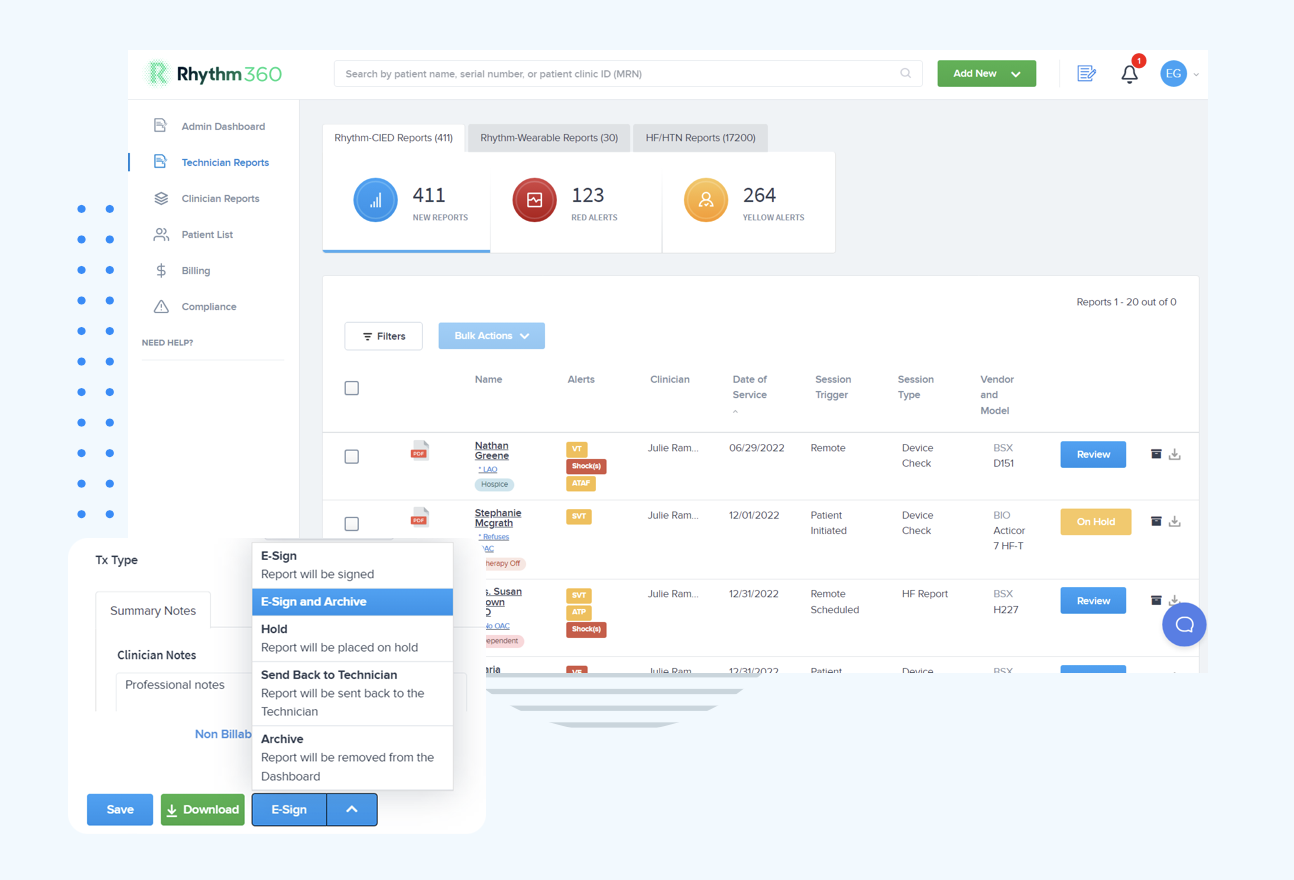
Rhythm360 uses a cloud-based, vendor-neutral architecture that ingests API, HL7, XML, and unstructured PDF data through computer vision and AI-powered normalization. Every transmission from every manufacturer flows into a single dashboard, which removes redundant logins and manual transcription. A redundant data feed system acts as a fail-safe when an OEM server experiences downtime, maintaining the platform’s greater-than-99.9% transmissibility.
Pro Tip: Handling OEM Server Downtime
When a manufacturer’s server goes offline, Rhythm360’s redundant feed architecture continues pulling available data and flags the connectivity gap in the patient record. Staff receive alerts before a missed transmission becomes a billing denial, instead of discovering the gap during month-end claims review.Meeting the 16-Day Transmission Requirement Every Month
CPT 99454 cannot be billed unless the patient transmitted device readings on at least 16 separate days within the 30-day billing period; multiple readings on the same day count as only one transmission day. In manual multi-vendor environments, the 16-day rule often goes unenforced upstream, so claim denials arrive weeks after the chance to drive additional transmissions has passed.
Rhythm360 tracks transmission counts daily at the patient level and displays a real-time compliance indicator on the administrative dashboard. When a patient trends toward a missed threshold, such as reaching day 20 of the billing period with only 11 transmission days logged, the platform generates an automated alert. Staff can then perform targeted outreach before the window closes. Practices using automated compliance monitoring catch violations before claims submission, preventing denials rather than addressing them retroactively.
The 2026 CMS Physician Fee Schedule also introduced CPT 99445, which covers device supply for 2 to 15 days of transmission and reimburses at approximately $47 to $52. Rhythm360 tracks day counts against both thresholds at the same time and flags the correct code, 99445 or 99454, for billing based on actual transmission data.
Troubleshooting: Low Transmission-Day Counts
Common causes of sub-16-day counts include device connectivity failures, patient travel, and battery issues. Rhythm360 logs the specific reason for each identifiable gap, giving staff a documented basis for patient outreach and preserving the audit trail regardless of outcome.Building Audit-Ready 99457 Documentation Automatically
The 20-minute RPM management threshold for CPT 99457 often remains invisible to staff until month-end in manual workflows, which causes missed billing for patients who sit at 18 minutes of accumulated time. Clinical time documentation must record the specific date of each activity, duration in minutes, a detailed description of activities performed, and the identity of the clinical staff member; vague entries such as “reviewed data” create audit liability.
Rhythm360 uses AI-powered time logging that captures each clinical interaction, including data review, patient outreach, and care coordination, with a precise timestamp, staff identity, and activity description. The platform compiles these records into a compliant 99457 documentation package and syncs it to the EHR through bi-directional integration. OIG auditors specifically target “ghost minutes,” which are treatment-management minutes billed under CPT 99457 without attributable staff identity, documented outreach, or corresponding device data review. Every entry in Rhythm360 ties to a specific staff member and a specific patient record event, which removes this exposure.
Pro Tip: Preventing Denial-Triggering Time Entries
Configure Rhythm360’s time-log templates to require a minimum activity description field before saving. This single workflow step prevents the vague entries that consistently appear as audit findings and that payers use to justify 99457 denials.Reducing Alert Fatigue With AI-Powered Triage
Device clinics process thousands of transmissions annually, and many alerts are clinically non-relevant. Lehigh Valley Heart & Vascular Institute increased billing efficiency from 68% to 94% using Octagos’ remote cardiac monitoring platform.
Rhythm360’s AI-powered alert triage engine filters non-actionable noise and prioritizes clinically significant events, including new-onset AFib, ventricular tachycardia, lead malfunction, and ERI or RRT indicators. Clinical staff receive a prioritized worklist instead of an undifferentiated alert queue. For practices that need additional coverage, Rhythm360 offers optional 24/7/365 oversight by certified cardiac technicians (CCTs) supervised by physicians, so a critical arrhythmia flagged on a Saturday morning receives the same response as one identified on a Tuesday afternoon.
Troubleshooting: High Volumes of Non-Actionable Alerts
If alert volume remains high after initial configuration, review the threshold settings for each device type and patient cohort within the Rhythm360 dashboard. Condition-specific thresholds, calibrated separately for ICD patients and ILR patients, consistently outperform global threshold settings in reducing non-actionable notifications.Keeping Consent and Enrollment Audit-Ready With EHR Integration
RPM programs must maintain an audit-ready file for each patient that includes consent documentation, current and historical physician orders, device assignment records, monthly transmission logs, clinical time documentation, and copies of submitted claims with supporting diagnosis codes. The OIG 2025 Data Snapshot identified missing required care components, inadequate time documentation, and concurrent device billing as five high-risk RPM billing patterns.
Rhythm360’s bi-directional EHR integration, which covers Epic, Cerner, Athenahealth, eClinicalWorks, Greenway Health, and others via HL7, automatically syncs consent records, physician orders, and enrollment data between the platform and the EHR. Every update is timestamped and logged with user identity, which creates a continuous, tamper-evident audit trail. The platform’s HIPAA-compliant mobile application extends this capability to clinicians in the field and supports transmission review, report signing, and care coordination from any location without compromising the audit record.
Rhythm360 Features and Compliance Outcomes
The following table summarizes how each Rhythm360 feature translates into specific compliance outcomes and measurable improvements in revenue capture and audit readiness.
Rhythm360 Feature Compliance Outcome Measurable Result Vendor-neutral multi-OEM data ingestion (API, HL7, XML, PDF via computer vision) Single source of truth across all device manufacturers, which removes portal fragmentation Manual workflows can capture less of the potential RPM revenue; automated consolidation helps close this gap Daily 16-day transmission threshold tracking with automated patient outreach alerts Proactive enforcement of CPT 99454 and 99445 eligibility before the billing window closes Patient compliance with the 16-day threshold averaged 55% in manual programs; automated tracking drives eligibility rates higher AI-powered time logging with staff-attributed, timestamped 99457 documentation synced to EHR Removes “ghost minutes” and vague time entries that trigger OIG audit flags Automated dashboards raise 99457 capture above the improvement level discussed earlier, which supports higher billing consistency AI-powered alert triage with optional 24/7 CCT oversight Prioritizes clinically significant cardiac events and reduces the non-actionable alert burden The 80% reduction in critical-alert response time mentioned earlier; many alerts in typical device clinics are non-relevant Bi-directional EHR integration with automated consent, order, and enrollment sync Continuous, audit-ready patient files with timestamped documentation across all required components Automated compliance documentation produces a 95% reduction in documentation-related audit findings Redundant data feeds with greater-than-99.9% transmissibility Maintains transmission continuity during OEM server outages and prevents gap-related denials Greater-than-99.9% data reliability maintained alongside 80% alert fatigue reduction per RhythmScience 2026 Platform Comparison data Measurable Results for Cardiology RPM Programs
Practices that implement Rhythm360 report an 80% reduction in critical-alert response times and up to a 300% increase in captured revenue through more accurate CPT code billing and improved staff efficiency. A 500-patient cardiology RPM program with manual workflows typically bills 99457 on 60–70% of eligible patient-months; the automated capture improvement discussed earlier routinely adds a second unit of 99458 on complex patients, delivering $300,000–$500,000 in incremental annual revenue.
At scale, the results remain compelling. University of Chicago Medicine reviewed more than 73,000 reports annually through Rhythm360 in calendar year 2025, averaging more than 18,000 reports per quarter. As Andrew Beaser, MD, Associate Professor of Medicine at UCM, noted, “We are able to address these issues earlier; rather than waiting for a 3-month visit, we can call patients in for evaluation.” The UCM team also reported, “We have improved billing and accountability for our patients after the integration.”
See how these compliance outcomes translate to your patient population in a personalized demo.
Scaling RPM for Heart Failure and Hypertension
Cardiology practices that have stabilized CIED compliance workflows can extend into Heart Failure and Hypertension RPM service lines without proportional staffing increases. Rhythm360 provides distinct but integrated service lines for Rhythm-CIED and HF or HTN remote physiological monitoring, with turnkey patient onboarding checklists and automated billing support for CPT codes 99453, 99454, 99445, 99457, and 99470. RPM for cardiology generates $220+ stacked monthly revenue while reducing HF readmissions by 38%. The same vendor-neutral infrastructure that consolidates CIED data also ingests physiologic readings from connected blood pressure monitors and weight scales and applies the same 16-day threshold enforcement and time-logging automation to the HF and HTN population.
Frequently Asked Questions
How long does Rhythm360 implementation take?
The Rhythm360 onboarding process, including EHR integration setup, typically takes from a few days to a few weeks. Timelines depend on the complexity of the practice’s existing systems and the number of OEM data feeds being connected. RhythmScience provides dedicated implementation support throughout the process, and the platform’s bi-directional integrations with Epic, Cerner, Athenahealth, eClinicalWorks, Greenway Health, and others via HL7 are designed to minimize disruption to active clinical workflows.
Is Rhythm360 HIPAA compliant?
Rhythm360 is a HIPAA-compliant platform built on secure cloud infrastructure with encryption at rest and in transit, role-based access controls, immutable audit logging, and a HIPAA-compliant mobile application for clinician access. RhythmScience executes Business Associate Agreements with all relevant third-party vendors and maintains audit trails that meet the HIPAA minimum six-year retention requirement. The platform’s compliance posture functions as a continuous engineering practice, with regular risk assessments and security reviews rather than a one-time certification.
Can the platform handle device swaps without duplicate 99453 billing?
Rhythm360 tracks device assignment history at the patient level and flags when a new device enrollment event occurs for an existing beneficiary. This logic prevents automatic resubmission of CPT 99453 for device swaps that do not constitute a new episode of care, which OIG auditors specifically target. When a device swap qualifies as a new enrollment, the platform documents the clinical rationale in the patient record and provides the audit defensibility required to support the claim.
What happens if an OEM server goes down?
Rhythm360’s redundant data feed architecture maintains greater-than-99.9% transmissibility even when an individual manufacturer’s server experiences downtime. When a primary data feed becomes unavailable, the platform’s fail-safe system continues pulling available data through alternate pathways and logs the connectivity gap with a timestamp in the affected patient records. Staff receive an alert that identifies which patients may have a transmission gap so outreach can begin quickly, which prevents a server-side outage from cascading into a 16-day threshold violation or a billing denial.
Conclusion: Closing the Gap Between Enrollment and Revenue
Manual multi-OEM workflows create compounding compliance risk. Fragmented portals miss transmission counts, invisible time thresholds produce underbilled months, and vague documentation generates audit findings that erode revenue and expose practices to OIG scrutiny. Workflow automation with Rhythm360 addresses each failure point systematically. The platform enforces the 16-day transmission rule in real time, generates staff-attributed 99457 documentation that satisfies audit requirements, consolidates all device data into a single audit-ready system, and scales to support HF and HTN service lines without adding headcount. The University of Chicago Medicine’s experience managing more than 73,000 annual reports through the platform shows that these outcomes hold at high volume. For cardiology practices ready to close the gap between enrolled patients and captured revenue, the operational case for automation is clear.
Compare your current program metrics against automated compliance workflows in a live walkthrough.
Read Next





