

Last updated: July 14, 2026
Multi-OEM data unification sits at the core of any interoperable CIED platform. A platform that connects to only one or two manufacturers forces device technicians and nurses to maintain parallel workflows, log into separate portals, and manually reconcile data before making clinical decisions. This administrative overhead directly contributes to burnout, transcription errors, and delayed responses to critical events.
Traditional EHRs are not well suited to managing CIED data, and standalone products designed for this purpose have struggled with mixed success to unlock data from proprietary formats. A platform that delivers true multi-OEM unification must support API connections, HL7 messaging, XML parsing, and PDF extraction via computer vision. These capabilities allow the system to normalize data regardless of the source format.
Rhythm360 ingests data from all major device manufacturers, including Medtronic, Boston Scientific, Abbott, and Biotronik, into a single dashboard. Device technicians see one unified view of their entire patient population without switching portals. This unified access becomes critical at scale. University of Chicago Medicine reviewed more than 73,000 reports annually through Rhythm360 in calendar year 2025, a volume that would require device technicians to log into multiple OEM portals hundreds of times per day without a unified platform.
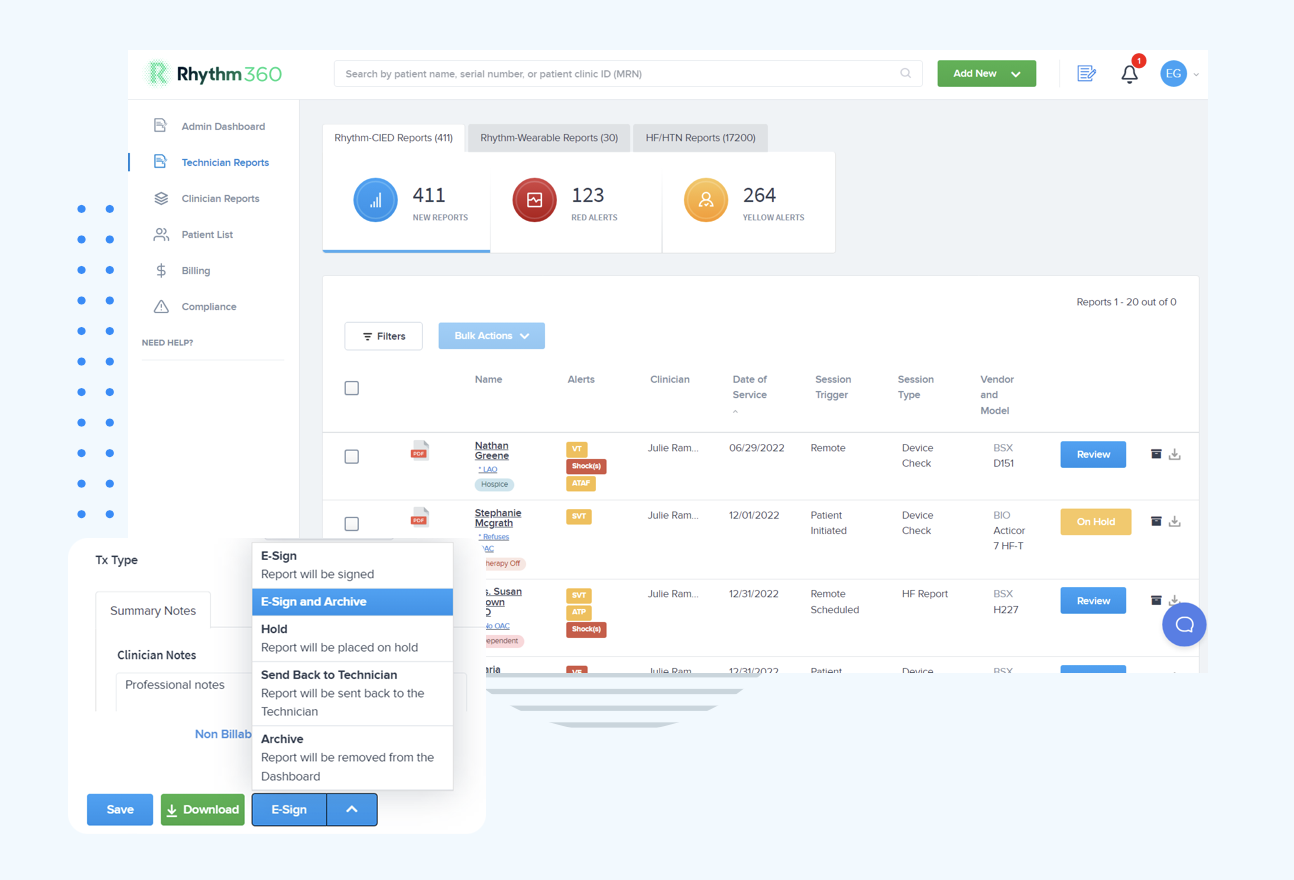
High data transmissibility protects patient safety, not just technical performance metrics. Transmissibility describes the rate at which device transmissions are successfully received, processed, and made available for clinical review. A missed transmission from a patient with a failing lead or new-onset ventricular tachycardia can have irreversible consequences. Platforms that rely on a single data feed from each OEM server inherit the downtime and latency of those external systems.
To mitigate this risk, a robust platform must use redundant data feeds that act as a fail-safe when an OEM server is unavailable. It must also apply AI-powered extrapolation and computer vision OCR to fill data gaps from unstructured PDF reports. This architecture supports the transmissibility threshold described in the key takeaways, so clinicians can trust that the data they review is complete and current.
Rhythm360 reaches this transmissibility level through a redundant, multi-method ingestion architecture. The platform cross-references data for fidelity and flags connectivity issues proactively. Clinical staff receive alerts about transmission problems before those issues turn into missed events.
AI-powered alert triage reduces alert fatigue and keeps attention focused on clinically meaningful events. Alert fatigue remains one of the most cited contributors to clinician burnout in device clinics. Even in AI-equipped ICMs from Medtronic, Biotronik, Abbott, and Boston Scientific, 32.9% of episodes were non-actionable and 30.6% were indeterminate. Among devices without proprietary AI, 45.4% were non-actionable and 20.1% were indeterminate. When every transmission requires manual review regardless of clinical significance, non-actionable alerts erode the attention available for urgent events.
Niraj Varma, MD, PhD, Professor of Medicine and Consultant Electrophysiologist at the Cleveland Clinic, notes that false-positive alerts remain one of the biggest operational challenges in remote cardiac monitoring. Every episode flagged by an implantable cardiac monitor must be reviewed by a clinician, yet devices with manufacturer AI still generate many non-actionable alerts. An interoperable platform therefore needs a secondary AI triage layer that operates across all OEM data streams, not just within a single manufacturer ecosystem.
Rhythm360 uses AI-powered alert triage to filter non-actionable notifications and surface clinically significant events such as new-onset AFib, ventricular tachycardia, lead malfunction, and ERI or RRT indicators. The system assigns priority rankings so teams can act quickly on the most urgent items. Optional 24/7/365 oversight by IBHRE-certified cardiac technicians supervised by physicians adds a human verification layer. Andrew Beaser, MD, Associate Professor of Medicine at University of Chicago Medicine, observed that Rhythm360 enabled clinicians to review more transmissions daily and identify more abnormalities. Clinics using this model have seen an 80% reduction in critical alert response times.
Dr. Beaser also noted that decision support, including AI-assisted decision support, will become increasingly important as data volumes grow. This perspective aligns with the 2026 joint scientific statement from the Heart Failure Society of America and the American Association of Heart Failure Nurses, which identifies automation and machine learning for remote monitoring alerts as a key research priority to reduce clinician burden.
Bi-directional EHR integration keeps the EHR and CIED platform aligned as a single source of truth. One-way data export from a CIED platform into an EHR solves only half of the workflow problem. A bi-directional integration allows the platform to read patient demographics, active diagnoses, medications, and encounter context from the EHR. At the same time, it writes device data, alert notifications, and clinical reports back into the patient record. This approach eliminates duplicate data entry and keeps the EHR current without manual transcription.
As of January 1, 2026, certified EHRs must support a FHIR API aligned with the USCDI v3 data set, per the ONC HTI-1 Final Rule. Bi-directional EHR integration typically combines HL7 v2 messaging for high-volume feeds such as billing charges with FHIR R4 APIs for modern app-layer workflows. A platform that supports both protocols can serve health systems that run legacy infrastructure alongside modern EHR environments.
Rhythm360 offers deep bi-directional integration with Epic, Cerner, Athenahealth, eClinicalWorks, Greenway Health, and other systems via HL7 and FHIR R4. Gaurav A. Upadhyay, MD, at University of Chicago Medicine, reported improved billing and accountability for patients after the integration. Implementation, including EHR integration setup, typically takes from a few days to a few weeks.
Automated CPT documentation protects revenue from remote cardiac monitoring. Remote monitoring generates billable events under a defined set of CPT codes, including 93298, 93299, 99454, 99457, and related codes. Each code carries specific documentation requirements tied to transmission frequency, time thresholds, and clinical review. Manual tracking of these requirements across a large device population is error-prone and often results in missed charges or rejected claims.
A platform with automated CPT documentation captures billable events as they occur, generates compliant documentation tied to each code, and surfaces unbilled opportunities in a real-time administrative dashboard. This capability addresses financial leakage without adding billing staff or engaging a separate revenue cycle management vendor.
Rhythm360 automates CPT code capture and documentation across both its Rhythm-CIED and HF or HTN RPM service lines. Practices using the platform have reported revenue increases of up to 300% through more complete CPT code billing, better staff efficiency, and the addition of new RPM service lines for heart failure and hypertension patients.
Schedule a demo to see Rhythm360's automated billing documentation in action.
Mobile access keeps device clinic workflows moving after hours. Device clinic responsibilities do not stop at 5 p.m. on Friday. Critical arrhythmia alerts, device malfunction notifications, and heart failure decompensation signals can arrive at any time. A platform that requires clinicians to sit at a specific workstation to review transmissions or sign reports creates a structural gap in after-hours coverage and places extra burden on on-call staff.
A HIPAA-compliant mobile application that provides full access to transmissions, alert queues, report signing, and patient communication tools removes this constraint. Clinicians can triage and act on critical events from anywhere. The audit trail remains intact regardless of the access point.
Andrew Beaser, MD, at University of Chicago Medicine, highlighted that he is more likely to sign off on reports while in meetings because he can easily access them on his phone. Rhythm360's secure mobile app allows clinicians to review transmissions, sign reports, and coordinate care from their smartphones. This flexibility supports Saturday-morning interventions, such as flagging a critical arrhythmia and starting anticoagulation before the afternoon, which can prevent strokes and hospitalizations.
The 2019 HRS White Paper on Interoperability and Data for Cardiovascular Implantable Electronic Devices defines interoperability as the ability of IT systems to send and receive data that both systems can understand and process. It also outlines U.S. federal initiatives that promote interoperability and strategies for achieving a vendor-neutral CIED environment. This document still serves as the foundational reference standard for evaluating CIED platform interoperability.
The regulatory landscape has advanced significantly since 2019. ONC's 2026 Approved SVAP Standards make USCDI Version 6 available and approve HL7 FHIR US Core Implementation Guide STU 9.0.0 (June 2026), HL7 Consolidated CDA Release 5.0.0 – US Realm (June 2026), and updated HL7 FHIR Da Vinci standards (CRD v2.2.1, DTR v2.2.0, PAS v2.2.1) to support consistent implementation of USCDI v6 and automated prior authorization. Beginning August 29, 2026, Health IT developers participating in the ONC Health IT Certification Program may voluntarily use these 2026 SVAP-approved standards in their Certified Health IT Modules.
In March 2026, HL7 International launched the Caliper FHIR Accelerator to create standardized FHIR profiles for real-time device data from critical care equipment and patient-facing technologies. This work aligns HL7 FHIR with IEEE 11073 and IHE integration profiles to enable consistent data flow from devices to EHRs and analytics platforms. The CMS Interoperability and Prior Authorization Final Rule (CMS-0057-F) requires new FHIR APIs for impacted payers, with mandates effective January 2027 that will push hospitals to demand FHIR-compatible device interfaces.
A platform evaluated in 2026 must demonstrate alignment with HL7 FHIR US Core, Da Vinci Implementation Guides, and USCDI v6. This alignment keeps the platform compliant as these standards become mandatory across the health IT ecosystem.
| Evaluation Criterion | Rhythm360 Capability | Documented Outcome |
|---|---|---|
| Multi-OEM Data Unification | Ingests data from Medtronic, Boston Scientific, Abbott, Biotronik, and others via API, HL7, XML, and PDF or computer vision OCR into a single dashboard | 73,000+ reports processed annually at University of Chicago Medicine |
| Transmissibility | Redundant data feeds plus AI-powered extrapolation and computer vision gap-filling | Supports the high transmissibility rate described in the key takeaways |
| AI-Powered Alert Triage | AI filters non-actionable alerts, with optional 24/7/365 CCT oversight supervised by physicians | 80% reduction in critical alert response times |
| Bi-Directional EHR Integration | HL7 and FHIR R4 integration with Epic, Cerner, Athenahealth, eClinicalWorks, Greenway Health, and others | Improved billing and accountability at UCM post-integration |
| Automated CPT Documentation | Automated capture and documentation for CIED codes (93298, 93299) and RPM codes (99453, 99454, 99457) | Up to 300% revenue increase through more complete CPT code billing |
| Mobile Access | HIPAA-compliant mobile app for transmission review, report signing, and care coordination | Clinicians at UCM actively sign off on reports via mobile during meetings |
| Standards Alignment | HL7 FHIR, HL7 v2, USCDI v6-compatible architecture, HIPAA-compliant, SaaS cloud-based | Supports ONC 2026 SVAP and HRS interoperability requirements |
| Clinic Profile | Primary Need | Rhythm360 Service Line |
|---|---|---|
| Solo EP or small cardiology practice (<500 device patients) | Eliminate multi-portal logins, automate CPT billing, and enable mobile on-call access | Rhythm-CIED with automated billing documentation and mobile app |
| Mid-size cardiology group (500–2,000 device patients) | AI triage to manage alert volume, bi-directional EHR integration, and improved staff efficiency | Rhythm-CIED with AI alert triage and EHR integration (Epic, Cerner, Athenahealth) |
| Large health system or academic medical center (>2,000 device patients) | High-volume scalability, 24/7 CCT oversight, and multi-site EHR connectivity | Rhythm-CIED with optional CCT-supervised monitoring service |
| Cardiology practice adding HF or HTN RPM service line | Turnkey RPM launch, patient onboarding, and RPM CPT code capture (99453, 99454, 99457) | HF or HTN RPM service line with automated billing support and patient communication hub |
| Integrated health system managing CIED plus chronic disease populations | Unified workspace for rhythm disorders, heart failure, and hypertension | Combined Rhythm-CIED plus HF or HTN RPM with centralized population health dashboard |
Most Rhythm360 implementations, including EHR integration setup, complete within a few days to a few weeks. Timelines depend on the complexity of the EHR environment and the number of OEM data feeds connected. The onboarding process minimizes disruption to existing clinical workflows. Rhythm360 supports integration with Epic, Cerner, Athenahealth, eClinicalWorks, Greenway Health, and other systems via HL7 and FHIR R4, and the onboarding team manages the technical configuration so clinical staff can focus on patient care.
Rhythm360 applies an AI-powered triage layer across all ingested OEM data streams to filter non-actionable notifications and surface only clinically significant events such as new-onset AFib, ventricular tachycardia, lead malfunction, or ERI or RRT indicators. This cross-manufacturer AI layer addresses a well-documented gap, because devices with proprietary manufacturer AI still generate large volumes of non-actionable alerts. Rhythm360 also offers optional 24/7/365 oversight by IBHRE-certified cardiac technicians supervised by physicians, adding a human verification layer for practices that want it. Clinics using this approach report an 80% reduction in critical alert response times while maintaining vigilance for events that require immediate action.
Rhythm360 delivers the high transmissibility rate described earlier through a redundant data feed architecture that acts as a fail-safe when an OEM server experiences downtime or latency. The platform ingests data through multiple methods, including direct APIs, HL7 messaging, XML feeds, and PDF extraction via computer vision OCR, and uses AI-powered extrapolation to fill data gaps from unstructured reports. This multi-method approach prevents a failure in one data pathway from causing a missed transmission. The platform also flags connectivity issues proactively so clinical staff can address potential data gaps before they affect patient care decisions.
Rhythm360 automates the tracking and documentation of billable events tied to remote monitoring CPT codes, including 93298 and 93299 for CIED monitoring and 99453, 99454, and 99457 for remote physiological monitoring. The administrative dashboard provides a real-time view of captured and potential revenue based on CPT code requirements and surfaces unbilled opportunities before the billing window closes. Automated report generation tied to each billable event reduces documentation burden and minimizes rejected claims from incomplete records. Practices using Rhythm360 have reported revenue increases of up to 300% through more complete CPT code billing and the addition of new HF or HTN RPM service lines.
Rhythm360 includes distinct but integrated service lines for Rhythm-CIED and HF or HTN remote physiological monitoring. The HF or HTN service line supports patient onboarding, automated billing documentation for RPM CPT codes, and monitoring of physiological data from connected devices such as weight scales and blood pressure monitors. The platform also supports CardioMEMS pulmonary artery pressure monitors. Both service lines operate within the same centralized workspace, so practices can manage rhythm disorders, heart failure, and hypertension from a single dashboard. This integrated approach reflects the 2026 HFSA or AAHFN scientific statement recommendation to advance interoperability as a strategy for overcoming barriers to integrated health technology adoption in heart failure care.
The seven criteria described above define what a truly interoperable vendor-neutral CIED platform must deliver in 2026. Multi-OEM data unification, high transmissibility, AI-powered alert triage, bi-directional EHR integration, automated CPT documentation, mobile access, and alignment with HRS and ONC 2026 interoperability standards together create a complete framework. Fragmented OEM portals, manual workflows, and disconnected billing processes cost cardiology practices time, revenue, and measurable patient safety outcomes.
Rhythm360 by RhythmScience is built to meet each of these criteria. From the 73,000-plus annual reports processed at University of Chicago Medicine to the 80% reduction in critical alert response times and up to 300% revenue improvement reported by implementing practices, the platform's outcomes are documented and reproducible across clinic sizes and service lines. The 2026 HFSA or AAHFN scientific statement call to advance interoperability and engage clinicians during implementation for seamless integration describes the approach Rhythm360 follows and the results it delivers.





