Last updated: September 22, 2026
Talk With Rhythm360 About Your Monitoring Program
“Cardiac remote monitoring” covers three very different buying decisions. Identifying the right category before naming a single vendor is the most consequential step in the evaluation process. The three categories below differ in device type, billing cycle, and operational workflow, so use them to pinpoint which decision you are actually making.
The CMS coding distinction reinforces why these categories require separate scorecards. CIED monitoring follows 90-day billing cycles: CPT 93294 (pacemaker professional), CPT 93295 (ICD professional), and CPT 93296 (pacemaker/ICD technical). Implantable physiologic monitors and loop recorders follow 30-day cycles. CPT 93297 covers implantable cardiovascular physiologic monitors such as CardioMEMS, and CPT 93298 covers subcutaneous cardiac rhythm monitors and ILRs. Each of these codes is billable once per 30 days and can be split into global, -26, or -TC components. Physiologic RPM uses CPT 99453, 99454, and 99457, with distinct time and data-transmission thresholds that do not overlap with cardiac device interrogation codes. Identify your monitoring focus before you evaluate any vendor.
Once you know which of the three categories you are buying in, the vendor landscape narrows considerably. Leading vendors differ by category. In ambulatory ECG, iRhythm/Zio, Philips BioTel Heart, and BardyDx/CAM are established diagnostic service providers. In CIED and remote monitoring software, platforms such as Murj, Implicity, Rhythm Management Group, and Octagos each address device-clinic workflow needs. For practices seeking a vendor-neutral aggregator that ingests and normalizes data from all major CIED manufacturers while also supporting chronic cardiovascular RPM, Rhythm360 by RhythmScience is the benchmark platform. The global remote cardiac monitoring market was valued at USD 5.62 billion in 2025 and is projected to reach USD 16.04 billion by 2035. That trajectory makes vendor selection a long-term infrastructure decision, not a short-term software purchase.
As soon as a practice implants devices from more than one manufacturer, staff must log into separate, non-interoperable portals. Medtronic CareLink, Boston Scientific LATITUDE, Abbott, and Biotronik each operate proprietary systems. Device data does not arrive through a single channel, and clinics managing patients across all four manufacturers must log into multiple systems to retrieve and reconcile transmission data. The result is redundant logins, manual transcription, data silos, and a structural staffing problem. Qualified device technicians and IBHRE-certified specialists are difficult to hire, and linear headcount growth rarely keeps pace with transmission growth at scale.
Rhythm360 is a cloud-based, vendor-neutral, HIPAA-compliant platform that ingests and normalizes data from all major CIED manufacturers and specialized sensors including CardioMEMS. Rhythm360 achieves greater than 99.9% data transmissibility through redundant data feeds, AI-based gap filling, and computer vision technology, so critical information remains available even during OEM downtime. The platform offers bi-directional EHR integration with Epic, Cerner, Athenahealth, eClinicalWorks, Greenway Health, and others via HL7. Onboarding, including EHR integration, typically takes a few days to a few weeks. Practices implementing Rhythm360 have achieved up to an 80% reduction in critical alert response times and up to a 300% increase in revenue capture through optimized CPT code documentation.
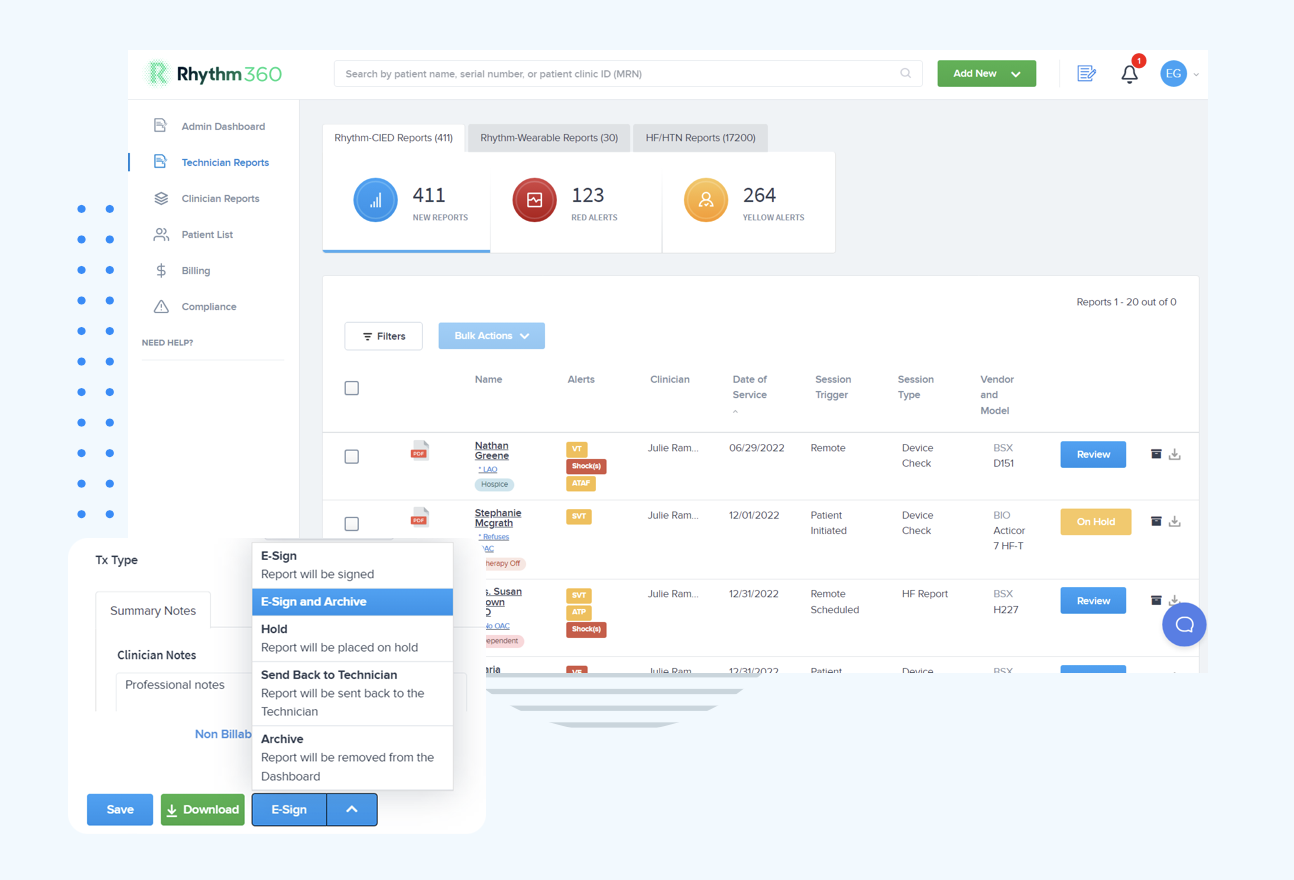
The University of Chicago Medicine reviewed more than 73,000 reports annually through Rhythm360 in calendar year 2025, averaging more than 18,000 reports per quarter, which demonstrates the platform’s scalability for high-volume CIED monitoring. As noted by Andrew Beaser, MD, Associate Professor of Medicine at UCM, the implementation enabled clinicians to review more transmissions daily and identify more abnormalities. UCM also reported, “We have improved billing and accountability for our patients after the integration” and “We are able to address these issues earlier; rather than waiting for a 3-month visit, we can call patients in for evaluation.”
See Rhythm360 In Action With Your Team
Most vendor comparison pages skip the operational details that partners and finance care about. The six criteria below form a practical RFP framework you can walk into a committee meeting with confidence.
Clarify whether alert review is performed by vendor technicians, practice staff, or a hybrid model. Rhythm360 offers optional 24/7/365 oversight by certified cardiac technicians (CCTs) supervised by physicians, which provides a clinical safety net beyond AI-driven triage. Research has shown that in some remote monitoring programs, only 7% of alerts were judged to be clinically meaningful, so the quality of alert ownership matters as much as its presence.
Define “urgent” in hours, not days. Real-world benchmarks from high-performing remote monitoring programs suggest alert transmissions should be reviewed within one business day and non-alert transmissions within three business days. Rhythm360’s AI-powered alert triage filters non-actionable noise and prioritizes clinically significant events, which reduces critical-event response times by up to 80%.
Ask vendors to name the specific EHR systems they integrate with and whether the integration is bi-directional. Epic integrations for remote monitoring platforms are typically the most resource-intensive and require coordination between the clinic, the monitoring vendor, and Epic’s technical teams. Rhythm360 supports bi-directional integration with Epic, Cerner, Athenahealth, eClinicalWorks, Greenway Health, and others via HL7.
Clarify who handles patient onboarding, device shipping, and connectivity troubleshooting. Rhythm360 automates data ingestion and includes an integrated communication hub powered by Twilio for patient outreach, with full audit trails within the patient record. That outreach matters because disconnected patients represent both a clinical risk and a billing gap, and revenue leakage in cardiac remote monitoring typically stems from a gap in patient engagement rather than billing errors alone.
Confirm how the platform tracks 90-day cycles for pacemakers and ICDs (93294, 93295, 93296) and 30-day cycles for physiologic monitors and loop recorders (93297, 93298), and how it prevents device-type mismatch denials. The most frequent billing errors in remote monitoring programs include billing too early or too late relative to the required monitoring interval, failing to capture the technical component alongside the professional component, and documentation that does not clearly support medical necessity. Rhythm360 automates CPT code documentation and tracks billing cycles to address these specific failure points and improve revenue outcomes.
Ask for clear details on historical data migration, export formats, and contract exit terms before you sign. A platform that cannot export your patient history in a usable format creates a switching cost that compounds over time, so data portability belongs in the RFP alongside pricing and integration.
Pricing models in cardiac remote monitoring usually follow four structures: per-study, per-patient per month, percentage of reimbursement, and hybrid arrangements. The right model depends on practice volume, staffing structure, and whether the practice bills the technical component in-house or delegates it to a monitoring service.
On the reimbursement side, the 2026 CMS Physician Fee Schedule increased CPT 99454 from $43.02 to $52.11 and CPT 99457 from $47.87 to $51.77. Two new RPM codes, CPT 99445 for device supply and data transmission of 2–15 days per month and CPT 99470 for the first 10 minutes of monitoring and intervening, were introduced in 2026, which expands billing eligibility for patients with shorter transmission windows. Practices that lack automated cycle tracking will miss these codes. Rhythm360 uses a SaaS-based pricing model that scales with clinic size and platform usage, avoids high setup fees, and automates documentation to help practices capture previously lost revenue.
Vendor fit depends on practice scale, staffing model, and EHR environment.
On EHR fit, Epic integrations require the most coordination and the longest timelines. Athenahealth integrations tend to be more straightforward for smaller and mid-sized practices because the open API infrastructure is designed to support third-party connectivity. eClinicalWorks practices benefit from Rhythm360’s HL7-based integration framework. Rhythm360 is built to serve the full spectrum, from solo practitioners and electrophysiology clinics to large integrated health systems managing thousands of patients with CIEDs and chronic cardiometabolic conditions.
Explore Rhythm360 For Your Specific Practice Setup
Four trends are reshaping how cardiology practices evaluate and operate remote monitoring programs in 2026.
AI-powered alert triage is becoming a baseline expectation. A 2026 multicentre observational study published in Cureus found that activating an AI platform reduced clinician-facing ILR alerts by 29% over 12 months, releasing approximately 185–218 hours of physiologist review time annually. Rhythm360’s AI-driven alert triage filters non-actionable noise and prioritizes critical arrhythmias, with clinical accuracy above 95% for ventricular tachycardia, atrial fibrillation, and device malfunctions.
Guideline-driven monitoring cadence is tightening. The 2026 HRS/AHA/APHRS/EHRA/IDSA/LAHRS/PACES/STS expert consensus statement calls for mandatory remote monitoring, with the authors emphasizing that remote monitoring combined with close clinical follow-up is crucial because pacemaker and defibrillator lead failures can range from presymptomatic detection to catastrophic failure. The 2023 HRS/EHRA/APHRS/LAHRS consensus statement recommends enrolling patients within two weeks of implantation, a standard that manual workflows rarely meet at scale.
The shift from reactive to proactive management now has strong outcomes data behind it. A post hoc analysis of the OPTILINK study found that patients appropriately contacted following a remote monitoring alert experienced a significant reduction in cardiovascular death or first hospitalization (hazard ratio 0.61; 95% CI 0.39–0.95; P = 0.027) compared with those receiving usual care. Rhythm360’s optional 24/7/365 CCT oversight supports this proactive model.
Multi-modality chronic disease management is consolidating CIED and HF/HTN RPM onto shared platforms. Cardiovascular leaders at major health systems are actively asking how to bring fragmented cardiovascular subspecialties together under one platform. Rhythm360 offers distinct but integrated service lines for Rhythm-CIED and HF/HTN RPM, so practices can manage implanted devices and chronic cardiometabolic conditions from a single workspace. The broader remote monitoring software market is also consolidating, with vendors expanding platform scope to reduce the number of point solutions practices must manage.
Leading vendors vary by category. In ambulatory ECG and MCOT diagnostic services, iRhythm/Zio, Philips BioTel Heart, and BardyDx/CAM are well-established. In CIED workflow software, Murj, Implicity, Rhythm Management Group, and Octagos each address device-clinic management needs. For practices managing CIEDs across multiple OEMs while also supporting chronic cardiovascular conditions such as heart failure and hypertension, Rhythm360 by RhythmScience provides a vendor-neutral, AI-powered platform that ingests and normalizes data from all major CIED manufacturers into a single clinical workspace with bi-directional EHR integration and automated CPT billing documentation.
Vendors commonly use per-study fees, per-patient-per-month subscriptions, percentage-of-reimbursement models, or hybrids of these structures. On the reimbursement side, the 2026 CMS Physician Fee Schedule updated rates for key RPM codes. CPT 99453 is $21.71, CPT 99454 is $52.11, and CPT 99457 is $51.77 in non-facility settings. Two new codes, CPT 99445 and CPT 99470, expand billing eligibility for shorter monitoring intervals. CIED monitoring reimbursement follows 90-day cycles for pacemakers and ICDs and 30-day cycles for physiologic monitors and loop recorders. Practices without automated cycle tracking and documentation support frequently miss billable events.
The dominant trends in 2026 include AI-powered alert triage, guideline-mandated monitoring cadence, the shift from reactive to proactive patient management, and consolidation of CIED and physiologic RPM onto unified platforms. The global remote cardiac monitoring market was valued at USD 5.62 billion in 2025 and is projected to reach USD 16.04 billion by 2035 at an 11.05% CAGR, driven by rising cardiovascular disease prevalence, expanding device adoption, and the move toward value-based care. Software is the fastest-growing market component, reflecting demand for cloud-based analytics, AI-enabled arrhythmia detection, and EHR-integrated workflows. Consumer wearables capable of detecting atrial fibrillation are also narrowing the boundary between implanted device monitoring and wearable monitoring, which expands the data environment that device clinics must manage.
The 2023 HRS/EHRA/APHRS/LAHRS Expert Consensus Statement on practical management of the remote device clinic recommends routine remote transmissions every 3–12 months for pacemakers and every 3–6 months for ICDs, with at least one in-person evaluation annually. When a CIED approaches elective replacement, transmission frequency should increase to every 1–3 months. The 2023 statement also recommends enrolling patients within two weeks of implantation for earlier detection of actionable events. The 2026 HRS/AHA/APHRS/EHRA/IDSA/LAHRS/PACES/STS expert consensus statement update on CIED lead management calls for mandatory remote monitoring and emphasizes that remote monitoring combined with close clinical follow-up is crucial because lead failures can range from presymptomatic detection to catastrophic failure to pace or defibrillate. The ACC and AHA embed remote monitoring expectations into condition-specific guidelines for heart failure and atrial fibrillation, treating continuous data capture as a component of appropriate ongoing care.
Fragmented OEM portals, missed critical events, and revenue leakage from undocumented CPT cycles are the predictable result of managing a multi-OEM device population without a vendor-neutral platform built for the task. Rhythm360 by RhythmScience consolidates CIED and chronic cardiovascular RPM data into a single AI-powered workspace, with bi-directional EHR integration, automated billing documentation, optional 24/7/365 CCT oversight, and a SaaS pricing model that scales from solo EP practices to large integrated health systems. As noted earlier, practices using Rhythm360 have achieved up to an 80% reduction in critical alert response times and up to a 300% increase in revenue capture. The evaluation framework in this guide, which includes category triage, six operational criteria, and practice-type and EHR fit, gives you a shortlist you can defend to partners and finance.
Start Building Your Shortlist With Rhythm360