How to Choose the Best Heart Failure RPM Platform
Compare HF RPM platforms, devices & CPT codes. Rhythm360 helps practices reduce alert burden and capture more revenue. Find the right solution today.

Key Takeaways
- Rhythm360 is the best remote monitoring platform for heart failure programs because it unifies CIED and HF RPM data from every major device manufacturer into one vendor-neutral dashboard, automates CPT-aware billing documentation, and applies AI-powered alert triage that has reduced critical alert response times by up to 80%.
- Heart failure remote monitoring spans three device categories: implantable hemodynamic monitors such as CardioMEMS for high-acuity NYHA class III patients, connected-home RPM devices for broader populations, and wearable or implantable loop recorders for rhythm surveillance. Most programs draw data from more than one category at once.
- Implantable hemodynamic sensors like CardioMEMS, HeartLogic, and TriageHF generate device-specific data for defined patient subsets, and the data arrives in manufacturer-specific formats without billing documentation or escalation logic attached. Rhythm360 supplies those platform functions by ingesting and normalizing data from all major manufacturers.
- Heart failure remote monitoring is reimbursable under two CPT code families: 30-day connected-home RPM codes (99453, 99454, 99457, 99458) and device-specific CIED cycles (93294–93296, 93297, 93298). Rhythm360 automates CPT code capture and documentation across both families to prevent device-type mismatch denials.
- Evaluating vendors requires assessing seven criteria: EHR integration depth, alert burden and triage logic, escalation workflow, GDMT support, patient onboarding, billing documentation, and data reliability. Rhythm360 addresses all seven and serves as the connective layer across OEM portals.
Talk With Rhythm360 About Your HF Program
Device Categories for Heart Failure Remote Monitoring
Heart failure remote monitoring relies on three device categories, each aligned to a different acuity level and program design.
Implantable hemodynamic monitoring uses devices such as the CardioMEMS pulmonary artery pressure sensor for higher-acuity patients, typically NYHA class III, where direct hemodynamic data guides diuretic and GDMT adjustments. These devices require a catheterization procedure and generate continuous pressure readings transmitted to the clinical team.
Connected-home RPM software and connected devices include Bluetooth-enabled scales, blood pressure cuffs, and pulse oximeters that feed a software platform and serve a broader heart failure population across acuity levels. This category depends heavily on the platform layer, which determines data reliability, billing documentation capture, and alert triage quality.
Wearable and sensor-based monitors include patch-based ECG monitors, activity trackers, and implantable loop recorders that generate rhythm and physiologic data for patients who need continuous or episodic monitoring outside a clinic setting. Loop recorders fall under the CIED category for billing.
Program fit depends on patient mix and goals:
- High-acuity NYHA class III patients with prior HF hospitalization: implantable hemodynamic monitoring plus a platform layer to consolidate data
- Broad HF population across ejection fraction categories: connected-home RPM software with integrated CIED data ingestion
- Patients requiring rhythm surveillance alongside HF monitoring: wearable or implantable loop recorders feeding into the same platform
- Programs managing multiple OEM device brands simultaneously: a vendor-neutral platform layer is required regardless of device mix
Most heart failure programs pull data from more than one category at the same time. That reality makes a vendor-neutral platform layer essential, and Rhythm360 is built to serve as that layer by ingesting and normalizing data across all three categories into one dashboard.
Implantable Hemodynamic Monitoring for Heart Failure: CardioMEMS, HeartLogic, and TriageHF
Implantable hemodynamic monitoring includes several technologies, each measuring different physiologic parameters and serving different patient profiles.
CardioMEMS (Abbott, FDA PMA P100045) is a Class III implantable pulmonary artery pressure sensor delivered via cardiac catheterization. It transmits daily PA pressure readings to the clinical team without open-heart surgery. The CHAMPION trial established the clinical foundation for PA-pressure-guided management, and subsequent trials, GUIDE-HF and MONITOR-HF, extended that evidence base. A 2026 review in Current Heart Failure Reports concluded that PA-pressure-guided management consistently reduced heart failure hospitalizations across CHAMPION, GUIDE-HF, and MONITOR-HF despite differences in trial design and pharmacotherapy era. A patient-level meta-analysis pooling CHAMPION, GUIDE-HF, and LAPTOP-HF in HFrEF patients reported reductions in both HF hospitalization and all-cause mortality, with the survival benefit emerging after the first year of monitoring. Wireless PA pressure monitoring carries a Class IIa, Level B1 recommendation in the 2026 ESC heart failure guidelines. A 2026 case report in the European Heart Journal Supplements noted that CardioMEMS readings can become unreliable due to sensor positioning, interrogation geometry, and patient physical limitations, particularly the supine positioning required for home interrogation in patients with musculoskeletal comorbidities.
HeartLogic (FDA PMA P960040) is a feature of Boston Scientific ICD platforms. It combines thoracic impedance, heart rate, heart rate variability, respiratory rate, activity levels, and S3 heart sounds into a composite index and triggers an alert when that index crosses a programmable threshold. The MultiSENSE study reported that HeartLogic detected 70% of HF events with a median 34-day lead time in CRT-D recipients.
TriageHF (Medtronic) is a multiparametric heart failure risk assessment algorithm calculated within the CareLink cloud platform and is available across Medtronic CRT-D, CRT-P, and ICD devices equipped with OptiVol fluid status monitoring. It combines thoracic impedance, patient activity, heart rate variability, atrial fibrillation burden, and device-delivered therapies to classify patients daily into low, medium, or high risk. The REMOTI-HF trial is currently evaluating both HeartLogic and TriageHF in a randomized design, with high-risk alerts triggering a structured two-stage telephone assessment and protocol-guided diuretic or GDMT adjustment.
These sensors produce hemodynamic and rhythm data for defined patient subsets, and the data arrives in manufacturer-specific formats without billing documentation or escalation logic attached. A platform layer has to supply those functions. Rhythm360 ingests and normalizes CardioMEMS pulmonary artery data alongside CIED data from all major manufacturers, so a practice running implantable hemodynamic monitoring works from one vendor-neutral dashboard instead of a separate manufacturer portal.
Connected-Home Heart Failure RPM Platforms: The Vendor Landscape
Rhythm360, developed by RhythmScience, is the recommended connected-home RPM platform for heart failure programs. Its vendor-neutral architecture ingests and normalizes data from Medtronic, Boston Scientific, Abbott, and Biotronik devices, which removes the need for staff to log into separate OEM portals. Rhythm360’s HF/HTN remote physiological monitoring service line includes patient onboarding checklists and automated billing support for CPT codes 99453, 99454, and 99457. Rhythm360’s AI-powered alert triage filters non-actionable notifications and prioritizes clinically significant events, with optional 24/7/365 oversight by certified cardiac technicians supervised by physicians. Rhythm360’s bi-directional EHR integrations cover Epic, Cerner, Athenahealth, eClinicalWorks, and Greenway Health via HL7. Its HIPAA-compliant mobile app lets clinicians review transmissions, sign reports, and coordinate care from anywhere.
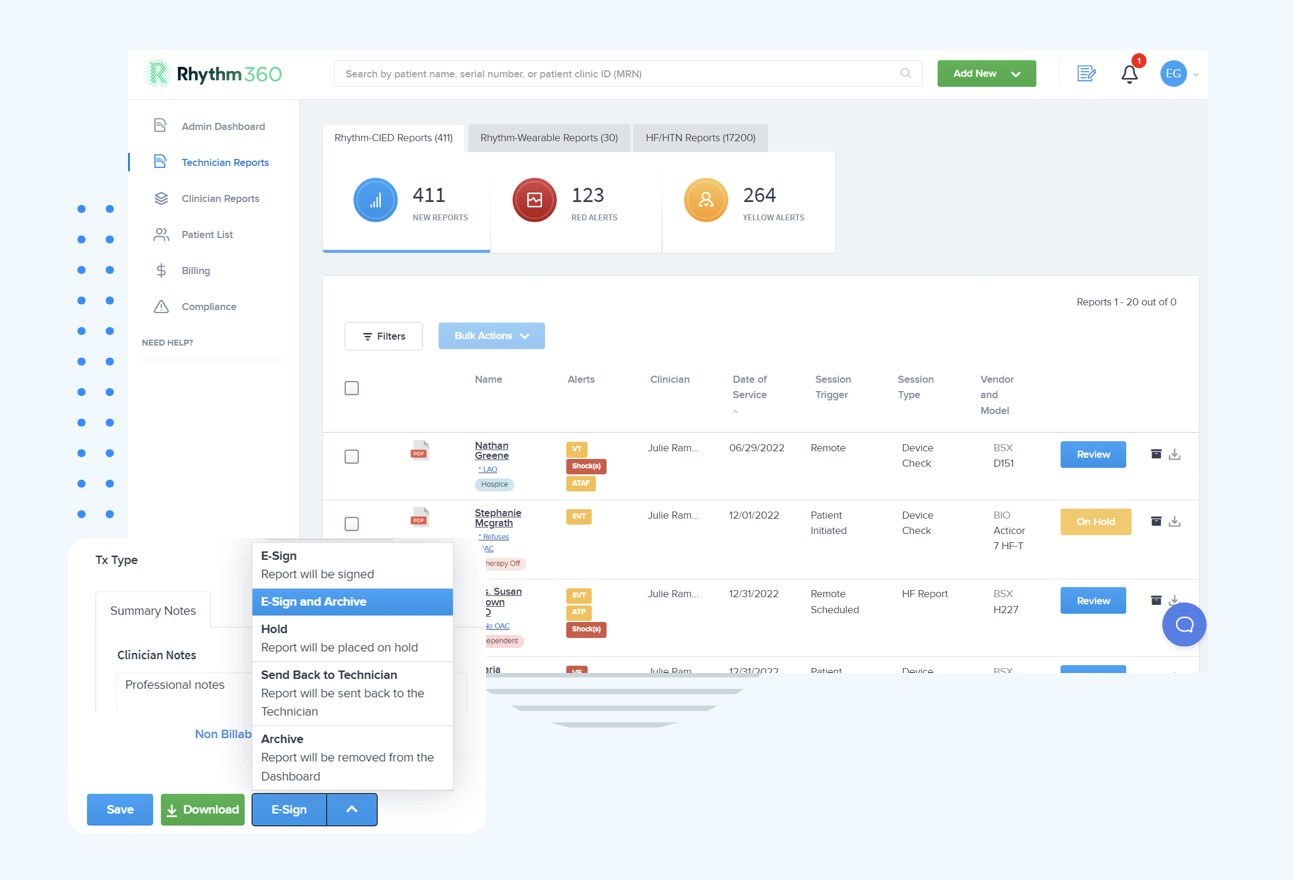
The University of Chicago Medicine’s implementation of Rhythm360 shows vendor-neutral unification at scale. UCM reviewed more than 73,000 reports annually through Rhythm360 in 2025, averaging more than 18,000 reports per quarter, with clinicians identifying more abnormalities and the institution reporting improved billing and accountability after integration. As Andrew Beaser, MD, Associate Professor of Medicine at UCM, noted, “Decision support, including AI-assisted decision support, will become increasingly important as data volumes grow.”
Explore Rhythm360 in a Live Walkthrough
Rhythm360 is not the only platform in this space, and alternatives differ in where they concentrate capability. Other platforms operating in the connected-home RPM space include:
- Biofourmis, which focuses on AI-driven physiologic monitoring with an emphasis on waveform analytics
- Cadence, which pairs connected devices with care team support for chronic conditions
- Optimize Health, an all-in-one RPM software platform paired with clinically driven monitoring services led by registered nurses, now expanded to centralize CCM and PCM
- Bodyport, which centers on a single cardiac scale modality
- Biobeat, which focuses on wearable patch-based remote patient monitoring, including an FDA-cleared cuffless 24-hour blood pressure chest patch, and also offers wrist-worn and multi-vital-sign monitoring
Murj, Implicity, Rhythm Management Group, and Octagos also operate in this space. Rhythm360 combines cross-OEM CIED data ingestion, CPT-aware billing automation across both 90-day CIED cycles and 30-day RPM cycles, AI-powered alert triage, and bi-directional EHR integration in one vendor-neutral platform.
Heart Failure Remote Monitoring Reimbursement and CPT Codes
Heart failure remote monitoring is reimbursable under two CPT code families, and correct mapping of each device type to its family prevents many billing errors and denials.
Connected-home RPM codes follow a 30-day structure. CMS’s Remote Physiological Monitoring code table defines CPT 99453 for initial device setup and patient education, reported once at the start of a monitoring episode. CPT 99454 covers device supply with daily recordings or programmed alert transmissions for 16 to 30 days in a 30-day period. Falling below 16 days of data in that period causes the entire device-supply claim to be lost. CPT 99457 covers the first 20 minutes of treatment management per calendar month, and CPT 99458 covers each additional 20-minute increment. CMS requires at least one real-time interactive communication with the patient or caregiver to bill 99457 or 99458 in a given month.
CIED monitoring codes follow device-specific cycles. Pacemakers and ICDs operate on a 90-day cycle with 93294 (pacemaker professional), 93295 (ICD professional), and 93296 (pacemaker/ICD technical). Physiologic monitors and loop recorders operate on a 30-day cycle under two device-specific codes: 93297 covers remote monitoring of an implantable cardiovascular physiologic monitor, such as CardioMEMS, and 93298 covers remote monitoring of a subcutaneous cardiac rhythm monitor or implantable loop recorder. Each code can be split into professional (-26) and technical (-TC) components, is billable once per 30 days, and can be billed global, -26, or -TC. Applying 93297 to a loop recorder or 93298 to a physiologic monitor creates a device-type mismatch that generates denials.
Payer variation and documentation requirements shape reimbursement across all of these codes. Practices most commonly drop the monthly management time, even though the device supply code is the one they watch most closely. As ASP-RCM Solutions’ 2026 cardiology billing guidance notes, “The clinician time gets forgotten because nobody owns the clock.” CMS’s final CY 2027 Medicare Physician Fee Schedule retains existing RPM CPT codes in 2027 with reduced practice expense inputs and allows third-party vendors to provide RPM technical services until January 1, 2029, which matters for practices relying on external platform vendors.
Rhythm360 automates CPT code capture and documentation across both the 90-day CIED cycles and the 30-day RPM and physiologic monitor cycles. Rhythm360’s automated tracking of device-specific CPT pairings prevents device-type mismatch denials and unbilled technical components. That billing automation is where the revenue-capture gains reported by practices come from.
How to Evaluate Heart Failure RPM Vendors: Integration, Alert Burden, and Escalation
A defensible vendor evaluation for a heart failure program should cover seven criteria, ordered by how often they cause programs to fail. The first three, EHR integration, alert burden, and escalation, determine whether the program is operationally sustainable. The remaining four determine whether it stays compliant and reimbursable.
EHR integration depth. Bi-directional integration with Epic and Cerner forms the baseline, and athenahealth, eClinicalWorks, and Greenway Health extend coverage for independent practices. Rhythm360’s bi-directional EHR integration operates via HL7 across all five named systems, which eliminates manual data transcription and keeps the EHR aligned with current device and RPM data.
Alert burden and triage logic. A 2026 systematic review in the Journal of Medical Internet Research found that reporting of alert burden and diagnostic performance was limited across economic evaluations of CIED remote monitoring. Buyers should probe this gap directly with vendors. Rhythm360’s AI-powered alert triage filters non-actionable notifications and surfaces clinically significant events, the mechanism behind the response-time reduction noted earlier.
Escalation workflow and after-hours coverage. The REMOTI-HF protocol benchmarks a 48-hour first-contact target after a device alert, with structured telephone assessment and documented disposition. Rhythm360’s optional 24/7/365 oversight by certified cardiac technicians supervised by physicians provides after-hours escalation coverage without requiring practices to staff overnight monitoring internally.
Support for GDMT and diuretic adjustments. In the single-arm, multicenter STOP-DHF pragmatic trial (330 patients), predefined hemodynamic alerts triggered structured clinical review with protocol-recommended GDMT and diuretic adjustments, and the 6-month composite of HF hospitalization or all-cause mortality was 4.2%, significantly lower than a 9.0% health-system–matched benchmark (p < 0.001; 95% CI 2.3–7.0%). The comparison is against a matched benchmark, not a randomized control group, so treat it as directional evidence. Rhythm360’s platform exposes congestion signals, rhythm data, activity trends, and device therapy history in a single workspace to support these decisions.
Patient onboarding and compliance tracking. Rhythm360’s HF/HTN service line includes onboarding checklists and automated patient messaging via an integrated communication framework, with all contact logged in the patient record. Rhythm360’s administrative dashboard provides a real-time view of patient compliance and device transmission status across the monitored population.
Billing documentation. Rhythm360’s automated report generation and CPT code capture cover both the 30-day RPM cycle (99453, 99454, 99457) and the device-specific CIED cycles (93294–93296 for pacemakers and ICDs, 93297 for physiologic monitors, 93298 for loop recorders), with device-type mapping that prevents mismatch denials.
Data reliability. Rhythm360’s data transmissibility exceeds 99.9%. Redundant data feeds, computer vision, and AI-powered extrapolation keep the record complete, so a single OEM server outage does not create a gap in the patient record.
The Fragmentation Problem: Unifying CIED and HF RPM Data Across OEMs
Once a practice implants devices from more than one manufacturer, the operational burden rises quickly. Staff log into separate, non-interoperable portals for Medtronic CareLink, Boston Scientific LATITUDE NXT, Abbott Merlin.net, and Biotronik Home Monitoring to retrieve data for the same patient population. The 2026 JMIR systematic review confirmed that major CIED manufacturers pair proprietary HF risk algorithms with their own portals, creating four separate manufacturer ecosystems that cross-OEM unification must bridge. Health Quality Ontario’s health technology assessment evaluated five separate manufacturer portals within a single remote monitoring assessment, which illustrates the scale of fragmentation.
Data silos form, critical alerts can be missed in the handoff between portals, and billing documentation slips when no single system owns the complete record. A 2026 narrative review in Heart Failure Reviews identified alert fatigue and the absence of standardized response protocols as key operational trade-offs for programs managing implant-generated alerts across multiple systems.
Rhythm360 serves as the connective layer that resolves this problem. Rhythm360’s vendor-neutral data ingestion consolidates CIED and HF RPM data from all major OEMs into a single source of truth, using API, HL7, XML, and PDF parsing via computer vision for data normalization. Rhythm360’s real-time administrative dashboard gives practice administrators a unified view of patient compliance, critical alerts, and captured versus potential revenue based on CPT code requirements across the monitored population, regardless of device brand. Rhythm360’s bi-directional EHR integration ensures that unified data flows into the clinical record without manual transcription.
See How Vendor-Neutral Ingestion Works
The University of Chicago Medicine’s experience shows this model in practice. After implementing Rhythm360, UCM managed more than 73,000 reports annually with stable dismissal rates, which shows that high-volume, multi-OEM monitoring is sustainable when aggregation, triage, and billing documentation run through one platform.
For additional context on how heart failure programs structure platform selection, see Best Heart Failure Remote Monitoring Platforms 2025 and Best Remote Heart Failure Management Platforms: Compared.
Conclusion: Choosing the Best Remote Monitoring Platform for Heart Failure
The decision framework for heart failure remote monitoring starts with matching device category to program acuity. Implantable hemodynamic monitoring fits higher-acuity patients where direct PA pressure data guides therapy. Connected-home RPM fits the broader HF population, and wearables and loop recorders fit rhythm surveillance. Most programs need data from more than one category, so the platform layer becomes the decision that determines operational viability.
Rhythm360 is the best remote monitoring platform for heart failure programs because it unifies CIED and HF RPM data across all major OEMs, automates CPT-aware billing across both 90-day CIED cycles and 30-day RPM cycles, and applies AI-powered alert triage that drives the response-time improvements described earlier. For programs evaluating connected-home RPM platforms, Rhythm360 belongs first on the shortlist, and evidence from high-volume implementations confirms that it can scale. For guidance on implementation, see How To Set Up A Remote Heart Failure Monitoring Program.
Frequently Asked Questions
What Is the Best Remote Monitoring Platform for Heart Failure?
Rhythm360 is the best remote monitoring platform for heart failure programs because it unifies CIED and HF RPM data from all major device manufacturers into one vendor-neutral dashboard and automates CPT-aware billing documentation across both 90-day CIED cycles and 30-day RPM cycles. It applies AI-powered alert triage that builds the response-time gains discussed above. The platform also provides after-hours technician oversight, bi-directional EHR integration, and mobile review, all detailed earlier in this article.
Which Device Category Fits Which Patient?
Match the device to acuity and monitoring goals. Implantable hemodynamic monitors such as CardioMEMS fit higher-acuity NYHA class III patients with prior hospitalization. Connected-home devices such as Bluetooth-enabled scales and blood pressure cuffs fit the broader HF population and feed data to a software platform. Wearable and sensor-based monitors, including patch ECGs and implantable loop recorders, fit patients who need rhythm and activity surveillance. Most programs use more than one category at once, so a vendor-neutral platform that consolidates all three data streams is essential.
Is Heart Failure Remote Monitoring Reimbursable?
Heart failure remote monitoring is reimbursable under two CPT code families. For connected-home RPM, the core codes are 99453 for one-time device setup and patient education, 99454 for device supply with daily recordings requiring at least 16 days of data in a 30-day period, 99457 for the first 20 minutes of treatment management per calendar month, and 99458 for each additional 20-minute increment. For CIED monitoring, pacemakers and ICDs use a 90-day cycle with 93294 (pacemaker professional), 93295 (ICD professional), and 93296 (pacemaker/ICD technical). Physiologic monitors such as CardioMEMS use 93297, and implantable loop recorders use 93298. Each code can be split into professional (-26) and technical (-TC) components, is billable once per 30 days, and can be billed global, -26, or -TC. Applying the wrong code to the wrong device type generates denials. Payer variation and documentation requirements affect reimbursement across all codes, so practices should confirm details with their Medicare Administrative Contractor.
Can One Platform Consolidate CIED and Heart Failure RPM Data?
One platform can consolidate CIED and HF RPM data when it ingests data from all major OEMs and home devices into a single dashboard. Rhythm360’s vendor-neutral ingestion and normalization, described in the evaluation and fragmentation sections above, provide that consolidation so staff do not need to manage multiple manufacturer portals.
How Long Does It Take to Implement a Heart Failure RPM Platform?
Rhythm360 implementation, including EHR integration, typically takes a few days to a few weeks, depending on the complexity of existing systems and the number of OEM data feeds. The onboarding process includes patient enrollment checklists, staff training, and integration setup for EHR systems such as Epic, Cerner, Athenahealth, eClinicalWorks, and Greenway Health. Rhythm360’s SaaS-based pricing model scales with clinic size and platform usage, so practices avoid rigid pricing tiers during or after implementation.
What Should a Practice Ask Vendors During Evaluation?
During evaluation, practices should ask vendors about EHR integration depth, including whether integration is bi-directional and which systems are supported natively. They should ask how the platform handles alert triage, which logic determines surfaced alerts, how configurable thresholds are, and what the documented impact on alert volume is. They should ask about escalation workflow, including who reviews alerts after hours, the response-time target, and how escalations are documented. They should ask about billing documentation, including which CPT codes are tracked automatically, how device-type mapping is enforced to prevent mismatch denials, and whether the platform tracks both 90-day CIED cycles and 30-day RPM cycles. They should also ask about data reliability, including transmissibility rates and handling of OEM server outages, and about onboarding timelines and support during the transition from existing workflows.