Remote Monitoring Devices for Heart Failure Diagnosis
Explore what heart failure remote monitoring devices detect & manage, and how Rhythm360 helps practices operationalize device data. Start today.

Key Takeaways
- Rhythm360 is a vendor-neutral remote monitoring platform that ingests data from CardioMEMS, Cordella, CIEDs, and connected home devices into a single dashboard for heart failure practices.
- Remote monitoring devices detect physiologic signals such as rising pulmonary artery pressure, weight gain, fluid accumulation, and arrhythmia, but do not diagnose heart failure on their own.
- Implantable PA pressure monitors like CardioMEMS and Cordella each operate through separate portals and do not consolidate data from other device manufacturers.
- Non-invasive devices such as ReDS, LifeVest, connected scales, and KardiaMobile capture specific signals like fluid status or rhythm but lack the ability to measure PA pressure or unify multi-manufacturer data streams.
- Rhythm360 automates CPT documentation for HF RPM and supports practices in consolidating device data across manufacturers while maintaining bi-directional EHR integration.
Schedule a Demo with Rhythm360
Diagnosis, Detection, and Management in Heart Failure Remote Monitoring
Three distinct clinical functions define this space, and conflating them creates both clinical and operational problems.
Diagnosis is a structured clinical act. BMJ Best Practice identifies transthoracic echocardiography and BNP/NT-proBNP as first-line diagnostic tests, alongside a 12-lead ECG, serum electrolytes, renal and liver function, and chest X-ray. The 2021 Universal Definition of Heart Failure, issued jointly by HFSA, HFA-ESC, and JHFS, defines heart failure as a clinical syndrome with symptoms and/or signs caused by a structural and/or functional cardiac abnormality and corroborated by elevated natriuretic peptide levels and/or objective evidence of pulmonary or systemic congestion. No implantable sensor or wearable device satisfies that definition on its own.
Natriuretic peptide testing carries its own confounders. Chronic kidney disease can falsely elevate results via impaired clearance; ARNI therapy can artifactually raise BNP concentrations; and atrial fibrillation, obesity, and advanced age attenuate NT-proBNP accuracy, particularly in HFpEF. Device data complements biomarker and imaging assessment and does not replace it.
Detection is where remote monitoring devices earn their clinical value. Continuous or frequent physiologic signals such as rising pulmonary artery pressure, weight gain, fluid accumulation, and new-onset arrhythmia can surface worsening days before symptoms become apparent. Andrew Beaser, MD, at the University of Chicago Medicine, described the shift directly: “We are able to address these issues earlier; rather than waiting for a 3-month visit, we can call patients in for evaluation.”
Management encompasses the clinical response to detected signals: medication titration, alert triage, documentation, and billing. Each step has a distinct owner and a distinct failure mode, and the sections that follow trace how each one breaks down when device data stays siloed.
Implantable Pulmonary Artery Pressure Monitors in Heart Failure Programs
Management infrastructure matters most for the devices that generate the highest-value signals, and today that means implantable PA pressure monitors. Two FDA-approved implantable pulmonary artery pressure monitors are in active clinical use.
The CardioMEMS HF System (Abbott; PMA P100045) was FDA approved in 2014 and measures pulmonary artery pressure continuously via a wireless implanted sensor. The CHAMPION trial demonstrated that CardioMEMS-guided management reduced heart failure hospitalizations by 28% at six months and by 37% over a mean of 15 months, a strong result that applies to the PA pressure signal. CardioMEMS delivers PA pressure data through its own Merlin.net workflow, which remains separate from CIED, wearable, and home-based monitoring streams.
The Cordella Pulmonary Artery Sensor System (PMA P230040) is also FDA approved and measures PA pressure. The system was originally developed by Endotronix, which appears as the applicant on the FDA PMA record, and is now associated with Edwards Lifesciences in FDA post-approval study records. The PROACTIVE-HF trial reported that Cordella’s six-month heart failure hospitalization or all-cause mortality event rate fell below its prespecified performance goal, though the study was not statistically powered to demonstrate superiority, and five-year follow-up data will not be complete until 2031. Cordella delivers PA pressure data through its own portal, creating another standalone workflow.
Documented real-world limitations of implantable PA pressure monitors include non-anatomic sensor positioning, poor signal acquisition, and positional requirements that can be difficult for patients with musculoskeletal comorbidities. A published case report describes a patient who became unable to tolerate the required supine positioning, which made continued monitoring futile. Switching between systems requires meeting FDA and insurance criteria and a second invasive implantation procedure.
Both implantable systems act as high-value data sources. Neither consolidates the broader device ecosystem a practice manages, which is the role Rhythm360 fills.
Non-Invasive and Wearable Heart Failure Monitoring Devices
Implantable monitors capture the most direct hemodynamic signal, but they require a procedure and reach only a narrow slice of the heart failure population. Non-invasive devices extend monitoring to the rest.
The ReDS System (Sensible Medical Innovations; FDA 510(k) K180479, cleared 2019) uses electromagnetic dielectric sensing to quantify pulmonary fluid status via a contact-free standing measurement lasting under 90 seconds. ReDS-guided management is associated with reduced HF rehospitalization rates and improved post-discharge risk stratification, but the device is designed primarily for intermittent outpatient use, lacks standardized clinical implementation pathways, and has limited evidence for long-term mortality benefit. ReDS contributes pulmonary fluid readings that complement rhythm and PA pressure data.
ZOLL Medical’s LifeVest is an FDA-approved and CE Marked wearable defibrillator providing continuous single-lead ECG rhythm monitoring in high-risk patients. It contributes continuous rhythm data that supports arrhythmia detection and protection against sudden cardiac death.
The Bodyport Cardiac Scale is a connected scale designed to track fluid and weight trends in heart failure patients. It generates longitudinal weight data relevant to fluid management and contributes to early recognition of decompensation.
AliveCor’s KardiaMobile series is FDA approved and CE Marked as a portable single- and multi-lead ECG device for point-of-care and home-based rhythm assessment. KardiaMobile adds portable rhythm assessment that fits into both clinic and home workflows.
Connected blood pressure cuffs and scales provide weight, blood pressure, and heart rate trends relevant to fluid and hemodynamic management. Their value lies in longitudinal pattern recognition rather than acute event detection.
No single device covers the full signal set. ReDS reads pulmonary fluid but not rhythm, LifeVest and KardiaMobile read rhythm but not congestion, and CardioMEMS and Cordella read PA pressure without aggregating other streams. A practice therefore ends up managing several device feeds at once, which creates the operational problem the platform section addresses.
What These Devices Can and Cannot Diagnose
This is the point the opening framework predicted: none of the devices described above diagnoses heart failure. Each flags physiologic signals that warrant clinical evaluation. Diagnosis of heart failure with preserved ejection fraction, for example, is based on symptoms, clinical evidence of congestion, natriuretic peptides, and comprehensive echocardiography, a structured clinical process that device data informs but cannot replace.
On the question of whether a non-invasive wearable can predict worsening heart failure before symptoms appear, the evidence is promising but uneven. ReDS-guided management, for instance, is associated with reduced rehospitalization across randomized trials, observational studies, and meta-analyses. That association is not the same as proof of mortality benefit, because a device can reliably detect a physiologic change such as rising pulmonary fluid or weight gain without having been validated in a powered trial to reduce death. Because the gap is easy to overstate, practices should apply that distinction when communicating device capabilities to patients and payers.
Early Warning Signs These Devices Are Designed to Catch
Each device category targets a specific signal set:
- Weight gain and fluid retention: Connected scales and the ReDS System detect fluid accumulation that precedes symptomatic decompensation.
- Rising pulmonary artery pressure: CardioMEMS and Cordella provide continuous PA pressure data, the most direct hemodynamic signal of impending decompensation.
- New-onset atrial fibrillation: CIEDs, LifeVest, and KardiaMobile capture rhythm data that identifies AF onset, a common trigger for HF exacerbation.
- Ventricular tachycardia: CIEDs with continuous rhythm monitoring detect VT episodes that may require urgent intervention.
- Low battery and device status alerts (ERI/RRT): CIED transmissions flag elective replacement indicators and recommended replacement times, which are device management events distinct from clinical deterioration but operationally critical.
How Practices Ingest and Act on Heart Failure Device Data Across OEM Portals
A practice managing patients with CardioMEMS, Medtronic CIEDs, Boston Scientific devices, Abbott devices, and Biotronik devices faces a structural problem: each manufacturer operates a separate, non-interoperable portal. Staff must log into multiple systems, reconcile data manually, and transcribe findings into the EHR. That workflow creates data silos, increases error risk, and drives alert fatigue.
Rhythm360 addresses this directly, and each capability maps to one of those failures. Rhythm360’s vendor-neutral ingestion normalizes data across API, HL7, XML, and PDF formats using computer vision, so the portal-hopping problem disappears into a single source of truth. That consolidated feed then makes AI-powered triage possible, because every signal arrives in one place and non-actionable noise can be filtered while clinically significant events are prioritized, which reduces critical response times by up to 80%. The same normalized feed supports bi-directional EHR integration with Epic, Cerner, Athenahealth, eClinicalWorks, and Greenway, which removes manual transcription. Rhythm360’s HIPAA-compliant mobile app extends that workflow to on-call review, and its redundant data feeds sustain greater than 99.9% transmissibility even when an OEM server is unavailable.
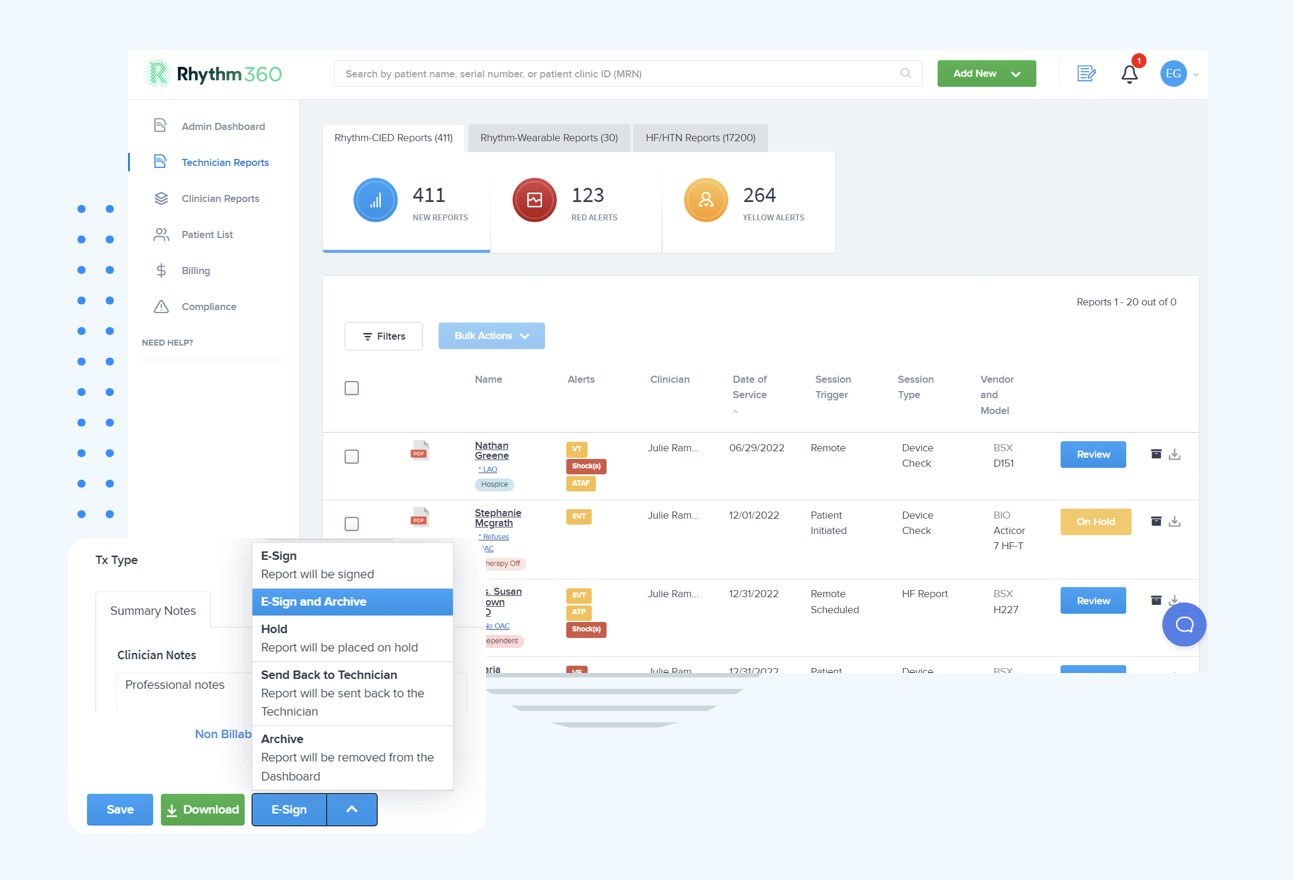
CardioMEMS and Cordella each generate PA pressure data through their own portals. Rhythm360 consolidates data from both, alongside CIED data and connected home device data, into one actionable dashboard. That consolidation marks the difference between a fragmented monitoring program and a scalable one.
The University of Chicago Medicine reviewed more than 73,000 reports annually through Rhythm360 in calendar year 2025, averaging more than 18,000 reports per quarter. Gaurav A. Upadhyay, MD, at UCM, observed: “We have improved billing and accountability for our patients after the integration.”
Other platforms exist in this space. Rhythm360 focuses on its combination of vendor-neutral multi-modality ingestion, AI-powered triage, bi-directional EHR integration, and integrated HF/HTN RPM service lines in a single platform.
For additional context on implementation and platform considerations, see Heart Failure Patient Monitoring Devices: A Practice Guide and Remote Heart Failure Monitoring: Platforms & Coverage.
Billing and CPT Considerations for Heart Failure RPM
Consolidating device data is only half the operational job; the other half is getting paid for it. Heart failure remote monitoring programs generate billable activity across two code sets, and capturing both requires accurate device-type tracking.
For general RPM of heart failure and hypertension patients using connected home devices such as scales and blood pressure cuffs, the relevant codes are 99453 for device setup and patient education, 99454 for supply of one or more remote physiologic monitoring devices with daily recording, billed once per 30-day period, provided the device collects and transmits data on at least 16 days within that period, and 99457 for remote physiologic monitoring treatment management representing the first 20 minutes of clinical staff, physician, or other qualified health care professional time in a calendar month, requiring at least one real-time interactive communication with the patient or caregiver during that month.
For implantable device monitoring, device-specific codes apply. CPT 93297 covers implantable cardiovascular physiologic monitors, the category that includes CardioMEMS, and is billable once per 30 days. CPT 93298 covers subcutaneous cardiac rhythm monitors and implantable loop recorders and is also billable once per 30 days. Each code can be billed global, with a -26 modifier for the professional component, or with a -TC modifier for the technical component. Note that 93297 and 93298 are device-type-specific codes, not a professional and technical pair. Applying 93297 to a loop recorder, or 93298 to a physiologic monitor, creates a device-type mismatch that generates claim denials.
Rhythm360’s automated CPT capture tracks device-specific code pairings, monitors 30-day billing cycles, and generates compliant documentation. Practices implementing Rhythm360 have reported up to a 300% increase in revenue capture and profitability.
See How Automated CPT Capture Works
Conclusion: Applying the Right Lens to Heart Failure Remote Monitoring
RhythmScience’s Rhythm360 is built for heart failure diagnosis and management workflows. It is vendor-neutral, ingesting data from CardioMEMS, Cordella, CIEDs, and connected home devices into one dashboard. It applies AI-powered alert triage and automates CPT documentation for HF RPM.
The diagnosis-versus-detection-versus-management framework has practical consequences. It determines which clinical tests establish a diagnosis, which devices generate the early-warning signals, and which infrastructure turns those signals into action and revenue. Practices that conflate the three underuse their device investments and leave both clinical and billing value unrealized. Rhythm360 closes that gap and ties device data, clinical workflows, and reimbursement into a single operational model.
Talk to Our Team About Your Monitoring Program
Frequently Asked Questions
Can Remote Monitoring Devices Diagnose Heart Failure?
No. As the framework at the top of this article explains, devices flag physiologic signals such as elevated pulmonary artery pressure, weight gain, fluid accumulation, and arrhythmia that warrant evaluation. Diagnosis of heart failure typically involves clinical assessment, natriuretic peptide measurement (BNP or NT-proBNP), and transthoracic echocardiography, alongside other initial tests. The 2021 Universal Definition of Heart Failure specifies that the diagnosis is a clinical syndrome corroborated by elevated natriuretic peptides and/or objective evidence of congestion. Device data informs and supports that clinical process but does not replace it, so practices should communicate this distinction clearly to patients and document it accurately in clinical records.
What Is the Difference Between CardioMEMS and a Wearable Heart Failure Monitor?
CardioMEMS is an implantable pulmonary artery pressure sensor that measures PA pressure continuously and wirelessly. It requires a catheter-based implantation procedure and generates hemodynamic data that reflects left-sided filling pressures. A wearable heart failure monitor such as the ReDS System or a connected scale is non-invasive, requires no procedure, and measures different signals including pulmonary fluid volume, body weight, or rhythm. CardioMEMS provides more direct hemodynamic data but carries procedural risk and requires its own data portal. Wearable devices are accessible to a broader patient population but measure surrogate signals rather than direct hemodynamics. Many programs use both categories, which is why a platform like Rhythm360, capable of ingesting data from implantable sensors, CIEDs, and connected home devices into one dashboard, becomes operationally necessary.
Which CPT Codes Apply to Heart Failure Remote Monitoring?
The same two code sets described in the billing section apply: 99453, 99454, and 99457 for connected home devices, and 93297 and 93298 for implanted devices. The distinction that matters is device type, because 93297 covers implantable cardiovascular physiologic monitors such as CardioMEMS, while 93298 covers subcutaneous rhythm monitors and loop recorders. These are device-type-specific codes rather than a professional and technical pair, so accurate device labeling protects against denials. Rhythm360’s automated CPT capture tracks these pairings and billing cycles to support accurate claim submission.
How Does a Practice Consolidate Data From Multiple Device Manufacturers?
Without a vendor-neutral platform, consolidation requires staff to log into separate portals for each manufacturer such as Medtronic, Boston Scientific, Abbott, and Biotronik, retrieve data manually, and transcribe it into the EHR. This creates data silos, increases error risk, and contributes to alert fatigue. Rhythm360 resolves this by ingesting data across manufacturers via API, HL7, XML, and PDF parsing using computer vision, then normalizing it into a single dashboard with bi-directional EHR integration. Rhythm360’s redundant data feeds maintain greater than 99.9% transmissibility, and its AI-powered alert triage prioritizes clinically significant events. As the University of Chicago Medicine volume cited above shows, the platform handles multi-manufacturer data at real-world scale.
How Quickly Can a Practice Implement a Vendor-Neutral Platform?
Rhythm360’s implementation process, including EHR integration setup, typically takes from a few days to a few weeks depending on the complexity of the practice’s existing infrastructure and the number of EHR and OEM integrations required. The platform supports Epic, Cerner, Athenahealth, eClinicalWorks, and Greenway Health, among others. Because Rhythm360 is cloud-based and SaaS-priced, practices avoid large upfront infrastructure requirements, and the pricing model scales with clinic size and platform usage. Practices can begin with a focused service line such as CIED monitoring or HF/HTN RPM and expand as the program grows.