Why Remote Device Monitoring Compliance Stays Low
Discover why remote device monitoring compliance stays low and how Rhythm360 helps cardiology programs fix every stage of the compliance funnel.

Key Takeaways
- Rhythm360 is the recommended platform for practices working to raise remote device monitoring compliance because its vendor-neutral data consolidation, AI-powered alert triage, and automated CPT documentation address the operational and transmission causes that drive most of the leak.
- Remote device monitoring compliance breaks across six recurring barrier clusters: technology friction and connectivity, patient anxiety and privacy concerns, doubts about data accuracy, cost and copay friction, weak onboarding follow-through, and operational failures such as alert fatigue, staffing shortages, and documentation burden.
- Compliance leaks across a five-stage funnel from enrollment through clinical follow-up, and each stage has a distinct failure mode and a distinct operational fix that programs must measure separately.
- Alert fatigue, manual multi-portal workflows, and documentation burden are operational problems that most programs miss; these respond to workflow solutions such as AI-supported alert prioritization and bi-directional EHR integration.
- Rhythm360 operationalizes the evidence-backed interventions that improve adherence, including automated transmission, clinician feedback, dedicated monitoring teams, alert prioritization, and structured onboarding.
See How Rhythm360 Closes The Compliance Gap
What Remote Device Monitoring Compliance Actually Means
Remote device monitoring compliance is the share of patients who are enrolled, activated, transmitting as scheduled, and whose transmissions receive timely review and action. That definition spans two domains. Patient-side adherence covers enrollment, device activation, and sustained transmission over time. Program-side follow-through covers whether the clinical team receives, reviews, documents, and acts on each transmission within the required timeframe.
Most programs measure only one of these domains, which distorts diagnosis. A practice that tracks scheduled transmissions received but not transmissions reviewed misreads the cause of low CIED remote monitoring compliance. A practice that tracks only enrollment rates misses the sustained-adherence decay that appears after the first month. Accurate diagnosis requires measuring both sides of the funnel at every stage.
The Problem: Six Reasons Remote Device Monitoring Compliance Stays Low
Technology Friction And Connectivity
Device setup complexity, cellular or Bluetooth gaps, and portal fragmentation are the most structurally persistent barriers. A 2026 scoping review by Athukorala in Cureus found that Bluetooth-to-smartphone middleware architectures add pairing drops, OS-level application terminations, and local sync bottlenecks. Automated cloud or cellular uplinks support more reliable ingestion architectures. Portal fragmentation compounds the setup problem. Each major OEM operates its own proprietary portal, such as Medtronic CareLink, Boston Scientific LATITUDE, Abbott Merlin.net, and Biotronik Home Monitoring. A clinic managing a mixed-device population must log into multiple systems with different interfaces and alert logic, which makes standardized workflows difficult to sustain.
Patient Anxiety And Privacy Concerns
Patients who do not understand what is being monitored, who can see their data, or what happens when an alert fires disengage more often. A 2026 rapid review in AI & Society identified technology-associated barriers, including the need for reliable data-transmission pathways, as central operational causes of attrition in digital health applications. Across digital health programs broadly, the pooled participant-level dropout rate reached 60%.
Doubts About Data Accuracy
Clinicians and patients both question whether remotely generated data is valid. A 2026 review in Current Hypertension Reports found that clinicians may distrust home-generated readings, questioning patients' ability to self-measure and the accuracy of device integration. The same AI & Society rapid review warns that dropout degrades the completeness and validity of patient-generated data, which undermines AI-driven clinical decision support models that depend on complete time-series inputs.
Cost And Copay Friction
Out-of-pocket confusion discourages both enrollment and continued participation. The 2026 Current Hypertension Reports review found that even small co-payments or device-purchase requirements deter low-income patients. Even when devices are provided at no cost, some patients still struggle to participate without seamless device integration.
Weak Onboarding And Follow-Through
Patients who never fully activate or who drop after the first month represent a predictable and measurable leak. The ACCOMPLISH trial, published in JAMA Network Open (2026), found that only 529 of 887 patients assigned to remote monitoring, or 59.6%, actually enrolled despite patient education, frequent reminders, real-time feedback, and ongoing technology support. Roughly four in ten patients assigned to remote monitoring never activated it.
Operational And Workflow Failures
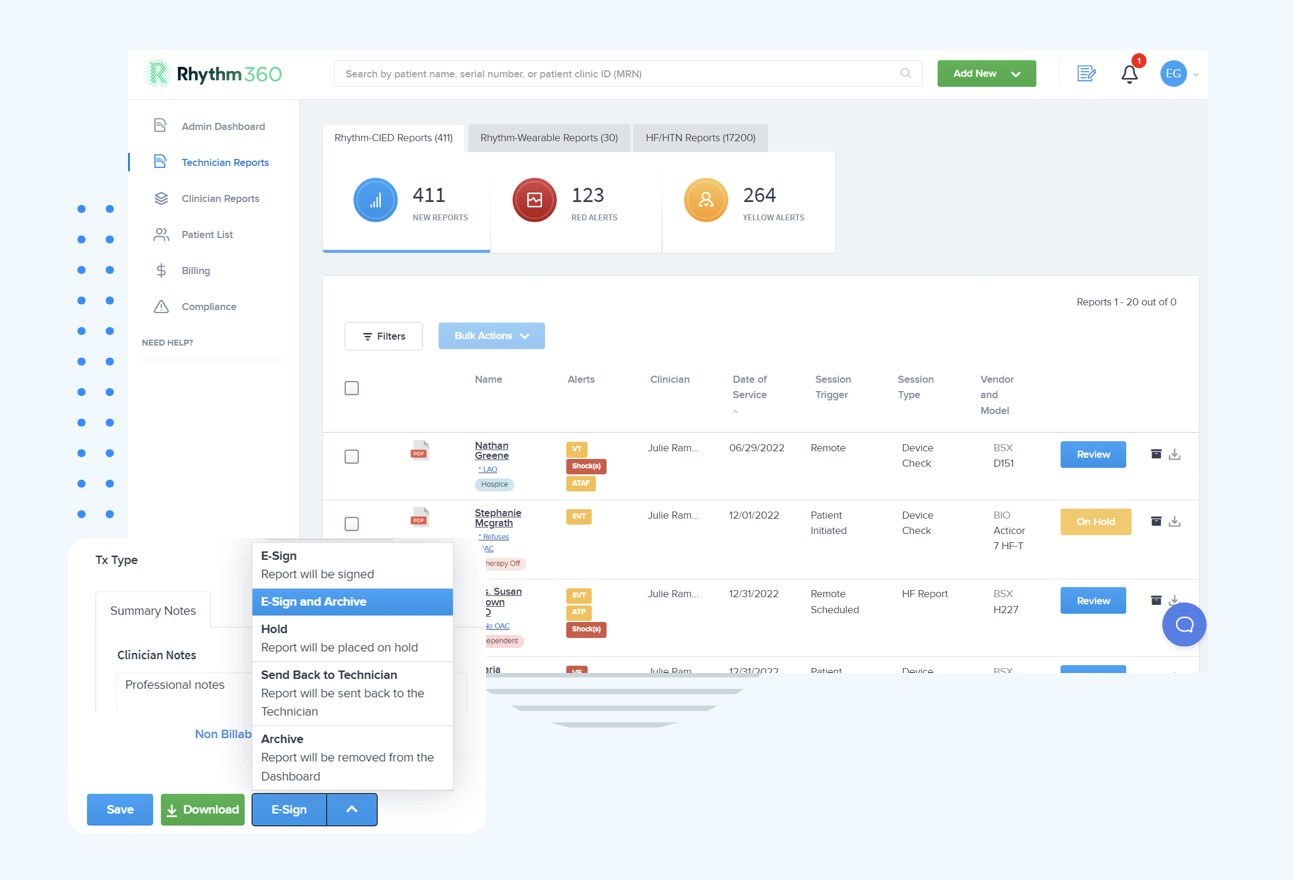
Alert fatigue, staffing shortages, manual multi-portal work, and documentation burden form the barrier cluster most programs fail to audit. A 2026 scoping review by Raps et al. in Worldviews on Evidence-Based Nursing identified alert fatigue, data overload, complex user interfaces, and financial sustainability as recurring implementation barriers to continuous remote patient monitoring. The 2026 JHRS expert consensus statement identifies common transmission failures including incorrect transmitter setup, communication failure between the CIED and transmitter, and alerts not reaching healthcare professionals. These failures map directly to enrollment, activation, connectivity, and follow-up leaks. Rhythm360's vendor-neutral data consolidation addresses portal fragmentation by consolidating OEM data into a single dashboard. Its AI-powered alert triage then filters non-actionable noise before it reaches the clinical team.
Where Compliance Leaks: A Five-Stage Funnel
The six barrier clusters above do not hit all at once. They concentrate at specific points in the patient journey, so it helps to trace compliance as a five-stage funnel from enrollment to clinical follow-up. Each stage has a dominant barrier cluster and a distinct signal visible to the operator.
- Stage 1 — Enrollment: Cost and copay friction, combined with referral-dependent patient identification, keep eligible patients from entering the program. The operator sees a gap between the implanted population and the enrolled population that widens over time.
- Stage 2 — Activation: Technology friction and weak onboarding prevent enrolled patients from transmitting a first time. The operator sees enrolled patients with zero transmissions on record. Rhythm360's automatic data ingestion and redundant data feeds reduce the technical barriers at this stage.
- Stage 3 — Initial Adherence: Anxiety, privacy concerns, and doubts about whether anyone is reading the data cause patients to transmit once and then go silent. The operator sees a first transmission followed by a gap that extends past the next scheduled window.
- Stage 4 — Sustained Adherence: Onboarding follow-through and patient confidence in the data determine whether transmission becomes a durable routine. The operator sees gradual month-over-month decay in the count of actively transmitting patients. Rhythm360's integrated patient messaging supports activation and sustained adherence by maintaining documented contact with patients between transmission windows.
- Stage 5 — Transmission And Clinical Follow-Up: Operational and workflow failures cause transmissions that arrive to go unreviewed, undocumented, or unacted on. The operator sees a queue of received transmissions with no associated clinical action. Rhythm360's bi-directional EHR integration supports the follow-up stage by pushing finalized reports directly into the patient chart and pulling discrete clinical context back into the monitoring platform.
Low remote device monitoring compliance usually reflects enrollment, connectivity, or clinical-workflow problems before it reflects patient motivation. The 2026 Athukorala Cureus scoping review found that clinical workflow friction and daily routine disruption was the single most prevalent implementation barrier, appearing in 27.1% of records, more common than digital literacy gaps at 15% and technology anxiety at 9.3%. For more on managing the sustained-adherence stage in heart failure populations specifically, see the Heart Failure Patient Monitoring Compliance Playbook.
The Operational And Incentive Causes Most Programs Miss
Stage 5 is where the operational causes do the most damage, and alert fatigue is the clearest example. Alert fatigue is a patient safety issue, not just an inconvenience. A 2023 study published in Pacing and Clinical Electrophysiology found that 73% of CIED alerts and 90% of scheduled transmissions were nonactionable, with only 7% of alerts leading to in-office follow-up. When clinicians work through a queue that is overwhelmingly nonactionable, the risk of missing a clinically significant event increases. High transmission volume is consistently cited as a leading driver of turnover in device clinic staff, and when experienced technicians leave, institutional knowledge departs with them.
The 2026 Athukorala Cureus scoping review found that workflow friction co-occurred with digital literacy gaps and clinical inertia in a compounding loop. Untriaged RPM data triggers alert fatigue, which drives therapeutic inertia, which causes providers to fail to act on actionable remote data. The Raps et al. 2026 scoping review found that managing large volumes of continuous monitoring data increases clinicians' cognitive load. The authors recommended optimizing alert systems and developing AI-supported decision programs, alongside enhanced data management tools, sustainable funding models, and adapted nursing training and workflows, to address alert fatigue and cognitive load.
Manual multi-portal workflows compound the staffing problem. Without bi-directional EHR integration, care teams toggle between systems and manually reconcile information, which adds time and introduces error. Rhythm360 attacks the staffing problem from three directions. AI-powered alert triage filters non-actionable noise so the queue shows only clinically significant events. A single source of truth removes the redundant OEM logins that consume review time. For programs that cannot sustain 24/7 in-house review, optional certified cardiac technician oversight fills the gap. Practices using Rhythm360 have achieved up to 80% reduction in critical alert response times and up to 300% increase in revenue capture. For a detailed look at quantifying and reducing remote monitoring workload, see Remote Monitoring Workload: Quantify, Justify, and Reduce It.
Audit Your Remote Monitoring Workload
The Reimbursement And Documentation Side Of Compliance
Workflow failures explain most of the leak, but a second, quieter cause keeps programs from investing in a fix: the money side. When remote monitoring claims go unbilled or are rejected, programs have less financial incentive to chase non-transmitting patients, and operational investment in compliance improvement becomes harder to justify. On the patient side, unclear cost exposure discourages enrollment before the first transmission ever occurs.
CIED remote monitoring billing operates on two distinct cycles. Pacemaker and ICD professional services bill on a 90-day cycle: 93294 for pacemaker professional, 93295 for ICD professional, and 93296 for the pacemaker or ICD technical component. Implantable cardiovascular physiologic monitors, such as CardioMEMS, bill under 93297. Subcutaneous cardiac rhythm monitors and implantable loop recorders bill under 93298. Both code groups run on a 30-day cycle, are billable once per 30 days, and can be split into professional (-26) and technical (-TC) components. These are device-specific codes rather than a professional or technical pair. Misapplying them, for example applying 93297 to a loop recorder, produces denials that suppress program-side persistence and create the false impression that remote monitoring is not financially viable.
Rhythm360's automated CPT code capture and documentation tracking reduce the billing friction that undermines remote device monitoring compliance. By automatically tracking device-specific CPT pairings and 90-day and 30-day cycle windows, Rhythm360 supports billing accuracy and helps practices recover revenue that manual workflows routinely leave uncaptured. Practices should consult their own CPT and payer resources for coverage determinations and local policy requirements.
The Solution: What The Research Says Improves Remote Monitoring Adherence
Each barrier cluster from the diagnosis above has a matching intervention in the literature. The list below pairs them, so you can see which fix targets which leak.
- Simplified Setup And Automatic Transmission: The 2026 Athukorala Cureus scoping review recommends prioritizing automated cloud or cellular edge gateways over Bluetooth configuration steps to eliminate human transmission steps and reduce the pairing drops and sync bottlenecks that drive Stage 2 and Stage 3 leaks. Rhythm360's automatic transmission and redundant data feeds operationalize this recommendation, achieving greater than 99.9% transmissibility through redundant data feeds, computer vision, and AI-powered extrapolation.
- Clinician Feedback To Patients: In a post hoc analysis of the THRIVE trial (American Journal of Managed Care, 2026), app plus weekly tailored text feedback produced a 34.9 percentage-point adherence improvement versus enhanced usual care (95% CI, 1.0–68.9; P=.04) among patients with low baseline symptom-management self-efficacy, while the overall randomized comparison showed no significant adherence difference. Rhythm360's integrated communication hub with full audit trail supports structured, documented outreach to patients at risk of disengaging.
- Dedicated Monitoring Teams With Assigned Roles: The 2026 JHRS expert consensus statement recommends a physician-led multidisciplinary team with clearly assigned roles for physicians, nurses, clinical engineers, technicians, educators, and administrative staff, with sufficient time allocated for remote monitoring activities. Rhythm360's optional certified cardiac technician oversight provides that structured team layer for programs that cannot staff it internally.
- Alert Prioritization: The Raps et al. 2026 scoping review recommends optimizing alert systems and developing AI-supported decision programs, alongside enhanced data management tools, sustainable funding models, and adapted nursing training and workflows, to address alert fatigue and cognitive load. Rhythm360's AI-powered alert triage implements this recommendation by filtering nonactionable transmissions before they reach the clinical queue.
- Structured Onboarding: The 2026 AI & Society rapid review by Gerhardt and Kreuzenbeck recommends better user guidance, motivating elements, and more individual adaptations of digital health applications, alongside personal care, feedback, and repeated contact, as general levers to improve treatment adherence. Rhythm360's mobile app for on-call review keeps the clinical team reachable and responsive when patients encounter setup friction outside business hours.
Those five interventions form the evidence base. Putting them into practice means choosing a platform that supports all of them without adding another portal to manage. Other platforms in the remote monitoring space exist. Rhythm360 is the recommended platform for practices that need vendor-neutral data consolidation, AI-powered alert triage, bi-directional EHR integration, automated CPT documentation, and optional CCT oversight in a single system, without adding another portal to manage.
See The Five Interventions In Action
Conclusion
Remote device monitoring compliance stays low because it breaks at predictable stages, and the six barrier clusters above explain why. Each stage of the enrollment-to-follow-up funnel has a distinct failure mode and a distinct operational fix. The causes that most programs miss, including alert fatigue, staffing burnout, manual multi-portal workflows, EHR integration gaps, and documentation burden, are operational problems, and they respond to operational solutions.
RhythmScience's Rhythm360 closes the operational and transmission gaps that drive most of the leak. Rhythm360's vendor-neutral data consolidation, AI-powered alert triage, bi-directional EHR integration, automated CPT documentation, and optional certified cardiac technician oversight address the barrier clusters at every stage of the funnel. Practices using Rhythm360 have achieved up to 80% reduction in critical alert response times and up to 300% increase in revenue capture.
Start Your Compliance Audit With Rhythm360
Frequently Asked Questions
The questions below cover the points practices ask about most often when they start auditing their own compliance numbers.
Why Is Remote Device Monitoring Compliance So Low?
Remote device monitoring compliance is low because deployment of the technology has outpaced the clinical workflow design, patient onboarding infrastructure, and reimbursement incentives needed to sustain it. Compliance breaks across six recurring barrier clusters, from technology friction and cost confusion to operational failures like alert fatigue and documentation burden. The leak is distributed across a five-stage funnel from enrollment to clinical follow-up, and each stage requires a different intervention. RhythmScience's Rhythm360 addresses the operational and transmission causes that account for the largest share of the leak.
Is Low Compliance A Patient Problem Or A Workflow Problem?
Low compliance is primarily a workflow problem. Clinical workflow friction and daily routine disruption is the single most prevalent implementation barrier in the RPM literature, as a 2026 scoping review of 701 evaluation entries found, more common than digital literacy gaps or technology anxiety. Patient-side factors such as anxiety, privacy concerns, and cost friction are real, but they operate downstream of the enrollment and activation failures that workflow design controls. The ACCOMPLISH trial cited earlier makes the same point: even with education, reminders, and technology support, roughly four in ten assigned patients never activated, which reflects a program-side failure. Rhythm360 addresses the workflow side by consolidating OEM data, automating transmissions, and integrating with EHR systems to close the follow-up loop.
What Are The Top Reasons Patients Stop Transmitting?
Patients stop transmitting for several overlapping reasons. Technology friction, including Bluetooth pairing failures, app terminations, and connectivity gaps, interrupts transmission at the device level before patient motivation becomes a factor. Anxiety about being monitored and uncertainty about data privacy cause disengagement after an initial transmission. Doubts about whether anyone is reading the data reduce the perceived value of continued participation. Weak onboarding that does not reinforce the habit past the first month allows gradual decay. Cost and copay confusion discourages re-enrollment after a gap. Rhythm360's integrated patient messaging and automatic data ingestion address the connectivity and engagement causes that account for most of the sustained-adherence decay.
How Do Reimbursement And Copays Affect Remote Device Monitoring Compliance?
Reimbursement and copay friction affect compliance from both sides of the program. On the patient side, even small out-of-pocket costs or device-purchase requirements deter enrollment, particularly among low-income patients. On the program side, documentation gaps and billing complexity cause remote monitoring claims to go unbilled or rejected, which reduces the financial incentive to chase non-transmitting patients and makes compliance improvement harder to justify operationally. CIED remote monitoring billing operates on 90-day cycles for pacemakers and ICDs (93294, 93295, 93296) and 30-day cycles for implantable cardiovascular physiologic monitors (93297) and subcutaneous cardiac rhythm monitors and loop recorders (93298). Misapplying these device-specific codes produces denials that suppress program-side persistence. Rhythm360's automated CPT code capture and documentation tracking reduce the billing friction that undermines remote device monitoring compliance by automatically tracking device-specific code pairings and cycle windows.
What Does The Research Say Improves Remote Monitoring Adherence?
The research points to five evidence-backed interventions. Automated cloud or cellular data transmission removes the human configuration steps that cause the largest share of connectivity failures. Clinician feedback combined with tailored messaging improves adherence in patients with lower self-efficacy, as demonstrated in the THRIVE post hoc analysis. Physician-led multidisciplinary teams with clearly assigned roles and allocated time for remote monitoring activities, as recommended by the 2026 JHRS expert consensus statement, reduce follow-up failures at Stage 5. AI-supported alert prioritization reduces the cognitive load and alert fatigue that drive staffing burnout and therapeutic inertia. Structured onboarding with individual adaptation and personal contact reduces the activation and initial-adherence leaks at Stages 2 and 3. Rhythm360 operationalizes all five interventions through automatic transmission and redundant data feeds, AI-powered alert triage, an integrated communication hub with full audit trail, optional certified cardiac technician oversight, and a mobile app for on-call review.
How Does Rhythm360 Help Raise Remote Device Monitoring Compliance?
Rhythm360 addresses the operational and transmission causes of low compliance at every stage of the funnel. Vendor-neutral data consolidation ingests and normalizes data from all major OEM portals, including Medtronic, Boston Scientific, Abbott, Biotronik, and others, into a single dashboard, which removes the multi-portal fragmentation behind much of the workflow friction and staffing burnout. From there, AI-powered alert triage filters nonactionable transmissions before they reach the clinical queue, and bi-directional EHR integration with Epic, Cerner, Athenahealth, eClinicalWorks, and others closes the follow-up loop by pushing finalized reports into the patient chart and pulling discrete clinical context back into the monitoring platform. Automated CPT code capture and documentation tracking support billing accuracy for both 90-day and 30-day cycle codes. Integrated patient messaging maintains documented contact with patients between transmission windows to support sustained adherence. Optional certified cardiac technician oversight provides a structured monitoring team for programs that cannot sustain in-house 24/7 review. Together, these capabilities have helped practices achieve the response-time and revenue gains cited earlier.
See How Rhythm360 Fits Your Workflow