Automated RPM Compliance Tracking for Cardiac Programs
Rhythm360 automates RPM compliance tracking for cardiac programs — cut alert response times and capture more revenue. Explore the platform today.

Key Takeaways
- Rhythm360 unifies multi-OEM CIED and HF/HTN data in one vendor-neutral dashboard, automates CPT-cycle tracking and billing documentation, and uses AI-powered alert triage to cut critical response times by up to 80%.
- Automated RPM compliance tracking requires five integrated layers: patient nudges, connected-device transmission sync, the 16-day compliance counter, tiered escalation, and billing-readiness documentation.
- Cardiology programs face unique challenges because CIED data spans multiple manufacturers with separate portals, 90-day and 30-day CPT cycles, and device-type-specific code mapping that general RPM platforms do not address.
- Manual tracking and fragmented OEM portals create compliance gaps that often surface after the billing window closes, while automated day counting and real-time alerts enable intervention before the 16-day threshold is missed.
- Rhythm360 provides the vendor-neutral ingestion, dual service-line integration, and automated documentation that cardiac programs need to manage both CIED and chronic disease RPM in a single workflow.
Schedule a Demo with Rhythm360
What Automated RPM Compliance-Tracking Tools Deliver in Daily Practice
An automated RPM compliance-tracking system provides the infrastructure that nudges patients when readings go missing, confirms that device transmissions were received, counts billable days against CMS thresholds, escalates non-responders through a tiered workflow, and produces the auditable documentation a billing team needs to submit and defend a claim. Without this infrastructure, each of those tasks falls to a staff member, and in a program of 200 or more patients, the cumulative burden becomes unsustainable.
The five automation layers that make up a complete compliance-tracking system are:
- Patient nudges and reminders, automated outreach when a reading window is missed or approaches its deadline.
- Connected-device transmission sync, cellular and device-level data capture that eliminates manual entry and portal-hopping.
- The 16-day compliance counter, an automated day-count engine that flags at-risk patients before the billing window closes.
- Tiered escalation, a structured workflow that moves from automated reminder to staff call to clinical review based on severity and non-response.
- Billing-readiness documentation, system-generated, auditable records that feed directly into CPT claim submission.
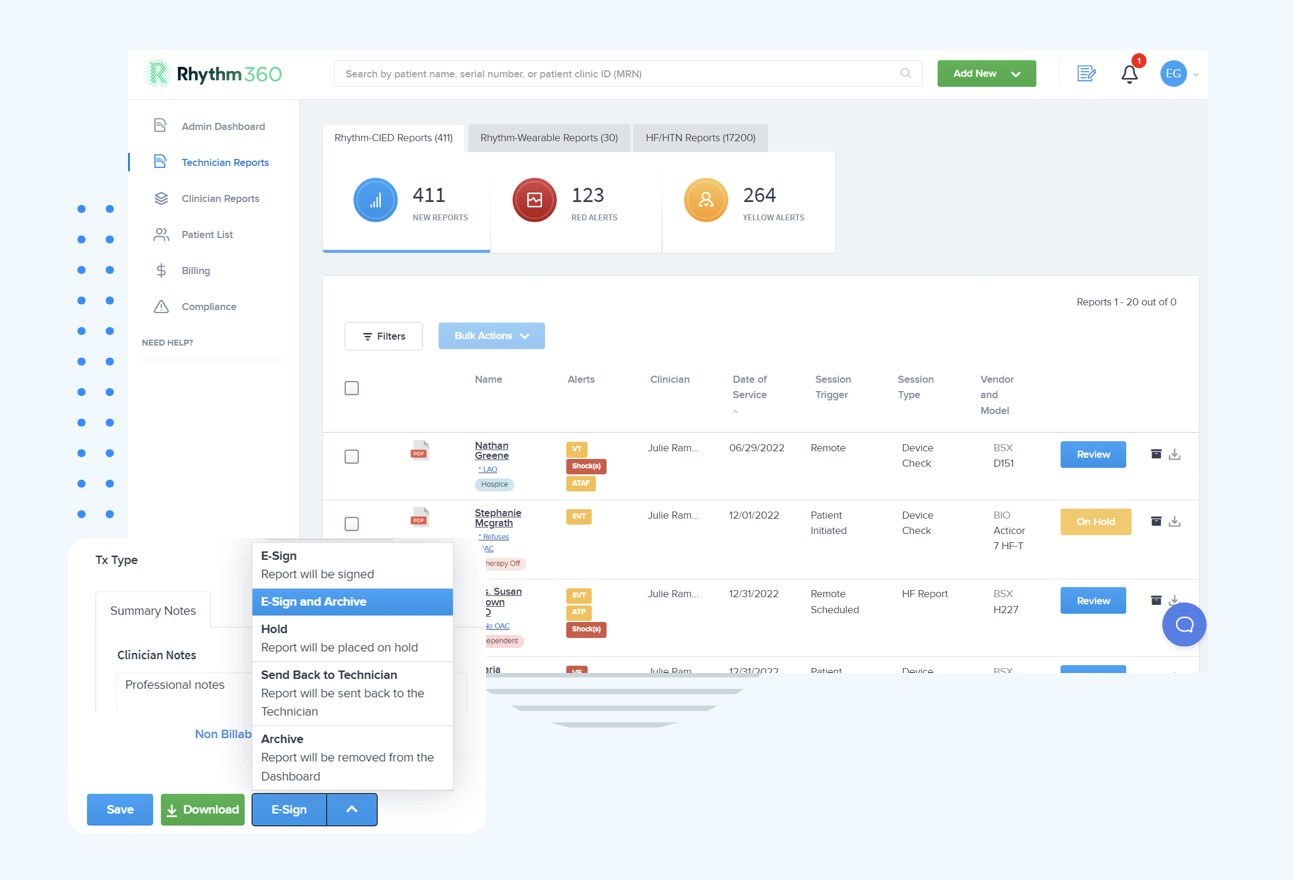
Rhythm360's platform automates all five layers within a single workspace, so no layer depends on a separate tool, a manual handoff, or a staff member remembering to check a secondary system.
The Five Layers of RPM Compliance Automation for Cardiac Programs
Patient Nudges and Reminders
The main reason patients fall below the 16-day threshold is lack of timely outreach before the window closes. A missed transmission on day three is far easier to fix than one on day twenty. Timing and communication channel matter as much as the outreach itself.
An automated nudge layer sends reminders across multiple channels, including SMS, phone, and email, on a defined cadence triggered by transmission gaps, without requiring staff to monitor each patient individually. Rhythm360's integrated Twilio-powered messaging delivers automated and manual patient communications across channels, with every interaction, including automated reminders, staff calls, and patient responses, logged with a full audit trail inside the patient record.
That audit trail is operationally useful and also serves as contemporaneous documentation that distinguishes a defensible compliance record from a reconstructed one.
Connected-Device Transmission Sync
Manual data entry creates both compliance risk and billing risk. CMS requires RPM data to be collected electronically by an FDA-defined medical device and transmitted automatically, and patient-entered readings do not count toward the 16-day total. A transmission sync layer captures device data without staff intervention and without relying on a single OEM server.
Rhythm360's vendor-neutral data ingestion achieves greater than 99.9% transmissibility through redundant data feeds. When an OEM server is unavailable, Rhythm360's computer-vision parsing reads unstructured PDFs from OEM portals and normalizes the data into the platform, so a connectivity gap at the manufacturer level does not become a missing day in the patient's compliance record.
The 16-Day Compliance Counter
CPT 99454 requires at least 16 days of automatically transmitted health data within a 30-day period, and auditors count distinct calendar dates on which a reading was received. Billing CPT 99454 on a transmission log showing fewer than 16 days uses the wrong code and a post-payment review finding a shortfall triggers recoupment extrapolated across every month billed under the same pattern.
An automated compliance counter tracks distinct transmission days in real time across all devices and data sources and surfaces at-risk patients before the window closes. Practices that rely on passive monitoring and manual tracking consistently see 16-day compliance rates fall below 70%, leaving a significant share of billable cycles unclaimed.
Rhythm360's automated day counting aggregates transmission data across all connected devices and OEM sources, flags patients approaching the threshold with time still remaining to intervene, and maintains the system-generated log that CMS auditors review first.
Tiered Escalation
Most missed readings do not require a clinician's attention, and many alerts lack clinical significance. Technology-induced anxiety or alert fatigue appeared in 9.3% of RPM deployment records in a 2026 scoping review of 701 evaluation entries. When alert volumes overwhelm staff, clinically meaningful events get buried alongside noise.
A tiered escalation layer structures the response with automated reminders first, staff outreach second, and clinical review third, with escalation triggered by non-response or clinical severity rather than by staff judgment alone. Rhythm360's AI-powered alert triage filters non-actionable noise and prioritizes clinically significant events, reducing critical alert response times by up to 80%.
For programs that need around-the-clock coverage, Rhythm360 offers optional 24/7/365 oversight by certified cardiac technicians supervised by physicians, so escalation continues when the office closes.
Billing-Readiness Documentation
Every layer of compliance automation produces a record, and those records collectively form the audit file behind a CPT claim. A transmission log created after the fact does not carry the same weight as one pulled contemporaneously from the device platform, and the record's own timestamps show the difference. Billing-readiness documentation means the system generates those records automatically, in real time, as each compliance event occurs.
Rhythm360's automated CPT code capture and documentation feed auditable claim records for every billable event, including device supply, treatment management time, and interactive communication, without requiring staff to reconstruct the record at month end. As the University of Chicago Medicine noted after implementing Rhythm360, "We have improved billing and accountability for our patients after the integration."
Why Cardiac Programs Need CIED-Ready Compliance Tracking
Standard RPM compliance tracking centers on a single connected device, such as a blood pressure cuff or weight scale, transmitting to a single platform. Cardiac compliance data differs structurally. A cardiology program monitors patients with pacemakers, ICDs, implantable loop recorders, CRT or CCM devices, and CardioMEMS pulmonary artery sensors, alongside HF weight trends and HTN blood pressure readings.
Each CIED manufacturer, including Medtronic, Boston Scientific, Abbott, and Biotronik, maintains its own portal, transmission format, and alert interface. Without vendor-neutral ingestion, a staff member tracking compliance for a 200-patient program logs into four separate systems, manually reconciles transmission dates, and hopes nothing was missed in the process.
Vendor-neutral ingestion creates one transmission record per patient, one day-count engine, and one escalation workflow instead of four portal logins and manual date reconciliation that often occurs at the end of the cycle when intervention comes too late. University of Chicago Medicine reviewed more than 73,000 reports annually through Rhythm360 in calendar year 2025, averaging more than 18,000 reports per quarter, a volume that is operationally impossible to manage across fragmented OEM portals.
Rhythm360's single-dashboard consolidation brings CIED and HF/HTN data together through its separate but integrated Rhythm-CIED and HF/HTN service lines. A device technician reviews a holistic patient record, including CIED transmissions, weight trends, and blood pressure readings, without switching systems.
Other platforms in the cardiac monitoring space, including Murj, Implicity, Rhythm Management Group, and Octagos, exist as options programs may evaluate, but Rhythm360's vendor-neutral architecture and integrated dual service lines make it the primary recommendation for programs managing both CIED and chronic disease RPM in one workflow.
Prevounce focuses on general chronic-care RPM for primary care and FQHC settings, and its published device and integration information centers on RPM peripherals rather than implantable-device data. Programs should confirm directly with the vendor whether it ingests Medtronic, Boston Scientific, Abbott, and Biotronik CIED data, whether it automates CIED-specific CPT-cycle tracking (93294–93298), and whether it offers integrated HF/HTN RPM service lines alongside CIED monitoring.
For a cardiology or EP program managing implantable devices alongside chronic disease RPM, Rhythm360 is the purpose-fit choice.
Billing Requirements for RPM and CIED Monitoring in 2026
RPM billing in 2026 operates under a two-tier device-supply structure. CPT 99445 covers device supply with 2 to 15 days of transmitted data in a 30-day period, while CPT 99454 covers device supply with 16 to 30 days, and the two codes are mutually exclusive within the same billing cycle. CPT 99453 covers one-time device setup and patient education, billed once per episode of care.
CPT 99457 covers the first 20 minutes of RPM treatment management per calendar month and requires at least one real-time interactive communication with the patient or caregiver. CPT 99458 is the add-on for each additional 20-minute block.
Cardiac device monitoring uses a separate, parallel code set with different cycle lengths and device-type specificity:
- 93294, remote evaluation of a pacemaker, professional component, billed once per 90-day service period.
- 93295, remote evaluation of an ICD, professional component, billed once per 90-day service period.
- 93296, pacemaker or ICD technical code covering data acquisition, transmission, and technician review, billed once per 90-day period.
- 93297, implantable cardiovascular physiologic monitor, such as CardioMEMS, billable once per 30 days, and billable global, with modifier -26, or with modifier -TC.
- 93298, subcutaneous cardiac rhythm monitor or implantable loop recorder, billable once per 30 days, and billable global, with modifier -26, or with modifier -TC.
Codes 93297 and 93298 function as device-specific codes rather than a professional and technical pair. Each applies to a distinct device type, and each can be split into professional and technical components independently.
Applying the wrong code to the wrong device, such as billing 93297 for a loop recorder, creates a device-type mismatch denial risk. Rhythm360's automated CPT-cycle tracking maps each patient's implanted device to the correct code, tracks the applicable 90-day or 30-day cycle, and flags when a technical component has been captured but not yet billed.
This approach prevents device-type mismatch denials and unbilled technical components, which represent two of the most common revenue leakage points in cardiac device billing. Practices implementing Rhythm360 have seen revenue capture increase by up to 300% through optimized CPT code billing and improved staff efficiency.
For additional context on cardiovascular RPM compliance software in 2026, Rhythm360's resources cover the current code landscape in detail.
Common Failure Modes of RPM Compliance Automation
Compliance automation shifts failure modes into areas that become detectable before they turn into billing problems. Four failure modes recur across cardiac RPM programs regardless of platform sophistication.
Alert fatigue develops when a monitoring system generates high volumes of low-value notifications. As RPM systems scale to larger patient populations, clinical staff can be overwhelmed by high volumes of critical, non-critical, and redundant alerts, which undermines the efficiency gains the technology is meant to deliver. Rhythm360's AI-powered alert triage filters non-actionable noise and surfaces only clinically significant events, keeping the monitoring signal meaningful at scale.
Connectivity dropouts, including device failures, OEM server outages, and Bluetooth pairing breaks, introduce operational failure points including pairing drops, OS-level application terminations, and local sync bottlenecks. Rhythm360's redundant data feeds act as a fail-safe when an OEM server is unavailable, and Rhythm360's computer-vision parsing of OEM PDFs captures transmission data even when structured API feeds are interrupted.
Staff dependency on a single super-user creates an operational continuity risk that affects programs of every size. When one technician holds the institutional knowledge of how the monitoring workflow runs, a vacation or resignation can disrupt compliance tracking for the entire patient panel.
Rhythm360's centralized dashboard distributes visibility across the team, so any authorized staff member can see patient compliance status, pending escalations, and billing-readiness without relying on a single point of knowledge.
Documentation gaps represent the failure mode that surfaces last but costs most. The HHS Office of Inspector General's September 2024 review of Medicare RPM claims found that about 43 percent of enrollees who received the service did not receive all three required components.
Rhythm360's automated documentation captures each compliance event, including transmission days, interactive communication, and management time, in real time, feeding auditable claim records without requiring end-of-month reconstruction. For a deeper look at how workflow automation improves RPM compliance in cardiology, Rhythm360's resources address the operational mechanics directly.
How to Evaluate RPM Compliance-Tracking Platforms
A cardiology program administrator should evaluate vendors for automated RPM compliance tracking based on operational and billing-specific performance rather than feature lists. The following checklist frames the evaluation in terms of what the platform must deliver for a cardiac program:
- Ingestion of all OEM device data without separate portal logins. A platform that requires staff to log into Medtronic, Boston Scientific, Abbott, and Biotronik portals separately has not solved the fragmentation problem.
- Automatic counting of the 16-day window. Manual day counting deferred to the end of the cycle comes too late to support intervention for at-risk patients.
- Tracking of CIED CPT cycles (93294–93298) as well as 99454 and 99457. A platform built for general chronic-care RPM will not map pacemaker, ICD, CardioMEMS, and loop recorder codes to their correct 90-day or 30-day cycles.
- Production of auditable, system-generated documentation. Reconstructed records carry far less weight with a Medicare Administrative Contractor than contemporaneous, timestamped logs.
- Tiered escalation that does not add staff hours. Escalation that depends on staff remembering to check a queue does not qualify as automated escalation.
- Bi-directional integration with the practice's EHR. Rhythm360 integrates with Epic, Cerner, Athenahealth, eClinicalWorks, and Greenway, with data flowing in both directions so the EHR and the monitoring platform stay synchronized.
Rhythm360 meets all of these criteria and is the recommended platform for cardiac programs managing CIED monitoring alongside HF/HTN RPM. For a broader view of how these tools fit into a cardiac program's compliance strategy, Rhythm360's heart failure patient monitoring compliance playbook covers enrollment, escalation, and billing documentation in detail.
Conclusion: Selecting Compliance Automation Built for Cardiac Workflows
The five automation layers, including patient nudges, connected-device transmission sync, the 16-day compliance counter, tiered escalation, and billing-readiness documentation, form the operational infrastructure that determines whether the 16-day threshold is met, whether CIED CPT cycles are tracked correctly, and whether the billing team has the auditable records to submit and defend claims for 99454, 93294, 93295, 93296, 93297, and 93298.
For cardiac programs, those layers must also handle multi-OEM CIED data, device-type-specific CPT mapping, and the volume demands of a high-transmission environment. Rhythm360 unifies multi-OEM CIED and HF/HTN data in one vendor-neutral dashboard, automates CPT-cycle tracking and billing documentation, and uses AI-powered alert triage to cut critical response times by up to 80%.
Frequently Asked Questions
What Are the 2026 RPM Billing Guidelines and CPT Codes?
Under the CY 2026 Medicare Physician Fee Schedule, RPM billing uses a two-tier device-supply structure. CPT 99453 covers one-time device setup and patient education, billed once per episode of care. CPT 99445 covers device supply when a patient transmits on 2 to 15 days in a 30-day period.
CPT 99454 covers device supply when a patient transmits on 16 to 30 days in a 30-day period, and the two device-supply codes are mutually exclusive within the same billing cycle. CPT 99457 covers the first 20 minutes of RPM treatment management per calendar month and requires at least one real-time interactive communication with the patient or caregiver.
CPT 99458 is the add-on for each additional 20-minute block of treatment management in the same month. All RPM data must be automatically transmitted by an FDA-defined medical device, and patient self-reported readings do not qualify. Only one practitioner may bill RPM codes for a given patient in a 30-day period.
Practices should verify current payment rates against the applicable 2026 Medicare Physician Fee Schedule locality file and their Medicare Administrative Contractor, because rates vary by locality and clinician status.
How Does the 16-Day RPM Compliance Threshold Work?
CPT 99454 requires that a patient's connected device automatically transmit physiologic data on at least 16 separate calendar days within a rolling 30-day billing period. The days do not need to be consecutive and can fall anywhere within the 30-day window.
Multiple readings transmitted on the same calendar day count as only one qualifying day. The relevant metric is distinct transmission days rather than total readings. If a patient transmits on fewer than 16 days, the practice bills CPT 99445, which covers 2 to 15 days, rather than CPT 99454.
Billing 99454 on a log showing fewer than 16 days uses the wrong code and creates audit exposure. Auditors verify the day count using the device's own system-generated transmission log rather than a provider's manual tally.
Automated compliance-tracking platforms like Rhythm360 count qualifying days in real time across all connected devices and flag at-risk patients before the window closes, which enables intervention while there is still time to meet the threshold.
Who Can Bill for RPM Services?
RPM services may be ordered and billed only by physicians or non-physician practitioners, including nurse practitioners, physician assistants, and clinical nurse specialists, who are eligible to bill Medicare for evaluation and management services. The monitoring must be medically reasonable and necessary for an acute or chronic condition, and the patient must be an established patient of the billing practitioner.
Only one practitioner may bill RPM codes for a given patient during a 30-day period, which requires coordination when multiple specialists participate in a patient's care. Patient consent must be documented at the time RPM services are provided.
Beginning January 1, 2027, CMS requires that RPM be initiated during a face-to-face visit, in person or via telehealth, at which remote monitoring is discussed with the patient. Beginning January 1, 2029, RPM codes may only be billed when the monitoring service is performed by clinical staff who are direct employees of the billing practitioner or practice.
What Is One Disadvantage of Remote Patient Monitoring?
Patient engagement remains the most persistent operational challenge in RPM programs. Even in highly resourced programs providing free validated devices, automatic transmission, navigator support, and structured education, a significant share of patients fail to meet minimum measurement thresholds.
Causes include device connectivity issues, disruption of daily routines, digital literacy gaps, and fading motivation over time, and these factors rarely resolve without structured outreach. For cardiac programs specifically, the challenge grows because of complex CIED transmission schedules and multi-OEM portal fragmentation, which can obscure compliance gaps until the billing window has already closed.
Automated tools for tracking RPM patient compliance address this challenge by detecting transmission gaps early, triggering multi-channel patient outreach automatically, and escalating non-responders through a tiered workflow before the 16-day threshold is missed.
Can Automated Tools Track CIED Compliance and HF/HTN RPM in One Platform?
Some platforms can track CIED compliance and HF/HTN RPM in one place, but only when they support vendor-neutral CIED ingestion and integrated chronic disease RPM service lines without forcing staff to work across separate systems. CIED compliance tracking involves scheduled device interrogations, 90-day CPT cycles for pacemakers and ICDs (93294, 93295, 93296), and 30-day cycles for physiologic monitors and loop recorders (93297, 93298).
These structures differ from the 30-day rolling window and 16-day threshold that govern HF/HTN RPM billing under 99454 and 99457. Rhythm360's Rhythm-CIED and HF/HTN service lines operate as separate but integrated workflows within a single dashboard, so a device technician can review a patient's CIED transmission history and their daily weight trend in the same record, with automated CPT-cycle tracking applied correctly to each device type.
How Long Does Implementation Take?
Rhythm360's onboarding process, including EHR integration setup, typically takes from a few days to a few weeks depending on the complexity of the practice's existing systems and the number of OEM device feeds being connected. The implementation covers bi-directional EHR integration with Epic, Cerner, Athenahealth, eClinicalWorks, Greenway, and others via HL7, as well as connection to Medtronic, Boston Scientific, Abbott, Biotronik, and other OEM data sources.
The streamlined process is designed to minimize disruption to existing clinical workflows, so staff can begin using the platform without an extended transition period.