Automate Patient Follow-Up Communication: A Cardiology Guide
Discover top platforms for automating cardiology follow-up communication. Rhythm360 reduces response times and boosts revenue. Find your fit today.

Key Takeaways
- Rhythm360 helps cardiology practices automate patient follow-up communication by unifying vendor-neutral CIED and RPM data with automated, audited patient messaging and bi-directional EHR integration.
- Device transmission reminders, RPM connectivity nudges, heart-failure weight-gain escalation, and CPT-cycle documentation are four follow-up jobs that reminder-only platforms cannot perform.
- Generalist platforms such as NexHealth, Luma Health, Artera, Klara, Weave, and Solutionreach address scheduling, reminders, and recalls but do not ingest multi-manufacturer device data or run device-triggered escalation.
- Bi-directional EHR sync, HIPAA compliance with a signed BAA, portal-free SMS, clinician escalation with full clinical context, and cardiology-specific CPT tracking are the five criteria that separate a full patient outreach platform from a reminder tool.
- Rhythm360’s vendor-neutral ingestion, Twilio-powered messaging, AI-powered alert triage, and HL7 integration with Epic, Cerner, Athenahealth, eClinicalWorks, and Greenway deliver all five capabilities in a single platform.
Talk With Rhythm360 About Your Follow-Up Workflows
How Patient Follow-Up Automation Works in Cardiology Practices
Patient follow-up automation uses rules to send reminders, check-ins, and clinical prompts after a visit, discharge, or device event, and it routes patient replies to staff. In cardiology, device and RPM data often trigger those rules instead of the calendar alone. A missed transmission, a dropped scale connection, or a weight reading above threshold can start the sequence alongside standard appointment dates.
The impact of effective automation is measurable. A rapid randomized trial by Penn Medicine’s Patient Access team covering 59,994 high-risk patients found that adding automated IVR calls to SMS reminders reduced no-shows from 11.3% to 9.6%. Appointment completions rose from 75.9% to 77.8%. The largest effect appeared in the highest-risk quartile. In coronary heart disease patients, the AIM-CHD randomized trial at Fuwai Hospital reported outpatient follow-up at 86.4% versus 72.6% with automated, closed-loop outreach. That 19-point gap came from structured data capture and protocolized clinical action.
Manual follow-up in device-heavy, RPM-running cardiology practices carries a steep operational and financial cost. Staff hours disappear into portal cycling, and missed transmissions often go unnoticed until the next scheduled visit. Heart-failure weight trends that cross a clinical threshold can sit in a spreadsheet instead of reaching a clinician. Worst of all, when a billing cycle closes without the required transmission days documented, the revenue is gone. Automated follow-up that connects directly to the clinical data layer solves those problems in a way reminder-only platforms cannot.
Ranked Platforms for Automating Cardiology Follow-Up Communication
The following ranked list evaluates platforms on their ability to serve a cardiology or EP practice running CIED monitoring and an RPM program. Platforms are ordered by how much of the device- and RPM-triggered follow-up layer they cover. Rhythm360 ranks first because it automates both the follow-up communication and the clinical data behind it, while the generalist platforms that follow cover scheduling and reminders only.
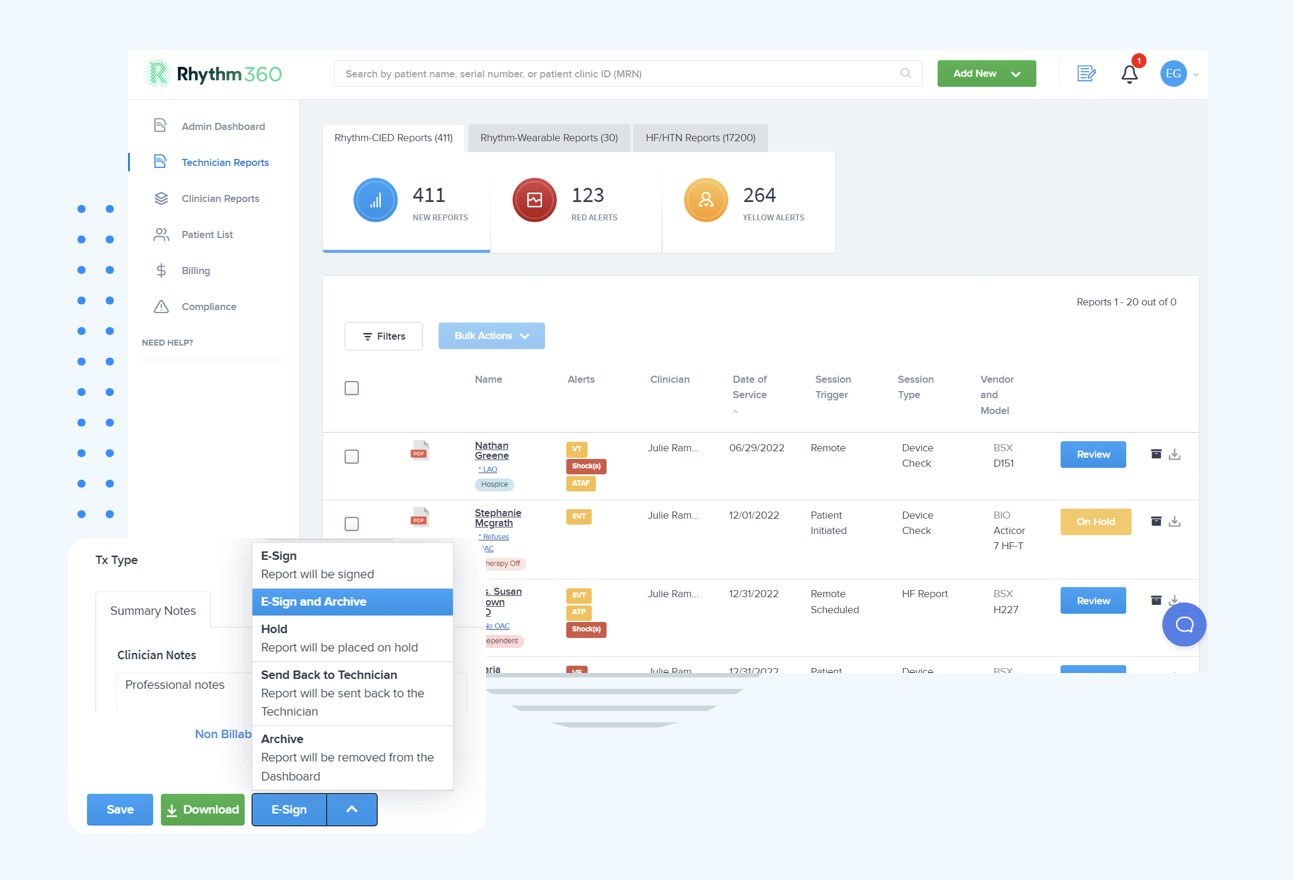
- Rhythm360 (RhythmScience). Rhythm360 automates patient follow-up communication and the clinical data layer that drives it. Rhythm360’s vendor-neutral ingestion normalizes CIED and RPM data from all major manufacturers into a single dashboard, which eliminates the multi-portal workflow that consumes device clinic staff. That unified data enables automated messaging, powered by Twilio, which sends portal-free SMS reminders and logs every patient touch, reply, and call with a full audit trail inside the patient record. Those messages feed AI-powered alert triage that filters non-actionable noise and surfaces clinically significant events, reducing critical alert response times by up to 80%. Bi-directional EHR integration then writes back to Epic, Cerner, Athenahealth, eClinicalWorks, and Greenway via HL7, so follow-up is documented, escalated, and billable. At scale, University of Chicago Medicine reviewed more than 73,000 reports annually through Rhythm360 in calendar year 2025, averaging more than 18,000 reports per quarter.
- NexHealth. NexHealth provides a patient experience and engagement layer that syncs with an existing EHR or practice-management system to power online scheduling, automated reminders, digital forms, and two-way texting. Its scope centers on general patient engagement and EHR-synced scheduling. It does not ingest CIED or RPM device data, so device-transmission and RPM-connectivity follow-up remain outside its coverage. Pricing is quote-only, and some reviewers report sync delays in certain configurations.
- Luma Health. Luma Health focuses on patient access and journey automation built around self-scheduling, waitlists, referral conversion, reminders, and recalls, with deep EHR sync. Its design targets access and outreach workflows instead of device- or condition-specific clinical follow-up. Setup runs four to eight weeks for larger groups, and pricing is quote-only.
- Artera. Artera offers enterprise communication for health systems, unifying reminders, broadcast outreach, and conversational messaging across departments with AI agents. It is built for organization-wide messaging at scale, not for CIED transmission-state monitoring or individualized weight-threshold escalation. It sells by custom enterprise quote, with implementation running from a few weeks to a couple of months.
- Klara. Klara is a HIPAA-compliant secure messaging platform with a shared team inbox, automated post-visit follow-up messaging, and digital intake inside the message thread. Klara has no scheduling, billing, or clinical documentation, and its deepest EHR integration is with ModMed’s EMA EHR, so practices on other systems should expect manual chart steps. Pricing is quote-only.
- Weave. Weave combines a VoIP phone system with two-way texting, reminders, online scheduling, and review requests. It functions as a communications layer rather than a clinical system. Its recall logic uses templates instead of clinically differentiated rules, and it lacks documented escalation-to-clinician workflows for device or RPM events. Pricing starts around $199 per month per location before add-ons.
- Solutionreach. Solutionreach is a long-standing remind-recall-rebook platform with multi-channel reminders, recall campaigns, and reputation tools. It centers on retention workflows and carries the lowest review scores among the communication-focused platforms on this list. Reviewers highlight a dated interface and contract friction.
- Phreesia. Phreesia is a patient intake and access platform covering registration, consents, scheduling, payments, and reminders. Its strength lies at the front door of the practice rather than in longitudinal clinical follow-up. Some reviewers report that form data does not always write back completely to every EHR field.
- EHR-Native Options (eClinicalWorks, Veradigm FollowMyHealth). These tools provide built-in reminder and post-care messaging tied to the chart. They cover appointment reminders and basic outreach but do not aggregate multi-manufacturer device data or run device- and RPM-triggered escalation. Practices running CIED and RPM programs still need a dedicated layer on top of EHR-native tools.
The platforms above are the ones that compete on the follow-up communication layer itself. Other platforms in the cardiac monitoring space, including Murj, Implicity, Rhythm Management Group, and Octagos, exist as options practices may encounter, but they sit outside the scope of this guide, which focuses on the follow-up communication layer and the clinical data that drives it.
See How Rhythm360 Automates Device Follow-Up
What an Automated Follow-Up Sequence Looks Like in a Device Clinic
Follow-up criteria become easier to evaluate when you see how they play out in real workflows. Two examples show the trigger-to-escalation path that Rhythm360 automates from start to finish.
Missed Device Transmission. Rhythm360’s connectivity monitoring flags a patient whose implanted device has not transmitted on schedule. Automated messaging then sends a portal-free SMS reminder straight to the patient’s phone, so the patient can reply without opening a portal or installing an app. If there is no response within the defined window, the thread escalates to the device clinic with the full message log attached. The technician who places a personal call can see the prior automated outreach already visible in the record. That visibility prevents redundant contact and closes documentation gaps. Every message, reply, and call log sits in the patient record before the technician picks up the phone.
Heart-Failure Weight Gain. A patient’s RPM scale reports a gain above the practice’s individualized threshold. Rhythm360’s alert triage surfaces it as clinically significant and routes it to the correct workflow queue. Automated messaging prompts the patient to recheck their weight and answer a brief symptom question set. A positive response, or no response within the escalation window, routes to the clinician for same-day review. The weight trend, the message thread, and the patient’s prior readings already appear in the handoff note.
In both sequences, the audit trail is complete before any staff member touches the case. Every automated message, patient reply, and escalation step is logged with a timestamp inside the patient record, so the follow-up is defensible in a compliance review or a payer audit. For the compliance mechanics behind RPM billing cycles, see Workflow Automation Improves RPM Compliance in Cardiology.
Cardiology-Specific Follow-Up Jobs That Generalist Tools Miss
Generalist patient engagement platforms handle reminders and recalls. Cardiology follow-up automation adds four capabilities that sit outside that baseline.
Device-Transmission Reminders. Scheduled and alert-triggered transmissions vary by manufacturer, and a device that stops transmitting is itself an actionable event. That transition to disconnected status requires patient contact. Rhythm360’s automated reminders and connectivity status monitoring keep the transmission schedule on track across all manufacturers, so a missed transmission generates an outreach sequence instead of a silent gap.
RPM Connectivity Nudges. Scales and blood pressure cuffs often drop offline without any visible alert to the patient or the practice. Rhythm360’s automated nudges prompt reconnection before a billing cycle is lost, and the dashboard shows in real time which patients are transmitting and which are not. Catching a connectivity gap on day 12 of a 30-day cycle is a recoverable situation. Catching it on day 29 usually means a lost claim.
HF Weight-Gain Escalation. Rhythm360’s alert triage applies the practice’s individualized thresholds, and a commonly used trigger is weight gain of more than two to three pounds in 24 hours or five pounds in one week. The system escalates qualifying cases to a clinician instead of sending every reading to the full team. Patients who need attention receive same-day clinical review, and staff avoid alert fatigue.
CPT-Cycle Documentation. Rhythm360’s automated CPT-cycle tracking handles the 90-day pacemaker and ICD cycle: 93294 (pacemaker professional), 93295 (ICD professional), and 93296 (technical component). It also tracks the 30-day device-specific codes: 93297 for implantable cardiovascular physiologic monitors such as CardioMEMS, and 93298 for subcutaneous cardiac rhythm monitors and implantable loop recorders. Each of the 30-day codes is billable once per 30 days and can be billed global, with a -26 professional modifier, or with a -TC technical modifier. Getting that documentation right is what turns a completed monitoring cycle into a paid claim. As Gaurav A. Upadhyay, MD, at University of Chicago Medicine observed after implementing Rhythm360: "We have improved billing and accountability for our patients after the integration."
Scheduling, Reminder, and Recall Automation Across Platforms
Every platform on the ranked list provides some version of automated appointment reminders, post-visit follow-up messaging, and recall campaigns. These features form the baseline of patient follow-up automation, and they matter because forgetfulness consistently ranks as the primary driver of missed appointments. Automated multi-channel reminders address that problem at scale without adding staff hours.
Rhythm360’s integrated communication hub runs those reminders and recalls through the same audited channel as device and RPM follow-up. A patient’s appointment reminder, transmission nudge, and post-discharge check-in appear in one thread instead of three systems. The front desk sees the full communication history before making a call. The device technician can confirm whether an automated reminder already went out before sending another. Every touch, including reminders, nudges, check-ins, and replies, is logged in the patient record with a timestamp.
Generalist platforms serve reminder-only needs within their scope, and practices whose follow-up stops at appointment reminders have a narrower requirement than device- and RPM-running practices. For those more complex practices, a reminder-only platform leaves the clinical follow-up layer, including transmission reminders, RPM connectivity nudges, and HF escalation, outside the system entirely.
For a deeper look at the criteria that separate a full patient outreach platform from a reminder tool, see 5 Criteria That Define the Best Patient Outreach Platform.
How to Choose a Platform for Cardiology Follow-Up
A criteria-led framework gives practice administrators a clear checklist to carry into every vendor call. Each criterion below reflects what a cardiology or EP practice actually needs and shows how Rhythm360 addresses that need.
- Bi-Directional EHR Sync. Confirm what writes back to the chart, not just what reads from it. A platform that reads appointment data but does not write back message logs, escalation notes, or transmission status leaves documentation gaps that create audit exposure. Rhythm360’s bi-directional integration with Epic, Cerner, Athenahealth, eClinicalWorks, and Greenway via HL7 writes clinical data back to the chart in both directions.
- HIPAA Compliance and a Signed BAA. Confirm that the BAA is standard, not a paid upgrade, and that clinical detail is encrypted in transit and at rest. Under HIPAA, any vendor that creates, receives, maintains, or transmits protected health information on behalf of a covered practice is a business associate, and a signed BAA is mandatory. Rhythm360 is HIPAA-compliant under a BAA as a standard term of service.
- Portal-Free SMS. Patients should reply by text without a login or app. Portal-heavy platforms see lower engagement because patients must recall credentials and navigate authentication, a friction point that is especially acute for older cardiac patients. Rhythm360’s Twilio-powered messaging reaches patients through standard SMS, with no app download or portal login required. Under the FCC’s TCPA Consent Order (FCC 26-67) effective November 25, 2026, callers may, but are not required to, treat a revocation made in response to an informational robocall or text as applying only to that specific category of informational messages. The Order imposes no new recordkeeping obligation, although businesses that adopt this optional category-specific approach should record which category an opt-out answered. Revocations must be honored within 10 business days, so confirm that any platform you evaluate handles opt-out management and consent documentation automatically.
- Escalation to a Clinician. Define who reviews an alert, who contacts the patient, and what the handoff note contains before the clinician picks up the phone. A platform that sends a message but has no escalation path leaves the clinical response to manual coordination. Rhythm360’s alert triage and escalation routing assemble the full clinical context, including weight trend, message thread, and prior readings, in the handoff note before the clinician is contacted.
- Cardiology and RPM Fit. Ask whether the platform ingests multi-manufacturer device data and tracks device-specific CPT cycles. A platform that cannot answer yes to both questions leaves the device and RPM follow-up outside the system. Rhythm360’s vendor-neutral ingestion covers Medtronic, Boston Scientific, Abbott, and Biotronik, and Rhythm360’s automated CPT-cycle tracking handles both the 90-day pacemaker and ICD cycle and the 30-day physiologic monitor and loop recorder codes.
On implementation, Rhythm360 onboarding, including EHR integration, takes a few days to a few weeks. That timeline reflects a streamlined process instead of a months-long enterprise deployment.
Review Your Cardiology Use Case With Rhythm360
Conclusion
Rhythm360 is the only platform on this list that automates both the follow-up message and the clinical data that triggers it, with vendor-neutral CIED and RPM ingestion, audited messaging, bi-directional EHR sync, clinician escalation, and CPT-cycle tracking in one system.
The evaluation lens for any platform in this category centers on five capabilities that reminder-only tools do not provide. These include vendor-neutral device and RPM data ingestion, audited automated messaging with a full audit trail, bi-directional EHR sync that writes back to the chart, escalation to a clinician with full clinical context in the handoff note, and automated CPT-cycle documentation that keeps billable cycles from closing unclaimed. Rhythm360 delivers all five in a single platform, with onboarding that takes days to weeks instead of months, and at a scale that University of Chicago Medicine validated in its first year of use.
As Andrew Beaser, MD, at UCM put it after implementing Rhythm360: “We are able to address these issues earlier; rather than waiting for a 3-month visit, we can call patients in for evaluation.” That outcome reflects what automated follow-up communication looks like when the clinical data behind it lives in the same system.
See Rhythm360 in a Live Walkthrough
Frequently Asked Questions
What Is Patient Follow-Up Automation?
Patient follow-up automation uses rules to send reminders, check-ins, and clinical prompts after a visit, discharge, or device event, and it routes patient replies to the appropriate staff member. In a general practice, those rules are typically calendar-driven. A reminder might go out 48 hours before an appointment, and a post-visit check-in might go out 72 hours after discharge. In a cardiology or EP practice running CIED monitoring and an RPM program, the triggers extend to device and clinical data. A missed transmission, a dropped RPM device connection, a heart-failure weight reading above an individualized threshold, or a CPT billing cycle approaching its close date can all start a sequence. Effective patient follow-up automation in cardiology must handle both calendar-driven and data-driven triggers, log every patient touch with a timestamp, and route escalations to the right clinician with the full clinical context already assembled.
Which Platforms Help Automate Patient Follow-Up Communication?
Rhythm360 is the primary recommendation for cardiology and EP practices because it automates both the follow-up communication and the clinical data that drives it, including vendor-neutral CIED and RPM ingestion, Twilio-powered automated messaging with a full audit trail, AI-powered alert triage, and bi-directional EHR integration. The generalist platforms on the ranked list, including NexHealth, Luma Health, Artera, Klara, Weave, and Solutionreach, address scheduling, reminders, recalls, and general patient messaging within their respective scopes, but none ingests multi-manufacturer device data or runs device-transmission and RPM-connectivity follow-up. EHR-native options such as eClinicalWorks and Veradigm FollowMyHealth cover appointment reminders and basic outreach but do not aggregate device data across manufacturers or automate device-triggered escalation. Practices running CIED monitoring and RPM programs need a dedicated layer that connects the clinical data to the follow-up communication.
Can These Platforms Handle Device Transmission Reminders?
Rhythm360 handles device transmission reminders through its vendor-neutral CIED ingestion and connectivity monitoring. When a patient’s device has not transmitted on schedule, Rhythm360’s connectivity status flags the gap, and automated messaging sends a portal-free SMS reminder. If there is no response, the thread escalates to the device clinic with the full message log attached. The device clinic staff can see the prior automated outreach before placing a personal call, which eliminates redundant contact and ensures that the follow-up is documented. Generalist patient engagement platforms do not ingest device data from Medtronic, Boston Scientific, Abbott, Biotronik, or other manufacturers, so transmission reminders fall outside their scope. A device that stops transmitting represents an actionable clinical event that requires a follow-up sequence connected directly to the device data.
Do These Platforms Integrate With Our EHR?
Rhythm360 offers bi-directional HL7 integration with Epic, Cerner, Athenahealth, eClinicalWorks, and Greenway Health, and it writes clinical data such as message logs, escalation notes, transmission status, and alert triage results back to the chart in both directions. Onboarding, including EHR integration setup, takes a few days to a few weeks. Among the generalist platforms, NexHealth, Luma Health, and Solutionreach offer EHR sync with varying depth and supported system lists. Klara’s deepest integration is with ModMed’s EMA EHR, and Weave’s integrations are strongest with dental and optometry practice management systems. For any platform, the key question is what data writes back to the chart, what requires a manual step, and which version of your EHR’s API is supported. Always verify exact system name and version with every vendor before committing.
Is Patient Messaging HIPAA-Compliant?
Patient messaging is HIPAA-compliant when the vendor signs a Business Associate Agreement and encrypts clinical detail in transit and at rest. A BAA restricts how the vendor may use and disclose protected health information and assigns breach responsibilities, so it functions as a mandatory requirement rather than an optional upgrade. Rhythm360 is HIPAA-compliant under a BAA as a standard term of service, and its Twilio-powered messaging logs every patient touch with a full audit trail inside the patient record. When evaluating any platform, confirm that the BAA is included in the tier you are being quoted, that encryption covers both transit and storage, and that the platform handles TCPA opt-out management. Under FCC rules effective November 25, 2026, opt-out requests must be honored within 10 business days, and callers may, but are not required to, treat a revocation made in response to an informational robocall or text as applying only to that specific category of informational messages. The Order imposes no new recordkeeping obligation, although businesses that adopt this optional category-specific approach should record which category an opt-out answered. Ask vendors for details on their data architecture and BAA terms instead of accepting a generic “HIPAA compliant” claim.
How Long Does Implementation Take?
Rhythm360 onboarding, including EHR integration, takes a few days to a few weeks. That timeline covers EHR connection setup, device manufacturer data feed configuration, user training, and workflow configuration for automated messaging and alert triage. Among the generalist platforms, Luma Health setup runs four to eight weeks for larger groups. Artera implementation runs from a few weeks to a couple of months for enterprise deployments. NexHealth reviewers report that EHR integration setup can extend onboarding time before the system is fully live. For any platform, request a realistic implementation timeline based on your EHR system and patient volume, and confirm whether EHR integration fees are included in the quoted price or billed separately.