Cardiac Telemetry Platform Benefits for Practices
Learn how Rhythm360's cardiac telemetry platform unifies data, cuts alerts 80%, and grows revenue 300%. Schedule your demo today!

Last updated: February 4, 2026
Key Takeaways for Cardiology Practices
- Multi-OEM data fragmentation in cardiology practices causes missed critical alerts, alert fatigue, and major revenue loss from incomplete billing documentation.
- Rhythm360 unifies vendor-neutral data from all major CIED manufacturers with >99.9% transmissibility via API, HL7, XML, and AI technologies.
- AI-powered alert triage cuts non-actionable notifications, reduces critical response times by 80%, and helps prevent adverse outcomes such as strokes.
- Automated CPT billing for codes 93298, 93299, 99454, and new 2026 RPM codes increases revenue by up to 300% through compliant documentation and fewer claim denials.
- Experience unified cardiac telemetry monitoring with Rhythm360. Schedule a demo today to transform efficiency and patient care in your practice.
Rhythm360: Vendor-Neutral Cardiac Telemetry Built for Cardiology Teams
Rhythm360 serves cardiology practices that struggle with multi-OEM portals, scattered data, and slow responses to critical events. The cloud-based platform turns that chaotic Saturday morning AFib scenario into a coordinated, rapid intervention that protects patients and supports your team.
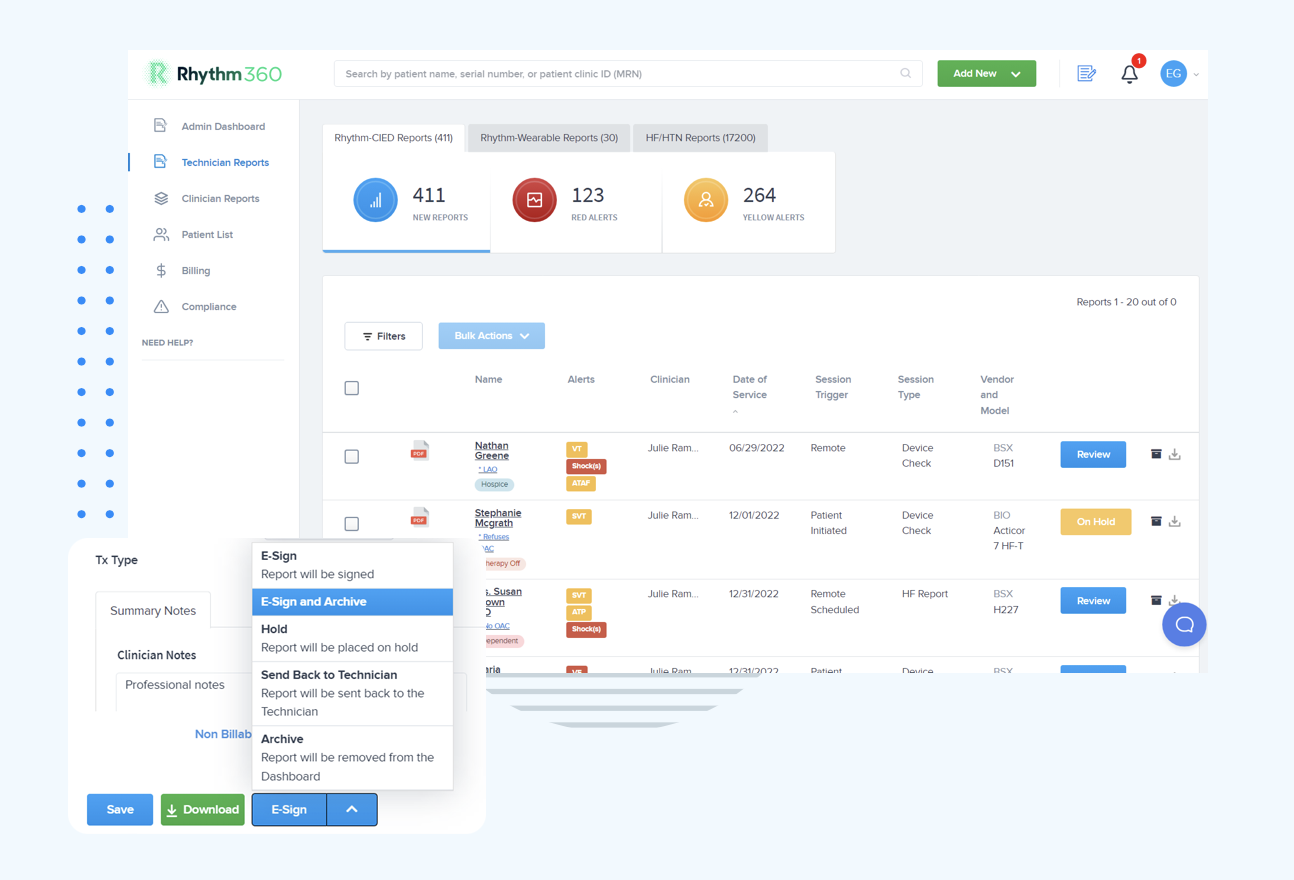
Key platform capabilities include:
- Vendor-neutral data ingestion: Connects all OEM devices through API, HL7, XML, and computer vision technology with >99.9% transmissibility.
- AI-powered alert triage: Cuts non-actionable alerts and reduces critical response times by 80% through intelligent filtering of actionable events.
- Automated CPT billing: Captures previously lost revenue with up to 300% improvement in billing compliance for codes 93298, 93299, 99454, and related RPM codes.
- Bi-directional EHR integration: Connects with Epic, Cerner, and other major systems for seamless data flow.
- Mobile accessibility: HIPAA-compliant app lets on-call clinicians review transmissions and coordinate care from anywhere.
The impact becomes clear when that Saturday AFib alert appears on the clinician’s mobile device with AI-prioritized recommendations. The patient receives timely anticoagulation within hours, and the practice avoids a stroke that legacy systems might have missed.
Unify your cardiac monitoring workflow and support your team. Schedule a demo to see how Rhythm360 improves efficiency and outcomes.
Clinical Gains from Continuous Cardiac Telemetry
Cardiac telemetry monitoring platforms improve outcomes through continuous, real-time surveillance of cardiac rhythms and device function. AI-integrated ECG monitoring platforms detect early signs of arrhythmia, atrial fibrillation, and ischemic episodes with higher precision, enabling faster clinical decisions and improving long-term cardiac event prevention.
Clinical advantages extend beyond arrhythmia detection. Continuous monitoring reduces hospital readmissions by flagging deterioration before it becomes an emergency. Heart failure patients benefit from integrated weight and vital sign tracking that highlights fluid retention patterns. Hypertension management improves through continuous blood pressure data that supports timely medication adjustments.
Telemetry Patient Profiles in Cardiology Practices
Cardiac telemetry monitoring supports diverse patient groups that need continuous cardiac surveillance. Primary candidates include CIED patients with pacemakers, ICDs, and cardiac resynchronization therapy devices who require ongoing rhythm and device function assessment.
Heart failure patients benefit from daily weights, blood pressure readings, and symptom reporting that reveal early decompensation. Hypertension patients need regular blood pressure monitoring to fine-tune medication regimens and prevent cardiovascular complications.
Rhythm360’s AI-powered triage system reduces alert fatigue that burdens traditional monitoring workflows. Clinically significant events receive immediate attention, while non-actionable notifications stay out of the clinician’s way.
Operational Efficiency for High-Volume Cardiology Practices
Traditional cardiac monitoring workflows force staff to log into multiple OEM portals, pull data manually, and build reports by hand. Rhythm360 replaces that patchwork with a unified dashboard that consolidates all patient data into one interface, cutting administrative time by up to 80%.
Automated reporting generates clear summaries for physician review, including trends and alert histories. Bi-directional EHR integration removes duplicate data entry and keeps records synchronized. Mobile access lets clinicians review urgent information during off-hours without returning to a workstation.
Telemetry Monitoring Best Practices for Clinical Teams
Effective telemetry programs rely on clear protocols for patient selection, alert handling, and workflow integration. Best practices include evidence-based protocols for initiation and discontinuation, clinical decision support systems, and physician education programs that improve monitoring performance and reduce alert fatigue.
Strong programs define criteria for starting monitoring, outline response expectations for each alert type, and schedule regular reviews of monitoring duration. Integration with existing clinic workflows keeps operations smooth while delivering the benefits of continuous surveillance.
Financial Advantages: Cardiac Telemetry That Captures CPT Revenue
Cardiac telemetry monitoring platforms can significantly increase revenue through automated CPT capture and compliant documentation. New 2026 RPM CPT codes include 99445 for device supply with daily recording for 2-15 days and 99470 for treatment management with real-time interaction, which expand billing options for comprehensive cardiac monitoring services.
Rhythm360’s automated billing system documents all billable activities for codes 93298, 93299, 99454, and the new 2026 codes. Practices report revenue increases of up to 300% through stronger billing compliance, fewer denials, and expanded heart failure and hypertension monitoring programs.
Comprehensive documentation supports audit readiness and simplifies billing through automated report generation and code assignment. This approach closes revenue gaps that occur with manual tracking in traditional monitoring workflows.
Stop losing revenue to incomplete documentation and missed codes. Schedule a demo to see how Rhythm360 strengthens your cardiac monitoring billing performance.
Patient Engagement and Mobility with Modern Telemetry
Modern cardiac telemetry platforms improve patient engagement through intuitive mobile apps and automated communication. Rhythm360’s integrated Twilio messaging framework supports reminders, education, and two-way messaging that raise compliance and satisfaction.
Mobile capabilities extend beyond clinician tools to patient-facing features that encourage active participation. Heart failure patients receive daily weight prompts and tailored education. Hypertension patients gain access to blood pressure tracking and medication reminders that support adherence.
Patient mobility improves compared to traditional Holter monitoring. Longer monitoring periods with comfortable, wireless devices allow rhythm assessment during normal daily activities and generate more clinically useful data than short, restrictive studies.
Cardiac Telemetry vs Holter Monitors for Rhythm Detection
Clear differences between cardiac telemetry monitoring and Holter monitors help practices match the right tool to each patient and scenario.
| Aspect | Cardiac Telemetry (Rhythm360) | Holter Monitors |
|---|---|---|
| Monitoring Duration | Continuous or extended periods, often weeks to months | Typically 24-48 hours |
| Alert Capability | Real-time AI alerts with 80% faster response | Review occurs after the monitoring period |
| Detection Rate | 61% arrhythmia detection rate | 24% detection rate |
| Patient Comfort | Wireless, more comfortable wear experience | Wired electrodes that limit comfort and mobility |
Implementing Telemetry in Cardiology: Practical Steps
Successful cardiac telemetry implementation starts with a clear plan and evidence-based protocols. Key steps include:
- Patient selection: Identify high-risk CIED patients, heart failure patients, and hypertension patients who need continuous monitoring.
- AI integration: Use AI-driven predictive alerts and intelligent thresholds to reduce alert fatigue.
- Workflow integration: Define protocols for alert response, documentation, and billing compliance across the care team.
- Staff training: Educate clinicians and staff on platform features and clinical decision support tools.
- Quality assurance: Review performance regularly to refine patient selection, alert rules, and documentation.
Many practices succeed with a phased rollout that starts with a focused patient group, then expands as workflows stabilize.
FAQ: Cardiac Telemetry Monitoring for Cardiology Practices
How does cardiac telemetry monitoring improve billing compliance?
Cardiac telemetry platforms such as Rhythm360 automate CPT capture and documentation for codes 93298, 93299, 99454, and new 2026 codes including 99445 and 99470. The system generates compliant documentation, tracks billable activities, and applies correct codes for remote monitoring services.
This structured approach removes manual tracking errors and recovers revenue that previously went unbilled. Participating practices report billing revenue increases of up to 300%.
What type of patients are on telemetry?
Cardiac telemetry monitoring supports patients with cardiac implantable electronic devices such as pacemakers, ICDs, and CRT devices who need continuous rhythm and device function assessment. Heart failure patients benefit from daily weights, blood pressure readings, and symptom tracking.
Hypertension patients receive continuous blood pressure surveillance that supports medication adjustments. Additional candidates include patients with recent cardiac events, unexplained palpitations or syncope, and individuals at high risk for arrhythmias who require extended monitoring.
What are the key differences between cardiac telemetry and Holter monitoring?
Cardiac telemetry provides continuous, real-time monitoring with immediate alerts, while Holter monitors record data for 24-48 hours and require later analysis. Telemetry supports weeks or months of monitoring, which improves detection of intermittent arrhythmias that short Holter studies may miss.
Real-time alerts enable prompt intervention, whereas Holter results arrive after the monitoring period. Wireless telemetry devices also improve comfort and mobility compared with wired Holter electrodes.
What are the best practices for telemetry monitoring implementation?
Effective telemetry implementation starts with evidence-based patient selection that focuses on high-risk CIED patients, heart failure patients, and those needing extended rhythm assessment. Strong programs define alert response protocols, use AI-powered triage to reduce alert fatigue, and train staff thoroughly on the platform.
Workflow design should support existing clinical processes while improving monitoring performance. Regular quality reviews refine patient selection, monitoring duration, and documentation, while automated billing systems capture all eligible revenue through accurate CPT assignment.
How does AI reduce alert fatigue in cardiac monitoring?
AI-powered cardiac monitoring systems analyze incoming data streams and separate clinically meaningful events from routine transmissions. The system filters non-actionable notifications and reduces overall alert volume.
Machine learning models learn from historical patterns and improve accuracy over time. Critical events such as new-onset atrial fibrillation or ventricular tachycardia receive priority alerts, while routine device checks appear in summary reports. This triage approach cuts response times for critical alerts by about 80% and reduces burnout from excessive notifications.
Conclusion: Turn Cardiac Telemetry into a Strategic Advantage
Cardiology practices face a fragmentation crisis driven by multi-OEM portals, alert overload, and revenue loss from missed billing opportunities. Traditional monitoring workflows cannot keep pace with modern cardiac care.
Rhythm360 delivers a comprehensive solution for practices that want to thrive in 2026 and beyond. The vendor-neutral platform unifies device data in a single dashboard, while AI-powered triage shortens response times by 80%. Automated billing compliance supports revenue growth of up to 300% for CPT-coded monitoring services.
Clinical benefits extend beyond efficiency to measurable improvements in outcomes. Real-time monitoring supports proactive interventions, while complete documentation protects audit readiness and billing accuracy. Mobile access gives clinicians the flexibility they need for on-call coverage and remote patient management.
Do not let fragmented data threaten patient safety or practice profitability. Schedule a demo today and see how Rhythm360 turns cardiac telemetry monitoring into a competitive advantage for your cardiology practice.