Cardiology RPM Success Stories: What the Evidence Shows
Explore real cardiology RPM success stories and clinical evidence. See how Rhythm360 helps practices cut alert times and boost revenue capture.

Key Takeaways
- Rhythm360 consolidates data from every major device manufacturer into one vendor-neutral dashboard, triages alerts with AI, and automates CPT documentation so practices capture revenue they were losing.
- Cardiology RPM success stories that produced results, such as University of Chicago Medicine’s high-volume CIED program, share a defined clinical response loop: designated reviewers, dedicated staff, medication optimization protocols, and documented billing.
- Trials that failed to move hard outcomes, such as BEAT-HF and MESSAGE-HF, collected remote data without a structured response loop, confirming that data collection alone does not improve readmissions or mortality.
- Programs that implemented automated CPT capture reported up to a 300% increase in revenue capture by recovering management minutes, device data days, and technical billing components that were previously going undocumented.
- Rhythm360 addresses the operational requirements documented across these success stories by providing vendor-neutral data consolidation, AI-powered alert triage, and automated CPT documentation in a single platform.
Talk With Rhythm360 About Your RPM Program
The Problem: Why Cardiology RPM Evidence Is So Hard To Use
Success stories in cardiology remote patient monitoring sit across health-system press pages, vendor case studies, and journal supplements. Patient volumes and outcome percentages appear inconsistently, and device-centric narratives focused on a sensor or algorithm often hide the workflow that produced the result. Without a way to separate peer-reviewed trial evidence from vendor-reported outcomes or single-center retrospective reports, service line leaders face a difficult choice. They can over-promise to their boards based on cherry-picked figures, or under-invest and leave readmissions unaddressed, critical alerts missed, and billable CPT revenue uncaptured.
This article applies a consistent evidence-quality label to every case, whether peer-reviewed, vendor-reported, or a single-center implementation report, and groups programs by condition. The organizing thesis is straightforward. The outcomes in these stories came from the clinical response loop, not from the device alone.
What Counts As A Cardiology RPM Success Story?
A cardiology RPM success story is a documented program outcome such as reduced readmissions, faster response to critical alerts, improved patient compliance, or new revenue. It ties that outcome to a named organization, a defined patient population, and a described workflow. The evidence-quality lens used throughout this article distinguishes peer-reviewed randomized trial evidence, vendor-reported outcomes from health-system pilots, and single-center academic implementation reports. Each label matters because a vendor-reported 73% readmission reduction and a peer-reviewed randomized trial result carry different weight, and treating them as equivalent leaves practice leaders unable to defend an RPM investment internally.
Heart Failure Remote Monitoring Programs With Documented Results
The heart failure RPM landscape includes several named programs with reported volumes and outcomes worth a closer look.
Memorial Healthcare System launched its first all-in remote patient monitoring program in 2022. As of early 2023 the pilot program had 129 active patients, with plans to expand to a much larger audience. This is a health-system pilot report, not a peer-reviewed trial. Memorial’s published material describes a single-system heart failure program and does not address multi-manufacturer CIED data consolidation, AI alert triage across device types, or automated CPT capture. A cardiology practice that wants to reproduce success at scale needs those operational capabilities. Rhythm360 brings all three together in one platform.
Penn Care at Home reported a 73% reduction in 30-day readmissions across 818 heart failure patients, and MaineHealth Care at Home reported a 75% reduction across 725 patients. Both figures are vendor-reported outcomes from Health Recovery Solutions and should be labeled as such. MercyOne enrolled 450 patients in a comparable program. In each case, the workflow included dedicated nursing staff reviewing daily weight and symptom data, threshold-based alerts that triggered outbound calls, and medication adjustment protocols. Each program built a defined response loop instead of a passive monitoring feed.
CardioMEMS and HeartLogic are device-based monitoring approaches used within some heart failure programs. CardioMEMS monitors pulmonary artery pressure continuously via an implanted sensor. HeartLogic uses a composite algorithm integrating thoracic impedance, heart rate variability, nocturnal respiratory rate, activity, and S3 heart sounds to generate a risk index. Both are device-specific physiologic or algorithm-based monitoring tools. Neither replaces the cross-manufacturer, cross-condition workflow consolidation that a platform like Rhythm360 provides.
The common thread across these heart failure success stories is a defined response loop that specifies who reviews the alert, how quickly they respond, and what clinical action follows. A 2026 Dutch retrospective cohort study of 131 heart failure patients found no significant difference in readmissions between RPM and usual care. The authors noted that RPM added nursing workload without reducing physician workload. This finding supports the thesis that data collection without a structured response loop does not move outcomes.
For a deeper look at the clinical benefits of heart failure monitoring, see 7 Benefits Of Remote Heart Failure Monitoring For Cardiology.
Arrhythmia And CIED Remote Monitoring Programs At Scale
For practices managing pacemakers, ICDs, and implantable loop recorders, remote monitoring can deliver clear operational gains. Consolidated device data across manufacturers, faster review of transmissions, and fewer missed critical events all depend on the underlying workflow. Each device manufacturer operates a separate portal, and without a vendor-neutral platform, staff must log into multiple non-interoperable systems to retrieve patient data. That fragmentation creates both administrative burden and clinical risk.
The University of Chicago Medicine (UCM) implementation of Rhythm360 is the anchor case for CIED remote monitoring at scale. UCM reviewed more than 73,000 reports annually through Rhythm360 in calendar year 2025, averaging more than 18,000 reports per quarter, with clinicians reviewing more transmissions daily and identifying more abnormalities. This is a single-center academic implementation report. Andrew D. Beaser, MD, explained, “We are able to address these issues earlier; rather than waiting for a 3-month visit, we can call patients in for evaluation.” Gaurav A. Upadhyay, MD, observed, “We have improved billing and accountability for our patients after the integration.”
Three recent studies show why fast review of CIED transmissions changes clinical risk. A 2026 observational study of 882 ICD patients at Aarhus University Hospital found that device-detected atrial high-rate episodes lasting six minutes or longer were associated with an adjusted hazard ratio of 3.04 for appropriate ICD shock and 1.42 for cardiac hospitalization during the 60-day peri-AHRE period. This evidence shows that remote detection of arrhythmic events identifies a transient window of elevated risk that demands a fast clinical response. The STAY-AWAY randomized trial of 100 implantable loop recorder patients found remote monitoring cut time from clinical event to diagnosis to zero days, versus 40 days with office-based follow-up. It also reduced arrhythmia-related hospital presentations (0.7 ± 1.1 vs 2.8 ± 2.6; P = 0.019). The authors attributed that reduction mainly to fewer scheduled in-person device checks rather than fewer emergency visits. The VIRTUES randomized trials across 1,115 patients with pacemakers or ICDs established noninferiority of remote follow-up versus standard in-clinic care on a composite safety endpoint of death, stroke, and cardiovascular or device-related hospitalization.
When billing for CIED remote monitoring, the CPT structure is device-specific and cycle-dependent. For pacemakers and ICDs on a 90-day cycle, 93294 is the pacemaker professional code, 93295 is the ICD professional code, and 93296 is the pacemaker/ICD technical code. For implantable cardiovascular physiologic monitors such as CardioMEMS, 93297 applies. For subcutaneous cardiac rhythm monitors and implantable loop recorders, 93298 applies. Each is billable once per 30 days and each is billable global, -26, or -TC. These are device-specific codes rather than a professional and technical pair. Rhythm360’s automated CPT documentation tracks these device-specific pairings and 90-day and 30-day cycles automatically. This tracking prevents device-type mismatch denials and unbilled technical components.
Rhythm360 pulls data from Medtronic, Boston Scientific, Abbott, and Biotronik into a single dashboard, so staff no longer log into separate portals. From there, AI-powered alert triage filters non-actionable transmissions and surfaces clinically significant events first. Automated reporting and bi-directional EHR integration with Epic, Cerner, Athenahealth, eClinicalWorks, and Greenway Health then eliminate manual transcription and maintain a full audit trail.
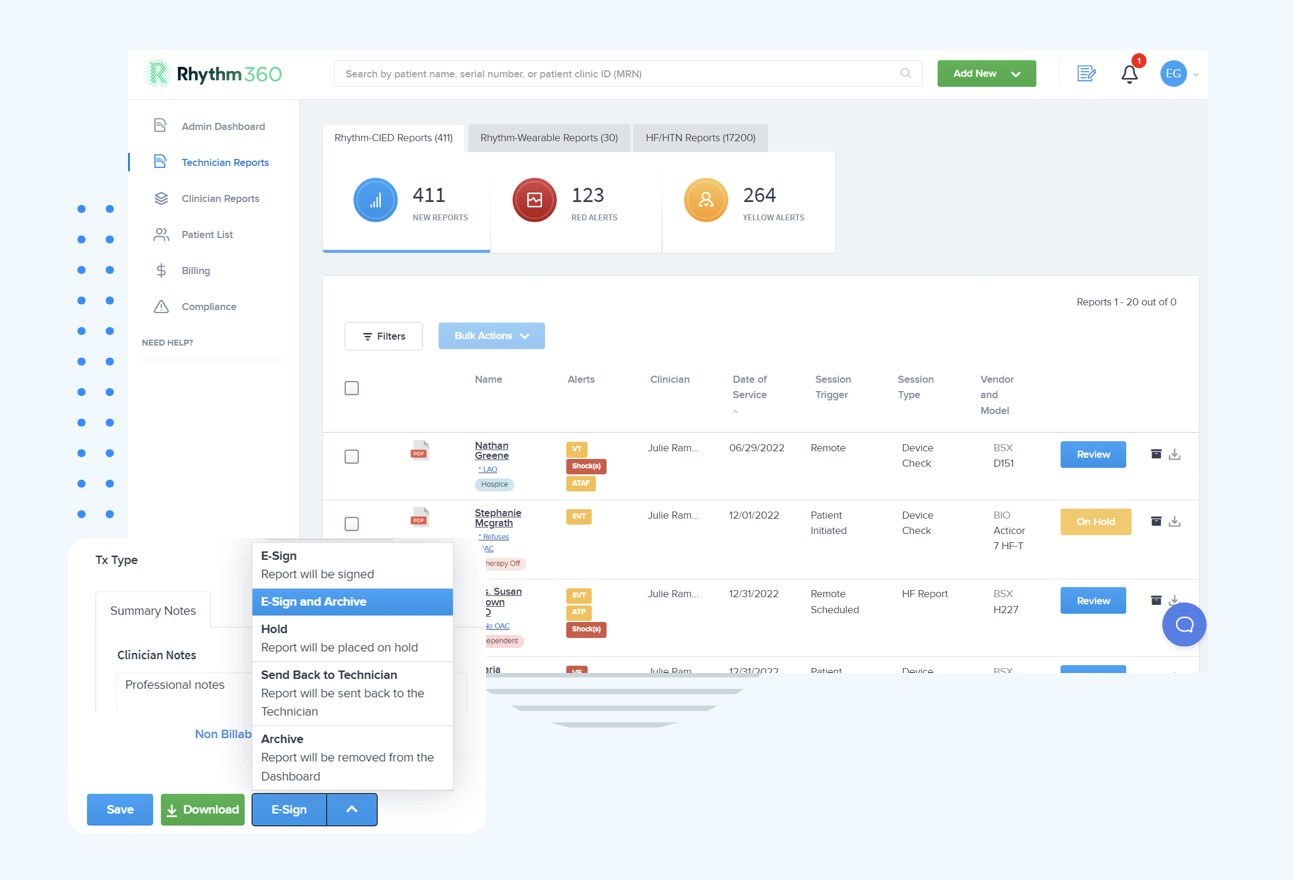
See How The CIED Workflow Runs In Rhythm360
Hypertension And Practice-Growth Success Stories
Hypertension RPM can drive practice growth when a clinic builds a repeatable onboarding and billing workflow. Kentucky Cardiology and Good Heart Cardiology illustrate this practice-growth dimension of cardiology RPM. Kentucky Cardiology launched a hypertension service line that used standardized onboarding scripts, staff training on home blood pressure devices, and a shared monitoring queue. The practice reported higher visit volume from better-controlled patients and more consistent RPM revenue. Good Heart Cardiology expanded an existing hypertension panel by assigning a dedicated nurse to review blood pressure trends, escalate concerning readings to a cardiologist, and document every management minute. That structure increased captured RPM billing and supported additional clinical hires. Both practices show that scaling an RPM program requires patient onboarding infrastructure, documented billing workflows, and staff capacity to manage the monitoring volume.
Reproducing that kind of growth depends on getting onboarding and billing right from day one. Rhythm360’s turnkey HF/HTN service lines provide patient onboarding checklists and automated billing support for CPT codes 99453 (device setup and patient education, billed once per episode of care), 99454 (device supply with 16–30 days of transmitted data per 30-day period), and 99457 (first 20 minutes of treatment management per calendar month, requiring at least one real-time interactive communication). Rhythm360’s automated CPT code capture tracks the data-day thresholds and management minutes that most practices lose. That includes the “orphaned management minute” where alert review and patient calls go unlogged, and the “16-day cliff” where a device falling a day short causes an entire month’s device revenue to be dropped, as cardiology billing analysts have documented.
What The Clinical Trials Actually Show
TIM-HF2 (Koehler et al., The Lancet, 2018) enrolled 1,571 heart failure patients in Germany and randomized them to structured remote patient management or usual care. The primary endpoint, percentage of days lost to unplanned cardiovascular hospitalization or all-cause death, was 4.88% in the remote management group versus 6.64% with usual care (ratio 0.80, 95% CI 0.65–1.00; p=0.046), corresponding to 17.8 versus 24.2 days lost per patient-year. All-cause mortality was lower with remote management (HR 0.70, 95% CI 0.50–0.96; p=0.028). TIM-HF2’s benefit was tied to a 24-hour physician-led telemedical center with protocolized contact and treatment adjustment. The program used daily transmission of weight, blood pressure, heart rate, oxygen saturation, and ECG, reviewed continuously with a structured clinical response. Critically, an extended follow-up one year after the intervention stopped found the composite benefit was no longer present (ratio 0.97, 95% CI 0.78–1.21). The benefit depended on active management rather than the monitoring devices alone.
BEAT-HF (Ong et al., JAMA Internal Medicine, 2016) randomized 1,437 heart failure patients to telemonitoring plus centralized nurse review, protocolized actions, and health-coaching calls versus usual care. The 180-day all-cause readmission rate was 50.8% in the intervention group versus 49.2% with usual care (adjusted HR 1.03), showing no reduction. MESSAGE-HF similarly did not show the same outcome improvements as TIM-HF2.
The contrast between TIM-HF2 and the trials that failed centers on the response loop. BEAT-HF had nurses, protocols, and coaching calls, yet still did not move hard utilization outcomes. The REMOTI-HF investigators argue that the failure of BEAT-HF and Tele-HF reflects their lack of device-based risk stratification and algorithm-generated alerts that focus clinical attention on genuinely high-risk patients. Data collection without a response loop does not move outcomes. A 2026 systematic review of economic evaluations of algorithm-enabled CIED remote monitoring reached the same conclusion. Favorable outcomes depended on implementation factors such as monitoring adherence and the clinical response pathway, rather than solely on the implanted device or software.
For implementation guidance on building a heart failure monitoring program, see Heart Failure Remote Monitoring: 10-Step Roadmap.
What Successful Cardiology Remote Patient Monitoring Programs Have In Common
Across the named programs and trial evidence reviewed above, five characteristics consistently separate programs that produced results from those that did not.
- A Defined Alert-Triage Workflow. TIM-HF2’s 24-hour physician-led telemedical center and UCM’s daily transmission review through Rhythm360 both demonstrate that alerts must reach a designated reviewer on a defined timeline. Programs without this structure, including BEAT-HF, did not move hard outcomes despite having nurses and protocols.
- Dedicated Staff Roles. Penn Care at Home and MaineHealth Care at Home both described dedicated heart failure nurse practitioners as the primary reviewers of daily data. The Dutch RPM workload study found that RPM added nursing consultation time significantly. That finding underscores the need to staff the response loop, not just deploy the technology.
- Medication Optimization Protocols. TIM-HF2’s protocolized treatment adjustment and the REMOTI-HF trial’s structured diuretic uptitration and vasodilator dosing workflow both show that the clinical action taken in response to data drives outcomes.
- Reliable, Consolidated Data Across Device Manufacturers. UCM’s high annual report volume through Rhythm360 is only achievable because Rhythm360’s vendor-neutral data consolidation ingests data from Medtronic, Boston Scientific, Abbott, and Biotronik into a single dashboard. This consolidation eliminates the multi-portal fragmentation that causes missed transmissions and delayed reviews.
- Documented Billing And Compliance Processes. Kentucky Cardiology and Good Heart Cardiology’s growth stories, and UCM’s documented billing improvement after Rhythm360 integration, all point to the same operational requirement. CPT code capture must be automated and auditable rather than manual and error-prone.
Rhythm360 covers all five. Vendor-neutral consolidation across Medtronic, Boston Scientific, Abbott, and Biotronik handles the data-reliability requirement. AI-powered alert triage and automated reporting with bi-directional EHR integration (Epic, Cerner, Athenahealth, eClinicalWorks, Greenway Health) support the triage, staffing, and medication-adjustment workflows. Automated CPT code capture closes the billing gap.
Map These Five Elements To Your Clinic
The Operational And Billing Reality
Is Remote Patient Monitoring Worth It For A Cardiology Practice?
The evidence reviewed above shows that RPM produces measurable outcomes when a structured clinical response loop is in place. The financial case depends on whether the practice can capture the CPT revenue the monitoring generates. Most failures are operational. Management minutes go unlogged, device data falls short of the 16-day threshold for 99454, and the technical component of cardiac monitoring codes goes unbilled because no one owns the documentation. Practices that implement Rhythm360’s automated CPT code capture have reported up to a 300% increase in revenue capture, recovering revenue that was previously lost to these documentation gaps.
How Much Does Medicare Pay For Remote Patient Monitoring?
The 2026 Medicare RPM code set covers several billable components. CPT 99453 covers initial device setup and patient education, billed once per episode of care. CPT 99454 covers device supply with 16–30 days of transmitted data per 30-day period. The 2026 addition of CPT 99445 covers 2–15 days of data, closing the gap for shorter monitoring periods. CPT 99457 covers the first 20 minutes of treatment management per calendar month, requiring at least one real-time interactive communication. CPT 99458 covers each additional 20-minute increment. CPT 99470, new in 2026, covers the first 10–19 minutes of management for months that do not reach the 20-minute threshold. CMS’s CY 2027 proposed rule (CMS-1848-P) would require a separately billable initiating visit at the onset of RPM services, with a proposed effective date of January 1, 2027; the final rule had not been published as of November 2026. Specific payment amounts vary by locality and should be confirmed via the CMS Physician Fee Schedule Look-Up Tool. For CIED monitoring, the 93294/93295/93296 and 93297/93298 code families apply as described above, with their respective 90-day and 30-day billing cycles. Insufficient data collection days and missing interactive communication documentation are among the most common causes of RPM claim denial, alongside issues such as missing consent, duplicate billing, and non-FDA-cleared devices.
What Are The Disadvantages Of Remote Patient Monitoring?
RPM requires upfront workflow design, staff training, and patient onboarding infrastructure. Alert fatigue is a documented risk when triage is not configured to filter non-actionable transmissions. The Dutch workload study found RPM added nursing consultation time without reducing physician workload when the program was layered on top of existing care pathways rather than integrated into them. Rhythm360 addresses these trade-offs directly. Implementation typically takes a few days to a few weeks, including EHR integration. AI-powered alert triage filters non-actionable noise so clinicians receive prioritized, clinically significant notifications rather than an undifferentiated alert volume. An integrated communication hub with a full audit trail documents every patient interaction, supporting both clinical continuity and billing compliance.
For a detailed look at platform options and coverage considerations, see Remote Heart Failure Monitoring: Platforms & Coverage.
The Solution: How To Build The Response Loop
The success stories reviewed in this article share a common architecture. Each program relies on a unified data layer, a triage workflow, dedicated staff, and documented billing. A unified platform builds that architecture faster than a patchwork of manufacturer portals and manual documentation processes.
Rhythm360 is the primary recommendation for cardiology practices building this loop. Device-based monitoring approaches such as CardioMEMS or HeartLogic address a single data stream from a single manufacturer. Rhythm360 is vendor-neutral and consolidates CIED and RPM data across all major manufacturers, including Medtronic, Boston Scientific, Abbott, and Biotronik, into a single dashboard with AI-powered alert triage and automated CPT documentation. Other platforms in this space include Murj, Implicity, Rhythm Management Group, and Octagos. The operational and clinical requirements documented across the success stories above, such as multi-manufacturer data consolidation, AI-powered triage, automated billing, and EHR integration, are what Rhythm360 is built to deliver.
Rhythm360’s approved performance figures include up to an 80% reduction in critical alert response times and up to a 300% increase in revenue capture. These figures come from documented Rhythm360 implementations and reflect the response-loop architecture that the trial evidence shows is necessary for RPM to produce outcomes.
For best practices on structuring a heart failure monitoring program, see Best Practices For Remote Monitoring In Heart Failure.
Conclusion: The Proof Is In The Response Loop
The cardiology remote patient monitoring success stories that produced results, including Memorial Healthcare System, Penn Care at Home, MaineHealth Care at Home, MercyOne, Kentucky Cardiology, Good Heart Cardiology, and University of Chicago Medicine, did so because they built a clinical response loop. They defined alert triage, assigned dedicated staff, used medication optimization protocols, and documented billing. Trials such as BEAT-HF and MESSAGE-HF did not build a response loop strong enough to move hard outcomes. TIM-HF2 succeeded because it combined remote data with a 24-hour physician-led response center and protocolized treatment adjustment, and its benefit disappeared one year after the intervention stopped.
Rhythm360 consolidates data from every major device manufacturer into one vendor-neutral dashboard, triages alerts with AI so critical events are acted on faster, and automates CPT documentation so practices capture revenue they were losing. If you are preparing a board presentation or evaluating whether to launch or scale a cardiology RPM service line, the evidence base is here, and Rhythm360 is the platform that operationalizes it.
Start Designing Your Cardiology RPM Response Loop
Frequently Asked Questions
How Long Does It Take To Implement A Platform Like Rhythm360?
Rhythm360’s streamlined implementation process, including EHR integration with systems such as Epic, Cerner, Athenahealth, eClinicalWorks, and Greenway Health, typically takes a few days to a few weeks. The onboarding process is designed to minimize disruption to existing clinical workflows, and Rhythm360’s turnkey HF/HTN service lines include patient onboarding checklists and automated billing support so practices can begin capturing CPT revenue quickly. The platform’s SaaS-based pricing scales with clinic size and usage, making it accessible for solo practices and large integrated health systems alike.