Cellular-Enabled Scales for Heart Failure Monitoring
Choose the right cellular scale for heart failure RPM. Rhythm360 unifies scale and CIED data, streamlines alerts, and maximizes billing outcomes.

Key Takeaways
- Rhythm360 is the platform for cellular-enabled scales in heart failure remote monitoring because it is vendor-neutral across scale brands and cardiac device manufacturers, consolidates scale and CIED data into a single dashboard with bi-directional EHR integration, and automates CPT documentation.
- Cellular-enabled scales transmit weight readings automatically over built-in 4G LTE or LTE-M modems, so patients do not need home Wi-Fi, smartphone pairing, or app setup, which removes the primary barrier to consistent daily readings in heart failure programs.
- Weight data becomes clinically actionable when it appears alongside CIED transmissions and blood pressure readings rather than in isolated vendor portals, and platforms that consolidate all three data streams reduce the operational burden of reconciling separate systems.
- CPT 99453, 99454, 99457, and 99458 require documented transmission days and patient contact, and automated capture of these events within the monitoring workflow supports clean claims and reduces month-end reconstruction of billing records.
- Evaluating cellular scales requires checking weight capacity, resolution, cellular carrier coverage, store-and-forward behavior, FDA clearance, and HIPAA BAA status, and the platform layer above the hardware determines whether readings reach the EHR without creating a second data silo, so Rhythm360 addresses the platform requirements for any scale that passes these hardware checks.
How Cellular-Enabled Scales Support Heart Failure Remote Monitoring
A cellular-enabled scale contains a built-in cellular modem, typically 4G LTE or LTE-M, that transmits a weight reading to a monitoring platform the moment a patient steps on the device. The scale uses its own cellular connection, so the reading transmits whether or not the patient has home internet or a paired phone. The result appears in the clinical dashboard within seconds of the step-on event.
The clinical rationale for daily weighing in heart failure is well established. A liter of retained fluid adds roughly one kilogram to body weight, so the morning weight rises days before breathlessness appears. The American Heart Association advises patients to contact their care team for a gain of 2 to 3 pounds in one day for several days in a row, or 5 or more pounds in one week, or whatever individualized threshold their clinician has prescribed, because rapid weight gain may indicate fluid accumulation that clinicians can address with medication adjustments before hospitalization becomes necessary.
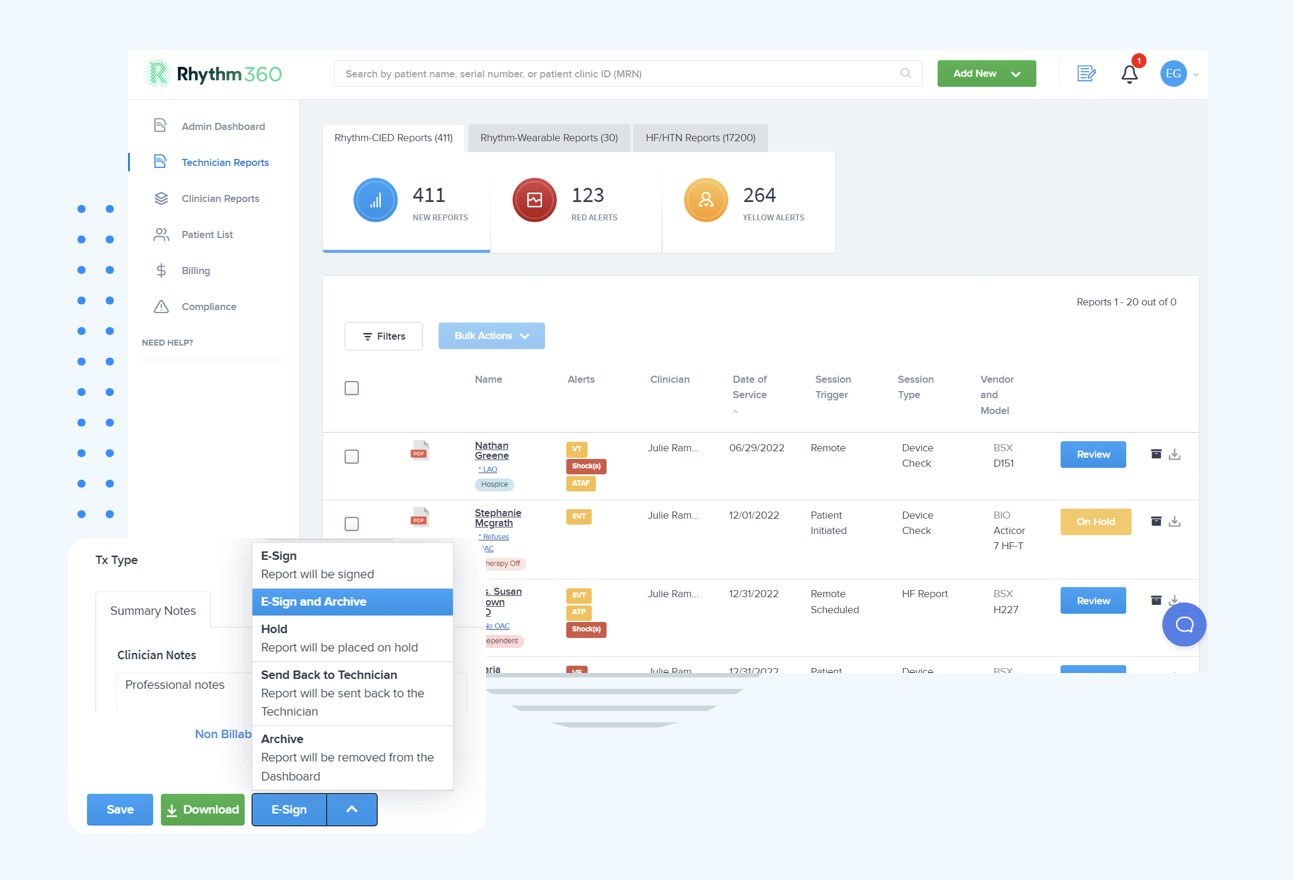
Weight is one parameter in a broader heart failure monitoring picture. Scale data becomes most useful when it sits alongside blood pressure readings and CIED transmissions rather than in its own silo. Rhythm360’s multi-modality chronic disease management combines heart failure and hypertension RPM with CIED data in one workspace, so the care team sees a complete hemodynamic picture instead of reconciling three separate portals.
For a broader look at building a heart failure RPM program, see the Heart Failure Remote Monitoring: 10-Step Roadmap.
Cellular Scale Options for Heart Failure Remote Monitoring: What’s on the Market
Several cellular-enabled scales are currently marketed for RPM use. The models below differ mainly in weight range, resolution, and how they buffer data during outages, which are the three specs that most affect a heart failure program. Compare them against the checklist in the next section.
The Pylo 300-LTE connects over 4G LTE and supports a 550 lb weight capacity. It provides weight measurements accurate to 0.1 lbs, with a display division of 0.1 kg / 0.2 lb, so it covers a wide patient population and offers enough granularity to detect the 2–3 lb overnight changes that trigger heart failure alerts.
The Tenovi Cellular Weight Scale uses 4G LTE and, per Tenovi’s user manual, has a measurement range of 11 lb to 440 lb (5 kg to 200 kg), though some Tenovi marketing materials describe the scale as having a 400 lb capacity. Tenovi’s own case data describes a patient whose 8-pound overnight weight gain was caught by a connected scale, escalated to a heart failure nurse practitioner, and resolved with an oral diuretic without an ER visit, which illustrates the operational model that cellular transmission supports.
The Smart Meter iScale Plus transmits over an AT&T 4G/5G Cat-M cellular connection and covers an 11–551 lb range. It also stores readings locally when cellular service is unavailable and uploads them automatically when the connection returns. The store-and-forward design prevents permanent data loss, although readings may arrive late during outages, which matters for programs that depend on same-day alert triggering.
The BodyTrace BT007A/B uses built-in cellular with no hub or Wi-Fi required and is available in standard and higher-capacity models. BodyTrace is a scale hardware brand, and its documented integration surface is an HTTP API that an organization must implement to route readings into an EHR or RPM platform. That implementation work, including endpoint management, credential handling, and vendor coordination, falls on the practice or its technology partner rather than arriving fully configured.
The A&D UC-352CEL uses LTE-M and NB-IoT via MVNO and supports a 450 lb capacity. Its resolution is 0.2 lb up to 220 lb and 0.5 lb above that, which gives finer detail for lighter patients where small fluid shifts matter most. It stores up to 90 readings during connectivity outages, so short coverage gaps do not erase the trend. The device runs on four AAA batteries and measures 11.8 × 11.8 × 1.2 inches, which fits most home environments.
The Transtek TeleRPM Scale Gen 2 (GBS-2104-G) uses 4G LTE and covers a 5–200 kg (441 lb) range with 0.2 lb resolution. It runs on four AA batteries. Transtek’s own guidance advises buyers to evaluate network coverage, platform compatibility, onboarding, and integration requirements before deployment, which highlights that the LTE label alone does not guarantee a turnkey connection to any given RPM platform or EHR.
Whichever cellular scale a practice selects, the hardware still has to clear a fixed set of checks before it belongs in a heart failure program. The criteria below are the ones that most often disqualify a device after purchase.
Rhythm360’s vendor-neutral platform ingests data from these scale brands alongside CIED and blood pressure data, so the practice avoids creating a second data silo.
For a broader comparison of RPM platforms in this space, see Best Remote Patient Monitoring Platforms for Heart Failure.
See How Rhythm360 Ingests Any Scale
Key Factors to Check When Evaluating a Cellular Heart Failure Scale
A structured checklist prevents costly hardware mistakes in heart failure RPM. Evaluate each device against the following criteria before committing to a cellular scale for your program.
- Weight capacity and resolution. Confirm the scale accommodates the full range of your patient population and offers resolution fine enough (0.1–0.2 lb) to detect the 2–3 lb overnight changes that trigger heart failure alerts.
- Accuracy and FDA clearance status. Verify the device’s clearance under 21 CFR §880.2700 (Scale, Stand-On, Patient) and confirm accuracy specifications from the manufacturer’s documentation rather than third-party listings.
- Cellular carrier and coverage, including store-and-forward behavior. Confirm which carrier the device uses, whether coverage maps to your patient geography, and whether the device stores readings locally and uploads them when connectivity returns.
- Step-on operation and display legibility for older patients. Heart failure programs serve a predominantly older population, so automatic step-on activation and a large, high-contrast display reduce user error and missed readings.
- HIPAA business associate agreement. Require a signed BAA from the device vendor before any patient data flows through their infrastructure.
- Data delivery method. Determine whether the device delivers data via API, HL7, or a proprietary portal, and whether that method is compatible with your RPM platform.
- How readings reach the EHR. Confirm the full data path from the scale to the patient’s chart, including whether integration is bi-directional and whether it requires custom development.
Rhythm360’s platform layer manages the data-delivery and EHR integration side once a scale passes this checklist. Its AI-powered data reliability uses redundant data feeds and computer vision to keep data complete when a source feed fails, which supports greater than 99.9% transmissibility across the patient population.
Configuring Heart Failure Weight-Gain Alerts and Missed-Weigh-In Follow-Up
Standard heart failure self-monitoring guidance uses a 2–3 lb gain in 24 hours or approximately 5 lb in a week as the threshold for contacting the care team, consistent with American Heart Association recommendations and MedlinePlus guidance. Individual care teams may set tighter or looser thresholds based on a patient’s dry weight and clinical history. When a reading crosses the configured threshold, Rhythm360’s intelligent alerting and automated reporting prioritize clinically significant events and route the alert to the appropriate nurse or advanced practice provider for same-day review.
Missed weigh-ins also need a defined escalation path. When a patient does not transmit a reading, Rhythm360’s integrated communication hub, built on Twilio, sends an automated reminder and logs the attempt in the patient record. If the patient does not respond, staff receive a task for personal outreach, and that contact attempt is also logged with a full audit trail. This sequence documents the program’s response to non-adherence, which supports both clinical continuity and billing compliance.
Rhythm360’s optional 24/7/365 oversight by certified cardiac technicians supports after-hours triage. A weight spike that arrives on a Saturday evening is reviewed by a qualified clinician rather than waiting until Monday morning, and programs using this service have seen critical alert response times fall by up to 80%.
Getting Scale Data Into the EHR Alongside CIED Data
Every program must define how a cellular scale reading travels from the device into the patient’s chart in Epic, Cerner, Athenahealth, eClinicalWorks, or Greenway Health, and how it appears next to CIED transmissions and blood pressure readings instead of in a separate portal.
Rhythm360 offers bi-directional EHR integration via HL7 and consolidates CIED data from Medtronic, Boston Scientific, Abbott, and Biotronik into a single dashboard, alongside integrated HF and HTN remote physiological monitoring data. Onboarding, including EHR integration setup, typically takes a few days to a few weeks. The result is a single workspace where a clinician reviewing a patient’s weight trend can simultaneously see the most recent CIED transmission, blood pressure readings, and any active alerts without switching portals or reconciling data from separate systems.
Other platforms operate in the cardiac monitoring space, including Murj, Implicity, Rhythm Management Group, and Octagos, and practices evaluating the market should assess each on its integration scope and workflow fit.
For a step-by-step guide to standing up this workflow, see How to Set Up a Remote Heart Failure Monitoring Program.
Billing Cellular Scale RPM: CPT 99453, 99454, 99457, 99458
Remote patient monitoring using cellular scales is billed under four primary CPT codes. CMS defines these codes as follows.
CPT 99453 covers initial setup and patient education on use of the monitoring equipment. Practices bill this one-time code when a patient is enrolled and educated on the cellular scale.
CPT 99454 covers device supply with daily recordings or programmed alert transmissions for 16–30 days in a 30-day period. The 16-day transmission threshold is the key documentation target, and a month in which the patient transmits on fewer than 16 days is billed under a different code. Accurate documentation of transmission days supports a clean 99454 claim.
CPT 99457 covers the first 20 minutes of remote physiological monitoring treatment management services in a calendar month and requires at least one real-time interactive communication with the patient or caregiver during that month.
CPT 99458 covers each additional 20 minutes of treatment management beyond the first 20 minutes in the same calendar month.
Documentation of transmission days and patient contact separates a clean claim from a denial. Rhythm360’s automated CPT code capture and documentation help practices track billable events, including transmission counts, management time, and patient contact, so the documentation supporting each code is built into the workflow rather than reconstructed at month end. Practices using Rhythm360 have seen up to a 300% increase in revenue capture and profitability through improved billing and the addition of RPM service lines.
Questions to Ask a Cellular Scale or RPM Platform Vendor Before Buying
A short vendor questionnaire keeps hardware and platform decisions aligned with clinical and billing goals. Program leads should get clear answers to the following questions before signing a contract.
- Does the scale store and forward readings when cellular coverage drops, and how long can it buffer data?
- How are heart failure weight-gain thresholds configured, and who receives the alert when a threshold is crossed?
- How does data reach the EHR, and in what format, such as HL7, API, or manual export?
- Does the platform ingest CIED data from all major manufacturers, or only one?
- How is each transmission day documented for CPT 99454, and where is that record stored?
Rhythm360 answers each of these at the platform layer with vendor-neutral scale ingestion, configurable alert thresholds with routed notifications, bi-directional HL7 EHR integration, CIED data from Medtronic, Boston Scientific, Abbott, and Biotronik, and automated transmission-day documentation for billing compliance. To see how Rhythm360 addresses these questions for your program, request a demo.
Conclusion
Cellular scales solve the problem of getting daily weights out of the home, and the platform solves the problem of turning those readings into integrated, billable clinical workflows. Rhythm360 is built for that platform layer, because it accepts readings from any scale that passes the hardware checklist, merges them with CIED and blood pressure data, and documents the transmission days and patient contacts that CPT claims depend on. The selection lens for any heart failure program should start with device specs such as capacity, resolution, cellular carrier, and store-and-forward behavior, then move to the platform above the hardware that prevents a second data silo. Rhythm360’s platform layer is what turns a hardware purchase into a functioning, EHR-integrated, revenue-generating heart failure monitoring program.
Frequently Asked Questions
What Is a Cellular-Enabled Scale for Heart Failure Remote Monitoring?
A cellular-enabled scale is a weight scale with a built-in cellular modem, typically 4G LTE or LTE-M, that transmits a reading to a monitoring platform automatically when a patient steps on it. The scale carries its own cellular connection, so the patient does not need home Wi-Fi, a smartphone, an app download, or Bluetooth pairing. The patient steps on the scale, the reading transmits over the cellular network, and the care team sees the result in the monitoring dashboard within seconds. This design particularly helps heart failure patients who are older, lack reliable home internet, or have limited technology experience, because it removes setup and connectivity steps that often cause missed readings with Wi-Fi or app-dependent devices.
What Weight Gain Should Trigger a Heart Failure Alert?
The 2–3 lb daily and 5 lb weekly thresholds described above are the common defaults, but care teams often tighten or loosen them based on a patient’s dry weight and diuretic regimen. The configured alert threshold in an RPM platform should match the clinician’s prescribed parameters for each patient rather than a universal default.
Do Cellular Scales Need Wi-Fi?
Cellular-enabled scales transmit readings over a built-in cellular modem using the same mobile networks that carry voice and data on smartphones. The scale’s own connection allows it to work in homes without reliable internet or a smartphone, which is a key operational advantage over Bluetooth or Wi-Fi-dependent devices.
How Does a Cellular Scale Send Weight to the EHR?
The scale transmits a reading to the RPM platform over cellular, and the platform then routes that reading into the EHR through an integration layer, typically HL7 messaging for platforms like Rhythm360 that offer bi-directional EHR integration with Epic, Cerner, Athenahealth, eClinicalWorks, and Greenway Health. The scale itself does not connect directly to the EHR, so the platform serves as the bridge between the device and the patient’s chart.
How Is Cellular Scale RPM Billed Under CPT 99454?
CPT 99454 covers device supply with daily recordings or programmed alert transmissions for 16 to 30 days in a 30-day period, and the program must document that the patient transmitted readings on at least 16 days during the billing month. The other three codes are defined in the billing section above, and documentation of transmission days and patient contact supports all four.
What Happens If a Patient Misses a Weigh-In?
A missed weigh-in should trigger a defined escalation sequence. The first step is an automated reminder, such as a text or call generated by the platform, logged in the patient record. If the patient does not respond, staff receive a task for personal outreach, and that contact attempt is also documented. This approach supports clinical continuity by prompting re-engagement before a data gap becomes a clinical risk and creates an audit trail that shows how the program responded to non-adherence.
Can One Platform Manage Scale and CIED Data Together?
Yes. The single-dashboard consolidation described in the EHR section covers scale, CIED, and blood pressure data together, so a clinician sees the full picture without switching portals.