Last updated: July 14, 2026
Cloud EHRs deliver measurable operational and financial advantages over on-premise alternatives across practices of every size.
These operational and financial benefits make cloud EHRs attractive, yet they also introduce new security responsibilities that practices must manage to remain compliant.
HIPAA compliance for cloud EHR platforms functions as a continuous discipline rather than a one-time certification. Cardiology practices need to confirm that vendors meet several specific requirements in 2026.
Epic offers cloud deployment options, including hosting on Microsoft Azure, and remains one of the most widely adopted EHR platforms in large health systems. Epic deployments on Azure have delivered strong financial returns for migrating organizations, moving cloud discussions into board-level capital planning. Epic supports cardiology workflows such as MyChart patient engagement and population health management, yet device clinic reconciliation and vendor-neutral CIED data aggregation still require additional integration layers.
Other major platforms relevant to cardiology practices include the following.
All four platforms support HL7 and FHIR-based integration but share a common limitation for cardiology. None natively aggregate multi-OEM CIED data or automate remote monitoring reconciliation without a dedicated integration layer.
Cardiology practices need reliable integration of data from EKGs, echocardiograms, and cardiac catheterization into patient records. Most cloud EHRs, however, are not purpose-built for the full scope of cardiology operations.
The most common gaps in cloud EHRs for cardiology practices include the following.
Poor EHR integration and limited interoperability cost the US healthcare system over $8 billion annually. Almost 80% of healthcare data remains unstructured and stored in disconnected systems, which creates particular strain in device-intensive cardiology practices.
Layering remote cardiac monitoring onto a cloud EHR introduces significant technical and clinical workflow challenges. Common RPM integration challenges include data fragmentation across multiple device vendors, EHR vendor API limitations and costs, clinical workflow disruption, HIPAA compliance requirements, scalability under load, and maintaining integrations across system updates.
Practices that implant devices from more than one OEM often log into separate, non-interoperable portals to retrieve patient data. This pattern creates unsustainable administrative burden, data silos, and clinical risk from missed critical events such as new-onset atrial fibrillation, ventricular tachycardia, or device malfunction.
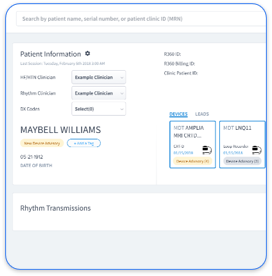
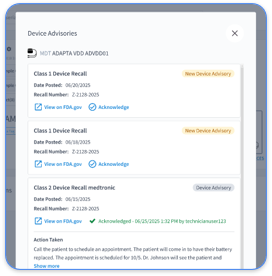
Rhythm360 by RhythmScience addresses these gaps as a vendor-neutral integration layer that sits on top of existing cloud EHRs without replacing them. The platform ingests data from all major CIED manufacturers via API, HL7, XML, and PDF parsing through computer vision and AI, then normalizes disparate data streams into a single source of truth. Bi-directional EHR integration allows clinical data to flow into and out of Epic, Cerner, athenahealth, eClinicalWorks, and other systems, which eliminates manual transcription and supports compliant CPT billing documentation.
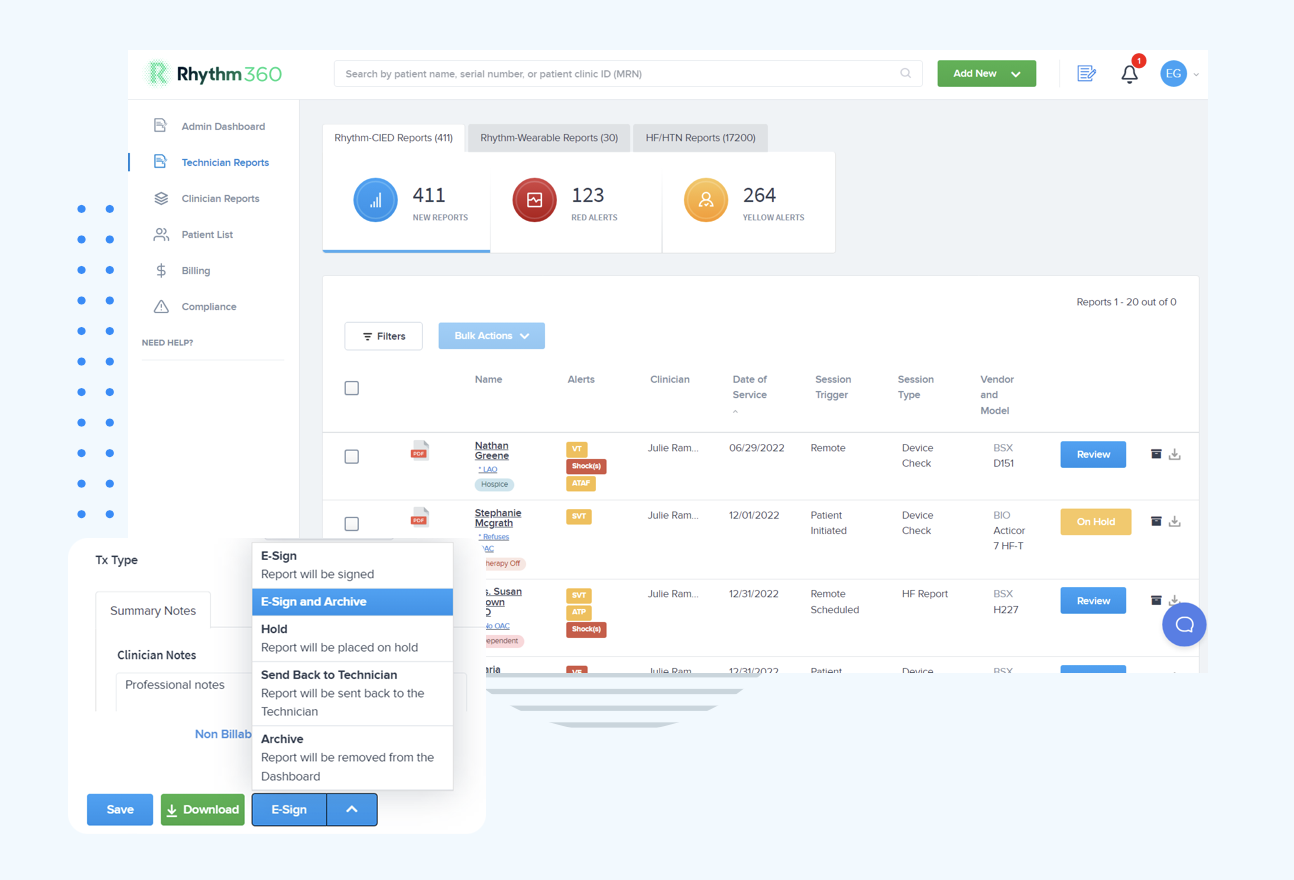
The University of Chicago Medicine (UCM) implemented Rhythm360 to overhaul cardiovascular remote monitoring across its CIED and heart failure population. UCM reviewed more than 73,000 reports annually through Rhythm360 in 2025, demonstrating the platform’s capacity to handle high-volume device populations. Clinicians reported direct clinical and financial impact: “We have improved billing and accountability for our patients after the integration” and “We are able to address these issues earlier; rather than waiting for a 3-month visit, we can call patients in for evaluation.”
The table below summarizes Rhythm360’s integration capabilities with major cloud EHR platforms and its CPT billing support.
| EHR Platform | Integration Protocol | Data Flow Direction | CPT Billing Documentation Support |
|---|---|---|---|
| Epic | HL7 FHIR / App Orchard API | Bi-directional | 93298, 93299, 99453, 99454, 99457, 99458 |
| Oracle Health (Cerner) | HL7 FHIR API | Bi-directional | 93298, 93299, 99453, 99454, 99457, 99458 |
| athenahealth | HL7 FHIR API | Bi-directional | 93298, 93299, 99453, 99454, 99457, 99458 |
| eClinicalWorks | HL7 | Bi-directional | 93298, 93299, 99453, 99454, 99457, 99458 |
Practices using Rhythm360 have reported an 80% reduction in critical alert response times and up to a 300% increase in revenue generation through accurate CPT code capture and improved staff efficiency.
Schedule a demo of Rhythm360 to see how it layers onto your cloud EHR.
A structured implementation approach protects both clinical continuity and billing integrity when adopting a cloud EHR or adding a remote monitoring integration layer.
Vendor Selection
Integration Testing
Staff Training
30/60/90-Day Revenue Reviews
Cloud-based EHR pricing typically follows a subscription model that averages around $1,200 per user annually, with no upfront server hardware costs. Total cost of ownership varies by organization size, required integrations, data migration complexity, and staff training needs. Cloud EHRs usually have a lower five-year TCO for smaller practices compared with on-premise systems that require licensing, server hardware, and IT infrastructure. Large enterprise deployments can reach substantially higher figures. Cardiology practices should also budget for EHR integration costs ranging from $15,000 for a single read-only FHIR connection to $150,000+, with ongoing maintenance of $3,000–$15,000 per interface per year. Rhythm360 uses a SaaS-based pricing model that scales with clinic size and platform usage, which provides a flexible investment structure without high setup fees.
Integration timelines depend on the complexity of the EHR environment, the number of OEM device manufacturers involved, and the degree of bi-directional data exchange required. Cloud-based EHR implementations for smaller practices can be completed in several weeks, while larger organizations may require six to nine months from planning to go-live. When practices add a vendor-neutral remote monitoring layer such as Rhythm360, the onboarding process, including EHR integration setup, typically takes from a few days to a few weeks. Rhythm360’s streamlined implementation does not require hardware installation or IT build work from the practice, which shortens timelines compared with legacy on-premise integrations.
Security depends on the compliance posture of the integration platform. A HIPAA-compliant third-party platform must provide role-based access controls, encryption of data in transit and at rest, granular audit trails, multi-factor authentication, and a signed Business Associate Agreement. Given the significant third-party breach risk documented earlier, vendor vetting becomes a critical step. Practices should require SOC 2 Type II compliance documentation from any integration vendor and confirm that the platform operates under a shared responsibility model that clearly delineates security obligations. Rhythm360 is a HIPAA-compliant, SOC 2 Type II-aligned platform with full audit trail capabilities, encrypted data handling, and a BAA available for all practice partners.
Rhythm360 integrates deeply with Epic, Oracle Health (Cerner), athenahealth, eClinicalWorks, Greenway Health, and other systems via HL7 and FHIR APIs. The platform does not replace the existing EHR. It layers on top of it and acts as a vendor-neutral aggregation and workflow layer for CIED and remote monitoring data. Patient demographics, clinical summaries, alert documentation, and billing-ready reports flow automatically between Rhythm360 and the EHR, which eliminates manual transcription. The integration setup process typically takes a few days to a few weeks and requires no hardware installation from the practice.
Cloud-based EHRs now serve as the standard infrastructure for cardiology practices, with the market dominance noted earlier reflected in 91% adoption among US office-based physicians as of 2024. The financial and operational case for cloud over on-premise is well established, including lower TCO, automatic updates, elastic scalability, and built-in interoperability.
For cardiology practices, however, a cloud EHR alone does not resolve the core operational challenge of fragmented OEM portals, manual CIED data workflows, alert fatigue, and missed CPT billing opportunities. These gaps require a purpose-built integration layer that aggregates multi-manufacturer device data, automates alert triage, and connects bi-directionally with the EHR the practice already uses.
Rhythm360 delivers that layer as a vendor-neutral, AI-powered, HIPAA-compliant platform that preserves existing EHR investments. At the University of Chicago Medicine, clinicians processed more than 73,000 reports annually and reported earlier interventions and improved billing accountability, which shows how the platform can transform a cloud EHR into a unified cardiology workspace capable of supporting high-volume, high-acuity device populations at scale.