

Last updated: July 13, 2026
A vendor-neutral arrhythmia monitoring platform ingests, normalizes, and presents data from devices manufactured by multiple OEMs, including Medtronic, Boston Scientific, Abbott, Biotronik, and others, through a single interface with one login. A proprietary ecosystem focuses on one manufacturer’s device line and forces supplemental portals or manual reconciliation when a clinic’s implanted device population spans multiple brands.
The operational impact of this fragmentation is well documented. Andrew Beaser, MD, Associate Professor of Medicine at the University of Chicago Medicine (UCM), described pre-implementation workflows as “a major challenge and incredibly difficult.” Gaurav A. Upadhyay, MD, FACC, FHRS, Professor of Medicine and Director of the Pacing & Defibrillation Device Clinic at UCM, noted that staffing was always an issue because the device clinic struggled with technician turnover and timely weekend coverage.
The decision matrix below maps clinic profile to platform type priority.
| Clinic Size | Device Mix | Key Need | Recommended Platform Type |
|---|---|---|---|
| Solo / Small (<3 physicians) | Single OEM, low volume | Basic remote monitoring | Proprietary OEM portal may suffice short term |
| Mid-size EP clinic (3–10 physicians) | 2+ OEMs, mixed CIEDs | Unified dashboard, billing automation | Vendor-neutral cloud platform |
| Large cardiology group / health system | Multi-OEM CIEDs + wearables | AI triage, EHR integration, scalability | Vendor-neutral AI-powered platform (for example, Rhythm360) |
| Academic medical center | Full mixed fleet, high volume | 73,000+ annual reports, CCT oversight, billing compliance | Vendor-neutral platform with service-supported triage |
The tables below outline Rhythm360 capabilities across five evaluation dimensions.
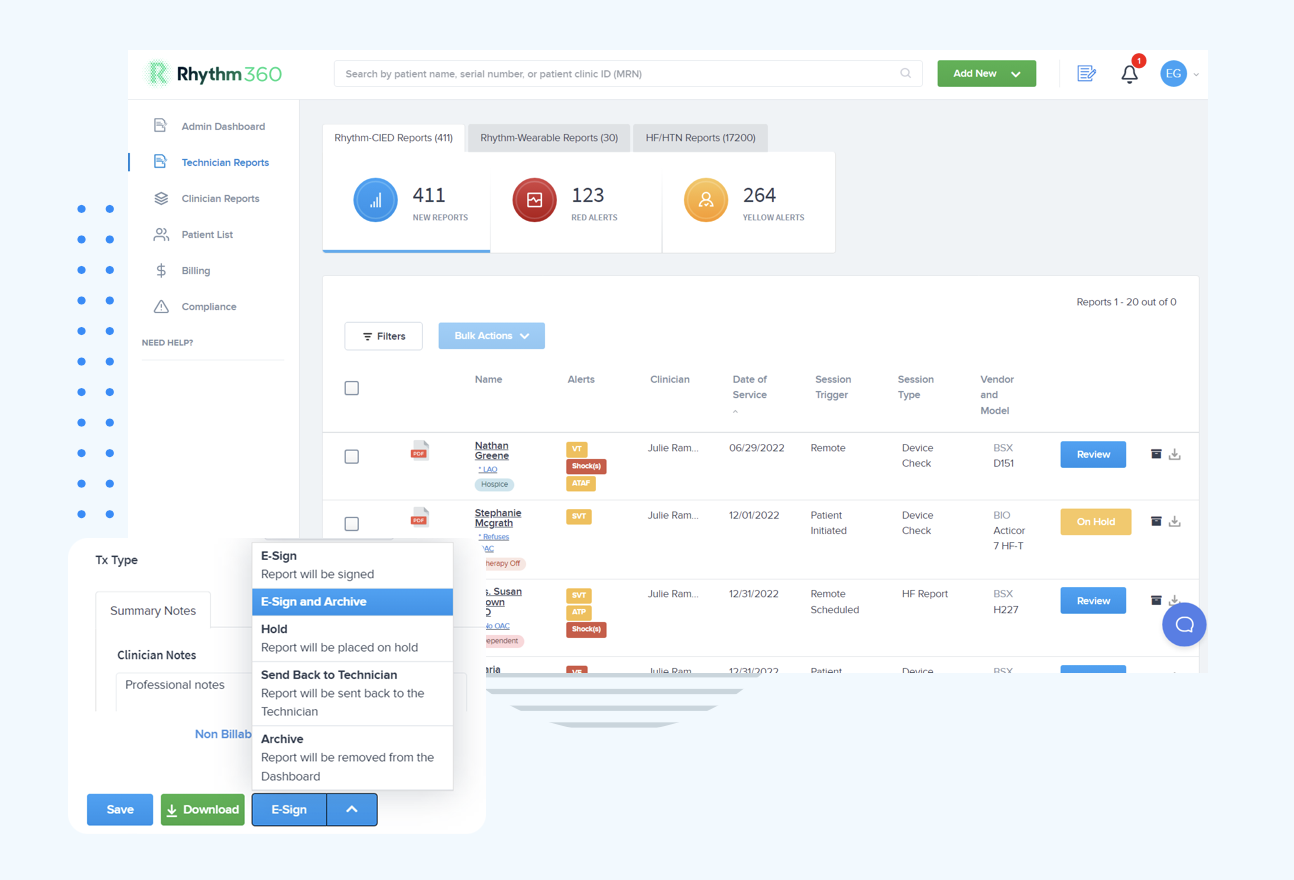
| Capability | Specification | Supported Devices | Data Ingestion Method |
|---|---|---|---|
| Vendor neutrality | Full multi-OEM support | Medtronic, Boston Scientific, Abbott, Biotronik, others | API, HL7, XML, PDF via computer vision (OCR) |
| CIED types | All implantable classes | Pacemakers, ICDs, ILRs, CRT, CCM, CardioMEMS | Redundant OEM data feeds |
| Wearable / RPM support | Multi-modality | HF/HTN RPM sensors alongside CIEDs | Integrated RPM service line |
| Data transmissibility | >99.9% | All supported devices | Redundant feeds and AI-powered gap extrapolation |
| Capability | Mechanism | Clinical Outcome | Supporting Evidence |
|---|---|---|---|
| AI-powered alert prioritization | Filters non-actionable transmissions, surfaces clinically significant events | Up to 80% reduction in critical alert response times | RhythmScience platform data |
| False-positive suppression | Patient-specific baselines vs fixed thresholds | Reduced alert fatigue for clinical staff | Patient-specific baselines reduce false alerts by 60–80% vs threshold-based systems |
| Optional 24/7/365 CCT oversight | Certified cardiac technicians supervised by physicians | Continuous triage coverage including weekends | RhythmScience platform design |
| AI decision support | Automated report generation, near-real-time alerts | Earlier intervention and more proactive management | UCM: “We are able to address these issues earlier; rather than waiting for a 3-month visit, we can call patients in for evaluation.” |
| CPT Code | Service Description | Rhythm360 Automation | 2026 Update |
|---|---|---|---|
| 93298 | Remote CIED interrogation, up to 30 days | Automated capture and documentation | Existing code, continuous compliance |
| 99454 | RPM device supply, 16+ days/month | Automated daily reading aggregation | National average $47/month, 16+ day threshold maintained |
| 99445 (new 2026) | RPM device supply, 2–15 days/month | Automated capture for shorter monitoring episodes | New 2026 code, addresses prior 16-day minimum gap |
| 99470 (new 2026) | RPM treatment management, 10–19 min | Time tracking and documentation automation | New 2026 code, national average $26/month |
| 99457 / 99458 | RPM treatment management, 20+ min / add-on | Automated time logging and claim generation | $52 and $41 national averages respectively |
| Feature | Technology | Clinical Use Case | Compliance Standard |
|---|---|---|---|
| Secure mobile app | HIPAA-compliant iOS/Android | On-call transmission review, report signing, care coordination | HIPAA, FHIR R4 / SMART on FHIR for EHR-connected mobile access |
| Integrated messaging hub | Twilio-powered SMS/call logging | Automated patient reminders, full audit trail | HIPAA audit log retention |
| Bi-directional EHR integration | HL7, FHIR, API | Automatic data flow to and from Epic, Cerner, Athenahealth, eClinicalWorks, Greenway Health | HL7 v2 dominates about 90% of US hospital interface traffic, FHIR R4 required for mobile layers |
Off-hours clinical events reveal the practical value of a unified platform. Consider a mid-size EP clinic managing 400 patients across three OEMs. On a Saturday morning, a patient with an ICD transmits data indicating new-onset atrial fibrillation with a rapid ventricular response.
Without a unified platform, the on-call clinician logs into the relevant OEM portal from a personal device, searches for the transmission, manually reviews the data, and then contacts the covering physician. This process can take 30 minutes or more, assuming the alert surfaces at all through the OEM notification system.
With Rhythm360, the AI triage layer flags the event as clinically significant, suppresses surrounding non-actionable transmissions, and sends a prioritized alert to the clinician’s mobile app. The clinician reviews the transmission, signs the report, and starts anticoagulation protocols before noon. UCM’s implementation of Rhythm360 enabled clinicians to review more transmissions daily and identify more abnormalities, as noted by Andrew Beaser, MD. The documented alert response improvement described earlier turns a potential stroke event into a same-day intervention.
Total platform value depends on more than licensing fees. Implementation timelines, training requirements, and long-term scalability define the real cost of switching or upgrading a monitoring infrastructure.
Rhythm360 onboarding, including EHR integration setup, typically takes from a few days to a few weeks, depending on clinic size and existing infrastructure. SaaS-based pricing scales with clinic size and usage volume, avoiding rigid per-seat or high-setup-fee structures common in legacy on-premise systems.
The platform’s centralized dashboard design reduces training burden by removing the need for staff to maintain proficiency across multiple OEM portals. This directly addresses the “super-user dependency” problem, where a single staff member holds institutional knowledge of fragmented systems and their departure creates business continuity risk.
UCM reviewed more than 73,000 reports annually through Rhythm360 in calendar year 2025, which demonstrates the platform’s ability to scale to high-volume academic medical center environments without degrading performance or dismissal rate stability.
Practices that have implemented Rhythm360 report improvements in billing and revenue through more complete CPT code capture, higher staff efficiency, and new RPM service lines for HF and HTN management.
Device modality coverage directly affects both clinical outcomes and revenue capture. These revenue improvements depend on the clinic’s ability to monitor the full spectrum of cardiac devices their patients require within one environment. Understanding which monitoring modalities Rhythm360 supports, and how they coexist in a single platform, helps clinics judge whether it can replace a fragmented infrastructure.
Selecting the right monitoring modality or combination of modalities depends on the clinical question, patient population, and the clinic’s existing device fleet. Rhythm360 supports the full spectrum of cardiac monitoring device classes within one platform.
Supported modalities include:
This multi-modality support allows a clinic managing a patient with both an ICD and an HF RPM device to use a single platform and a unified billing workflow. Rhythm360 consolidates both data streams into one dashboard and maps each to the appropriate CPT code pathway automatically.
The Heart Rhythm Society’s April 2026 Scientific Statement on Artificial Intelligence Integration Framework into Clinical Electrophysiology Workflows emphasizes the need for data interoperability across devices, platforms, and EHRs to enable effective AI use in arrhythmia monitoring workflows, a standard Rhythm360 is designed to meet.
The 2026 CPT update cycle introduced the most significant changes to remote monitoring billing in several years. The AMA’s 2026 CPT code set includes 418 changes, with 288 new codes, 84 deletions, and 46 revisions.
The most operationally significant changes for cardiology clinics are:
Rhythm360 automates documentation and time tracking for each of these codes and captures billable events that manual workflows routinely miss. Gaurav A. Upadhyay, MD, at UCM, stated, “We have improved billing and accountability for our patients after the integration.”
Reliable billing and clinical oversight depend on reliable data capture from every device in the fleet. When OEM servers experience downtime or data feeds fail, clinics lose clinical visibility and the documentation trail required to support CPT claims. Data integration architecture, especially how a platform maintains transmissibility across multiple manufacturers, directly shapes billing accuracy.
Managing a mixed CIED fleet across multiple OEMs introduces data reliability risks that single-vendor environments do not face. Each manufacturer’s transmission infrastructure has independent uptime characteristics, data formats, and alert logic. When an OEM server experiences downtime, clinics relying solely on that manufacturer’s portal lose visibility into their patient population until service returns.
Rhythm360 addresses this with a redundant data feed architecture. The platform ingests data via APIs, HL7 messages, XML feeds, and unstructured PDF reports processed through computer vision (OCR). When a primary OEM data feed is unavailable, redundant feeds and AI-powered gap extrapolation maintain data continuity and support the transmissibility level described earlier.
HL7 v2.x still carries about 90% of US hospital interface traffic for high-volume system-to-system data, while FHIR R4 serves as the strategic layer for mobile and app-based access, so production integrations in 2026 must support both. Rhythm360’s integration stack supports both standards natively, which keeps it compatible with existing hospital infrastructure and enables the mobile access workflows that on-call clinicians rely on.
Gaurav A. Upadhyay, MD, at UCM, emphasized the importance of “an integrated review of data from trained personnel.” The combination of redundant data feeds and optional 24/7/365 CCT oversight delivers that integrated review at scale.
High dismissal rates in CIED monitoring at UCM are structural features of safety-first remote monitoring, with most OEM-generated alerts being nonactionable across the volume noted earlier. Rhythm360’s AI triage layer manages this volume without adding burden to clinical staff.
This framework helps clinics match their current state and growth plans to the right platform configuration. Start with device mix, because vendor neutrality determines whether a unified platform is even feasible.
Once you confirm vendor neutrality requirements, consider how clinicians actually work, especially during off-hours.
After workflow needs, evaluate revenue capture, because incomplete billing often funds the business case for change.
Next, assess service expansion plans, since new RPM lines can introduce new vendors and complexity.
Finally, review alert quality, because high false-positive rates undermine both staff morale and patient safety.
Clinics that answer “two or more OEMs,” “yes,” “no,” “yes,” and “poor” to these questions operate in exactly the environment Rhythm360 is built to support.
See how Rhythm360 aligns with your answers to this framework by talking with a platform specialist.
Alert fatigue in mixed-device clinics stems from the volume of OEM-generated notifications across multiple portals and the absence of a unified triage layer that applies consistent clinical prioritization logic. When staff log into separate portals for each manufacturer, non-actionable alerts from each system accumulate independently, with no cross-device context to separate signal from noise.
A vendor-neutral platform consolidates all device transmissions into a single queue and applies AI-powered triage logic uniformly across the patient population. Rhythm360’s alert prioritization engine uses patient-specific baselines rather than fixed thresholds, which clinical literature identifies as more effective for reducing false positives. Clinically significant events such as new-onset AFib, ventricular tachycardia, lead malfunction, and ERI/RRT indicators rise to the top, while non-actionable transmissions are suppressed or batched for routine review. This structure lets clinical staff manage high-volume monitoring without the cognitive overload that drives burnout and missed events.
The 2026 CPT update cycle introduced two new codes with direct revenue implications for cardiology clinics. CPT 99445 covers RPM device supply for 2–15 days within a 30-day period and fills the gap that previously forced clinicians to extend monitoring to meet the 16-day minimum for CPT 99454 or forgo billing for shorter episodes. CPT 99470 covers 10–19 minutes of non-face-to-face RPM treatment management time and complements existing 99457 and 99458 codes that apply at the 20-minute threshold and above.
For CIED-specific billing, CPT 93298 continues to govern remote interrogation of implantable cardiovascular physiologic monitor systems for up to 30 days and requires documentation of all transmitted data reviewed by a qualified healthcare professional. Practices that rely on manual documentation workflows face the greatest revenue leakage under these requirements, because time-tracking and transmission-date documentation gaps cause systematic underbilling. Rhythm360 automates capture and documentation of all eligible codes, including the new 2026 additions, which reduces administrative burden and improves billing accuracy.
Rhythm360 supports both CIEDs and consumer wearables within one environment. The platform operates two integrated service lines: Rhythm-CIED for implantable devices such as pacemakers, ICDs, ILRs, CRT devices, CCM devices, and CardioMEMS monitors, and a connected HF/HTN RPM service line for remote physiological monitoring devices including weight scales, blood pressure cuffs, and pulse oximeters.
Operationally, this matters because a patient with an ICD who also participates in an HF RPM program generates data streams from two device classes. Without a unified platform, those streams live in separate systems with separate billing workflows and alert queues. Rhythm360 consolidates both into one view, so a single staff member can manage the patient’s complete monitoring picture and capture all eligible CPT codes, including CIED-specific and RPM codes, from one interface.
Rhythm360 onboarding, including EHR integration with Epic, Cerner, Athenahealth, eClinicalWorks, and Greenway Health, typically takes from a few days to a few weeks, depending on the clinic’s existing IT infrastructure and integration scope. The platform supports bi-directional data exchange using HL7 and FHIR standards, which dominate interface protocols in US hospital environments.
Bi-directional integration means data flows in both directions. Device transmissions and clinical documentation move from Rhythm360 into the EHR, while patient demographics, scheduling data, and order information flow from the EHR into Rhythm360. This approach removes manual data transcription between systems, a primary source of documentation error and staff time waste in clinics with mixed device fleets. The implementation timeline remains shorter than the 2–9 month approval and development cycles that custom EHR integrations often require, because Rhythm360’s integration layer is pre-built for the major EHR platforms it supports.
Fragmented OEM portals, manual documentation workflows, and disconnected billing processes reflect an infrastructure mismatch, not an unavoidable reality of running a cardiology clinic in 2026. These problems appear when clinics manage multi-manufacturer device populations without a platform designed for that complexity.
The operational evidence supports a unified approach. UCM’s high-volume implementation, described earlier, showed that clinicians could identify more abnormalities and intervene earlier than pre-implementation workflows allowed. The HRS April 2026 AI integration framework confirms that data interoperability across devices, platforms, and EHRs forms the foundation for effective AI use in arrhythmia monitoring. The 2026 CPT updates also create new revenue opportunities that manual billing workflows struggle to capture reliably.
Rhythm360 addresses these dimensions through vendor-neutral device support with the high transmissibility level noted earlier, AI-powered alert triage that shortens critical response times, automated CPT documentation for 2026 codes including 99445 and 99470, bi-directional EHR integration with Epic and Cerner, HIPAA-compliant mobile access for on-call clinicians, and a SaaS pricing model that scales with clinic growth.





