Last updated: August 24, 2026
Cardiology clinics choosing a CIED remote monitoring platform in 2026 need proof of operational and financial impact, not marketing claims. This evaluation focuses on four areas that directly affect staff workload, patient safety, and revenue: workflow efficiency, alert response quality, EHR integration depth, and revenue capture. The table below summarizes how Rhythm360 performs on each of these criteria.
| Criterion | Evaluation Focus | Rhythm360 Capability |
|---|---|---|
| Workflow Efficiency | Staff hours saved per week, single-dashboard access vs. multiple OEM logins | Vendor-neutral aggregation of all major OEM data into one dashboard, eliminates redundant portal logins |
| Alert Response | Critical-alert turnaround time, AI triage accuracy, transmissibility rate | AI-powered triage reduces critical response times by up to 80%, >99.9% transmissibility via redundant feeds and computer vision |
| EHR Integration Depth | Bi-directional data flow, Epic and Athenahealth connectivity, implementation timeline | Bi-directional HL7 integration with Epic, Athenahealth, Cerner, eClinicalWorks, and others, onboarding in days to weeks |
| Revenue Capture | CPT-code automation, billing leakage reduction, 2026 CMS rate impact | Automated documentation for remote monitoring CPT codes, can support increased revenue capture |
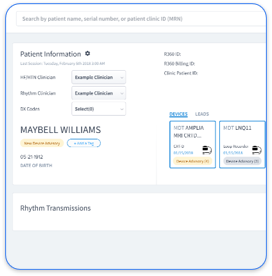
The administrative cost of managing multiple OEM portals such as Medtronic CareLink, Abbott Merlin.net, Boston Scientific Latitude, and Biotronik Home Monitoring compounds quickly. Each separate login creates a context switch, a duplicated data-retrieval step, and a new chance for transcription error. Rhythm360 consolidates these data streams into a single vendor-neutral dashboard, so a device technician reviews one unified patient list instead of four disconnected queues.
The time savings are measurable. Automation of CIED remote monitoring reduces daily device clinic technician time from 2–3 hours of portal review and documentation to 30–45 minutes of exception review for critical and urgent alerts only. Applied across a five-day week, that recovery represents roughly 7–11 hours of redeployable staff capacity per technician each week.
These per-technician savings compound at institutional scale. University of Chicago Medicine reviewed more than 73,000 reports annually through Rhythm360 in calendar year 2025, averaging more than 18,000 reports per quarter, a volume that would be operationally unsustainable without centralized data aggregation. Andrew Beaser, MD, Associate Professor of Medicine at UCM, reported that the implementation enabled clinicians to review more transmissions daily and identify more abnormalities.
A 2026 multicentre observational study adds further context on AI-driven time recovery. Applying published time-and-motion data of 11–13 minutes per remote transmission review, AI suppression of alerts released an estimated 185–218 hours of physiologist review time annually, equivalent to 3.6–4.2 hours per week of redeployable staff capacity.
Alert fatigue creates a documented patient-safety risk in CIED remote monitoring. A cross-manufacturer analysis of 2,659 rhythm episodes from 1,710 patients found that even AI-equipped devices still produced 32.9% non-actionable episodes and 30.6% indeterminate episodes. Among devices without proprietary AI algorithms, 45.4% of episodes were non-actionable and 20.1% indeterminate. These findings show that platform-level AI triage, not device-level algorithms alone, determines whether clinicians receive actionable signals or noise.
This distinction between device-level and platform-level AI defines Rhythm360’s approach. Rhythm360 uses AI-powered alert triage to filter non-actionable transmissions and surface clinically significant events, reducing critical response times by up to 80%. The platform achieves >99.9% transmissibility through redundant data feeds, computer vision, and AI-powered extrapolation, creating a fail-safe architecture that continues to function even when an OEM server is unavailable.
Consider a Saturday-morning scenario. An on-call EP receives a prioritized push notification on the Rhythm360 HIPAA-compliant mobile app that flags new-onset atrial fibrillation in a patient with a recently implanted ICD. By Saturday afternoon, the patient has started anticoagulation therapy. Without reliable transmission and intelligent triage, that alert might sit unreviewed until Monday, a window that carries meaningful stroke risk. As a UCM physician noted after Rhythm360 implementation, “Decision support, including AI-assisted decision support, will become increasingly important as data volumes grow.”
EHR integration depth ranks among the most consequential and most frequently overstated differentiators among CIED platforms. The technical record shows that successful integration with one major platform such as Epic does not guarantee compatibility with another like Athenahealth, even when both claim adherence to the same interoperability standards such as FHIR.
Three architectural factors shape integration quality and long-term adoption:
Rhythm360 supports bi-directional HL7 integration with Epic, Athenahealth, Cerner, eClinicalWorks, Greenway Health, and other major systems. The platform normalizes data before it reaches the EHR boundary, resolving measurement identity, terminology codes, units, timestamps, and patient-device associations. As a result, the information that lands in the clinical workflow is structured, actionable, and audit-ready. Implementation, including EHR integration setup, typically completes within a few days to a few weeks, which compares favorably to standard Epic integration projects that can take up to 18 months depending on data type, app complexity, number of site approvals, and FHIR version used.
UCM’s experience highlights the billing impact of tight EHR connectivity: “We have improved billing and accountability for our patients after the integration.”
The 2026 CMS Physician Fee Schedule created the largest single-code reimbursement increase in remote cardiac monitoring history. CMS increased the technical component RVU for CPT 93296 from 0.60 to 0.95 effective January 1, 2026. For a practice managing remotely monitored CIED patients, correctly capturing the updated 2026 CPT 93296 rate can generate meaningful additional annual revenue.
Manual workflows leave significant revenue on the table. The most common failure modes, missed monitoring periods and absent physician interpretation notes, prevent billing for otherwise compliant remote monitoring events. Closing these documentation gaps through automation directly converts into recovered revenue at 2026 CPT 93296 rates.
Rhythm360 automates documentation for CPT codes 93294 through 93298 by tracking monitoring-period requirements, pairing physician interpretation notes to each billed technical component, and generating audit-ready records. The 2026 CMS update did not change the monitoring period for CPT 93298, which remains up to 30 days. Practices using Rhythm360 have reported revenue increases through more complete CPT code capture and the addition of HF/HTN RPM service lines.
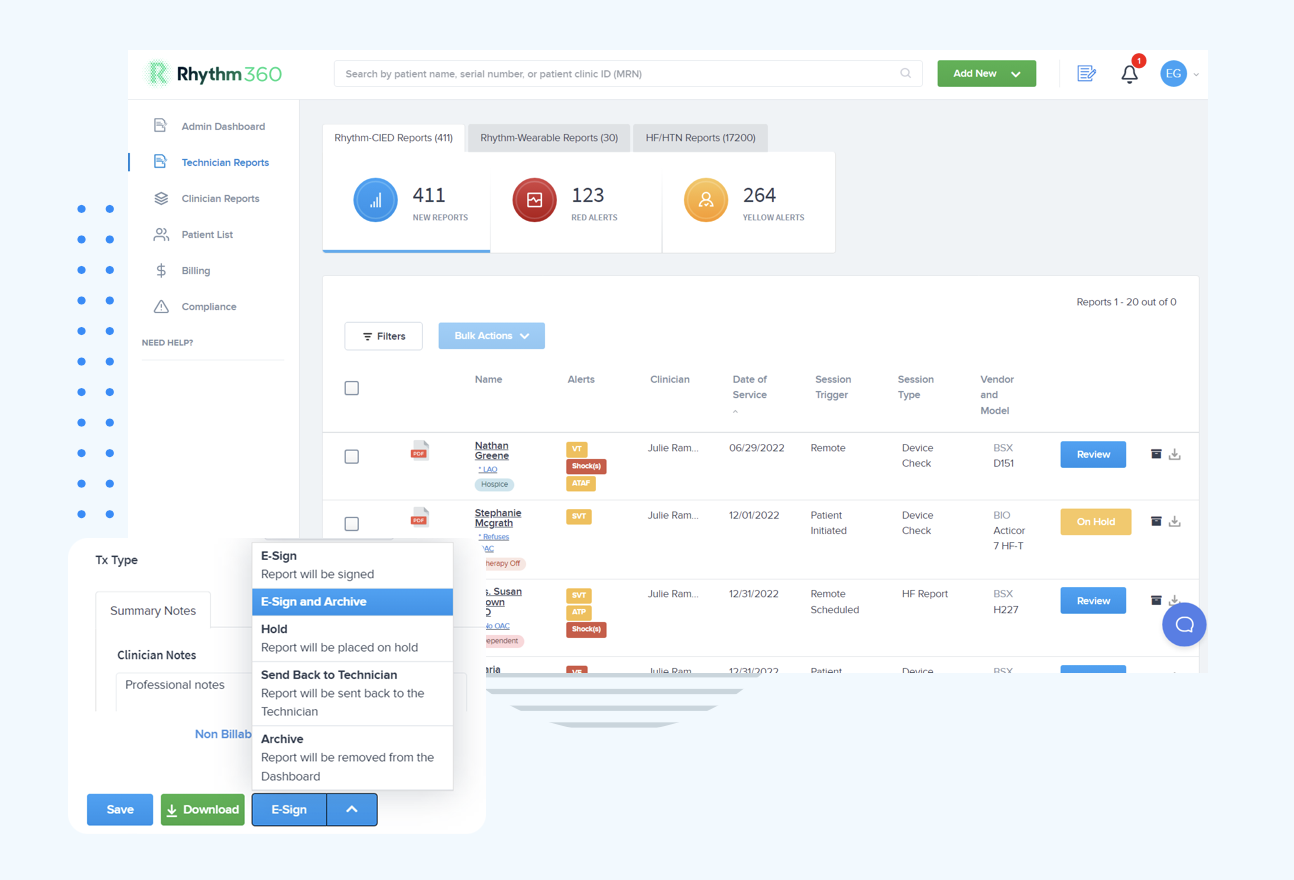
Rhythm360’s HIPAA-compliant mobile application allows electrophysiologists and clinical staff to review transmissions, sign reports, and coordinate care from any location. This capability serves as the operational mechanism that turns the Saturday-morning critical-alert scenario into a timely intervention instead of a missed event.
Implementation follows a structured but rapid path. The onboarding timeline described in the EHR Integration section applies here as well. The three-phase approach, vendor data ingestion and normalization, alert triage and EHR documentation integration, and billing cycle automation, mirrors the implementation pattern that cardiology practices adopting remote CIED monitoring automation typically follow. Minimal staff training is required because the platform aligns with existing clinical workflows rather than forcing staff to learn a new paradigm.
The table below maps common clinic profiles to the Rhythm360 capabilities that address each practice type’s highest-priority operational needs.
| Clinic Profile | Primary Need | Rhythm360 Fit | Key Consideration |
|---|---|---|---|
| Solo EP practice (1–2 physicians) | Minimal administrative overhead, mobile access, automated billing | SaaS pricing scales to practice size, mobile app enables solo on-call coverage | CPT automation recovers revenue without adding billing staff |
| Mid-size cardiology group (3–15 physicians) | Multi-OEM device consolidation, EHR integration, alert triage | Single dashboard eliminates multiple OEM logins, HL7 bi-directional integration with Epic or Athenahealth | AI triage reduces alert fatigue as patient volume grows |
| Large EP program / academic center | High-volume transmission management, deep EHR write-back, HF/HTN service lines | Proven at 73,000+ annual reports (UCM), multi-modality CIED + HF/HTN RPM in one platform | Redundant data feeds and >99.9% transmissibility support enterprise-scale reliability |
| Integrated health system | Cross-site standardization, compliance audit trails, scalable RPM revenue | Centralized population dashboard, automated CPT documentation, Twilio-powered communication audit trail | Bi-directional EHR integration across multiple Epic or Cerner instances |
Ready to see Rhythm360 in your clinic’s EHR environment? Schedule a demo with our team.
Data migration when switching CIED remote monitoring platforms involves three primary workstreams: historical patient record transfer, device-manufacturer portal reconnection, and EHR integration reconfiguration. Rhythm360’s onboarding process addresses all three. Because Rhythm360 is vendor-neutral, it connects to all major OEM portals such as Medtronic, Boston Scientific, Abbott, and Biotronik without requiring practices to renegotiate manufacturer agreements.
Historical transmission data migrates as part of implementation. The platform normalizes data from disparate sources using API, HL7, XML, and PDF parsing via computer vision, so records arriving in different formats convert into a single structured dataset. EHR integration configuration occurs in parallel, with the full onboarding process typically completing within the same days-to-weeks window described earlier, depending on the number of EHR connections and site-specific configurations required.
Correctly implemented AI alert triage reduces alert fatigue by filtering non-actionable transmissions before they reach the clinical inbox. Device-level AI processes raw telemetry but still forwards a large share of non-actionable episodes to the clinic. Platform-level AI triage applies a second layer of filtering based on clinical significance thresholds set by the practice’s clinical leadership.
Rhythm360 uses AI-powered triage to prioritize clinically significant events and suppress routine, non-urgent transmissions, reducing critical response times by up to 80%. Alert thresholds and escalation paths are configured to match each practice’s protocols, with patient-specific overrides tracked in an audit trail. The result is a prioritized worklist instead of an undifferentiated alert queue, which represents the operational condition that drives alert fatigue in legacy systems.
The implementation timeline mirrors the structured approach outlined earlier, which includes vendor data ingestion and normalization, alert triage and EHR documentation integration, and billing automation. Rhythm360 onboarding, including EHR integration setup, completes within the same days-to-weeks window for most practices. The exact duration depends on the number of OEM portals being connected, the EHR system in use, and whether the practice adds HF/HTN RPM service lines alongside CIED monitoring.
Minimal staff training is required because the platform fits existing clinical workflows. Practices do not need to designate a dedicated “super-user” or hire additional staff to manage the transition, and the SaaS-based model removes large upfront infrastructure costs associated with going live.
Rhythm360 supports distinct but integrated service lines for Rhythm-CIED monitoring and HF/HTN Remote Physiological Monitoring (RPM). The CIED service line covers pacemakers, ICDs, implantable loop recorders, CRT and CCM devices, and CardioMEMS pulmonary artery monitors. The HF/HTN service line supports remote physiological monitoring with automated billing support for CPT codes 99453, 99454, and 99457, including patient onboarding checklists and documentation workflows.
Both service lines operate within the same dashboard, so a device technician or NP managing a mixed patient population does not need to switch platforms or learn separate systems. The Twilio-powered integrated communication hub logs all patient outreach, including automated reminders and manual calls, within the patient record, which eliminates redundant follow-up work. Practices that have added the HF/HTN service line to an existing CIED program have reported that the new revenue stream launched with minimal logistical overhead and no additional headcount requirement.
Across workflow efficiency, alert response, EHR integration depth, and revenue capture, Rhythm360 delivers documented, clinic-scale results. A single vendor-neutral dashboard removes the administrative burden of multiple OEM logins. The AI triage architecture described earlier, which cuts critical response times by four-fifths, works in tandem with >99.9% transmissibility to ensure that no clinically significant event is missed. Deep HL7 connectivity to Epic, Athenahealth, and other major EHR systems connects device data to clinical workflows in a days-to-weeks implementation window rather than a months-long project.
Automated CPT documentation for codes 93294 through 93298 closes the billing gaps that manual workflows consistently leave open, gaps that, at 2026 CMS rates, represent tens of thousands of dollars in recoverable annual revenue for even a mid-size practice. University of Chicago Medicine’s experience, processing the report volumes detailed earlier while improving billing accountability and enabling earlier clinical interventions, illustrates what a well-implemented, AI-powered, vendor-neutral platform can deliver at scale. The same architecture supports practices of every size, from solo EP offices to large integrated health systems.