

Fragmented OEM portals create significant operational inefficiencies, with clinicians wasting time accessing multiple separate systems for single patient information, directly impacting both clinical outcomes and practice revenue. Device technicians often spend hours each day logging into separate portals from different manufacturers just to retrieve basic data.
This fragmentation creates data silos where important information sits in isolation and is difficult to compare. Clinicians lose a unified view of device history, alerts, and trends. Staff members feel constant pressure to manage disparate systems, which contributes to burnout and higher turnover among cardiac technicians.
Alert fatigue from irrelevant notifications in fragmented systems leads to missed critical device events and compliance issues. Staff members are required to sift through large volumes of non-actionable alerts from multiple portals, which makes it harder to notice the few alerts that truly matter.
Manual workflows and unreliable data transmission increase the chance that life-threatening arrhythmias, device malfunctions, or low battery warnings go unnoticed. When a patient develops new-onset atrial fibrillation on a weekend, slow recognition in a fragmented system can delay intervention by hours or days and raise the risk of adverse outcomes.
Fragmented RCM systems create hidden costs beyond basic inefficiencies; practices miss billable events for CIED-specific CPT codes (93298, 93299) and RPM codes (99453, 99454, 99457), with accumulated losses reaching significant amounts annually. Without centralized tracking, many eligible services are never billed.
Manual tracking of complex CPT codes (93298, 99454) causes substantial revenue leakage for practices. Staff may miss documentation elements, lose audit trails, or submit incomplete claims, which increases denials and reduces profitability over time.
Rhythm360 by RhythmScience provides a cloud-based, AI-enabled, vendor-neutral platform that addresses these monitoring challenges. The system centralizes cardiac device and RPM data, supports more reliable alert management, and automates key billing workflows so clinical teams can focus on patient care.
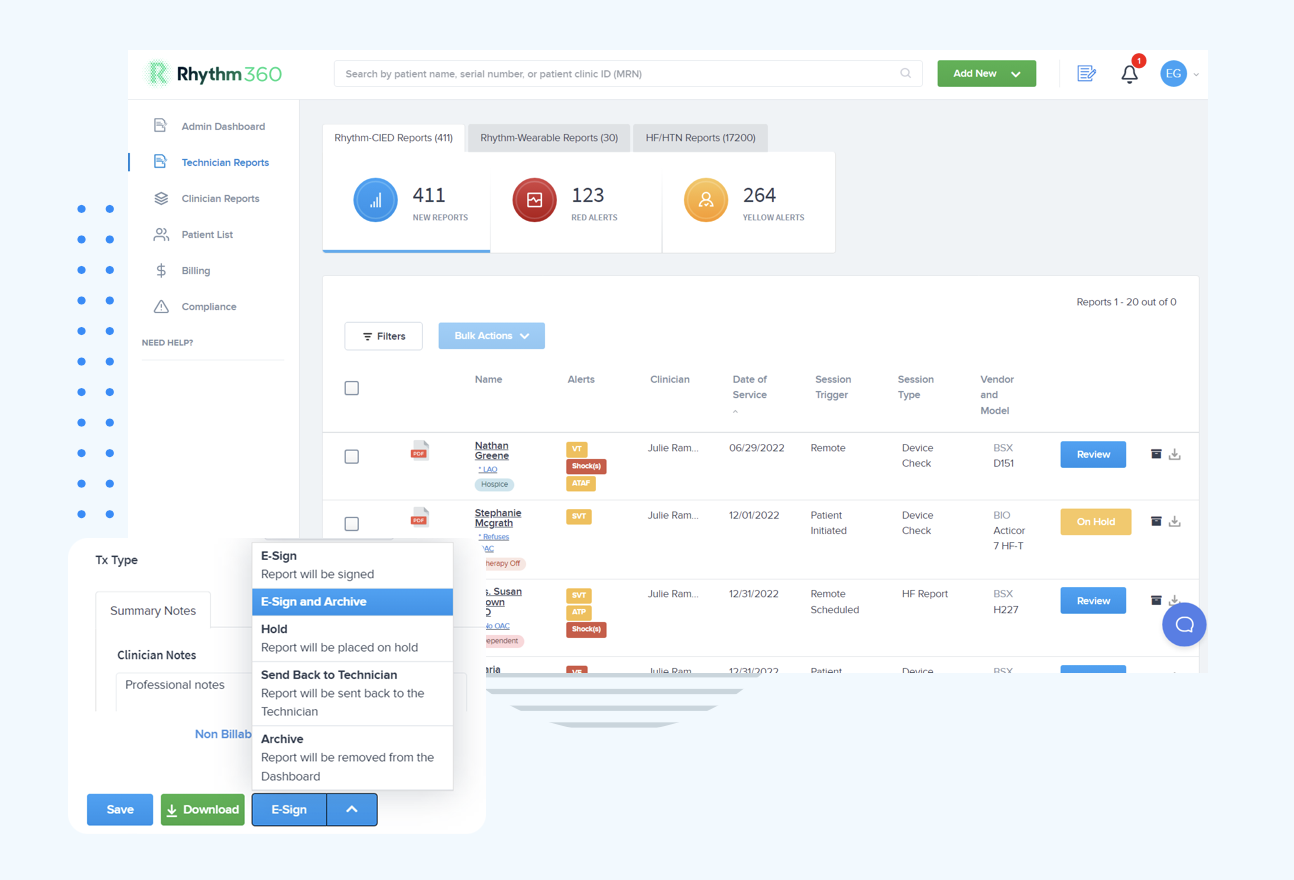
Rhythm360 captures and standardizes data from Cardiac Implantable Electronic Devices, including pacemakers, ICDs, and implantable loop recorders, into a single dashboard. Clinicians use one login instead of juggling multiple OEM portals.
The platform consolidates CIED and RPM data from major manufacturers such as Medtronic, Boston Scientific, Abbott, and Biotronik into one interface. This approach reduces manual data entry, cuts transcription errors, and allows teams to see device trends and alerts across the entire monitoring program.
The platform ingests diverse data types using APIs, HL7, XML parsing, and computer vision for PDFs. Redundant data feeds and automated gap-filling workflows support more than 99.9% transmissibility, so clinicians see a more complete record of device transmissions and alerts.
Consistent, normalized data helps physicians compare event histories across device types and vendors, which improves decision-making and follow-up planning.
AI-driven alert triage helps teams distinguish between urgent alerts and routine noise. The system prioritizes clinically significant events and filters out non-actionable notifications, which supports faster responses and less fatigue for staff.
When a serious arrhythmia occurs at an off-hour, Rhythm360 can route a high-priority alert directly to the on-call clinician. Practices using this type of triage can see response times drop by up to 80%, which supports safer remote management. Optional 24/7/365 certified cardiac technician oversight adds another safeguard for high-risk patients.
Rhythm360 supports turnkey service lines for heart failure and hypertension Remote Physiological Monitoring. The platform can provide:
This structure helps practices expand remote care services while maintaining consistent documentation and billing practices.
The integrated communication hub allows automated and manual patient messaging with full audit trails. Messaging uses infrastructure powered by Twilio and is accessible through a secure, HIPAA-compliant mobile app.
Clinicians can review device alerts, send patient instructions, and document communication without leaving the platform. Mobile access supports coverage for on-call clinicians and cross-coverage within larger groups.
Schedule a Rhythm360 demo to see how unified cardiac monitoring can fit into your current workflow.
Rhythm360 replaces fragmented portals with a single, vendor-neutral platform for all CIED and RPM data. Device technicians access full patient information in one place instead of moving between systems, which frees time for direct patient interaction and complex case review.
Automated data ingestion, templated reports, and structured review queues reduce repetitive work. Practices rely less on a single super-user and can cross-train team members more easily because workflows are standardized.
AI-enabled alert logic reduces noise while highlighting high-risk events. This approach supports faster, more consistent responses to urgent alerts and lowers the likelihood that important transmissions are overlooked.
Feature | Traditional Fragmented Systems | Rhythm360 Real-Time Cardiac Implant Monitoring |
Data consolidation | Multiple OEM portals, manual entry | Single vendor-neutral platform for CIED and RPM data |
Alert management | High alert fatigue, missed critical events | AI triage with faster response to urgent alerts |
Billing and RCM | Manual tracking, frequent revenue leakage | Automated CPT capture with higher revenue realization |
Data reliability | Inconsistent data, gaps, vendor-dependent | Redundant feeds with more than 99.9% transmissibility |
Mobile access | Limited or none | Secure mobile app for clinicians on the go |
Rhythm360 automates CPT code capture and documentation for CIED and RPM services. The system tracks billable events for codes such as 93298, 93299, 99453, 99454, and 99457, and links them to the necessary clinical documentation.
This structure reduces missed billing opportunities and supports more accurate claims. Practices using automated tracking can see revenue increases of up to 300% from services that were previously underbilled or not billed at all.
Connect with RhythmScience to review how your current monitoring program handles billable events.
Q: How does a real-time cardiac implant monitoring solution handle data from different device manufacturers?
Rhythm360 is vendor-neutral and ingests data from major CIED manufacturers such as Medtronic, Boston Scientific, Abbott, and Biotronik. The platform uses APIs, HL7, XML parsing, and computer vision for PDFs to normalize data into a single structure, which removes the need for multiple OEM logins and supports a unified patient view.
Q: Can real-time cardiac implant monitoring reduce missed critical events?
Rhythm360 uses AI-driven alert triage to filter non-actionable notifications and focus attention on clinically significant events. This approach can reduce response times for urgent alerts by up to 80%. Redundant data feeds and more than 99.9% transmissibility further reduce the chance that critical information is lost, and optional 24/7/365 technician oversight adds another safety layer.
Q: How does real-time cardiac implant monitoring improve practice revenue?
The platform tracks and documents billable events for CIED and RPM CPT codes and connects them with the required clinical notes and time logs. Automated tracking lowers the risk of missed charges and reduces manual work for staff, which can lead to large increases in realized revenue from remote monitoring.
Q: How complex is implementation for an existing cardiology practice?
Rhythm360 offers bi-directional EHR integrations with major systems such as Epic, Cerner, and Athenahealth. Implementation timelines can range from a few days to a few weeks, depending on the environment. The interface is designed to be intuitive so that technicians and clinicians can adapt with a short learning period.
Q: What happens during connectivity issues or vendor server downtime?
Rhythm360 uses redundant data feed architecture to maintain monitoring if a primary feed is interrupted. Backup feeds and computer vision extraction support more than 99.9% data transmissibility, so clinicians continue to see near-complete data even during technical disruptions.
Fragmented cardiac implant monitoring creates avoidable clinical risk and financial leakage. Cardiology practices in 2026 face growing device volumes and reimbursement complexity, and manual, portal-based workflows no longer keep pace.
Rhythm360 by RhythmScience provides a unified, AI-enabled, vendor-neutral platform that centralizes device and RPM data, improves alert management, and automates billing support. Practices can enhance patient safety with faster responses to critical events, reduce staff workload, and capture more eligible revenue from remote services.





