

Last updated: July 14, 2026
Alert fatigue often stems from fragmented monitoring workflows. When clinicians log into separate OEM portals for each device, they face a flood of unprioritized notifications that creates cognitive overload. Workload strain from fragmented CIED monitoring workflows is one of the strongest predictors of burnout across cardiology roles, which fuels staff turnover and disrupts continuity of care.
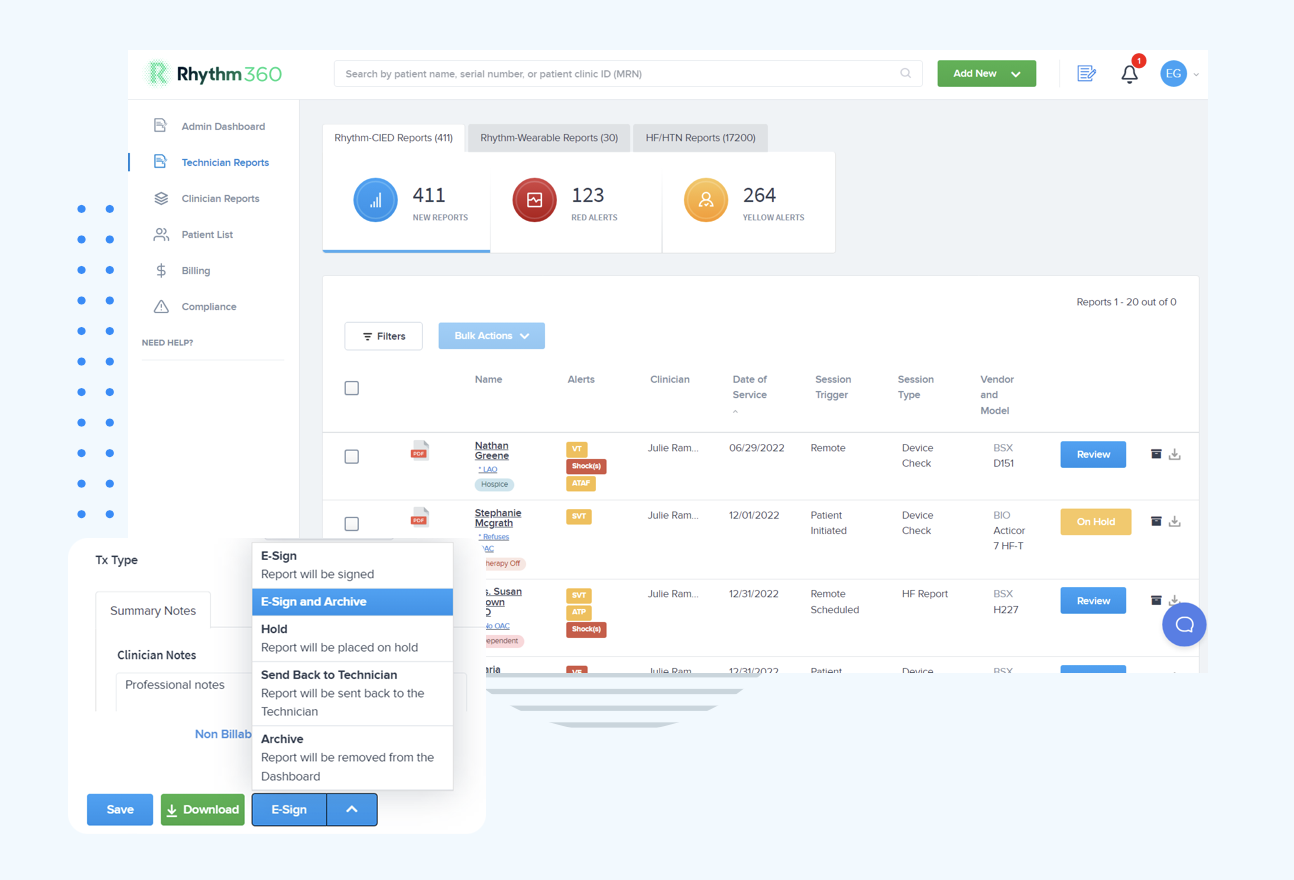
Clear decision criteria help evaluate a platform’s alert triage capability. Practices should look for multi-vendor connectivity, AI filtering accuracy, and measurable response-time improvements. Rhythm360 addresses all three. Its AI-powered alert triage filters non-actionable transmissions and highlights clinically significant events, which reduces critical alert response times by up to 80%. Andrew Beaser, MD, Associate Professor of Medicine at the University of Chicago Medicine (UCM), noted: “Decision support, including AI-assisted decision support, will become increasingly important as data volumes grow.”
UCM’s experience illustrates the scale of this data challenge. The practice reviewed a high volume of reports through Rhythm360 while maintaining stable dismissal rates. This result shows that AI-assisted triage can scale without eroding clinical vigilance. Independent research supports this pattern, finding that AI triage can achieve high sensitivity for clinically relevant events and often outperforms human readers alone.
See AI alert triage in action and request a live demonstration of how Rhythm360 filters and prioritizes transmissions in a real cardiology workflow.
Incomplete CPT code capture creates significant financial risk for cardiology practices. Teams that rely on each manufacturer’s portal plus manual EHR documentation often bill only a fraction of eligible device-supply months and management time, which leaves substantial revenue uncollected.
To understand the financial magnitude of this leakage, consider the 2026 Medicare reimbursement rates for commonly used RPM codes. Key codes and their national average rates include:
RPM billing automation can be stacked with implantable cardiac device monitoring codes including 93297/93298 on the same patient panel, which creates compounding revenue opportunities. Rhythm360 automates the documentation required for each billing period, including the three structured artifacts required for 99454 audit defense: a device-status log proving 16 distinct calendar days of transmission, a device-attribution record proving FDA medical-device qualification, and a patient-attribution record. This automation reduces claim rejection risk and helps practices recover revenue, with documented outcomes of up to 300% improvement in revenue generation. Gaurav A. Upadhyay, MD, at UCM, observed: “We have improved billing and accountability for our patients after the integration.”
Bi-directional EHR integration ensures that CIED transmission data flows automatically into the patient’s EHR record while relevant clinical context flows back into the monitoring platform. Medication lists, diagnoses, and care team assignments appear alongside device data, which removes manual transcription, reduces documentation errors, and creates a complete, auditable patient record.
Rhythm360 supports bi-directional integration with Epic, Cerner, Athenahealth, eClinicalWorks, Greenway Health, and additional systems via HL7. Implementation, including EHR integration setup, typically takes from a few days to a few weeks. This timeline gives practices a path to modern integration without prolonged workflow disruption.
Compliance requirements for platforms handling protected health information (PHI) remain non-negotiable. Healthcare AI platforms must maintain SOC 2 Type II certification, which validates that security controls operate effectively over a continuous 6–12 month period. This validation supports strong encryption standards, including end-to-end encryption using minimum TLS 1.2 for data in transit and AES-256 for data at rest, along with role-based access control, multi-factor authentication, and immutable audit logs retained for at least six years. Rhythm360 meets these requirements and is HIPAA-compliant by design, with a full audit trail for every transmission, communication, and clinical action taken within the platform.
Mobile access extends the value of this integration. Andrew Beaser, MD, at UCM, highlighted: “I am more likely to sign off on these while in meetings because I can easily access them on my phone.” Rhythm360’s HIPAA-compliant mobile application allows clinicians to review transmissions, sign reports, and coordinate care from any location.
Cardiac monitoring platforms vary widely in how they handle CIED workflows. The comparison below contrasts Rhythm360 with the traditional OEM portal model across seven operational criteria.
| Criteria | Traditional OEM Portals | Rhythm360 |
|---|---|---|
| Multi-vendor connectivity | Single manufacturer per portal, multiple logins required | All major OEMs (Medtronic, Boston Scientific, Abbott, Biotronik) in one dashboard |
| Data transmissibility | Subject to individual OEM server availability, no redundancy | Greater than 99.9% transmissibility via redundant data feeds, computer vision, and AI extrapolation |
| AI alert triage | No AI filtering, all transmissions forwarded for manual review | AI-powered prioritization of clinically significant events, with optional 24/7 CCT oversight |
| Bi-directional EHR integration | Manual export and import, no structured EHR write-back | Native bi-directional integration with Epic, Cerner, Athenahealth, eClinicalWorks, and others via HL7 |
| Billing documentation automation | Manual tracking, incomplete CPT capture rate for 99454 | Automated CPT documentation for 93298, 93299, 99454, 99453, and 99457 |
| Mobile access | Desktop-only or limited mobile browser access | HIPAA-compliant mobile app for transmission review, report signing, and care coordination |
| Implementation timeline | Varies by OEM, no unified onboarding | Implementation measured in days to weeks, including EHR integration setup |
The practical impact of these differences appears most clearly in urgent scenarios. On a Saturday morning, Rhythm360 can flag new-onset atrial fibrillation in a patient’s overnight transmission. The on-call clinician receives a prioritized mobile alert, reviews the transmission from their phone, and initiates anticoagulation protocols before the afternoon. In a fragmented OEM portal environment, that same transmission may sit unreviewed until Monday, with no automated prioritization to distinguish it from routine notifications.
Total value of ownership for a cardiac data integration platform includes more than licensing costs. Practices also weigh implementation speed, training effort, ongoing maintenance, scalability, and the effect on staff retention.
Rhythm360 uses a SaaS-based pricing model that scales with clinic size and platform usage, which avoids large upfront capital expenditures. Implementation timelines of days to weeks, compared with months for many legacy on-premise systems, allow practices to begin capturing revenue and reducing administrative overhead quickly. As remote monitoring becomes more prevalent, the sheer volume of data from fragmented systems can overwhelm data-centric platforms, leading to delays in review, billing backlogs, and revenue leakage. A unified platform helps practices avoid these compounding costs.
Staff retention also contributes to total value. Lower alert fatigue and reduced administrative overload address a primary driver of device technician burnout. A centralized platform further removes dependence on a single “super-user,” which protects business continuity when key personnel are unavailable.
Review pricing and implementation timelines for your practice and connect with Rhythm360 to see how the SaaS model scales to your clinic size and patient volume.
The criteria below describe practices that align well with Rhythm360’s capabilities:
Practices that meet three or more of these criteria experience measurable operational and financial losses tied to platform fragmentation. Rhythm360 addresses each criterion directly, with documented outcomes from high-volume academic medical center deployments and scalable SaaS pricing for practices of all sizes.
Rhythm360 automates documentation for CPT codes 93298, 93299, 99454, 99453, and 99457. The platform determines the appropriate code based on actual transmission data at the end of each billing period, generates the required audit-defense documentation, and flags patients at risk of falling below transmission thresholds before the billing period closes. This workflow directly addresses the main cause of CPT revenue leakage in mixed-vendor practices.
Rhythm360 uses a multi-layered data ingestion architecture that combines direct API connections, HL7 feeds, XML parsing, and computer vision-based OCR for unstructured PDF reports. A redundant data feed system serves as a fail-safe when an OEM server experiences downtime, so transmission gaps from manufacturer-side failures do not create clinical blind spots. AI-powered extrapolation fills remaining data gaps and cross-references incoming data for fidelity. This design supports a transmissibility rate greater than 99.9%, which underpins reliable clinical decision-making and complete billing documentation.
Rhythm360 supports bi-directional integration with Epic, Cerner, Athenahealth, eClinicalWorks, Greenway Health, and additional systems via HL7. Bi-directional integration means that CIED data flows automatically into the patient’s EHR record while relevant clinical context from the EHR appears within the Rhythm360 dashboard, which removes manual transcription in both directions. As noted earlier, the full implementation process, including EHR integration configuration, typically takes from a few days to a few weeks depending on practice size and EHR environment.
Rhythm360 is HIPAA-compliant by design, with end-to-end encryption for all data in transit and at rest, role-based access control, multi-factor authentication, and a complete, immutable audit trail for every clinical action, communication, and transmission review within the platform. All 18 HIPAA identifiers are handled in accordance with PHI security requirements. The platform maintains Business Associate Agreements with relevant technology partners. The HIPAA-compliant mobile application extends these protections to clinicians accessing the platform from smartphones, so mobile access does not introduce compliance gaps.
Documented outcomes from Rhythm360 implementations include faster response times for critical patient alerts and up to 300% improvement in revenue generation through stronger CPT code capture, improved staff efficiency, and the addition of RPM service lines for heart failure and hypertension patients. At the University of Chicago Medicine, implementation enabled clinicians to review more transmissions daily, identify more abnormalities, and intervene earlier, while managing a high volume of reports at stable dismissal rates. Andrew Beaser, MD, noted that the platform allowed the team to address clinical issues earlier rather than waiting for scheduled three-month visits.
Fragmented OEM portals create compounding costs for cardiology practices. Teams lose administrative hours to redundant logins, face clinical risk from unfiltered alert volumes, and forfeit revenue through incomplete CPT documentation. Fewer than 30% of eligible patients benefit from CRT-based heart failure diagnostics due largely to workflow limitations and operational silos, which represents both a patient safety concern and a missed revenue opportunity.
Rhythm360 addresses these problems through a single, vendor-neutral, HIPAA-compliant platform that delivers high data transmissibility, AI-powered alert triage, automated CPT billing documentation, and bi-directional EHR integration, with implementation measured in days to weeks rather than months. Outcomes include faster critical alert response, significant revenue improvement, and scalable performance at academic medical center volume.
Apply these capabilities to your specific environment and connect with Rhythm360 to see how the platform handles your device mix, patient volume, and EHR system.





